Thursday, 24 March 2022

Professional Development: PE - Hockey

Kelly Sport Session - Hockey 23/3

Correct Grip:

  • To get the correct grip, lay the stick flat-side down on the ground and pick it up with the left hand at the top of the stick.
  • Left hand at the top of the tick, right hand halfway down the handle, this enables maximum control of the stick and ball.
  • Knees are bent and not your back.
  • Head is up so you can see the opposition coming and also so you can see where your own team is to pass to them.
  • Keeping the stick on the ball when dribbling means it is harder for other players to get the ball off you.
  • Left hand at the top of the stick, right hand about halfway down the stick, head of stick on the ground, legs bent and head up looking at the coach.
  • Players dribble around the area and must stop in the correct position when you blow the whistle. When they have balls, they must try and stop their ball as well when you blow your whistle. They can only use the flat side of the stick to stop their ball.

Dribbling:
  • Ball should be at the head of the stick with right hand about halfway down the stick.
  • Players begin dribbling the ball with the ball remaining on the head of the stick, trying to avoid any other players in the space. 
  • Ball remains under their eyes, and weight transfers from right leg to left leg back and forth. When transferring weight, rotate the hockey stick either side of the ball to gently nudge the ball side to side while only using the flat side of the stick. 
  • Left hand (top hand) remains firmly on the stick, the right hand (bottom hand) hold the stick loosely as a guide while the stick rotates.

Push Pass, Sweep Pass:

  • Hands together at the top of the stick or hands apart like in a push pass and make a sweeping action with their sticks starting from behind them and finishing in front of them.
  • Step forward onto a bent front leg and keep hands very low to the ground (almost scraping their knuckles on the ground). Should be a harder pass so they can stand further away from each other.
Hit:
  • Establish clear expectations with stick - can not go above waist height
  • Front foot on line with ball/ weight on front foot/ eyes over ball and swing
Stopping:
  • Jab
  • Flat stick tackle
Putting it together - relay challenges/skill drill around cones/practise in pairs 


Tuesday, 22 March 2022

Teacher Inquiry at PBS...

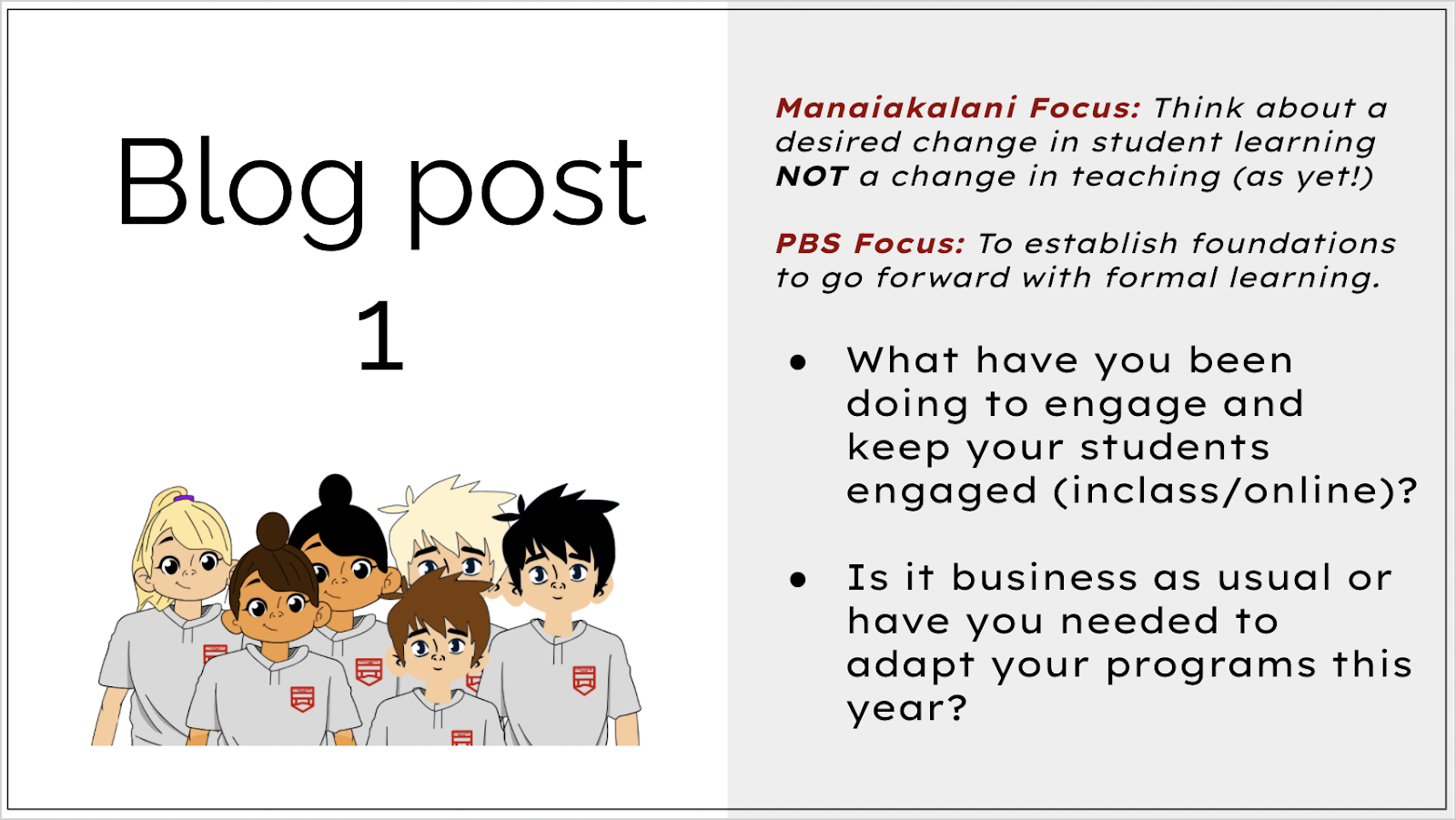
At Panmure Bridge School we decided as a school and before our students returned in February, that our initial inquiry focus would centre around student engagement by establishing foundations to go forward with formal learning. To support this at a school wide level we have started with syndicate discussions using the questions the COL teachers discussed at our first meeting.


This will then followed up with a blog post that encourages everyone to think about what it is they have been doing to engage their students and keep them engaged in class and online. We learn best we we learn from each other and in our current situation, this will be such a powerful resource to have at the end of the term because each and everyone of us is constantly changing and adapting what we are doing in our rooms.


Thinking ahead to Term 2 we will be using our data to form the basis of our individual teacher inquiries. As a school we will have an overarching focus on Reading, but at teacher and class level this picture will look quite different. Having an idea of the way forward allows teachers to start thinking about the direction they will take. As always having an overarching focus allows for the conversations to flow as we bounce ideas off one another.

Establishing foundations to go forward with formal learning...

After our first COL meeting for 2022 I came away thinking about Russell's question, 'How do I have present, happy, healthy, engaged tauira who are learning in the Goldilocks Zone?'

Good inquiry happens in teams, something we have done as a school for a number of years. It means we can have those informal conversations with colleagues that helps us problem solve and form new ideas as we have access to a larger pool of experience and knowledge. Before this meeting, as a school we had decided before our students returned in February, that our initial inquiry focus would centre around student engagement. Without establishing foundations to go forward with formal learning we realised we would struggle to engage our learners and be in a position to effectively contribute to wider school and cluster goals further down the track.

Covid lockdowns in 2021 meant we needed to help our students to reconnect with the formal learning environment. For some, this was no issue at all. They simply walked into our shared learning space on Day 1 and picked up where they left off, but for others it was a different story. School was a place they hadn’t been in since August 2021 and through 1:1 conversations throughout the day, became aware of how daunting to walking through the doors of a classroom for the first time in 6 months actually was. Something made even more challenging with a mask on. We all felt the challenge of mask wearing, but reassuring our learners that mask breaks were important and could be taken when they were needed helped to alleviate some of these new hurdles. In addition to this we began establishing foundations to go forward with formal learning by:

Creating a sense of belonging:

Having a level of or sense of ownership towards something, is what builds strong connections. With this in mind we, (Dianne and I) began building our class culture by setting learning tasks that required our students to talk to each other. As I mentioned earlier, a number of our 2022 learners had not engaged in online learning or physically been in a classroom since August 2021. This meant their verbal interactions had been mostly informal since then. Relearning how to take part in the learning was something we needed to scaffold. We have been doing this by creating tasks that needed paired or group collaboration to complete. We revisited group norms and set challenges that needed input from everyone to achieve. These mini challenges have helped increase buy-in as not only do we have a really competitive class, but it's also a fun way to learn something. This sense of normality helped to set the tone of our classroom, and definitely made everything seem normal to our students. These collaborative activities have helped to form bonds amongst our learners and have allowed us to display work on the walls with their names on, giving our students a real sense of ownership in the room.

Harnessing the power of the familiar:

Our learners who show up in class or online are there to learn so we need to make sure that is exactly what they have the opportunity to do. We were initially challenged with the erratic levels of attendance as it became very clear to us very early on that we never knew who would actually be in front of us each day. We are now in March and are yet to see everyone on our roll in the classroom on the same day! Our expectation from day 1 has been 'it is important to keep your learning going' so our students learning from home or learning in the classroom, understand what they are expected to do and more importantly know why they need to do this. We are continuing with instructional group teaching so we can provide the right level of challenge and support to help our learners keep their learning going. Hybrid learning in LS2 is not about setting different tasks for those accessing the learning outside of the classroom, it is opening a Google Meet and including them in the same instruction that is taking place in the classroom. With more than one adult in the room it is easy to monitor the Meet while the teaching is taking place, which means the students online are able to actively participate in the learning. We follow our timetable regardless of where we are learning, and has been a huge help with continuity as the gaps in learning are lessened. It has also meant those not at school remain an active part of our class with work on our walls.

Scaffolds:

The frameworks and scaffolds we use are unpacked and explained so that the purpose behind a task becomes clearer. We use the same scaffolds across all learning areas which means regardless of ability level or location of learning, our learners are able to carry our the task. Dianne and I have aligned our teaching DLOs so they look the same. The work is differentiated but the layout means which ever DLO you need to access, the instruction is the same making it easier for everyone to use.

Purpose:

Having a real purpose behind the learning has been one of the important messages we have shared with our students. As with anything you do, knowing why you're doing it, is what motivates you to participate actively. I have found that this year I have spent more time introducing and revisiting the learning intentions and purpose of the tasks I have set. My students know what they need to do and why they need to do it, and has helped those who are learning from home maintain stronger connections to what is happening in the classroom. The same thinking and transparency was applied to assessment week. We explained to our students that we didn't have current achievement data so we needed to take time to gather this in order to be able to teach them properly. For the first time in a long time I saw my learners approach assessment week with a real understanding of why they were doing these tasks, and have enjoyed the rich discussions that followed as we discussed next steps as a class.

Expectation to finish work:

Like many of our colleagues around the motu, we have been challenged with the ever changing attendance levels each day brings. To help us navigate this uncertainty we have kept our expectations to complete all work set, in place. Teacher feedback on every piece of work via the comments tool in G Suite has allowed us to give affirmations and identify where tweaks (or if needed, specific guidance) can be made to increase the detail and accuracy of responses. This has proven to be a really valuable way to connect with our students on an individual level as the protocol in our class is to reply to any comment received. They can see by acknowledging their work we are valuing the efforts they are putting in, regardless of where that effort was put in. 

We are continuing to establish the foundations that will enable us to go forward with formal learning. Nothing is set in stone and in the spirit of full transparency, it is important to note that all our initial ideas have been tweaked and adapted along the way to keep our learners engaged both in person and online so that we are all able to move forward in our 2022 learning journey and make the most of our learning time.


Monday, 28 February 2022

Professional Development: PE - Cricket

Kelly Sport Session - Cricket 24/2

Warm up - Batters v Fielders 

  • One team put ball on low cones other team knock them off. 
  • Start with balls on all cones
  • Swap teams reduce number of balls
  • If no balls flip cones - sad face happy face - up/down


Skill Session - Catching and Throwing

  • Students stand in 2 even lines about 2m apart
  • Partner throw and catch challenge
  • Catch with 2 hands - Hands point to ground fingers to sky
  • Shift distance after 5 throws
  • Under arm throw.
  • Every catch move back a step


Team Challenge: 

  • Make a line of witch cones
  • Take turns in pairs try to knock cones over on the full
  • When all cones have been knocked down count up the cones facing in the different directions. Winning team has the most cones facing away from them.


Game - Nonstop Cricket


Equipment:

  • 3 witch cones
  • 1 wicket 3 bats

Rules: 

  • 3 people hold a bat
  • If hit ball or miss run around cone then to back of line passing bat to next person at front of line
  • If wicket is hit you still run and hand bat to next person
  • Hit with flat side of bat - might need to correct this for some students
  • Batters wait behind cone
  • Fielders spread out
  • Wicket keeper needed
  • Can be caught out but not out also not out for hitting wickets or being bowled out
  • 1 hit them change batter
  • Throw ball back to bowler
  • Bowler doesn’t wait for batter just bowls - means team must stay alert. 

Tuesday, 14 December 2021

2021 Teacher Inquiry Evaluation

This year I set out to find out if a focus on oral language in maths would accelerate student confidence and capability to use spoken and written maths vocabulary and language.


In order to be able to do something, you need to have access to the tools you need and the understanding of how to use them. This is no different in a classroom. The challenge for my students this year was to make accelerated shift in Maths by being able to talk about their learning in thinking groups, explain it on their blogs and create comment threads that invite others to respond by talking/writing about their learning in maths. This was something I quickly realised that I had to unpack fully, as my initial analysis of my target group’s thinking group conversation showed that my students were not able to access the content vocabulary they needed to be able to have a rich learning conversation. The quieter students chose to remain silent which resulted in the more confident students filling the void with ideas that lacked detail eg: “I did this and then I moved that number…”. They did try to initiate a discussion however, “What did you do?” was the only question I heard being asked. Simply put, my students were not able to talk in depth about their learning.


Being silent is not an option if acceleration is to take place so I realised quickly that I needed to model the language of explanation eg: “I saw that the question was asking me to… so I knew I needed to think about…” or “Groups of means… so I…”; and support the use of questions that encourage justification, eg: “How do you know it works?”, “So what happens if you…”, “What about if you say…does that still work”, “So if we…”  if I wanted rich learning conversations to become the norm.


Summarise evidence about key changes in teaching and other factors that influence student learning.


When asked specific questions eg; “What is this question asking us to do with the numbers?” or “How did you find your answer?” The learned go-to was to remain silent, however being silent is not an option if acceleration is to take place. My initial thinking was that a lack of comprehension remained one of our biggest obstacles. After listening and observing from a distance I realised my students were just not confident when using maths vocabulary as the connections between the words and the strategies had not been made. 


I began breaking down the barriers by:


  • Introducing the Talk Moves framework into our maths program so that the discussion stems could become the norm within our learning time. This didn’t work for us because we simply did not use or connect to the words in the stems in. Our solution was to repurpose the Talk Moves idea by co-constructing and implementing a framework that we could connect to because it used our own words. We called it LS2 Moves.

  • Modelling the language and supported the use of questions which lead to justification like “How do you know it works?”, “So what happens if you…”, “What about if you say…does that still work”, “So if we…”. 

  • Unpacking Jo Boaler’s positive classroom norms.

  • Stepping my students through the Talk Moves framework by explaining each component and giving individual students different roles within the group.

  • Explaining the purpose behind having a learning conversation.

  • Actively planning for talking about and reflecting on our learning in each lesson.

  • Actively planning time in class, for students to create blog posts, comment on each other's blogs and respond to comments on their own blogs. This allowed me to see where connections to the learning content were strong, and where the gaps in knowledge were evident.

  • Acknowledging individual success in talk time regardless of how big or small that success was.

  • Setting the expectation that during our talk time, everybody in the group needed to participate actively.

  • Modelling how to bring someone into a conversation in a way that wasn’t seen as ‘scary’.


Summarise evidence about key shifts in the problem of student learning:


Due to the impact of lockdown the shifts in my student’s learning this year are based on OTJs and observations. I collected detailed baseline data in Term 1 and student voice in Term 1 and 2, but am unable to make any time point 1/time point 2 comparative shift analysis this year as lockdown forced me to draw a line under my original inquiry. I literally lost contact with half of my focus group. Due to the length of time we had been learning from home, as a school we decided not to formally assess our students at the end of the year. Because of both these reasons I can not make accurate measures in academic shifts this year. I have additionally chosen not to use the three student voice comparisons I did manage to get as this does not paint a true picture of the change in my learner’s perspectives on maths. 


Write an overall evaluation of your intervention in terms of the causal chain you had theorised. To what extent was the intervention successful in changing factors such as teaching? To what extent were those changes in teaching effective in changing patterns of student learning?


In all assessments our students are required to read and respond to questions. Often our students are not literate in their own language so the gaps that emerge when questions are written in English are getting wider, thus causing bigger disconnects in the learning. This year I want to implement the strategy of Talk Moves in Maths. Talk Moves is a strategy that promotes classroom conversations centred on maths that helps to improve students' understanding of mathematical concepts. It is a framework to prompt the discussion, and will allow me to capitalise on the learning I got from my inquiry in 2020 by providing authentic opportunities to use this 'talk' within blog posts and blog comments to help strengthen connections.


What I had begun to notice in class was that there was a stronger connection to the maths language used in written questions. The evidence I have for this I have taken from my observations in class lessons (T1/2), GLOSS testing (T2) and online collaborations (T3/4). 


I noticed that my target group approached a written question by immediately looking at what the question was asking. (eg: This says XXX had 3 times as many XXX… that means we need to times it). By doing this, the talk then moved quickly to which strategy would help them solve this in the most efficient way. On this occasion I saw this group all solve the problem using their preferred multiplication strategy, then share their ideas with the group. Student G83 then took on the leadership role, cast our LS2 Moves framework to the TV and asked everyone to share their strategy. What was interesting to see was that without a teacher involved the discussion flowed much better. Possibly because these students feel less pressure when talking in front of their familiar group of peers. Acceptance of all contributions was the key to the success on this occasion, with student B82 taking on the role of affirming each response.


During GLoSS testing all these students repeated the question I had asked aloud, then set to work to find the answer. What impressed me here was no one ‘worked it out in my head’ - the usual go-to when they don’t have the words to explain what they did. There were calculation errors but the foundations for the Y8 students were much stronger than I remember in the previous year. What I wasn’t expecting was all these students asked questions for clarification when their connections to the strategy they had chosen weren’t as strong. I asked each person what they felt they needed help with and got quite specific responses (eg: I want to learn more words that mean addition… I think I need more help with XXX strategy… I need to learn my times tables so I can use them to help me with the bigger numbers… I need to practise my place value…) 


The online environment was completely different. The talk just stopped. This meant I had to think carefully about how I could keep the thinking going. I did this through skill drill challenges, which for some reason got huge buy in,  by basing our maths questions around popular topics/themes and by introducing the idea of ‘find the error, fix the error, explain the error’. My thinking here was that if I couldn’t hear the talk I could still read it. My students shared with me that they collaborated on the maths tasks so behind the scenes talk was happening, but most importantly they remained connected as a group.


Write a reflection on your own professional learning through this inquiry cycle.


This year’s inquiry into my own practice as a teacher has highlighted the importance of being creative and making adaptations that work for the tamariki in front of me. One size definitely does not fit all and in our case using Talk Moves did not work. Rather than discarding the idea of using a talking framework, I asked my students why they felt this wasn’t working. We came up with the theory that we simply didn’t speak this way, so we worked together to co-construct a framework we felt would work for us. A week later LS2 Moves had evolved and had become visible in our learning environment.


We were on a roll when lockdown happened this all changed. I have summarised my own learning in my Bursts in Bubbles presentation which can be read and/or watched here. My journey this year reminded me you need to continually think outside the box. You need to adapt and try, then try again. If something doesn’t work, look for the why then find a how.... then repeat.


Monday, 29 November 2021

Bursts in Bubbles 2021

This year due to Covid restrictions our Bursts 'and' Bubbles became Bursts 'in' Bubbles, an online opportunity for the Manaiakalani COL teachers to share their 2021 inquiries into their own practice. You can watch the presentations here.


Inquiry Focus Question

Will a focus on oral language in maths accelerate student confidence and capability to use spoken and written maths vocabulary and language?

The ability to use Maths is a communication tool to describe relationships and connections becomes compromised when maths language and literacy skills are not in place.

I noticed that my maths assessment results did not align with what I was seeing in the classroom. Formative maths assessments require students to read and respond to written questions, or to derive an answer and explain their thinking. The disconnect gap continues to widen when our tamariki do not have the comprehension and language skills in place that allow them to talk about their maths using maths words.

I used the evidence and data from the PAT Maths, IKAN, GLoSS and Running Record assessments, student voice and baseline observations to build a rich picture of my students’ learning.

During the profiling phase I noticed my target students sat silently in maths time, listening carefully and nodding their heads in agreement to avoid looking lost in the learning. Not having the words meant they became visibly anxious when asked to share their ideas. Collecting student voice each term allowed me to see maths through their eyes and helped to inform the changes I was making to my own practise.

Profiling of my own teaching after capturing and analysing the words spoken my baseline lesson gave me a valuable insight to the words and scaffolds I use. I use a wide variety, and a good balance of deliberate acts of teaching. However, I also realised that by stepping in with scaffolds too early meant the students who were less confident with sharing, weren't given a true opportunity to take a risk and share their thinking. The lesson captured was an honest one. I did not do anything I don't normally do, because someone was observing me as I wanted real and purposeful feedback and evidence.

The changes I made in my teaching were to consciously allow longer periods of wait time and to find activities that allowed us to use the maths words in context. We introduced the Talk Moves framework, but did not connect to these question stems. When I asked my students why, they pointed out that we don’t actually speak this way. That was true so we adapted the original framework and made our own version called LS2 Moves.

The literature that helped me make informed changes are summarised on my blog. These readings reminded me that Talk is not an add-on... it is a critical component of the lesson... that allows students to explore ideas and use evidence to build and critique academic arguments. It promotes the transfer of knowledge, and skills with learning to talk and learning through talk being of equal importance.

The easiest thing for me to change was actively planning time for talk to take place, time for scaffolding the talk and time to let my students respond in their own time.

Overall I would rate the changes in student learning as a work in progress. When lockdown sent us back to teaching online, the talk literally stopped. I lost contact with half of my target group and the students I did see, did not have the confidence to share their thinking in an online environment.

The most important learning I made in regard to increasing student confidence and capabilities when using spoken and written maths vocabulary and language was that you need to be creative.

Some learnings that would be relevant to other teachers are that you need to think outside the box. You need to adapt and try, then try again. If something doesn’t work, look for the why then find a how.


Tuesday, 21 September 2021

Professional Development Updates...

During this current Level 4 Lockdown I have taken advantage of several online professional development opportunities that were offered. Distance learning in LS2 was about doing what we could to keep our learning going, so that's exactly what I did. 

The Literacy Place The Literacy Place Homepage

Reading for meaning - Teaching comprehension strategies: Sheena Cameron

Focus: 

  • To explore what good readers do
  • To unpack the levels of comprehension
  • To explore the role of executive skills
  • To explore the importance of talk
  • To explore a variety of reading strategies
This year LS2 has been working with Sheena Cameron and Louise Dempsey on their poetry focus. This in itself has been a really valuable and purposeful learning experience for both myself and my students. A few weeks ago Dianne, Linda and I were invited to take part in this workshop which was an amazing opportunity as the LS2 teaching team were able to all hear a shared message about Reading. The powerful part of this learning came from the conversation we had the following day. We now have a shared understanding, shared language of instruction and a shared vision (photo below) to implement so that we can help our students make connections and gain meaning when reading, regardless of level.


My Takeaways:
  • Good readers use specific strategies to gain meaning from text by searching for connections, asking questions, making inferences, identifying important ideas, synthesising/summarising information (as new information emerges opinions change when meaning is made), monitoring understanding by (rereading, reading on and looking up words), and visualising ideas in the text. They have a purpose, know why they are do something and what they will need to do with that information. Students need to be explicit about the strategy they are using when self monitoring.
  • 3 levels of comprehension - literal (stated in text, can point to it), inferential (use text information and prior knowledge by thinking about the author and me when searching for hidden ideas) , evaluative (justify opinion using information from the text to analyse and think critically).
  • Comprehension processes depend on what you read and your purpose for reading.
  • Executive skills - working memory (keep something in mind while doing something else), cognitive flexibility (able to shift attention form one activity to another), inhibition/self control (ability to stay focused on task).
  • Talk is key for understanding as it promotes listening between other ideas to consolidate understanding. Talk prompts need to be visible!
  • Short punchy lessons remind students of strategies already known.
  • Teach strategies in shared reading (use DATS)
  • Make strategy posters visible.
  • If you understand the structure of the text type and language features comprehension is stronger. Preview text structure before reading help students organise information.
  • Purpose must be explicit!
  • Remind students to adjust speed of reading to match text demands
  • Key words are the most important words in a text.
  • teach comprehension strategies with the purpose of understanding how to use and how the strategy will help support increased comprehension.

  • Activities I will be introducing:
    • Dot to dot connections
    • Y chart predictions using images
    • Use key words to retell information in a text by creating sentences with those words.
    • Visual summary
    • 10 word summary
    • Story map
    • Character inferences using props
    • Picture inference
    • Explain the strategy you used and how it helped you make meaning

Fractions Toolkit: Donna Yates - Link to Donna's presentation

Focus: 

  • To explore the progressions for Fractions through the levels
  • To explore online materials to turbocharge the learning.
  • To unpack the misconceptions students have with learning Fractions. 

Donna shared some key ideas for fractions and reminded us what knowledge is required at each stage for understanding to be consolidated and connections made. From this alone I can see that for many of my learners it is the gaps in their knowledge that prevent them from making strong connections to the learning. 


My Takeaways:
  • Remember to provide equipment for students to manipulate
  • Students need conceptual knowledge before they can progress
  • Use words to get understanding before introducing number representations
  • Explain the parts of a fraction
  • Emphasise use of 'ths' code using language and words before using  numbers and symbols.
  • Remember not to use 'out of' - this is not a fraction!
  • Links to creativity tools
  • Give your create tasks a purpose eg: Make sure your DLO can teach someone new knowledge

Jamboard Toolkit:  Vicki Archer - Link to Vicki's presentation

Focus: 

  • To explore the functionality of Jamboard - a collaborative whiteboard space. 
  • To explore the basics and some tips and tricks to get you started.
Jamboard is a collaborative online whiteboard. It gives students lots of creative work space. It can be opened inside a Google Meet (with the link being automatically shared in the chat) or created from your Google Drive. Both options allow you to save the Jamboard in your drive. 

My Takeaways:
  • Use to add visuals alongside a task explanation
  • Sticky notes can be used to collate student responses
  • Remember to click on the select tool to use another feature or move shapes etc.

E-Tap
Focus: 
  • To walk through the features E-TAP offers as a student management tool