Showing posts with label COL 2022. Show all posts

Friday, 18 November 2022

2022 Teacher Inquiry Evaluation...

This year I set out to find out if focusing on Reading for Enjoyment would increase student self efficacy and capability in Reading?

My reason for choosing this inquiry and the shifts between time point 1 testing and time point 2 testing are explained in detail in the previous two posts. The changes/tweaks I made are shared here and the picture the data paints is here. These posts explore both the qualitative and quantitative measures undertaken this year.

Summarise evidence about key changes in teaching and other factors that influence student learning.

Creating a causal chain helps you to stay focused on the purpose of your teacher inquiry. It is so easy to fall down many rabbit holes along the way so having a causal chain to look back on helps to keep you on track. My biggest takeaway from looking at a variety of readings is if we are to develop reading for pleasure habits in students we need a collective and collaborative approach that allows our tamariki to see role models at school and at home who value reading.

I wanted my students to want to read a wide variety of texts because they want to. My aim this year was to help the students in LS2 to see our weekly library visit as both fun and to quote one of my learners, understand 'that opening the covers of books you haven't read books is a fun way to find new ideas or even learn a thing or two.... It's like a supermarket for the brain' - quote taken with student permission from this year's T1 writing sample. My challenge was to find out why the links in the chain appeared to be broken again. I work in an ILE and share a class with Dianne Fisi’iahi and knew that if my inquiry was to become a success it needed to become our inquiry.

We began by:
  • Actively planning time in class for reading for enjoyment, after all if you want something to happen you need to make time for it to happen.
  • Getting to know our learners as readers by gathering student voice through Naomi Rosedale’s Reading for Enjoyment survey.
  • Analysing beginning of year data to give us a clear picture of what our students can do and where our knowledge gaps are.
  • Connecting with whanau to foster support for reading for enjoyment at home
  • Using our student leaders as role models to promote reading for enjoyment across our school
  • Creating our own LS2 Reading Challenge to motivate our learners to read a wider variety of texts.
  • Making reading for enjoyment visible in our class
  • Researching the benefits of RFE and ways other schools have grown this culture

Write an overall evaluation of your intervention in terms of the causal chain you had theorised. To what extent was the intervention successful in changing factors such as teaching? To what extent were those changes in teaching effective in changing patterns of student learning?

At the end of Term 2 I looked back at my causal chain and realised through our weekly RFE tips shared at assemblies by our student leaders and our Leaders in the Library initiative, my students are seen as readers. More importantly they are beginning to see themselves as readers as we are actively reading for enjoyment in our classroom each day. To reinforce this latter point I made a point of capturing all of this in photos which were prominently displayed in our classroom. However because I was always beyond the lens I had not been allowing my learners to consistently see me as a reader.

I was introduced to my students as readers when they completed RFE survey at the start of the year and got to know them better by observing what books they were choosing to read then taking time to talk to them about their chosen texts. I also asked for text recommendations and made sure my learners saw me reading the texts they had suggested I read. This served two purposes, one showed that I was an active reader and the second that I valued their input.

We turned the results of our monitored time we spent RFE and the RFE survey into purposeful statistical inquiries by using the data gathered to identify the problem areas and offer possible solutions. This gave all of us ownership of our shared goal of increasing the time we spent reading for enjoyment.

The RFE display in the classroom not only gave my learners the opportunity to see themselves as readers but also the opportunity to talk about the importance of RFE to their whanau during our student-led conferences. The parents/caregivers enjoyed seeing not only their children in LS2 reading but also their younger children. Listening to some of the conversations taking place during this time I realised that our learners understood what RFE was and were able to talk about why they needed to be encouraged to do this at home. As a result most of the parents/caregivers leaving the room promised to help keep the reading for enjoyment going at home.

Timetable opportunities for RFE so students read the books they take out of the library and introduce LS2 RFE challenge to encourage students to RFE in their own time helped us to drive this initially, however whilst the timetabling remained in place, our reading challenge fell by the wayside. After several attempts to reignite this we understood that our 2022 were not motivated by the follow up challenges. We wanted them to want to read so readily removed any barriers that may have prevented this from happening. What was a success however was our RFE Holiday Challenge. A reading challenge created and managed by two of our student leaders. What was exciting to see was who participated and what they have posted on their blogs, even more amazing was the interaction that took place in the blog comments. 38% of our class took part in this challenge which may look like a low number, but in my mind that's 38% of our class that we know of who made time to read for enjoyment over the holiday break.

As I stated in a previous inquiry, in all assessments our students are required to read and respond to questions. Often our students are often not literate in their own language so the gaps that emerge when questions are written in English are getting wider, thus causing bigger disconnects in the learning. Sharing an infographic I saw online with our class last helped to strengthen connections and understandings to the importance of RFE. We didn't focus on the test scores rather the amount of word knowledge gained by finding 20 minutes a day to read.

Creating and referring back to my causal chain has resulted in this intervention successfully changing my thinking around the value of RFE in the classroom. I am now seen as a reader and know that if this is to continue I need to continue to motivate my learners and plan time for this to happen within our class program. The changes in teaching have been effective in changing patterns of student learning as our students now open the covers of the books that once simply stayed in their trays. The data analysed in my previous two posts are evidence of the shifts in both mindset and learning. I do see a change in attitude towards reading, strengthened connections to new learning, increased vocabulary awareness which has been transferred to personal writing, higher levels of self efficacy and an overall shift in achievement which has resulted in a higher number of our learners achieving at or above the expected norms in literacy.

Write a reflection on your own professional learning through this inquiry cycle.

One of the most important changes I made in my teaching was to make sure my students saw me as a reader. Chrissy Smith put it best when she said ‘by not reading with our students we are not valuing what we are asking them to do’. I am definitely now a teacher who actively opens a book when my students open a book. My biggest takeaway from looking at a variety of readings earlier in the year was that if we were to develop reading for pleasure habits in students we needed a collective and collaborative approach that allowed our tamariki to see role models at school and at home who value reading. Leaders in the Library, whanau support and sharing RFE tips at assemblies has helped achieve this and are initiatives I want to keep in place when we move into our 2023 learning journey.

I have summarised my own learning in my Bursts in Bubbles presentation which can be read  here. My journey this year reminded me if you want something to become a success you need to be walking the walk and talking the talk. Plan for it, drive it and find ways to give your students ownership of the change you want to effect.

Thursday, 10 November 2022

Describe and explain the changes/tweaks you have made in your practice along the way...

Motivation is intrinsically related to engagement, so learner engagement was a vital component in establishing a class culture of learners who are motivated to read for enjoyment and understand the benefits that reading outside of the classroom could bring them. Developing this motivation did not happen by magic. This is something Dianne and I have worked hard to develop with one of the most important changes we made to our teaching being to make sure our students saw us as a readers. Chrissy Smith put it best when she said ‘by not reading with our students we are not valuing what we are asking them to do’

If I roll back the clock to the start if the year, I remember walking past the student trays in our class and noticing that the library books I had seen earlier in the week were in exactly the same place. The reason for this was simply that no one said they could take the books they had borrowed home. I knew I needed to do something about this but I didn’t know how.

After a very rich learning conversation with Naomi Rosedale I had a tentative pathway mapped out going forward and was challenged to think about and inquire into and track my learners’ reading dispositions and interests. I didn’t have to start from scratch as I was able to use Naomi's Reading for Enjoyment survey with my class to help me get to know my students as readers.

Our data showed that within our class there was a huge disparity between the students who have made the connections they need to allow them to operate at a higher and more challenging level, and those for whom the gap has widened each year. By strengthening students connections to the benefits of reading for enjoyment, I hoped to see a change in attitude towards reading, strengthened connections to new learning, increased vocabulary awareness which would be transferred to personal writing, higher levels of self efficacy and an overall shift in achievement so that a higher number of our learners are achieving at or above the expected norms in literacy.

Gathering student voice gave us a clear picture of where our students were at, what they were thinking and what we needed to do to allow our learners to make their individual connections to the learning. Naomi's reading for enjoyment survey has allowed me to measure both the small and big changes. The presentation below does exactly that. Each slide contains the comparative data gathered from time point 1 and time point 2. Underneath the graphs I have analysed the shifts in more detail. It is important to note here that although this was a whole class inquiry I have only anaysed the data gathered from the 26 students present at both data collection times. I have gathered data from a cross section of students. The biggest and most noticeable change towards the benefits of reading for enjoyment are the mindsets of our students. 


We adapted our timetable to incorporate RFE as a valued and visible part of our program and by that I don't mean we just made a time slot for reading. We discussed books, created book chains, created our own student led holiday reading challenge (explained in more detail in this post), introduced the Leaders in the Library initiative (explained in more detail in this post), shared our weekly RFE tips at our school assemblies and invited our whanau to share our journey. Reading for enjoyment needed to be visible so I spent the year capturing and displaying photos of our learners actively reading. The idea behind this was that if we couldn't see ourselves as readers change would not happen. Additionally we made and displayed posters to encourage others to RFE. 

One of the most successful ideas we tried was to put the data we gathered back in the hands of our learners. As a class we analysed the initial RFE survey findings and came up with ideas as to how we could change the deficit we had towards RFE. This was how the LS2 Reading Challenge was born. Our thinking was that if our learners had ownership of the challenge they would have more skin in the game. Following on from this we decided to capture the time spent RFE. This post explains this in more detail. What surprised us as teachers was that simply being transparent with the amount of time spent RFE motivated our most reluctant readers to come in before school and open the cover of a book. 

However not everything we tried worked. When we began this journey as I mentioned earlier, we created our own RFE challenge. This started with a hiss and a roar but Dianne and I quickly realised that our students preferred to read and talk about their books instead of completing follow up challenges. Not wanting disengagement to raise its head we let this idea fall by the wayside. It's not something I wouldn't try to use in the future but was something that didn't work this year.  

Did our focus on Reading for Enjoyment increase student self efficacy and capability in Reading? The qualitative data discussed and analysed in this post indicates that we most definitely increased our student's motivation to read which tells us that barriers have come down because we took the time to make something that was not the norm become the norm. By walking the walk and talking the talk we removed the fear of failure that fuels low self efficacy and showed our learners that RFE opens the doors to a wide variety of learning opportunities.


Sunday, 21 August 2022

The impact of reading 20 mins each day...

'Children who read for just 20 minutes per day see 1.8 million words each year and have scores on standardised tests in the 90th percentile (because they have experienced so many words!). Compare this with the child who is reading for just 1 minute per day, they only see 8000 words each year and have scores in the 10th percentile on standardised tests. A small amount of reading each day makes an incredible difference!' (Nagy and Herman, 1987) Infographic sourced here.

I saw this poster online and shared it with my class last week then asked them to talk about the purpose of the message in the poster. We didn't focus on the test scores rather the amount of word knowledge you gain if you find 20 minutes a day to read. This resulted in a rich discussions as connections were made as to why reading is so important. 

How Maths helped my students see their true RFE picture...

Giving my students and authentic purpose to carry out a statistical inquiry strengthens their connections to the task as a whole. This year we have been trying to increase the time we spend reading for enjoyment (RFE). After chatting with Fiona about my inquiry I realised I needed to be regularly monitoring my intervention so that I had concrete data to allow me to measure shifts over smaller periods of time. 

I wanted to find out:

  • How much time do you RFE each week?
  • What time we are reading?
  • Where we read?
The Process:


I found out:


To allow me to gather a fair picture of the time spent RFE I used the data from the 22 students who were present at school for the time period 30/7 - 12/8. This meant that my data was clean as it put everyone on an even playing field as no one had extra time to read, or missed the opportunities that were given in class to read.

From the data I collected I can see that evenings are the most popular time for reading for enjoyment in LS2, with bedrooms being the preferred space. When we unpacked this further I found out that this is the time of day when chores are done, younger siblings are in bed and RFE is used to get some downtime in a quiet space. What I didn't include in this data was that 7/22 students choose to RFE on a rainy day. 

Hours spent RFE increased by 129 hours from 143 hours in week 1 to 273 hours in week 2. This is probably a direct result of our focus on RFE. I can see from data not included that the students who were absent during this measurement period, RFE was not something that is embedded in the reading habits of my students. The overall data paints a good picture as shift did occur. My goal now is to explore ways I can keep this momentum going.

Restating my inquiry question and chain of events...

'Will a focus on Reading for Enjoyment increase student self efficacy and capability in Reading?' This is the question that is guiding my inquiry this year and is the question I keep coming back to when I need to refocus myself. My thinking behind this question has been if I open the doors that lead to opportunities for my learners to read for enjoyment I will open the doors that self efficacy is hiding behind. A few weeks ago I was chatting with Fiona about where I was at in my inquiry when she asked me how I was changing minds and ideas...


My earlier blogpost about my causal chain is here. I use this tool to keep myself on track and focused on my inquiry. Taking the time to evaluate where I'm at to write this blogpost, shows me that I'm meeting the goals I set. I have needed to reset timeframes a few times and this is something I think needs to be shared. Things happen along the way that cause us to lose focus or traction. It is how we get back on those tracks that counts, not how long it took us. 


Term 2 was a challenge for me as far as my inquiry was concerned. Erratic attendance, timetable changes and staff absences meant we weren't able to get the traction I had hoped we would at this stage in the year due to disconnects in continuity. Not an excuse just a real picture of the current climate many schools find themselves in. At the end of the term I worked alongside a group of students to help them create our LS2 RFE Holiday Challenge to help reignite my inquiry for both myself and my students. We 'sold' the idea to our parents at our student led conferences by having a wall display that each student explained to their whanau. Having such a visible display was the key to opening rich and purposeful dialogue about what reading for enjoyment is and why it is so important. It worked! My students and their families bought into the challenge and I was motivated after watching the challenge evolve online. 


Fast forward to Term 3... Reading for enjoyment (RFE) is firmly embedded into our timetable. We begin each learning day with all of us stopping and reading for enjoyment for 15 minutes. To help us keep track of the time we use a large purple egg timer as this not only ensures no short cuts with time but also gives those who need a visual guide, exactly that. 


I made sure I introduced the book I'm reading with the class and told them what made me want to read it. My current book is Bastion Point 507 Days on Takaparawha, Auckland, 1977-78 by Tania Roxborogh. All our students know that I love history so by sharing that I chose to read this text because I want to see the event from a different perspective (- I explained here that I only knew what I heard my parents talking about from what the papers reported at the time) I am also showing my learners that I am a lifelong learner. This text has lead to a number of chats with my students who have shared how some of their whanau were there and have told me about their memories of the protest. One student has even asked to read the book after me because her nan was there and she wants to talk to her about what she remembers. 


I had collected baseline data using Naomi Rosedale's RFE survey in Term 1 and knew that I was going to give my students the same Google form in Term 4 then compare the data, but realised the gap between time point 1 and time point 2 would be too long to wait to see if any change is taking place. I knew if wanted to capture a true picture I would need to get buy in from the class so I created a purpose for our challenge (statistics) and asked the students how we could record the time spent we reading for enjoyment over the next seven days. A number of suggestions were made with the most popular being that I create a chart to put on the board that the students would fill in each morning. 


This worked really well as everyone was able to add at least 15 minutes to the chart every day. The visibility of the chart kept it alive in the classroom and the larger times being recorded by some, motivated others. At the end of week 2 we had a set of data that we transferred to individual Google spreadsheets, graphed and analysed. To allow for comparisons to be made and measured we decided to collect data for the following week. A task made much easier when we harnessed the digital affordances. The end result had a number of outcomes:

  1. Each student was able to see the progress in time spent reading for enjoyment. Those that had gaps were able to explain why, making everyone accountable to themselves.
  2. I got a rich overall picture of the amount of time the class as a whole spend RFE.
  3. We had an authentic purpose for our maths task that made the learning meaningful and purposeful.
  4. The data collection served as an intrinsic motivator to encourage everyone to find time to read for enjoyment.
  5. I realised that my students enjoy talking to me about the books they are reading so I need to continue to make time for this to happen.
  6. My class respond well to reading challenges.
  7. This challenge reminded me that I needed to drive it constantly. RFE is not an embedded habit in our classroom so I need to continue to motivate and encourage my students if I want them to pick a book and enjoy it.
Have a look at David, Farzana and Fotu's blogs to see what they discovered about their RFE habits.

Sunday, 24 July 2022

RFE Holiday Challenge...

At the end of last term I challenged our student leadership team to create and manage a holiday reading challenge. The students who accepted the challenge are all working towards a CARE badge, an initiative where our Year 7 and 8 students use our school CARE values of confidence, attitude, respect and excellence to strengthen their leadership skills. 

Our RFE challenge is running on a similar format to the Summer Learning Journey and is 100% student led. Creating this challenge has created another opportunity for the LS2 students to read for enjoyment. What has been exciting to watch is who has participated and what they have posted on their blogs, even more amazing was the interaction that took place in the blog comments! 38% of our class took part in this challenge which may look like a low number, but in my mind that's 38% of our class that I know of who made time to read for enjoyment over the holiday break. I love the fact this student created, student led and student managed challenge was a success! 

This time I did not comment on any blogs as it wasn't about my input. I wanted to see if we had genuine buy in for RFE instead of 'I'd better do this as Mrs Anderson is checking our work'. If we run this again I would encourage the leaders to send out daily whole class motivational emails to inspire more people to join in and to maintain the momentum. Capturing student voice when we get back to school will give us some real and honest feedback that we can use to strengthen this idea going forward.


I would like to say a huge thank you to our awesome student leaders who created and ran this challenge without any teacher intervention, and to our awesome students who kept their learning going by reading for enjoyment and completing the follow up tasks.

Have a look at Chisa, Farzana and Fotu's blog posts to see this challenge from the student's perspective. 

Sunday, 17 July 2022

Causal Chain... A tool for planning and reflecting...

This year I want to find out if a focus on Reading for Enjoyment increase student self efficacy and capability in Reading? Creating a causal chain helps you to stay focused on the purpose of your teacher inquiry. It is so easy to fall down many rabbit holes along the way so having a causal chain to look back on helps to keep you on track. My biggest takeaway from looking at a variety of readings is if we are to develop reading for pleasure habits in students we need a collective and collaborative approach that allows our tamariki to see role models at school and at home who value reading. 

Looking back at my causal chain I realise my students are seen as readers through our Leaders in the Library initiative, through sharing reading tips at our school assemblies and by actively reading for enjoyment in the classroom. It is important that my learners see themselves as readers too so I have made a point of capturing all of this in photos which are clearly displayed in our classroom. However when I look back at my causal chain I can see that because I'm always taking photos I have not been allowing my learners to consistently see me as a reader. As we approach Term 3 I know exactly what my goal is... make sure my learners see me as a reader too.


Link to causal chain

Professional Readings...

Reading for Pleasure — A Door to Success...

Link to original text

'Aside from the sheer joy of exercising the imagination, research shows reading for pleasure improves literacy, social skills, health, and learning outcomes.' The National Library Trust (UK), defines reading for pleasure as 'Reading we do of our own free will, anticipating the satisfaction we will get from the act of reading.' There are a number of benefits of RFE that are identified by the National Library article, Reading for pleasure — a door to success, but I would like to highlight the fact that RFE helps to develop positive attitudes towards reading and increases self efficacy, which as we know breeds success in reading and across a wider range of learning areas. If you feel you're good at something you’re more prepared to engage.

  • Opportunity for choice = motivation
  • Frequency, duration and increases reading mileage
  • Stimulates imagination
  • Academic success 
  • Engagement
  • Stronger social and oral skills
  • Positive reading attitudes
  • Self-confidence as a reader
The students we teach now 'will need literacy to feed their imaginations, so they can create the world of the future.'


Why is reading for pleasure important?


Books and reading transform lives and enrich our communities. Research cited in this article also shows that reading for pleasure at school is strongly influenced by relationships between teachers and children, and children and families. Parents are influential in developing early reading for enjoyment, and if books are valued from a young age, this is likely to continue. We need to take a collective and collaborative approach across school and community. Exposure to a wide vocabulary helps children absorb and connect to information across the curriculum. 


The Benefits of Reading for Pleasure


'When a reader is lost in a book... it develops the capacity to engage... visualise meanings, relate to characters, and participate in making meaning.... it develops the capacity to experience the world from other perspectives' 

One idea I took from this article that will help me promote RFE is to be seen as a fellow reader by my students. The idea shared here was to put up a sign eg: “Mrs A is reading _____.” The article suggested I share not only texts I choose to read for pleasure but also suggests I share that I am reading the texts my students like to read to help to foster informal opportunities for us to talk about a wider variety texts. My biggest takeaway from these readings is if we are to develop reading for pleasure habits in students we need a collective and collaborative approach that allows our tamariki to see role models at school and at home who value reading. 

Monday, 23 May 2022

Implement and Try #1: Leaders in the Library...

Last week during my weekly catch up with our student leaders, we discussed ways we can inspire others to read for enjoyment. After talking through a couple of a suggestions we all decided one way we could do this was to offer a weekly lunchtime reading opportunity. The plan is to invite one class a week on a Monday to join the leaders in the library for story time. There is no formal plan as we want this to be organic and evolve naturally.

To set ourselves up for success we introduced the Leaders in the Library idea to the school at our weekly assembly. Room 7, our Year 2 students were the first class to be invited. Even though I'm pretty sure they didn't fully understand, Room 7 were very excited to hear they had been chosen as the first class to take part. To keep the momentum going we will be announcing the name of the class who will be invited to join us each week at assembly. 


Fast forward to today... The students of Room 7 were invited to join our Leaders in the Library group for story time. Some students wanted to have a story read to them 1:1, some preferred having a story read to them with their friends in the same small group, and others want to read the book to one of our leaders themselves. My total input to this initiative was to unlock the library and take photos. Our amazing student leaders took control and created the most welcoming and relaxing reading environment. When I walked back into the library after chatting to a colleague I saw one of our Year 8 students helping one of our younger learners to choose a book. She was asking him all sorts of questions to understand what type of story he enjoyed so she could help him choose the 'perfect' book. Dotted all over the library were pairs or small groups of Year 2 students enjoying exploring stories with our Year 8 students. What truly amazed me even more was that apart from the murmur of the reading together session, there was absolutely no need for any behaviour reminders. All the students who were there wanted to be there. 

A shared love of books was the connection these students had today despite being a number of years apart in age. I did have to smile at my class who decided after reading the books they would have low key 'learning conversations' with their new reading buddies to check their understanding of the story and talk about the characters. I am excited to see where this goes as the experience was empowering for everyone involved.  


Wednesday, 4 May 2022

Q2: What is it that we want our students to learn?

Developing an intrinsic motivation to want to read for pleasure is not going to happen by magic. This is something I need to develop by first analysing the baseline data that was gathered at the end of Term 1. I actually took this a step further and got my learners to analyse the data we collected and come up with their own suggestions as to how we can grow a culture of reading for enjoyment in our class. You can find a more detailed explanation of this task here.

A post on the National Library website states that reading for enjoyment 'gives people access to culture and heritage and empowers them to become active citizens, who can contribute to economic and social development.... It is also reading that may have begun at someone else’s request, which we continue because we are interested in it... AND CAN BE can be described as an act of play, which allows us to experience different worlds in our imagination and a creative and active/ interactive process.'

Research carried out by the Education Standards Research Team (ESARD) in the UK in 2012 found that reading for pleasure had educational benefits, supported personal development and had a positive impact on reading including:
  • reading attainment and writing ability
  • text comprehension and grammar
  • breadth of vocabulary
  • positive reading attitudes
  • self-confidence as a reader
The post also shares findings from The Growing Independence: Summary of Key Findings from the Competent Learners at 14 Project report that found, 'The ability to read competently and, more importantly, the enjoyment of reading has implications for a student’s academic success.'
  • higher scores on the cognitive and social/attitudinal competencies
  • consistently higher scores in mathematics, reading, logical problem-solving and attitude
  • higher average scores for engagement in school
  • higher levels of motivation towards school.

I want my students to want to read a wide variety of texts because they want to. My aim this year is to help the students in LS2 to see our weekly library visit as both fun and to quote one of my learners, understand 'that opening the covers of books you haven't read books is a fun way to find new ideas or even learn a thing or two.... It's like a supermarket for the brain' - quote taken with student permission from this year's T1 writing sample.


Our data shows that within our class there is a huge disparity between the students who have made the connections they need to allow them to operate at a higher and more challenging level, and those for who the gap widens each year. By doing helping all of my students understand the benefits of reading for enjoyment, I hope to see a change in attitude towards reading, strengthened connections to new learning, increased vocabulary awareness which is transferred to personal writing, higher levels of self efficacy and an overall shift in achievement so that a higher number of our learners are achieving at or above the expected norms in literacy.


Monday, 2 May 2022

Qu 1: Student Inquiry Foci...

The National Library Trust (UK), defines reading for pleasure as 'Reading we do of our own free will, anticipating the satisfaction we will get from the act of reading.' With this in mind the questions I am asking this year is, 'Will a focus on Reading for Enjoyment increase student self efficacy and capability in Reading?' 

Earlier this term I walked past the student trays in our class and noticed that the library books I had seen earlier in the week were in exactly the same place. I half heartedly asked my class if the books they took out of the library each week just stayed in their trays until the following week when they returned them to the library... what then completely shocked me was that most students very honestly replied, 'Yes!' We then discussed why this was and I unravelled the missing piece of the puzzle which was simply that no one said they could take them home. Immediately I thought about ways I could change this that were both fun and engaging.

A few weeks later I was speaking to Naomi Rosedale who in an earlier blog comment had already challenged me to think about inquiring into and tracking learners’ reading dispositions and interests. I know from a personal perspective that if I'm not interested or engaged in something, I simply don't do it. Sometimes this is because I don't think I could do it, or think I wouldn't enjoy it, and other times it's because I haven't made a personal connection to it. This made me think about my current student's self efficacy in reading. A few years ago I inquired into ways I could grow this with a group of struggling learners in my class. These students are all well into their college journey now, so with the students I teach now in mind, I can see a number of them are exhibiting the same aversions to reading. Motivation is intrinsically related to engagement so learner engagement is vital if I am to establish a culture in my class where my learners are motivated to read for enjoyment and understand the benefits that reading outside of the classroom will bring them. My challenge now is to find out why the links in the chain appear to be broken again. To do this I will be looking at shift or change in:

  • Disposition
  • Data
  • Reading mileage
  • Student voice

Having decided on my inquiry focus this year I approached Naomi to talk it through. I came away from a very rich learning conversation with a tentative pathway mapped out going forward but also a renewed sense of enthusiasm. I'm not starting at this point from scratch as I have been able to use Naomi's Reading for Enjoyment survey with my class to help me get to know my students as readers. Responses in this survey has opened both my eyes and my student's eyes. I'm excited to see where this inquiry takes us this year.

Tuesday, 22 March 2022

Teacher Inquiry at PBS...

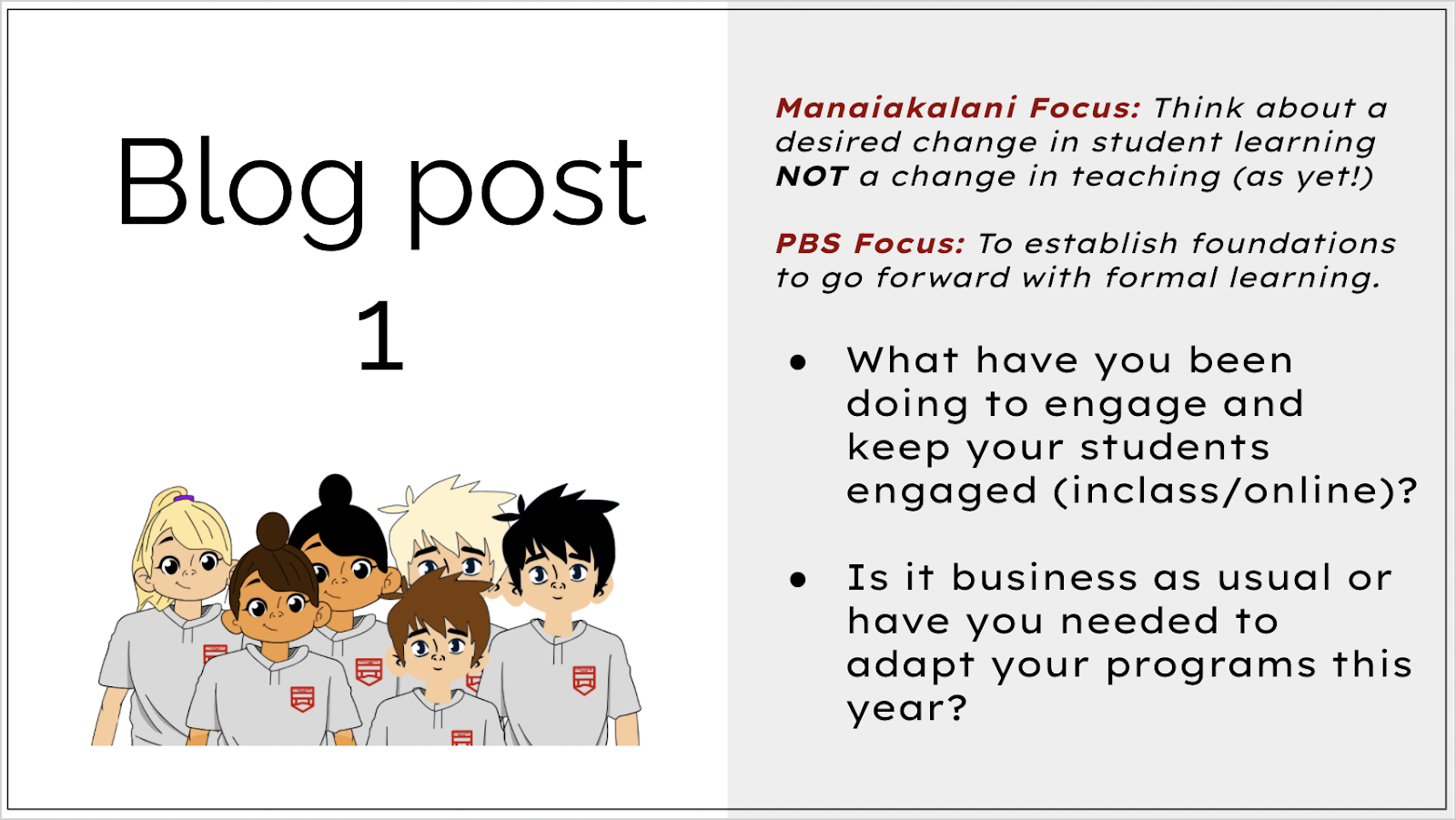
At Panmure Bridge School we decided as a school and before our students returned in February, that our initial inquiry focus would centre around student engagement by establishing foundations to go forward with formal learning. To support this at a school wide level we have started with syndicate discussions using the questions the COL teachers discussed at our first meeting.


This will then followed up with a blog post that encourages everyone to think about what it is they have been doing to engage their students and keep them engaged in class and online. We learn best we we learn from each other and in our current situation, this will be such a powerful resource to have at the end of the term because each and everyone of us is constantly changing and adapting what we are doing in our rooms.


Thinking ahead to Term 2 we will be using our data to form the basis of our individual teacher inquiries. As a school we will have an overarching focus on Reading, but at teacher and class level this picture will look quite different. Having an idea of the way forward allows teachers to start thinking about the direction they will take. As always having an overarching focus allows for the conversations to flow as we bounce ideas off one another.

Establishing foundations to go forward with formal learning...

After our first COL meeting for 2022 I came away thinking about Russell's question, 'How do I have present, happy, healthy, engaged tauira who are learning in the Goldilocks Zone?'

Good inquiry happens in teams, something we have done as a school for a number of years. It means we can have those informal conversations with colleagues that helps us problem solve and form new ideas as we have access to a larger pool of experience and knowledge. Before this meeting, as a school we had decided before our students returned in February, that our initial inquiry focus would centre around student engagement. Without establishing foundations to go forward with formal learning we realised we would struggle to engage our learners and be in a position to effectively contribute to wider school and cluster goals further down the track.

Covid lockdowns in 2021 meant we needed to help our students to reconnect with the formal learning environment. For some, this was no issue at all. They simply walked into our shared learning space on Day 1 and picked up where they left off, but for others it was a different story. School was a place they hadn’t been in since August 2021 and through 1:1 conversations throughout the day, became aware of how daunting to walking through the doors of a classroom for the first time in 6 months actually was. Something made even more challenging with a mask on. We all felt the challenge of mask wearing, but reassuring our learners that mask breaks were important and could be taken when they were needed helped to alleviate some of these new hurdles. In addition to this we began establishing foundations to go forward with formal learning by:

Creating a sense of belonging:

Having a level of or sense of ownership towards something, is what builds strong connections. With this in mind we, (Dianne and I) began building our class culture by setting learning tasks that required our students to talk to each other. As I mentioned earlier, a number of our 2022 learners had not engaged in online learning or physically been in a classroom since August 2021. This meant their verbal interactions had been mostly informal since then. Relearning how to take part in the learning was something we needed to scaffold. We have been doing this by creating tasks that needed paired or group collaboration to complete. We revisited group norms and set challenges that needed input from everyone to achieve. These mini challenges have helped increase buy-in as not only do we have a really competitive class, but it's also a fun way to learn something. This sense of normality helped to set the tone of our classroom, and definitely made everything seem normal to our students. These collaborative activities have helped to form bonds amongst our learners and have allowed us to display work on the walls with their names on, giving our students a real sense of ownership in the room.

Harnessing the power of the familiar:

Our learners who show up in class or online are there to learn so we need to make sure that is exactly what they have the opportunity to do. We were initially challenged with the erratic levels of attendance as it became very clear to us very early on that we never knew who would actually be in front of us each day. We are now in March and are yet to see everyone on our roll in the classroom on the same day! Our expectation from day 1 has been 'it is important to keep your learning going' so our students learning from home or learning in the classroom, understand what they are expected to do and more importantly know why they need to do this. We are continuing with instructional group teaching so we can provide the right level of challenge and support to help our learners keep their learning going. Hybrid learning in LS2 is not about setting different tasks for those accessing the learning outside of the classroom, it is opening a Google Meet and including them in the same instruction that is taking place in the classroom. With more than one adult in the room it is easy to monitor the Meet while the teaching is taking place, which means the students online are able to actively participate in the learning. We follow our timetable regardless of where we are learning, and has been a huge help with continuity as the gaps in learning are lessened. It has also meant those not at school remain an active part of our class with work on our walls.

Scaffolds:

The frameworks and scaffolds we use are unpacked and explained so that the purpose behind a task becomes clearer. We use the same scaffolds across all learning areas which means regardless of ability level or location of learning, our learners are able to carry our the task. Dianne and I have aligned our teaching DLOs so they look the same. The work is differentiated but the layout means which ever DLO you need to access, the instruction is the same making it easier for everyone to use.

Purpose:

Having a real purpose behind the learning has been one of the important messages we have shared with our students. As with anything you do, knowing why you're doing it, is what motivates you to participate actively. I have found that this year I have spent more time introducing and revisiting the learning intentions and purpose of the tasks I have set. My students know what they need to do and why they need to do it, and has helped those who are learning from home maintain stronger connections to what is happening in the classroom. The same thinking and transparency was applied to assessment week. We explained to our students that we didn't have current achievement data so we needed to take time to gather this in order to be able to teach them properly. For the first time in a long time I saw my learners approach assessment week with a real understanding of why they were doing these tasks, and have enjoyed the rich discussions that followed as we discussed next steps as a class.

Expectation to finish work:

Like many of our colleagues around the motu, we have been challenged with the ever changing attendance levels each day brings. To help us navigate this uncertainty we have kept our expectations to complete all work set, in place. Teacher feedback on every piece of work via the comments tool in G Suite has allowed us to give affirmations and identify where tweaks (or if needed, specific guidance) can be made to increase the detail and accuracy of responses. This has proven to be a really valuable way to connect with our students on an individual level as the protocol in our class is to reply to any comment received. They can see by acknowledging their work we are valuing the efforts they are putting in, regardless of where that effort was put in. 

We are continuing to establish the foundations that will enable us to go forward with formal learning. Nothing is set in stone and in the spirit of full transparency, it is important to note that all our initial ideas have been tweaked and adapted along the way to keep our learners engaged both in person and online so that we are all able to move forward in our 2022 learning journey and make the most of our learning time.