Showing posts with label CoL. Show all posts

Monday, 22 July 2024

Implement and Try #1...

I am a firm believer when it comes to the effectiveness of professional learning development (PLD) is that when a team walks the journey together it becomes a journey that has life. PLD done alone or in isolation is much harder to keep going as there is no one to bounce ideas off, share successes, problem solve when it doesn't quite go to plan or to keep you on track.

With new team members there is always the challenge of getting everyone on the same page. With this thinking in mind at the end of Term 1 I got my team together and suggested the idea of an 'in house' literacy PLD day. In my team leader role I spend time in each room coaching and supporting my team in their literacy practice. This traditionally was always on a 1:1 basis which meant I wasn't using my time effectively and ended up repeating myself a lot. We all agreed to use a CRT day, and despite the logistical nightmare of ensuring everyone was released on the same day, we went ahead with the full support of our management team. 

With a wide range of teaching experience in my team I chose to start at the beginning by looking at how we are using the data to inform our planning through to the scaffolds and words we are using in front of our tamariki. You learn better when you physically do the task so I asked my team to see the learning through the eyes of our learners by taking them through the lessons. This provided us with clarity, a shared understanding of what procedural writing looked like and how to use the strategies I was sharing in context. I would like to take this opportunity to thank my team for approaching the day with open minds and a willingness to actively participate.

The DLO below shows what we covered. Some links are restricted to keep student anonymity. The aim of the day was to set us up for success in Term 2 by leading a guided planning session for the first three weeks of literacy. 


As with anything you try for the first time there is always an element of risk. I didn't want to undervalue what my team was bringing to the table but I did want to streamline our process by helping everyone make connections to our 'why' as well as our 'how'. 

At the end of the day I asked my team what their takeaways were. Their anonymous responses are below:

Teacher A 

  • How explicit things are if you show and tell - you learn by doing it
  • Foundational basics are important
  • Refer back to the data
Teacher B
  • How to unpack a text type - going back to basics
  • Tapping into prior knowledge and data
  • Gallery walk
  • Working in pairs
  • The power of talk
Teacher C
  • Prior knowledge shows me what the students already know
  • How to model explicitly eg- time connectives
  • How we can combine reading and writing together - integration
  • What to focus on when you teach a text type
  • How to use the data

    Teacher D

    • Going back to basics
    • Integration of planning
    • Clarity in planning transfers to the lesson
    • How to use the data

    As you can see the responses were different as we connect best to what resonates with us and what we needed to learn or be reminded of. Going forward as a team we have decided to continue with this type of PLD, only this time covered in our team meetings. It won't always be a literacy focus and it won't always be led by me. We have a great skills set in our team that we can tap into, after all we learn better when we learn together.

    Sunday, 5 November 2023

    Exploring Qualitative and Quantitative Data...

    Each slide below contains the comparative data gathered from time point 1 and time point 2. Underneath the graphs I have analysed the shifts in more detail. It is important to note here that I have only analysed the data gathered from the 15 students in my literacy group that present both data collection times.


    What I noticed as a result of my intervention was that once the knowledge of simple rules and/or conventions of spelling was in place, the challenge element was lost. If I wanted the momentum to continue I quickly realised I needed to adapt and change my thinking and my approaches.

    As mentioned in my previous post, the fear of spelling a word wrong or choosing a simpler word seemed to have been left behind as the desire to use the words was more powerful. The learning became about the words and not the hurdles that prevent them from being used. The more I used these words, the more my students used them. Being confident to use and apply more sophisticated vocabulary in context accurately became the norm. My expectations were clear and I noticed that as my student's confidence grew the higher my expectations became. The exciting part was the students took ownership of this challenge and regularly helped each other find the words to use to shift responses to the next level. Student created and driven tally charts evolved as a way of monitoring that everyone had used their word twice, with the others in their group prompting those who had not met daily challenge. 

    An interesting observation with the word gifting strategy was when I physically gave my students a piece of paper with their word on it, the ownership and connection to that words was much stronger than when we used a randomiser wheel to select our words. I feel this was because the words on paper could be physically touched, seen and used. Making the gifted words digital made them more abstract. Maybe this was a step too far too quickly, as looking back we overlooked the consolidation step. 

    Student voice gathered at both TP1 and TP2 and collated in the DLO above, allows for a comparison of student voice and attitudes towards spelling. To collect this data we used a Google Form survey to get to know our class as spellers. I have edited the original survey responses to reflect those only from my focus group who were present at both time points.

    The comparison between the two timepoints (all analysed in the DLO above) shows there are some positive shifts happening in mindsets but when looking closely at how my learners see themselves I see we have a long way to go. This is possibly due to the historical belief that I can't spell it so I won't use it, ESOL obstacles and a fear of getting it wrong. This will definitely take more than a year for change to cement itself, but as we close our 2023 learning journey's deep dive into word consciousness, I feel confident we have laid some strong foundations to build on.

    Monday, 21 August 2023

    Implement and Try#2: Word Gifting...

    I have been approaching my inquiry into word consciousness as a whole language focus and not simply looking for opportunities to strengthen spelling skills. This term I have actively planned for opportunities to adopt the word gifting strategy that Sylvia Ashton-Warner used to elicit key vocabulary. 

    Making Reading Meaningful - Sylvia Ashton-Warner and the Language Experience Approach by Sherron Killingsworth Roberts points out that by embracing some of the guiding principles for practice of Sylvia Ashton-Warner’s work in developing the Language Experience Approach (LEA) we can strengthen the connections our tauira have to the more challenging topic based vocabulary needed to make sense of new learning. The principle that resonates most with me is to offer ongoing, authentic language and literacy experiences, including lots of opportunities to speak, listen, read, write, and think about their own and others’ words.

    In my reading program this term I have been focusing on the concept of representation in texts. This unit was designed as part of the T-Shaped literacy PLD that I have been on with the University of Auckland for the past two years. In each unit there is a vocabulary component that we up until now have unpacked as a class. This time around I decided to make a few changes, with the most powerful change being to gift the content specific vocabulary to my learners. 

    The first thing I did was to create a list of the words and their definitions. These were then cut up and placed face down in front of the groups. After everyone physically selected their card the next challenge was to find the their partner by matching the word to its meaning. We needed to establish ownership of these words so the challenge to use their specific words twice each reading lesson was laid down. To ensure this happened my learners were asked to bring their word to every time we had reading. These word cards were not pretty or laminated but became a part of every reading lesson as along with ownership came a sense of responsibility.


    No one immediately connects to a word so each pair was given the challenge of introducing their word to us. The details of the challenge are on the slide below.


    What I found was that strong connections were made by the owners of these words. This was evident in reading responses, extended discussions and questions asked. What I wasn't expecting was that every student in the group could use every word accurately and in context. The example below from team 1 shows how these words were used in context accurately and effectively.

    With the success I found in reading using this strategy, I decided to transfer this challenge to our science inquiry. Again, ownership meant connections and connections meant explanations of experiment outcomes were explicit. This is definitely an activity I would use again as it was unique, purposeful and fun.

    Sunday, 25 June 2023

    Linking my Inquiry to the Literature....

    Share academic or professional readings and explain how they and other sources helped you form hypotheses about aspects of teaching that might contribute to current patterns of learning.

    Teaching Spelling in Primary and Intermediate Schools - Link to article

    'Spelling is key to success in writing... In the intermediate years, spelling and handwriting combined (together labelled ‘transcription skills’) account for 41% of the difference in students’ writing fluency. Working memory is limited in its capacity which means that if transcription skills – spelling and handwriting – have not been practised to automaticity, these will likely occupy all of working memory and prevent the student from thinking about other things, such as the ideas they wish to express.'

    Reasons why spelling impacts on students’ writing:
    • Misspelled words may blur the writer’s message and could influence teachers perceptions of the student’s ability.
    • Lack of spelling knowledge may lead to a student avoiding certain words
    • Spelling difficulties may affect student confidence about their ability to write, which in turn may impact on motivation and cause them to avoid writing practice
    • Spelling supports decoding as it allows students to hear sounds in words and represent them with letters and orthographic patterns (the ways sounds are spelt).  
    • Key learning in a spelling program (explained here) should include phonemes, graphemes, vowels, consonants, syllables, digraphs, morphology, and etymology. A challenge because of the 44 sounds (phonemes) in spoken English, the 250 ways to write those sounds (graphemes) and the facts that many of these sounds can be represented in more than one way.
    • Teachers should follow a spelling programme to support teaching of spelling patterns and rules.
    • Students need to practise retrieving knowledge from memory before it needs to be taught again. 
    • 10 minutes of spelling instruction every day is more effective than longer less frequent lessons - guided reading allows opportunities to revisit this learning at the right level.
    What to teach...
    • Phonemic awareness (listen for sounds and syllables in words)
    • Sound-to-letter patterns and relevant spelling rules.
    • Use lists of words with the same sound-to-letter correspondences (not randomly spelt ‘essential words’).
    • Morphology– the study of meaningful word parts (eg: adding prefixes and suffixes and how they change word meanings)
    • Latin and Greek roots
    • Etymology– the study of word origins.
    • Identify the anomalies of written English
    Joy Allcock' example of senior primary spelling program...
    • Day 1: Sound or rule for the week
    • Day 2: Word meanings
    • Day 3/4: Segmenting and write words with the spelling pattern
    • Day 5: Dictation


    Effective Vocabulary Instruction - Link to article

    'Vocabulary knowledge is fundamental to reading comprehension; one cannot understand text without knowing what most of the words mean... The amounts of difficult words in a text predicts text difficulty, and a reader’s general vocabulary knowledge predicts of how well a reader can understand text.... The goal of all vocabulary teaching is for students to be able to use new vocabulary fluently and purposefully in speaking, reading, and writing. This is best achieved through a combination of explicit instruction and opportunities for meaningful practice,  both during literacy instruction and across the curriculum'

    • Vocabulary knowledge is a strong predictor of reading comprehension by Year 5, and by Year 8 it is the main predictor of success. Research has shown the gaps and disparities between high and low achieving students widens as students in these year levels require higher levels of word knowledge in order to infer new word meanings, make meaning and find success. 
    • Whole class teaching has been shown to be just as effective as small group and one-on-one interventions, and short sessions (of 20 minutes or less) can be just as effective as longer ones.
    • To achieve students need to learn about 3,000 words per school year.
    • Vocabulary knowledge is the key to progress in literacy, and in all other curriculum areas. 

    Incidental learning and explicit instruction

    • Incidental word learning occurs within the context of reading
    • Teachers should model use of sophisticated vocabulary across the curriculum and in instructional language
    • Use the think aloud strategy to define words and reflect on the author’s use of a word in a text.
    • Explicit instruction in word meanings is essential as a deficit in vocabulary knowledge will prevent inferences from being made.
    Selecting words to teach during literacy instruction and across the curriculum
    • When planning a unit consider vocabulary challenges to identify which words that need explicit instruction.
    • Use a three-tiered system to decide which words need to be taught explicitly:
      • Tier 1 words are common, everyday words used in oral language
      • Tier 2 words are more wide-ranging, specific used in written language more than in conversation 
      • Tier 3 are content specific 
    • Tear 2 words are the words that will need to be targeted for explicit instruction.
    What to teach...
    • Correct pronunciation, the written form, and an understanding of the word’s meaning are key priorities
    • Greek and Latin roots
    • Affixes
    How to do this...
    • Be clear and explicit when discussing word meanings
    • Repetition to consolidate
    • Use visual representations of words to aid memory
    • Provide opportunities for students to pronounce the words themselves
    • Finish a sentence which uses the word
    • Act out word meanings
    • Unpack sentences with the word that do and do not, make sense
    • Identify examples and non-examples of the word’s meaning. 
    • Find synonyms and use in context

    The Role of Motivation in Learning - Link to article

    Motivation is what ‘moves’ us and is the reason we do anything at all. It is an orientation towards learning. Motivation can be intrinsic (motivated by enjoyment) and extrinsic (motivated by reward). For teachers, a lack of motivation has long been one of the most frustrating obstacles to student learning. 

    How to do this... 

    • Set goals - performance and mastery
    • Be aware of self efficacy - the extent to which a student values learning a skill or concept directly impacts their effort and mastery of that skill or concept. 
    • Normalise the struggle 
    • Encourage the importance of asking for help
    • Students who believe that they can succeed are more likely to reach their goals.
    • Use the analysis of the student survey 
    • Remind students of the purpose behind the learning
    • Allow for visual connections to be made

    How these readings helped me to form a hypothesis... 

    My hunch at the start of the year was that my learners opted for the safe and known when selecting vocabulary to use when asked to write independently. It is the fear of making errors that decides the levels of self efficacy. If you begin school with a vocabulary deficit the gap only widens as the depth of learning increases. To help overcome the low self efficacy and reliance on the use of everyday words I see from these readings that I need to be actively planning for more opportunities for word consciousness to be explicitly taught. This term I did the training and will be introducing 'The Code' spelling programme to support the teaching of spelling patterns and rules, something suggested in the article, 'Teaching Spelling in Primary and Intermediate Schools'. 

    Much of what I have read affirms the direction I am taking, with my biggest takeaway being the amount of time I need to spend focusing on word consciousness. To date we have been spending longer but less frequent periods of time on these lessons, so I will be increasing the frequency and decreasing the amount of time spent on each lesson. I now need find out if I am motivating my students to want to use more challenging vocabulary, not because I want them to, but because they realise they know how to do this and want to take risks in their writing.


    Sunday, 23 April 2023

    Qu 4: Collecting evidence and data...

    Begin to collect evidence and data and come to the next session ready to share your preliminary findings about the nature and extent of the student challenge i.e. using your baseline student data and evidence.

    I will use this opportunity to introduce the group of students I will be working with on this inquiry this year. There are 19 students in this group of year 7/8 students (5 Year 7 girls, 3 Year 7 boys, 3 Year 8 girls and 8 Year 8 boys). When referring to the Writing and Spelling data, these students have been identified as our most able students. 


    What I noticed when looking closely at their e-asTTle results was that our Year 8 students scored well in their vocabulary choices, possibly due to the increased levels of vocabulary they gained from actively participating in the Reading for Enjoyment and T-shaped literacy initiatives last year. The Year 7 students however, chose to play safe and use the words they knew how to spell. One example of this evident in a comparison of two of the Term 1 e-asTTle writing explanations on the same community facility. The Year 8 student referred to the facility as 'appealing' and 'affordable', whereas the Year 7 student explained that it was 'fun' and 'didn't cost much'. 

    My next steps are to explore ways I can grow vocabulary, the knowledge of words and word meanings so that the words met on this journey are transferred from where they were found, to my learner's personal word banks. 


    Saturday, 12 November 2022

    Timepoint 2 Testing - What the Data tells us...

    When we began this inquiry both Dianne and I knew intrinsic motivation to want to read for enjoyment was something our learners wouldn't achieve on their own. We needed to develop a class culture where reading for enjoyment was seen as the norm. Influenced by the decision to build a class culture is why we chose to show student data from the whole class as selecting a target group wouldn't give us a true picture of the change. Due to absence and students transitioning in and out of our class over the year we are now sharing the data of the 26 students who were present at both timepoints.

    The presentation below is an comparison of our time point 1 and time point 2 data and paints a clear picture of the shift that has occurred in attainment levels. I still believe that the last two years of disruptions to learning due to Covid and ongoing unexplained absences this year are still impacting some of our students learning opportunities, as connections made through continuity and consolidation have not been consistent.


    Analysis of PAT Reading data shows at TP1 27% of Year 7 students and 40% of Year 8 students were achieving at or above the norm. TP2 data shows shift in both year groups with Year 7 increasing by 46% to 73% and Year 8 increasing by 20% to 60% at or above the expected norms.

    An observation both Dianne and I made during the TP2 testing was the increase in confidence across the board. The TP2 tests took longer to complete than the TP1 test, perhaps because this time responses were informed and linked to the text rather than randomly 'guessed' as we suspected happened during the TP1 testing. Probe running record results reflect a shift that aligns with the rest of our data. RFE opportunities have increased our learner's reading mileage and exposed them to a wider range of vocabulary. Current data shows at least 60% of our students in both Year 7 and Year 8 who were present at both testing timepoints are reading at or above their chronological age, with the most significant shift belonging to our Year 8 learners. When looking at the vocabulary section of the e-asTTle writing the data between the reading ages and vocabulary scores shows that 60% of our Year 7 learners have shifted from 'below' to 'at' or 'above'.

    The shifts evident in the data show that there has been an increase student self efficacy and capability in Reading. However, alongside our Reading for Enjoyment focus our active participation in the T-Shaped Literacy and Extended Discussion PD have complimented and strengthened all reading opportunities in our learning space. Reading a wide variety of texts has allowed our learners to move beyond the literal by considering and discussing mood, atmosphere, characterisation, narrators and point of view. The connections to these focus areas has enriched our discussion and have enhanced all reading opportunities, both in class and when reading for enjoyment. All three interventions have given us the opportunity to help our learners strengthen their connections between the written word and their comprehension.

    Sunday, 15 May 2022

    Qu 4: Collecting evidence and data...

    Begin to collect evidence and data and come to the next session ready to share your preliminary findings about the nature and extent of the student challenge i.e. using your baseline student data and evidence.

    Developing an intrinsic motivation to want to read for enjoyment is not something my learners will achieve on their own. To do this successfully we need to develop a class culture where reading for enjoyment is seen as the norm. Because of this, I have chosen to show a snapshot of whole class of the student data. To select only a small group wouldn't give me a true picture of the change I hope to facilitate. The presentation below is an analysis of our time point 1 data and paints a clear picture where we are at now.


    From this analysis I am now aware that 29% of my Year 7 students are reading at 1.5 years + below their chronological ages, and 49% students 2.5 years + reading below chronological age. Historical data shows me there are no surprises with the Year 8 data. I do believe that the last two years of disruptions to learning due to Covid is one of the main reasons these students are continuing to struggle with reading. Many of these students did not engage with online learning and for some, continued absences this year are proving to be having an impact on their learning.

    When looking at the vocabulary section of the e-asTTle writing the data between the reading ages and vocab scores in Year 8 aligns. These students are not being exposed to a wider range of vocabulary as they are not engaging in reading outside of the instructional lessons in class. I am surprised at the Year 7 results as the data shows 85% of our Year 7 students are below the expected level in vocabulary.

    Sometimes the starting point is harsh to look at, however looking forward, a focus on reading for enjoyment will hopefully become a catalyst in effecting the changes in these levels I hope to see.


    Sunday, 6 June 2021

    Qu 7: Readings to support my hypothesis...

    Share three pieces of academic or professional reading and explain how they and other sources helped you form hypotheses about aspects of teaching that might contribute to current patterns of learning.

    If I want to use Talk Moves in maths accelerate student confidence and capability to use spoken and written maths vocabulary and language I need to make sure I have set the norms that allow for academically productive talk to take place.

    'Students explain their ideas in detail with evidence... listen carefully to each other with respect... evaluate their own and others’ competing ideas.... are intellectually engaged.... Talk is not an add-on... it is a critical component of the lesson... that allows students explore ideas and use evidence to build and critique academic arguments.'
    Page 13 of this reading suggests four goals that might support me in providing a learning environment where academically productive talk to take place
    1. Individual students share, expand and clarify their own thinking
    2. Students listen carefully to one another
    3. Students deepen their reasoning
    4. Students think with others
    Michaels and O'Connor (2012)
    Talk Science Primer


    Instructional strategies are the tools of effective practice. They are the deliberate acts of teaching that focus learning in order to meet a particular purpose. Instructional strategies are effective only when they impact positively on students’ learning. Teachers need to be able to use a range of deliberate acts of teaching in flexible and integrated ways within literacy-learning activities to meet the diverse literacy learning needs of our students. These deliberate acts include modelling, prompting, questioning, giving feedback, telling, explaining, and directing.

    Effective Literacy Practice in Years 5 to 8, p. 78


    Oracy is defined as ‘the ability to use the oral skills of speaking and listening’.... Spoken language is... of equal importance to reading and writing.... we need to make our classrooms talk-rich environments where every child is encouraged, expected and supported to develop a range of effective speaking and listening skills in a range of contexts.... Strategies for talk need to be in place to promote the transfer of knowledge, skills.... In practice this means there are two aspects to oracy, each equally important: learning to talk (oracy education) and learning through talk (dialogic approaches to teaching and learning).

    Mannion, J. (2020, October 19). Oracy in The Learning Skills Curriculum: Rationale. Oracycambridge.Org. https://oracycambridge.org/oracy-learning-skills-rationale/#_ftn44


    Wednesday, 2 June 2021

    Qu 6: How I will use the data...

    Explain how some of the data you have used to build a profile of the students’ learning will be used as baseline data at the end of the year.

    Time point one data (shared and analysed in this blog post) was captured through:

    • Informal teacher observation
    • Student voice
    • Assessment (IKAN, PAT Maths, GLoSS)
    • Formal observation by a colleague to identify teacher talk time vs student talk time, strategies I use, purpose for talk (teacher/student)
    This year I have moved away from comparing historical data with current data as the picture painted does not relate to my inquiry question. I feel however, the methods of data collection used at time point 1 will be able to be easily replicated when I am gathering data at the end of the year and will allow me to make clear comparisons.

    The comparative data I am most excited to see is the data from the formal observations as this is not subjective. It is real and will allow me to see very quickly if there have been shifts in student confidence levels, teacher/student talk time and the amount of scaffolding I am needing to provide to get the maths talk going.

    Student voice comparisons will allow me to see if there has been any shifts in attitude, use of content specific vocabulary and efficacy. Assessment shifts will allow me to see if the language we use when actively participating in Talk Moves conversations is helping to make the connections to the learning needed to show that understanding is being transferred and applied independently. Finally the informal observations will show if there has been any change in participation levels.

    Qu 5: Nature and Extent of the Student Challenge...

    Share your findings about the nature and extent of the student challenge. Make sure it is clear what evidence from your inquiry supports each finding.

    The challenge for my students this year is to make accelerated shift in Maths by being able to talk about their learning in thinking groups, explain it on their blogs and create comment threads that invite others to respond by talking/writing about their learning in maths.

    Accessing content vocabulary continues to be one of the obstacles that seems to limit assessed student achievement. Our students are not confident when using maths vocabulary out of context. As a school we have been inquiring over the last few years into ways we can help our students to see that learning used in one area can be transferred to another - linked to vocabulary, instruction and strategy. With teachers being transparent in their inquiries we can see what is working and what we can build on. Building on from the year before is the direction we are all heading this year. In 2020 we were successful in using our blogs to encourage our learners to share their learning, ask questions and talk about their learning.

    Fast forward to 2021 and we have all got new students in front of us. For many the simple transition between rooms is a challenge for many of our learners as they leave behind the known when they walk through the new doors of the unknown. The students who were with me last year, for the most part, are able to talk confidently about their learning when asked. This is because this is embedded into our classroom culture. However for many others being asked to talk about their learning is a huge challenge. Low self efficacy and a limited knowledge of vocabulary means these students find the 'talk' component to be overwhelming. Student voice collected earlier in the term identified shyness as one of our biggest obstacles and shows what I have stated above to be an accurate observation. It is from this data that I now realise the more able students find it frustrating that others in their group rely on them for the answers. The fear of 'getting it wrong' or having their ideas overlooked are other factors at play here.

    I know from previous inquiries that if students are not able to use their words to explain their thinking, their connection to the task become compromised. I want all my learners this year is to create comment threads on blogs that help strengthen their connections and the connections others are making to the learning. I want them to refer to the learning intention and confidently use content specific language when giving feedback and feed forward. I also want questions to be asked that provide opportunities for those receiving the comments to justify their thinking. If this is to become the norm and be a successful intervention I need to provide a scaffolded framework so that opportunities to use content specific vocabulary in context, are not seen as safe learning opportunities and not overwhelming and scary situations.

    I need to help my learners understand what a learning conversation is and realise 'talk' has a valid place in our class strategy toolbox as it helps us unpack and reflect on our learning. So the question I am asking is 'will using Talk Moves in maths accelerate student confidence and capability to use spoken and written maths vocabulary and language?'

    Saturday, 15 May 2021

    Qu 4: Collecting evidence and data...

    Begin to collect evidence and data and come to the next session ready to share your preliminary findings about the nature and extent of the student challenge i.e. using your baseline student data and evidence.

    My focus group are made up of a mix of Year 7 and Year 8 students. Four students I taught last year and two who are new to LS2 this year. These students are the students who prefer to sit silently in maths time. They work hard and listen carefully but all become anxious if they are asked to share their thinking during instructional teaching times. With my inquiry in mind I stepped back and watched how they interact with others when working in maths thinking groups. The information below indicates what I observed on this occasion.

    • 6/6 students look at the person speaking and nod their heads in a way that looks to others like they agree with what is being shared.
    • 1/6 students offered to act as scribe.
    • 4/6 students turned down the opportunity to act as scribe.
    • 6/6 students did not share an alternative strategy (their book work showed a variety of different strategies had in fact been used)
    • 4/6 students did not volunteer to speak first during sharing time.
    • 6/6 students enjoyed the group success when their group's strategy was successfully shared with the class.
    • 1/6 students offered to act as spokesperson.
    Student Voice

    The best way to see how my students feel about contributing their ideas when working in thinking groups or commenting on a maths blog post is to gain their perspective. I used Google forms to capture this data as it allowed my learners to share their thinking with me without being influenced by the ideas of others.


    Focus Group Baseline Data


    Baseline Observation 

    To enable me to measure time point one data with time point 2 data I took Kiri Kirkpatrick up on her offer to observe my learners and I in a guided lesson and record the talk that took place in that lesson. After the observation Kiri showed me how to analyse the amount of student talk compared to the amount of teacher talk in the lesson, so that when we repeat the process later in the year I will be able to see if my intervention has helped to change these percentages. 

    For anyone wanting to replicate this, you need to listen to the audio and record the timings of who is speaking and for how long. I will unpack this further in a future blog post. Analysing the audio takes a while but gives you also gives you so much more information about your own practice that you can reflect on. For example, I noticed that I use a wide variety of deliberate acts of teaching (DATs) to scaffold the learning and help my learners strengthen their connections to the task ahead. 

    I used modelling to clarify and let my learners see what they needed to do. I realise that I prompted to encourage talk and the use of the content specific vocabulary. I used questioning throughout the lesson to encourage my learners to add detail to their responses. Without realising, I heard that my feedback to affirm, inform and guide was ongoing, informal and when needed. There were several opportunities where telling and explaining was used to help clarify confusions, and I directed my learners towards the success criteria, questions stems, new content specific vocabulary and the teaching DLO slides when specific instructions were given so the purpose of the task was made clearer. I could also see that I need to allow a longer period of wait time with the students who prefer to listen rather than contribute. On two occasions I feel I stepped in too early which meant the students who were less confident with sharing actually weren't given a true opportunity to take a risk and share their thinking.

    The lesson captured was an honest one. I did not do anything I don't normally do because someone was observing me because I wanted real and purposeful feedback. Additionally this group had not worked together before so confidence levels were altered. 


    Monday, 16 November 2020

    TAI 2020 WFRC # 10 To what extent was the intervention successful in changing teaching?

    I initially linked my inquiry question 'Will strengthening connections to Smart Relationships help our tamariki to understand and use content specific language and vocabulary in Maths?'  directly to our school wide professional development of maths, but due to the changes lockdown and distance learning presented, I widened my focus to incorporate the additional curriculum areas of reading and writing. This is something I see as a bonus as it afforded me the opportunity to reinforce and make connections across these curriculum areas. 

    Since beginning my in-school COL teacher journey in 2017 I have realised the power knowing how to transfer learning across the curriculum areas really has. This isn't something new or something I hadn't done previously, but rather something I learnt to take time to think about and actively try to facilitate by consciously drawing attention to, and is something I feel is one of the key changes in my practice this year. 

    Drawing attention to the learning intention helped us to identify the purpose behind the learning. In maths for example, the purpose of the lesson may be to 'make ten then add', and in reading might be to 'identify the main ideas', however because the word 'purpose' has been unpacked and used in context, the outcome is that my students know why they are learning what they are learning in both curriculum areas. Revisiting learning intentions (LI) to strengthen my own knowledge has meant these have become more specific. For many years I have written learning intentions on my teaching DLOs and discussed them at given points in the instructional lessons. One big change I have made this year is to record the LI's on the board, in modelling books or on whatever I am using to build the rewindable opportunities that allow visual connections to be made. I now make a conscious effort to begin each instructional lesson by introducing the learning intention. It has a dedicated place within each lesson and is referred to throughout so that I can show my learners where the connections are between the purpose of the task and the actual task. Even though I write these LIs before we begin the learning, on many occasions these are now tweaked and reconstructed with my learners using their words. The latter being highly valued as I think as teachers, it is important to embrace opportunities to learn from our students.

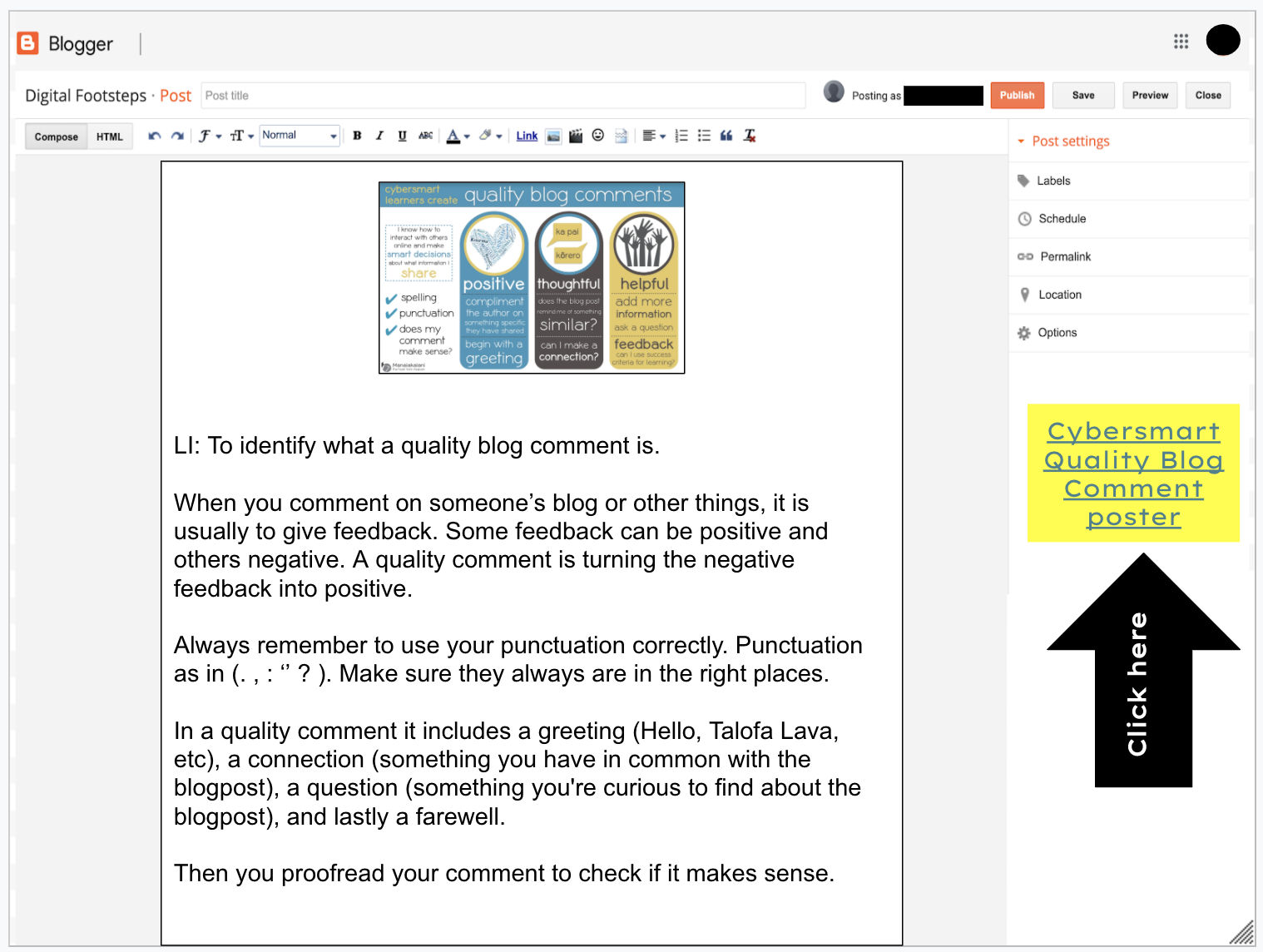
    Identifying the learning intentions on blog posts became our point of focus when commenting on each others blogs. When I asked my learners to comment on their peer's blogs I taught them to first look for the learning. Knowing the purpose of learning intentions helped my learners to find the learning in the post. We followed this with a focus on questioning and explored the difference between open and closed questions. This enabled feedback to be given and questions to be asked that dug deeper and linked directly to that learning rather than surface level comments linked to the visual features of the DLOs. As a direct result dialogic and rich learning conversations in the form of comment threads emerged.


    At the beginning of my inquiry this year I realised I needed to revisit how to write a quality blog post so that my learners had the tools they needed to work with when creating comment threads. The way I chose to do this was to create a blog post scaffold, and was something that forced me to really think about what learning I wanted my students to take away from each lesson. 
    our blog post scaffold was created during our first round of distance learning and was  initially written by me, we progressed to co-construction as the year went on. Each scaffold gave my learners the title, blog post labels, the learning intention, a few points of information and / or a short co-constructed blurb that used the content specific vocabulary we had been using to unpack the learning, and a prompt to give a personal insight to the task. 

    As with any class, my learners have a wide range of abilities. Some learners need a lot of scaffolding, while others use that scaffolding as a prompt, in this case, to help them write their own task description. By co-constructing these scaffolds with my learners we first get an opportunity to revisit the purpose of the learning and the content specific vocabulary we have been using, then get a further opportunity to think about the title and labels. 

    By strengthening this area my students were then able to leave quality comments as they had the vocabulary tools to work with. 


    I linked our cybersmart lessons directly to the learning taking place in our classroom. This allowed for immediate connections to be made. We revisited the purpose behind leaving a comment and discussed how this would help us strengthen our own connections to the learning. When I looked at the way I taught my learners to be cybersmart I realised I was skimming over components I believed my learners had already connected with and knew how to use. This was something I changed immediately. I realised that despite having participated in cybersmart lessons about how to write a quality blog post and comment since their digital learning journeys began, many of my students across all ability levels had not actually made a strong connection to this. 

    To effect change here I began weaving this into all our sharing sessions. The words I used were the same, the scaffolds I used had the same structure and my expectation was that all blog posts would contain each element needed to allow our audience to make connections to our learning. Blog commenting was unpacked, scaffolded and given a place within the timetable. I found by actively planning for these opportunities they became the expected norm. 

    Bullets free icon

    Modelling and purposefully using the content specific vocabulary was another area I concentrated on in my own practice. In day to day classroom life often we think we are doing something, but the reality is often it this doesn't happen. To support this my observations this year have all focused on my use of content specific vocabulary (CSV) and how I am supporting my students to use this in their blog posts and comments. 

    What do you want me to notice during the observation?
    • Do the student blog posts match my teaching DLO?
    • Are my instructions explicit?
    • Am I using content specific language throughout the lessons?
    • Does this language link to the task and the LI and cybersmart?
    • Are the students using CSV in their blog posts to explain their learning?
    • Do comments left use CSV reflect a connection to the learning?
    Kiri Kirkpatrick observed my practice in Term 2 and then again in Term 4. Both observations had the same focus to allowed us to have a rich discussion. From these observations I see that I:
    • Provide very explicit learning intentions, both verbal and written
    • Vocabulary introduced by teacher and generated by students is recorded on the board so students can refer back to CSV
    • Students are engaged and ask questions for clarification.
    • Opportunities for peer to peer talk to strengthen connections

    The most important learning I made through my inquiry is that by embracing change we strengthen our ability to provide our tamariki with the tools they need to strengthen their connections to the learning.

    TAI 2020 WFRC # 9 To what extent were the changes in teaching effective to changing patterns of learning?

    To gain a clear picture of the changes that have been made to patterns of learning I looked at patterns in their historical achievement data and analysed the shift data (PAT Reading and Maths, STAR and e-asTTle writing) of the Year 7 students in my focus group. To establish a norm across my classroom, I have compared their results against the remainder of my other Year 7 students whose data was captured at both time points. Additionally I have compared the student voice captured at Time Point 1 with the student voice captured at Time Point 2 as this best reflects the growth this learning journey has taken these students on. 

    Assessment Data


    Scale Score Shift Analysis

    'The average scale score progress for each year group is described by a benchmark scale score for each year level from the Term 1 trials. They can be used as a guide to compare individual student /class progress between two assessment time points.' - source NZCER

    I noticed student engagement, work completion rates and the confidence levels of my focus students increased when new learning was introduced and unpacked. This pattern was evident both in the classroom and during distance learning. This confidence did not always transfer to assessment situations. Student G71 and student G73 although both focused and engaged in class, seem to completely freeze when the task ahead is an assessment task. Their results do not reflect the work produced or quality of learning conversations I observed in class. This pattern is historic and shows me that next year I need to build self efficacy in this area.

    Learning intentions gave us the purpose for the learning and once the connection was truely made to the value of understanding this, blog posts became easier to write in all curriculum areas. Content specific vocabulary was used to explain and discuss learning both in class and on blogs. This meant that comments on blogs linked specifically to the learning and threads that followed replicated learning conversations in the classroom. 

    Questioning was another area we focused on. Once my students understood the power of open questions the quality of online interactions in blog comments became much richer. I noticed in class that my focus group students were the students who asked the most questions during learning time, something that became evident in emails to me to clarify understanding during distance learning time too. 

    Student Voice


    The Time Point 1 student voice data (captured 4/5/20) shows that all my focus students were aware of the purpose of commenting on others blogs, but when we unpacked this further I discovered that these were the words they had heard during cybersmart lessons and that they did not truly understand the value their feedback could have on their peer’s learning. The Time Point 2 slide shows these students have made a significant shift in their thinking as they have strengthened their connections to the purpose behind commenting on blogs. A possible reason for this is that blog commenting has a place and a purpose in our classroom.

    B72: We comment on blogs so that we can give feedback and give them gratitude about their work (TP1)

    B72: We comment on blogs to give positive feedback to someone’s blog post to help them improve their blogs. Commenting also gives us the opportunity to ask questions about their learning, by doing this we can create a comment thread (Blog Conversation). (TP2)

    My initial hunch was that our students weren’t commenting because they were 'lazy' (even though they identified this as a reason in Time Point 1), but possibly because as teachers, we had not set them up for success in this area. When I saw their responses I knew that I was on the right track. This data has been unpacked in an earlier post. The Time Point 1 slide below (captured 4/5/20) . The Time Point 2 slide shows these students have made a significant shift in their thinking as they have strengthened their connections to the purpose behind commenting on blogs. A possible reason for this is that blog commenting has a place and a purpose in our classroom. 

    G74:
    I usually don’t comment because I’m not sure what to write. (TP1)

    G74: 
    For me it's not finding the L.I so I can understand the learning. This is very tricky because I can’t make a connection with them, and it is also very hard to find a question about their learning to try and help them fix their mistake. (TP2)

    At the time this student voice was captured we were well into the first lockdown of 2020. I met with my target group on Google Meet. We had an open and honest discussion, and used this collaborative DLO to capture time point 1 student voice data and establish the group's understanding of how to write a quality blog comment. Posting and commenting on blogs during this time needed to be seen as a valuable part of the learning process so I set off on my quest to change their mindset and establish the purpose behind these two very important parts of our digital learning journey. Basically we reminded ourselves how to write a quality blog comment by co-constructing a collaborative comment and learnt how to create a comment thread. My learners then paired up and practised leaving comment threads on each others blog posts. As I have said earlier, I felt from the outset that this was not because they were lazy or disinterested, but rather because they were not sure of how to do this. After all if you don't know, you don't know.

    One major hurdle we found as we began our challenge was that many students had become complacent when it came to including a learning intention. As one student said, ‘If I can’t find the learning, how can I comment on it?’ So rather than seeing this as a hurdle we couldn't climb over we decided that as a group we would model best practice. Baseline evidence unpacked here, had shown me that I not only needed to revisit how to write a quality blog comment, I also needed to revisit how to write a quality blog post. 

    I knew from observations in my class, and other classes across our school, if students are asked to have a ‘learning conversation’ they will confidently carry out a conversation using content specific language and learning intentions to give their partner (or group) feedback and feed forward connected to a completed task. However before I could expect to see this taking place I needed to make sure that my learners were creating quality blog posts that clearly identify the purpose of the learning, a detailed explanation of the task and a personal statement linked to something they found interesting or where they feel they did something well.

    .

    TP1                                                      TP2

    Comparisons between blog post content in the earlier part of the year and blog post content now is poles apart. 'Today we had to...', or 'Here is my my DLO of...' has been replaced with clear learning intentions and detailed explanations of tasks. I have noticed that content specific vocabulary is defined when included in a blog post, and used to build content. This shows learning in the classroom is being transferred in a way that shows connections have been made.

    The challenge for my learners this year was to be able to create comment threads on blogs to help strengthen their own connections to the learning. I wanted my learners to refer to the learning intention and confidently use content specific language when giving feedback and feed forward. I wanted them to ask questions that provide opportunities for those receiving the comments to justify their thinking, and I wanted them to understand that giving and receiving blog comments is an important part of our learning. So has this happened?

    In a nutshell yes! However, this success is not yet the norm for all my learners. The reflections here pertain only to my focus students. I chose to work with this group of Year 7 students this year so that I was able to move into 2021 with an 'expert' group who could both model and teach their peers how to strengthen their connections to the learning through blog commenting.