Showing posts with label LReflect. Show all posts

Saturday, 1 November 2025

Unpacking Qualitative Data - My Journey to Balancing Rigor and Transformation...

My central motivation for this inquiry stems from a concern that the necessary rigor of the Structured Literacy framework could unintentionally stifle creative expression and deep demonstration of learning. 

My perspective is rooted in my own educational experiences from a time dominated by repetitive, uninspired reading consolidation (the classic ‘duplicated worksheet’ era) where genuine engagement was rare. The moments that truly stood out were interactive like using the listening post or, more enjoyably, performing plays, especially when we could create our own costumes or masks.

This pattern continued early in my teaching career. I often defaulted to guided reading worksheets that, despite having diverse texts, asked the same predictable questions, which stifled independent thought. While I attempted to introduce new ideas, limited classroom technology and a lack of accessible Professional Learning and Development (PLD) hindered my sustained pedagogical growth.

When I joined the Manaiakalani cluster I was introduced to a culture of continuous learning and innovation that prioritises student engagement. This culture intensified my fear that the required intensity of Structured Literacy might accidentally regress our practice back to those days of ‘boring repetition.’

This concern drove my inquiry into effectively utilising the 'Create' component within our kura. A core goal of our previous PLD was moving teaching and learning 'above the line' of Dr. Ruben Puentedura's SAMR model—a framework that pushes technology use from simple enhancement (Substitution and Augmentation) toward transformation (Modification and Redefinition). My primary focus for this year was to ensure our literacy instruction maintained its rigor without sacrificing this transformational practice.
Initially, I looked at creative opportunities school-wide, quickly realizing the junior team excels in this area. For early readers, creativity is best fostered by hands-on, collaborative fun, rather than only with digital tools. This realisation saw me pivot for the first time as I couldn't limit my study to only digital affordances if I wanted to fully understand and strengthen 'Create' within Structured Literacy.
My next step was to narrow the focus to the senior team. However, I soon realised that a team embracing new PLD needs time to build confidence and implement change. Feedback from team meetings told me they certainly didn't need me critically observing the create opportunities in their reading lessons. This led to my final pivot of focussing exclusively on my own practice in my Year 7/8 classroom.

Focusing on my own Year 7/8 students (our most capable readers), provided an advantage. Given my existing literacy PLD, I wasn't entering the Structured Literacy framework completely cold. I challenged myself to incorporate the affordances of AI, alongside my well established kete of follow-up challenges, to encourage students to build on prior knowledge when showing their understanding of the new texts we unpacked.

How to use Gems - Gemini Apps Help

A clear example is the inclusion of Gemini Gems in our guided reading follow-up (unpacked in an earlier post). The resulting change has been significant as student responses now feature more extended, student-initiated, and student-led discussion.

Ultimately, when 'Create' is properly embedded, it becomes a purposeful and engaging opportunity for tauira to demonstrate understanding. As educational theorist Elwyn Richardson observed, research shows students learn by actively constructing knowledge—a process that involves breaking down, rearranging, selecting, and demonstrating their understanding so that visualised thoughts were given an opportunity to be created.

Exploring Quantitative Data...

The purpose of this inquiry was to evaluate the integration and frequency of 'Create' opportunities, a key component of the Manaiakalani ‘Learn-Create-Share’ pedagogy, within Reading instruction across our kura.

To measure the shift in practice, analysis was conducted comparing:

  1. Opportunities explicitly planned for by teaching staff.

  2. Opportunities shared via class Digital Learning Objects (DLOs).

  3. Qualitative feedback sourced from Teacher Planning in Term 2 and Term 4 

Confidentiality: Due to the identifiable nature of the small learning environment, all data is presented in aggregated and generalised form. Individual teacher or classroom data will not be shared to preserve the privacy and confidentiality of staff, ensuring the focus of this inquiry remains on collective pedagogical practices rather than individual appraisal.

Quanititative analysis of the data indicates a noticeable increase in the provision of opportunities for our tauira to consolidate their reading comprehension and literacy learning through the 'Create' component of the Manaiakalani framework.

The presentation below unpacks the increase in planned opportunities for our tauira to creatively explore their new learning. The detail in the analysis in reflected in the breakdown of the graphs on slides 4, 6, 8 and 10. It is important here to recognise the fact that our staff have a wide range of teaching experience ranging from less than one year to thirty plus years. It is also important to note that everyone has put a lot of effort into embracing a new curriculum and integrating new PLD, whilst trying hard not to throw the baby of 'create' out with the bath water.

The following factors are hypothesised to have contributed to the observed increase in 'Create' opportunities:

  • Recognition that 'Create' extends beyond digital products to encompass various non-digital outputs.
  • Completion of Structured Literacy Professional Learning and Development (PLD).
  • Targeted staff meeting on the Manaiakalani ‘Create’ principle.
  • In-class support provided by Manaiakalani facilitators.
  • Active sharing of 'Create' outcomes in team meetings.
  • Increased utilisation of blogging as an immediate output and sharing platform.
  • Elevated kaiako confidence in teaching Structured Literacy.
  • Improved kaiako confidence in utilising digital capabilities for task design.
  • Increased staff ownership of accountability for pedagogical integration.
  • Active planning for 'Create' opportunities.
  • Effective establishment of connections between new and prior learning.
  • Development of greater tauira (student) independence, enabling more complex, self-directed creation tasks.

The following factors are hypothesised to account for areas where the integration of 'Create' has seen minimal change:

  • 'Create' opportunities were not explicitly integrated into planning cycles.
  • Lower kaiako confidence in implementing Structured Literacy instructional practices.
  • Lower kaiako confidence in leveraging digital capabilities for task design.
  • Perceived pressure resulting from connecting existing practice to new PLD requirements.
  • Initial resistance to pedagogical change within some practices
  • Disconnects between teacher expectation and tauira capability, particularly concerning the complexity of independent creation tasks.
In summary, this inquiry confidently confirms that 'Create' opportunities are thriving in our kura. We acknowledge the wide spectrum of teaching experience within our staff, recognising that new pedagogical learning often generates self-doubt, leading some to initially favour highly structured, familiar methods. While there is a necessary place for less creative consolidation tasks, the key to effective literacy mastery is 'repetition without boring'. This critical element is demonstrably afforded when students are given agency, choice, and creative opportunity within their follow-up learning.

Wednesday, 10 September 2025

Implementing Structured Literacy one step at a time: Step #1 - Handwriting...

With the challenge of keeping the 'create' aspect alive in our kura, I made the conscious decision to lead by example. Last term we began our structured literacy journey. The first three PLD sessions were huge! The cognitive overload was real. I am a teacher with many years classroom experience both in Aotearoa and in the UK and I found making sense of all the new learning a genuine challenge. I found myself quickly realising why the 'create' component of our learning was pushed to the back. 

The big message behind everything is that the learning should be taking place at a 'perky pace'. That's doable once you have made your own connection but when I first attempted a structured literacy handwriting lesson it took 35 minutes! Not 35 minutes because my learners were off task or because I didn't understand the goal of the lesson, but 35 minutes because my learners were focusing of being meticulously neat. No one wanted to make  an error, no one wanted messy work. I genuinely ran out of motivating phrases to say! As for the spelling, well lets just say that was another time consuming disaster. My experience told me I needed something to change and it had to be fast. The first thing I changed was to ditch the preplanned resources and use my own. I needed to make my connection through my ownership of the learning. So how did I do this?

  • I co-constructed a handwriting resource with my learners by giving them each a letter and asking them to come up with the practise sentence to accompany the letter formation learning.
  • I introduced the digital timer. What a life saver this turned out to be. It added a fun challenge element that kept us all on our toes and helped us meet the brief of having a 'perky pace'. We vary times now from 5 minutes to 10 minutes. This allows the person keeping time to randomly challenge the pace of fluency. I do need to remind people here that Year 7/8 students in the main do not need to be taught letter formation so that removes one of the challenges our junior team have.
  • As I said earlier we needed an element of ownership in the learning. I wanted my students to monitor their own progress and set their own goals. We did this by creating a marking sticker. My learners now evaluate their own work by considering the size, shape, slope, speed and space. It allows them to easily see where they have been successful and what areas they need to focus on. This has now evolved to our very own stamp thanks to the awesome design skills of April Song, who helped me bring my idea to life. We use a buddy system to share our successes and our next steps at the end of each handwriting session and at the start of the next one. This also helps me see at a glance what it is I am looking for when I am roving around the room giving feedback or when I'm starting a lesson and need a focus point.


  • We alternate handwriting lessons with keyboard lessons to build keyboard fluency. Doing this has been a huge hit with my learners. We use this site for the keyboard challenges.

To remind myself why we need a handwriting focus I have added this last part from notes I made during one of our initial training days (source unknown). Fluency in handwriting helps to enhance critical thinking. Writing fluency encourages students to think critically about their ideas and how to present them, ultimately deepening their understanding of the subject matter.


Sunday, 13 July 2025

Research 1: Why 'create' so important...

To explore the importance of creativity in education I asked Gemini to carry out a deep research for me based on the prompts I gave it. The findings below are my words but are based on what Gemini generated. Sites I retrieved information from have been linked but this summary of my reading does not reflect all the sites I visited as a result of my initial search.

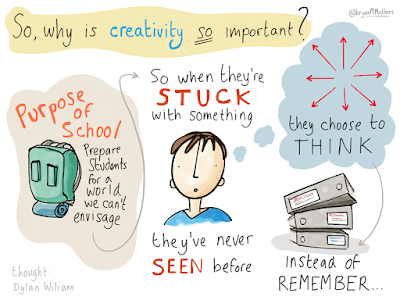
Creativity is a core building block in education. It affects how students think and turns learning from simply remembering facts into a fluid connection to the learning. When looking at it through the lens of school, creativity means a student's ability to come up with new and valuable ideas, solutions, or tasks. This often involves thinking outside the box, using their imagination, and being willing to take risks and try new things. It empowers students to think differently, look at problems from all perspectives, and create original answers that strengthen their connections to the learning. 

Image retrieved from here

Creativity helps prepare students for the future. In our ever-changing world, the ability to adapt, innovate, and solve problems creatively is essential if the students we teach today are going to find success tomorrow. Creativity improves learning outcomes when the learning is engaging, meaningful, and relevant. This is the catalyst to keeping our students motivated as it provides the opportunities needed to deepen their connections to the new learning.

In the past, literacy was seen as a foundational set of reading, writing, and counting skills. The 21st century has transformed this thinking to meet the demands of an increasingly digital, interconnected, and information-rich world. UNESCO defines literacy as a continuous process of learning and proficiency in reading, writing, and using numbers throughout life. This encompasses the ability to identify, understand, interpret, create, and communicate information effectively in a rapidly changing global environment. This leads to a deeper comprehension than simply processing words and phrases at a linguistic level.

The article 'What is creativity in education?' by Tim Patston, retrieved from the The Education Hub, states that 'Creativity is producing something new, relevant and useful to the person or people who created the product within their own social context.... Something that is very creative to a Year One student – for example, the discovery that a greater incline on a ramp causes objects to roll faster – would not be considered creative in a university student.... Creativity is valuable in education because it builds cognitive complexity... it relies on having deep knowledge and being able to use it .... with an existing set of knowledge or skills... to increase both knowledge and skills. It develops over time and is more successful if the creative process begins at a point where people have at least some knowledge and skills'. The sentence in bold is the one that resonates most with me when I apply it to my structured literacy context. I refer back to my previous post where I explain how we are using creativity to build on the known.

Nicole Krueger's ISTE blog post from 2022 states that creativity motivates kids to learn because 'when students are focused on a creative goal, they become more absorbed in their learning and more driven to acquire the skills they need to accomplish it'. This post reaffirms my initial thinking that we need to continue to harness the digital affordances a 1:1 chromebook class has to offer as we navigate our structured literacy journey by stating that 'teachers who frequently assign classwork involving creativity are more likely to observe higher-order cognitive skills — problem solving, critical thinking, making connections between subjects — in their students. And when teachers combine creativity with transformative technology use, they see even better outcomes'.

This deep research has allowed me to gain a deeper understanding of my topic. I will be continuing my journey to explore the importance of creativity in learning in my next post. 


Monday, 24 March 2025

Teaching as Inquiry 2025...


Click here to see how I align my inquiry with the Manaiakalani framework.

“Recognising and spreading sophisticated pedagogical practice across our community so that students learn in better and more powerful ways...”

The Manaiakalani Community of Learning is working together on this task using the expertise existing in of our community of learning. 


Labels:

LEvidence, LScan, LTrend, LHypothesise, LResearch, LReflect,
CPlan, CTry, CInnovate, CImplement, CReflect,
SPublish, SCoteach, SModel, SGuide, SFback, SReflect

Wednesday, 6 November 2024

Exploring Quantitative Data...


To measure the difference our syndicate focus on effective reading planning has made, I have analysed the achievement shifts of our students who achieved 'below' in the PAT Panui / Reading comprehension assessments at Time Point 1 (TP1), and were present for the Time Point 2 (TP2) assessments. The graphs show a decrease in 'below' levels across the syndicate. These shifts across the year groups are illustrated in the graphs in the DLO above. To unpack this further I have analysed the GAP analysis completed by each class teacher. Due to the need to maintain privacy I will not be sharing these docs as students and teachers are easily identifiable. 

Possible reasons for students with no shift or a shift backwards:
  • IEP
  • Erratic attendance
  • Behaviour
  • Limited connections to the learning
  • ESOL funded
  • Disconnect with language of questioning
  • Low level text comprehension
  • Low self efficacy
  • Overthinking the challenge
Continued absence from school prevents strong connections to the learning being made. These students are still learning to read and a lack of continuity means their cognitive load has increased as the gaps in their learning have widened and they have not been able to capitalise on the supports put in place for them. 

A lack of focus during learning time often results in learning has been impacted. Students who are off-task are not engaged in their learning tend to fall even further behind as the gap widens, causing already low levels of self efficacy to become an even bigger hurdle to get over. Low self efficacy also brings about the fear of failure, something often masked with a reluctance to participate and engage in the learning. 

Students with an IEP, or who are ESOL funded, often have disconnects with the language of questioning and low level text comprehension due to their limitations in gaining meaning from text at a higher than normal level. Removal of additional learning support or the opportunity to collaborate in testing situations, are also factors to be considered here as the reality of having to rely on the underdeveloped independent working skills leads to self doubt. In turn this leads to overthinking and/or not knowing how to access and apply the strategies needed to gain meaning. 

Possible reasons for no shift or a shift backwards linked to teacher practice:
  • Students not being taught at the right level
  • Teacher content knowledge not a strength
  • Limited opportunities for differentiation
  • Links to writing not planned for
  • Learning Intentions and Success Criteria not being unpacked or linked directly to the learning
  • Text choice
  • Limited opportunities for discussion
  • Create opportunities too limited
  • Reading To missing
  • Shared Reading missing
  • Reliance on 'safe' and 'known' comprehension strategies
  • No opportunities to reflect on own fluency
  • Multimodal opportunities present in only some classes
  • Syndicate created comprehension scaffolds used and displayed in some classes
 

Year Group

Shift backwards 

No shift

Shift

4

13.3%

26.6%

0

5

6.5%

13%

6.5%

6

0

6.3%

9.4%

7

0

7%

14%

8

0

7%

14%


Time Point 1 achievement data was the catalyst behind the introduction of the Manaiakalani Reading Pillars of Practice (MRPP) as a framework to align our reading planning with. Through observations, appraisal discussions and planning feedback I noticed areas in our practice that were strong and the areas that needed strengthening. These are illustrated below in the TP1/TP2 reading planning analysis. After the TP1 planning analysis had been discussed both with the team and individually we set ourselves both syndicate and individual focuses. As with the data above, anonymity has been respected so classes and teachers have not been identified.

Shift in effective teacher practice between TP1 and TP2:
  • Data analysed effectively to support group learning needs
  • Teacher content knowledge strengthening
  • Text choice strengthened
  • Text structure and vocabulary focus introduced in all classes
  • LI/SC align with syndicate co-created LI/SC to promote shared language of instruction
  • A wider variety of reading comprehension strategies being explicitly planned for
  • Multimodal opportunities present in 4/5 classes
  • Explicit links between student achievement data, long term plans and guided reading plans
  • Wide variety of questioning being used
  • Questioning linked to comprehension strategies
  • Syndicate created comprehension scaffolds used and displayed in all classes
  • Planning is moving from being done for compliance to be done for a purpose.


Adopting the Manaiakalani Reading Pillars of Practice as a guiding framework has directly benefited our students by empowering our team of teachers with the knowledge and tools to improve instruction. This shared understanding has facilitated our collaborative learning journey, and highlighted the importance of using data to inform our planning to help us meet the learning needs of the students in our classes.


Tuesday, 5 November 2024

Exploring Qualitative Data...

This qualitative evaluation explores the impact of the Manaiakalani Reading Pillars of Practice (MRPP) on reading planning, teacher practice and capability, and student achievement within our school context. Capability, defined as the ability to effectively apply knowledge and skills to achieve desired outcomes. By aligning our planning to the MRPP has helped strengthen teacher capability and enhance reading instruction for our Year 4-8 teachers. In turn this has helped accelerate shift in student achievement in Reading.

To do this I analysed both long term planning and guided reading lesson plans with the time point 1 student achievement data in mind. Learning conversations with teachers allowed us both to explore their perceptions of what was needed to help all our students find success in reading. This process fostered a shared understanding of effective reading instruction within our team and promoted a cohesive approach where our thinking is more aligned. It allowed us to introduce mini PLD sessions that explored and unpacked comprehension strategies and the need for an aligned shared language of instruction in our team meetings. We co-constructed learning intentions, scaffolds and group norms. Using these resources helped us strengthen the questions we asked to ensure we were introducing our students to a wider variety of comprehension skills and providing them with increased opportunities to apply these skills in context both independently and collaboratively through discussion.

The MRPP has provided a clear framework for aligning long-term and short-term planning with evidence-based practices. The use of student achievement data alongside this has facilitated a shift from compliance-based planning to purposeful instruction. This shift has resulted in teachers moving away from simply falling back on the known to actively considering the specific needs of their students and tailoring instruction accordingly. 

                                                                Round Table Meeting Icon ...

This process has introduced opportunities for rich professional conversations to take place. Additionally it had provided opportunities for best practices to be shared and both syndicate wide and individual areas that need strengthening to be identified. Using the Manaiakalani Reading Pillars of Practice has provided us with a clear framework for planning and instruction. This has as previously mentioned, reduced ambiguity, strengthening teacher confidence and has helped to put us all on the same page. From a leadership perspective this process has been the stepping stone we needed to engage in rich professional conversations where both successes can be identified, hard messages given and clarity of where to next co-constructed.

Use of a gap analysis has helped us to tailor instruction to meet individual learning needs of the tamariki in our own classes. Embracing change by beginning to multimodal text sets has provided our students with more opportunities to engage with and unpack the texts in front of them. We still are still on a journey but with a stable staff going forward we have the advantage of having already taken the first steps towards change.

The implementation of aligning our planning with the Manaiakalani Reading Pillars of Practice has had a positive impact on teacher capability and student achievement. It has provided us with the common ground needed for professional collaboration, and has highlighted the importance of implementing the data-driven planning decisions around our syndicate wide focus on the comprehension strategies. 


Tuesday, 23 July 2024

Teaching as Inquiry 2024


Click here
 
to see how I align my inquiry with the Manaiakalani framework.

“Recognising and spreading sophisticated pedagogical practice across our community so that students learn in better and more powerful ways...”

The Manaiakalani Community of Learning is working together on this task using the expertise existing in of our community of learning. 


Labels:

LEvidence, LScan, LTrend, LHypothesise, LResearch, LReflect,
CPlan, CTry, CInnovate, CImplement, CReflect,
SPublish, SCoteach, SModel, SGuide, SFback, SReflect

Friday, 19 July 2024

Looking at the Research...

Professional learning development (PLD) refers to the ongoing process through which educators acquire the knowledge, skills, and attitudes necessary to be effective in their roles. To support the reasons behind this inquiry I have looked at the research to further inform my thinking. The notes below are written are summaries of the key points I took from these readings.

Teaching is a complex and demanding profession that requires ongoing, high-quality support and training. Professional learning and development (PLD) is essential for maintaining and improving teacher quality, with the primary goal of enhancing classroom practices. In 2009, schools faced challenges in allocating enough time to fully integrate new practices, which frustrated teachers.

In New Zealand, publications like the Ministry of Education’s Best Evidence Synthesis (BES) and John Hattie's work highlighted the importance of teacher quality in improving student achievement. Professional learning encompasses what teachers have learned from formal development and the informal knowledge they gain through feedback, discussion, reflection, and action. Effective PLD is diverse, linking directly to classroom practice to ensure practical application.

Principals who were actively involved in the learning process, participating as learners themselves, facilitated professional discussions with staff based on shared knowledge. Teachers felt more committed to changes when included in decision-making and valued opportunities for professional discussions, idea sharing, observing peers, and giving and receiving feedback. This interaction influenced their thinking and led to improvements in teaching practices. - Managing Professional Learning andDevelopment in Primary SchoolsJanuary 2009

Professional development (PD) for teachers should be practical, relevant, and fit into their busy schedules. It should empower teachers to lead in curriculum development and confidently manage classroom demands with confidence. PD must address teachers' needs, fostering collaboration and reflection. The most effective PD values teachers' experiences and offers ongoing support. When teachers are at the centre of PD, they more easily become reflective and transformative professionals capable of shaping curriculum and education policies. - Empowerment . . . through professional development set 1997: no. 1

With the belief that abilities are set in stone, individuals with a fixed mindset might not invest in continuous learning or skill development. This can lead to stagnation, where they find themselves left behind in rapidly evolving fields or areas of life.- Growth vs. Fixed Mindset: The Implications for Leadership and Innovation . 

Further Reading:

Wednesday, 1 May 2024

Qu. #2 - Why we judge this to be the most important and catalytic issue of learning for this group of learners this year...

Achieving accelerated shift in Literacy was identified as being one of the most important and catalytic issues of learning facing our students in Y4 - 8, this year, when the time point one data was analysed. Exploring how learning gained from professional development is helping to strengthen teacher practice and achievement in literacy is something I haven't looked at before so I am looking forward to sharing my findings.

As I am not looking specifically into my own practice it is important to maintain anonymity. This inquiry is a syndicate wide focus and therefore not a focus on individual teachers. Our starting point with professional development linked to Literacy undertaken by the senior syndicate (Y4-Y8) in the 2023/24 period consists of:

  • In Class Support (ICS) 2023
  • Reading Program Intensive 2023 teacher/mentor meetings and observations 2023
  • T Shaped Literacy 2023
  • The Code 2024
  • In Class Support (ICS) 2024
  • PRT Y1/2 teacher/mentor meetings and observations 2023/24

To measure the shift I needed clear picture of where our student's starting points were. What to collect for baseline data was something I struggled with as I couldn't decide on the best way to do this. Like many faced with a direction conundrum, the task ahead found its way to the 'I'll do it later basket'. My problem was 'later' became a hard time to find. I knew I needed help and today that help came in the form of Amy Tofa and Matt Goodwin. 

I explained my inquiry focus and together we came up with a way forward that made sense to me. A really useful piece of advice here is to talk to your colleagues as saying things out loud and getting a 2nd opinion, or 3rd in my case, is one of the most valuable resources we can tap into. Amy pointed out to me that the picture I was trying to capture was huge and suggested I focus on one group of students. I am 100% taking her advice to focus on our students who scored 'Below' on our beginning of year literacy assessments.


The data above shows the percentage of our Year 4 -8 students who scored Below expectation on the PAT Reading Comprehension and e-asTTle assessments. I will be using this data to measure the shift made between the two cluster wide assessment timepoints in my target group. 


Sunday, 5 November 2023

Exploring Qualitative and Quantitative Data...

Each slide below contains the comparative data gathered from time point 1 and time point 2. Underneath the graphs I have analysed the shifts in more detail. It is important to note here that I have only analysed the data gathered from the 15 students in my literacy group that present both data collection times.


What I noticed as a result of my intervention was that once the knowledge of simple rules and/or conventions of spelling was in place, the challenge element was lost. If I wanted the momentum to continue I quickly realised I needed to adapt and change my thinking and my approaches.

As mentioned in my previous post, the fear of spelling a word wrong or choosing a simpler word seemed to have been left behind as the desire to use the words was more powerful. The learning became about the words and not the hurdles that prevent them from being used. The more I used these words, the more my students used them. Being confident to use and apply more sophisticated vocabulary in context accurately became the norm. My expectations were clear and I noticed that as my student's confidence grew the higher my expectations became. The exciting part was the students took ownership of this challenge and regularly helped each other find the words to use to shift responses to the next level. Student created and driven tally charts evolved as a way of monitoring that everyone had used their word twice, with the others in their group prompting those who had not met daily challenge. 

An interesting observation with the word gifting strategy was when I physically gave my students a piece of paper with their word on it, the ownership and connection to that words was much stronger than when we used a randomiser wheel to select our words. I feel this was because the words on paper could be physically touched, seen and used. Making the gifted words digital made them more abstract. Maybe this was a step too far too quickly, as looking back we overlooked the consolidation step. 

Student voice gathered at both TP1 and TP2 and collated in the DLO above, allows for a comparison of student voice and attitudes towards spelling. To collect this data we used a Google Form survey to get to know our class as spellers. I have edited the original survey responses to reflect those only from my focus group who were present at both time points.

The comparison between the two timepoints (all analysed in the DLO above) shows there are some positive shifts happening in mindsets but when looking closely at how my learners see themselves I see we have a long way to go. This is possibly due to the historical belief that I can't spell it so I won't use it, ESOL obstacles and a fear of getting it wrong. This will definitely take more than a year for change to cement itself, but as we close our 2023 learning journey's deep dive into word consciousness, I feel confident we have laid some strong foundations to build on.