Showing posts with label Inquiry 2024. Show all posts

Thursday, 21 November 2024

Bursts and Bubbles 2024...

My inquiry this year has had many twists and turns. Achieving accelerated shift in Literacy was identified as being one of the most important issues facing our Y4 - 8 team, this year, when the time point one data was analysed. What began as an inquiry into how learning gained from professional development was helping to strengthen teacher practice and student achievement in literacy, completely morphed into the one you can see on the screen behind me. Why? Because it simply wasn't working.

The effect of staff changes on PLD is something I hadn't initially taken into consideration and I found myself going round in circles. I began my journey by trying to ensure we were all on the same page. I knew consistency and a shared language of instruction would help our students to make the connections they need to be able to access their learning with confidence and understanding.

This wasn’t about disregarding what my team brought to the table, but rather about aligning our thinking. However, as we were all coming from such different places, both literally and in knowledge gained from recent PLD, I hit a wall I couldn’t get over.

Midway through the year I spoke to Naomi Rosedale to get her advice on why this wasn’t coming together for me. To be honest, by this time I had pretty much lost interest as I was going round in circles. It’s amazing the power one conversation can have. I left totally reinspired with a completely new inquiry focus and my new best friend, the Manaiakalani Reading Pillars of Practice sitting comfortably in my Google drive. Aligning what I was looking for with the Pillars of Practice was the lightbulb moment I needed. In Term 3 I used the pillars to look closely at what and how we, that is my team and I, were actually teaching the tamariki in front of us, in our reading lessons. Time point one data analysis helped me gauge whether or not the learning planned met the learning needs. To allow for consistency, I took the stance that if it wasn't in the planning it wasn't happening. The follow up discussions were both rich and gave all of us the clarity we needed to help us move forward in our quests to meet the learning needs of our individual classes. This process was repeated in Term 4 and Time point 2 data analysed alongside it. What I noticed was with a shared understanding and stronger knowledge of why we need to make changes, changes had been made. These findings and the student shift we are celebrating are all explained in detail on my blog. Changing my inquiry focus has allowed me to introduce change in a manageable and achievable way. Mindsets where planning is concerned, have moved from compliance to purpose, something I struggled to initially get buy in from. I feel that looking closely at my own planning put us all on an even playing field. Having a framework allowed us to all learn together but at our own pace. The big message I want to share here is that change is good, it should be embraced and we should not be afraid to walk in a different direction if what we have tried is not working.


Wednesday, 6 November 2024

Exploring Quantitative Data...


To measure the difference our syndicate focus on effective reading planning has made, I have analysed the achievement shifts of our students who achieved 'below' in the PAT Panui / Reading comprehension assessments at Time Point 1 (TP1), and were present for the Time Point 2 (TP2) assessments. The graphs show a decrease in 'below' levels across the syndicate. These shifts across the year groups are illustrated in the graphs in the DLO above. To unpack this further I have analysed the GAP analysis completed by each class teacher. Due to the need to maintain privacy I will not be sharing these docs as students and teachers are easily identifiable. 

Possible reasons for students with no shift or a shift backwards:
  • IEP
  • Erratic attendance
  • Behaviour
  • Limited connections to the learning
  • ESOL funded
  • Disconnect with language of questioning
  • Low level text comprehension
  • Low self efficacy
  • Overthinking the challenge
Continued absence from school prevents strong connections to the learning being made. These students are still learning to read and a lack of continuity means their cognitive load has increased as the gaps in their learning have widened and they have not been able to capitalise on the supports put in place for them. 

A lack of focus during learning time often results in learning has been impacted. Students who are off-task are not engaged in their learning tend to fall even further behind as the gap widens, causing already low levels of self efficacy to become an even bigger hurdle to get over. Low self efficacy also brings about the fear of failure, something often masked with a reluctance to participate and engage in the learning. 

Students with an IEP, or who are ESOL funded, often have disconnects with the language of questioning and low level text comprehension due to their limitations in gaining meaning from text at a higher than normal level. Removal of additional learning support or the opportunity to collaborate in testing situations, are also factors to be considered here as the reality of having to rely on the underdeveloped independent working skills leads to self doubt. In turn this leads to overthinking and/or not knowing how to access and apply the strategies needed to gain meaning. 

Possible reasons for no shift or a shift backwards linked to teacher practice:
  • Students not being taught at the right level
  • Teacher content knowledge not a strength
  • Limited opportunities for differentiation
  • Links to writing not planned for
  • Learning Intentions and Success Criteria not being unpacked or linked directly to the learning
  • Text choice
  • Limited opportunities for discussion
  • Create opportunities too limited
  • Reading To missing
  • Shared Reading missing
  • Reliance on 'safe' and 'known' comprehension strategies
  • No opportunities to reflect on own fluency
  • Multimodal opportunities present in only some classes
  • Syndicate created comprehension scaffolds used and displayed in some classes
 

Year Group

Shift backwards 

No shift

Shift

4

13.3%

26.6%

0

5

6.5%

13%

6.5%

6

0

6.3%

9.4%

7

0

7%

14%

8

0

7%

14%


Time Point 1 achievement data was the catalyst behind the introduction of the Manaiakalani Reading Pillars of Practice (MRPP) as a framework to align our reading planning with. Through observations, appraisal discussions and planning feedback I noticed areas in our practice that were strong and the areas that needed strengthening. These are illustrated below in the TP1/TP2 reading planning analysis. After the TP1 planning analysis had been discussed both with the team and individually we set ourselves both syndicate and individual focuses. As with the data above, anonymity has been respected so classes and teachers have not been identified.

Shift in effective teacher practice between TP1 and TP2:
  • Data analysed effectively to support group learning needs
  • Teacher content knowledge strengthening
  • Text choice strengthened
  • Text structure and vocabulary focus introduced in all classes
  • LI/SC align with syndicate co-created LI/SC to promote shared language of instruction
  • A wider variety of reading comprehension strategies being explicitly planned for
  • Multimodal opportunities present in 4/5 classes
  • Explicit links between student achievement data, long term plans and guided reading plans
  • Wide variety of questioning being used
  • Questioning linked to comprehension strategies
  • Syndicate created comprehension scaffolds used and displayed in all classes
  • Planning is moving from being done for compliance to be done for a purpose.


Adopting the Manaiakalani Reading Pillars of Practice as a guiding framework has directly benefited our students by empowering our team of teachers with the knowledge and tools to improve instruction. This shared understanding has facilitated our collaborative learning journey, and highlighted the importance of using data to inform our planning to help us meet the learning needs of the students in our classes.


Tuesday, 5 November 2024

Exploring Qualitative Data...

This qualitative evaluation explores the impact of the Manaiakalani Reading Pillars of Practice (MRPP) on reading planning, teacher practice and capability, and student achievement within our school context. Capability, defined as the ability to effectively apply knowledge and skills to achieve desired outcomes. By aligning our planning to the MRPP has helped strengthen teacher capability and enhance reading instruction for our Year 4-8 teachers. In turn this has helped accelerate shift in student achievement in Reading.

To do this I analysed both long term planning and guided reading lesson plans with the time point 1 student achievement data in mind. Learning conversations with teachers allowed us both to explore their perceptions of what was needed to help all our students find success in reading. This process fostered a shared understanding of effective reading instruction within our team and promoted a cohesive approach where our thinking is more aligned. It allowed us to introduce mini PLD sessions that explored and unpacked comprehension strategies and the need for an aligned shared language of instruction in our team meetings. We co-constructed learning intentions, scaffolds and group norms. Using these resources helped us strengthen the questions we asked to ensure we were introducing our students to a wider variety of comprehension skills and providing them with increased opportunities to apply these skills in context both independently and collaboratively through discussion.

The MRPP has provided a clear framework for aligning long-term and short-term planning with evidence-based practices. The use of student achievement data alongside this has facilitated a shift from compliance-based planning to purposeful instruction. This shift has resulted in teachers moving away from simply falling back on the known to actively considering the specific needs of their students and tailoring instruction accordingly. 

                                                                Round Table Meeting Icon ...

This process has introduced opportunities for rich professional conversations to take place. Additionally it had provided opportunities for best practices to be shared and both syndicate wide and individual areas that need strengthening to be identified. Using the Manaiakalani Reading Pillars of Practice has provided us with a clear framework for planning and instruction. This has as previously mentioned, reduced ambiguity, strengthening teacher confidence and has helped to put us all on the same page. From a leadership perspective this process has been the stepping stone we needed to engage in rich professional conversations where both successes can be identified, hard messages given and clarity of where to next co-constructed.

Use of a gap analysis has helped us to tailor instruction to meet individual learning needs of the tamariki in our own classes. Embracing change by beginning to multimodal text sets has provided our students with more opportunities to engage with and unpack the texts in front of them. We still are still on a journey but with a stable staff going forward we have the advantage of having already taken the first steps towards change.

The implementation of aligning our planning with the Manaiakalani Reading Pillars of Practice has had a positive impact on teacher capability and student achievement. It has provided us with the common ground needed for professional collaboration, and has highlighted the importance of implementing the data-driven planning decisions around our syndicate wide focus on the comprehension strategies. 


Describe and Explain the changes/tweaks you have made in your practice along the way...

My inquiry this year has had many twists and turns. Achieving accelerated shift in Literacy was identified as being one of the most important and catalytic issues of learning facing our students in Y4 - 8, this year, when the time point one data was analysed. Exploring how learning gained from professional development is helping to strengthen teacher practice and achievement in literacy is something I haven't looked at before so I began with one idea which over the course of the year has completely morphed into another. Not because as I mentioned in an earlier post, because it was unachievable, but because my initial idea simply wasn't working. The effect of staff changes on PLD is something I hadn't initially taken into consideration. What began as an inquiry into how we (PBS) are using PLD to accelerate shift across our school' and over the course of the year required a change of tact to inquiring into how are we building and strengthening our capability in raising student achievement outcomes in Reading for years 4-8 at PBS.

I began my journey by trying to ensure we were all on the same page. Consistency and a shared language of instruction help our students to make the connections they need to be able to access their learning with confidence and understanding. At the start this wasn't about paying no regard to the skills and knowledge my team brought to the table but rather to align our thinking. This is explained in detail with examples in an earlier blog post. This wasn't as successful as I hoped as we were all coming from such different places both literally and in knowledge gained from recent PLD, so it was back to the drawing board.

Changing Direction Icons - Free SVG & PNG Changing Direction Images - Noun  Project

After speaking with Naomi Rosedale, I realised I needed a new pathway forward, a pathway that included a framework that would bring everything together and provide clarity. Aligning what I was looking for with the Manaiakalani Reading Pillars of Practice (MRPP) was the lightbulb moment I needed. In Term 3 I used the MRPP to look closely at what and how we, my team and I, were actually teaching the tauira in front of us in our reading lessons. I looked at the data and used the initial gap analysis to help me gauge whether or not the learning planned matched the student needs. To allow for consistency I stood by my decision that if it wasn't in the planning it wasn't there. The follow up discussions were both rich and gave all of us the clarity we needed to help us meet the learning needs of our individual classes.

This process was repeated in Term 4. I am yet to complete all my follow up discussions but have them timetabled for later in the week. What I noticed was with a shared understanding and stronger knowledge of why we need to make the changes. All my team have now included multimodal text sets, are looking at the structure and language in the different text types and have put a lot of thought into the questions they are asking. There is definitely a growth in the use of our shared language of instruction, a wider variety of comprehension skills being accessed. 

Changing my inquiry focus has allowed me to introduce change in a manageable and achievable way. Mindsets where planning is concerned has moved from compliance to purpose, something I struggled to initially get buy in from. I feel that looking closely at my own planning has added the 'teacher model' element to the learning. By using the MRPP it has allowed us to all learn together but at our own pace. Sharing people's successes and valuing their ideas has afforded us opportunities to learn with and from each other. 

The big message I want to share here is that change is good, it should be embraced and we should not be afraid to walk in a different direction if what we have tried is not working. 

Wednesday, 28 August 2024

You can't help yourself if you can't see yourself...

Once again I'm tapping back to Jason Borland's thinking in our 2015 Manaiakalani Innovative Teacher's PLG where he stated that "You can't help yourself if you can't see yourself." This thinking resonated with me when I first heard it, and after following Jason's inquiry I have often repurposed this idea in the classroom but know it has reaches much further and wider than only our learners.

At the start of this term I asked my team to video themselves teaching a guided reading lesson. The idea was to help everyone to see what they were doing well and what they felt they could do in a different way. I made it clear this was for personal use only, I didn't want to see it and I definitely didn't want a written analysis of it. The only video I wanted to see was my own because I do the same as I ask my team to do. It also gives me a video to use as a resource if I need to model the process. All wanted was for everyone to take a moment to reflect on what they do in the classroom to help their learners connect to the learning. 

Initially this challenge was seen as something my team needed to do for me. However, this recording definitely wasn't for me, it was for them. Falling back on the phrase 'you can't help yourself if you can't see yourself,' was the game changer. Through observation opportunities I have been able to see each room first hand. I often record these observations for this purpose but after watching some parts together I imagine time plays a huge part in the decision to continue watching it in entirety or not. When challenged to watch and reflect in a safe way, the table below identifies areas from our team discussion that we need to strengthen. 


This picture is real and as is it co-constructed there is an element of ownership that we can all capitalise on to make the changes needed in our practice that will help accelerate student achievement.

Where am I at and how will I measure this?...

As my inquiry has now taken a new direction I needed to collect an additional set of time point 1 (TP1) data that can be used at the end of the year to provide evidence of shifts in teaching. As this is for inquiry purposes the information needed to be formative. It needed to identify our current strengths as well a identifying our areas for development. The Manaiakalani Reading Pillars of Practice (MRPP) matrix has helped me do exactly that.

After analysing my reading planning against the MRPP with Toreka, the next step was to work together to analyse her reading planning. On this occasion I took the lead but asked her to step in if I needed to relook at something. Again a rich conversation was had and a clear picture of where she is at captured. I then repeated this process with the rest of my team.


The feedback was really positive and discussions had were rich and honest. I think the high levels of trust play a huge part in this process and I want to thank my team for their parts in these conversations. This process fully was transparent and I openly shared my matrix with my gaps clearly identified. I think this helped in strengthening the buy in as it wasn't about finding out right and wrong but rather finding out where our areas of strength and areas to strengthen were. The latter have since become part of our co-constructed team PLD plan going forward.


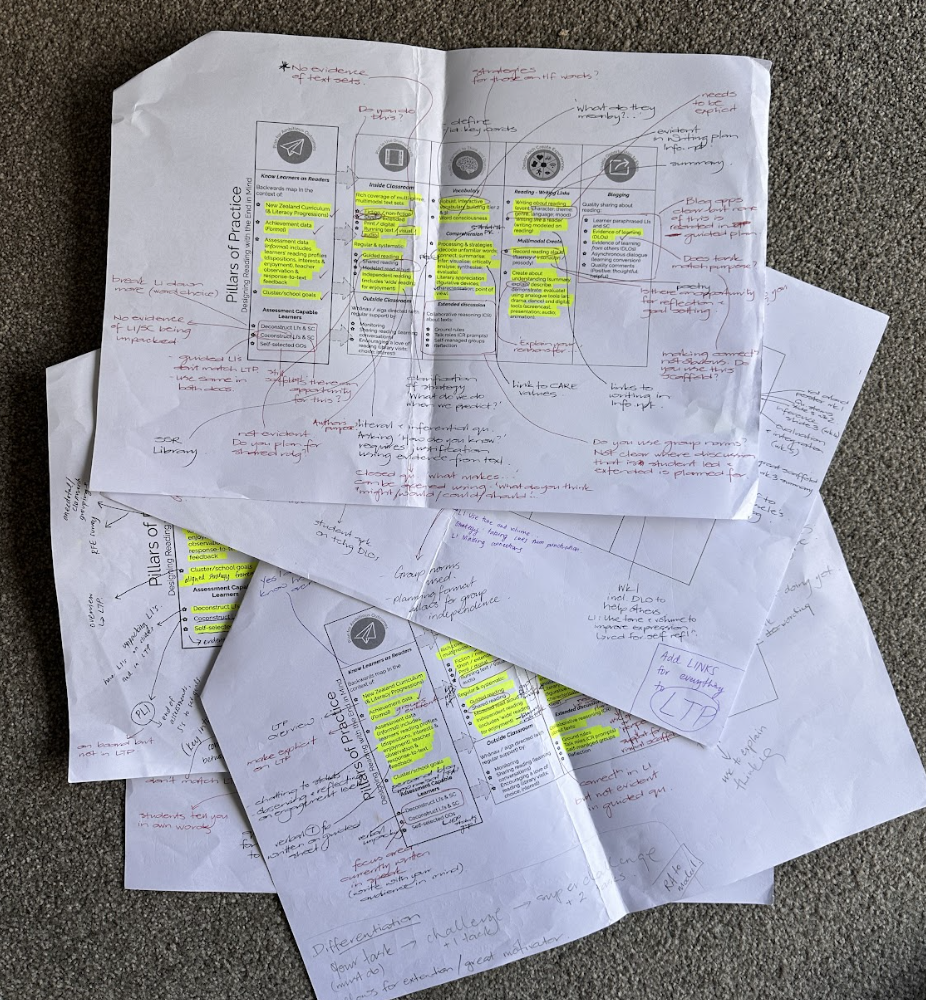
The matrix for all initial discussions was very much a working document (see image above). This gave me an opportunity to identify what I saw in the planning and my team to talk to it. Sticking firmly to the idea that 'if it wasn't in the planning it wasn't there', allowed for consistency across the board but it didn't mean I didn't listen. Using pen and paper on this occasion meant any adaptations made were clearly visible to both of us. The part of this process that I really liked was being able to celebrate and sometimes point out, people's successes. I found that by doing this first the door was opened for those more challenging conversations to take place. 

The presentation below is the formalised version of these conversations. Each teacher has their own digital copy that identifies areas of strength, areas to strengthen and next steps.

From the perspective of team leader, I now have a clear and visual picture of where we are at and what it is we need to do to help accelerate shifts in student achievement in reading. 

Stocktake of my Inquiry...

My inquiry this year has been to say the least, challenging. Not because it is unachievable, but because my initial idea just wasn't working. I had several attempts at exploring the effect of our recent Reading PLD on student achievement but soon found out this wasn't going to work as my team are are all coming at this from different places. The PLD I have had differs greatly from what the others have had. My biggest learning has been the realisation that something I think is a normal part of a lesson is not necessarily seen the same through the eyes of others. It was also a real eye opener to realise the effect of staff changes on PLD, something I'm sure all schools experience. 

After speaking with Naomi Rosedale at the last COL meeting, I realised I needed to make some changes. Once I had worked out my new pathway forward things began falling into place. I had a plan and had begun putting that plan into place, but what was missing was the framework to bring everything together. Naomi suggestion was that I align what I was looking for with the Manaiakalani Reading Pillars of Practice. That was the lightbulb moment I needed.

Light Bulb Moment Icons - Free SVG & PNG Light Bulb Moment Images - Noun  Project

Last year two of my team took part in the Reading Program Intensive (RPI) and although I didn't, I did join them in their journey through my role as a mentor. As a mentor I didn't get the explicit introduction to the Manaiakalani Reading Pillars of Practice (MRPP) so I needed to strengthen my connections. I did this by reversing the roles. This time it was me in the learning seat and Toreka in the mentor role, and turned into one of this richest learning conversations I have ever had. 

Together we analysed my long term reading plan and one randomly selected example of a guided reading plan against the MRPP.  As we unpacked each section I could see a clear picture of where my successes were and where my gaps were. Toreka was far more generous than me with this process. She kept saying 'I know you do this, I've seen you do it...' but I was of the opinion that if it wasn't in the planning it wasn't there. That decision allowed for consistency when I repeated the process with my team's planning.


The image above is the result of my conversation with Toreka. I'm sure to anyone looking at the writing all over the MRPP matrix it will look chaotic, but to me it's a rich summary of observations made, explored and discussed. I think what I liked the most in this process is that it is a true picture of my strong belief that we learn best when we learn with and from each other.

Tuesday, 23 July 2024

Causal Chain - mapping my inquiry...

As a part of the Manaiakalani Kahui Ako we are challenged to think about what we want to achieve then work backwards to map our steps. This is called a causal chain and is the logical thought process we follow to help us stay focused on on track throughout the entirety of our inquiries.


A causal chain is when a cause leads to an effect and that effect becomes the cause of another effect - A leads to B. B leads to C. C leads to D...start from D and work backwards Any intervention you design will (consciously or not) be based on a causal chain you have in mind - this is your theory of action.... To really understand deeply how teaching (as a cause) leads to a valued student outcome (effect), we need to know about more than just the first cause in the chain and the final - we need to know about each link.' - Dr Aaron Wilson


Teaching as Inquiry 2024


Click here
 
to see how I align my inquiry with the Manaiakalani framework.

“Recognising and spreading sophisticated pedagogical practice across our community so that students learn in better and more powerful ways...”

The Manaiakalani Community of Learning is working together on this task using the expertise existing in of our community of learning. 


Labels:

LEvidence, LScan, LTrend, LHypothesise, LResearch, LReflect,
CPlan, CTry, CInnovate, CImplement, CReflect,
SPublish, SCoteach, SModel, SGuide, SFback, SReflect

Monday, 22 July 2024

Implement and Try #1...

I am a firm believer when it comes to the effectiveness of professional learning development (PLD) is that when a team walks the journey together it becomes a journey that has life. PLD done alone or in isolation is much harder to keep going as there is no one to bounce ideas off, share successes, problem solve when it doesn't quite go to plan or to keep you on track.

With new team members there is always the challenge of getting everyone on the same page. With this thinking in mind at the end of Term 1 I got my team together and suggested the idea of an 'in house' literacy PLD day. In my team leader role I spend time in each room coaching and supporting my team in their literacy practice. This traditionally was always on a 1:1 basis which meant I wasn't using my time effectively and ended up repeating myself a lot. We all agreed to use a CRT day, and despite the logistical nightmare of ensuring everyone was released on the same day, we went ahead with the full support of our management team. 

With a wide range of teaching experience in my team I chose to start at the beginning by looking at how we are using the data to inform our planning through to the scaffolds and words we are using in front of our tamariki. You learn better when you physically do the task so I asked my team to see the learning through the eyes of our learners by taking them through the lessons. This provided us with clarity, a shared understanding of what procedural writing looked like and how to use the strategies I was sharing in context. I would like to take this opportunity to thank my team for approaching the day with open minds and a willingness to actively participate.

The DLO below shows what we covered. Some links are restricted to keep student anonymity. The aim of the day was to set us up for success in Term 2 by leading a guided planning session for the first three weeks of literacy. 


As with anything you try for the first time there is always an element of risk. I didn't want to undervalue what my team was bringing to the table but I did want to streamline our process by helping everyone make connections to our 'why' as well as our 'how'. 

At the end of the day I asked my team what their takeaways were. Their anonymous responses are below:

Teacher A 

  • How explicit things are if you show and tell - you learn by doing it
  • Foundational basics are important
  • Refer back to the data
Teacher B
  • How to unpack a text type - going back to basics
  • Tapping into prior knowledge and data
  • Gallery walk
  • Working in pairs
  • The power of talk
Teacher C
  • Prior knowledge shows me what the students already know
  • How to model explicitly eg- time connectives
  • How we can combine reading and writing together - integration
  • What to focus on when you teach a text type
  • How to use the data

    Teacher D

    • Going back to basics
    • Integration of planning
    • Clarity in planning transfers to the lesson
    • How to use the data

    As you can see the responses were different as we connect best to what resonates with us and what we needed to learn or be reminded of. Going forward as a team we have decided to continue with this type of PLD, only this time covered in our team meetings. It won't always be a literacy focus and it won't always be led by me. We have a great skills set in our team that we can tap into, after all we learn better when we learn together.

    Friday, 19 July 2024

    Looking at the Research...

    Professional learning development (PLD) refers to the ongoing process through which educators acquire the knowledge, skills, and attitudes necessary to be effective in their roles. To support the reasons behind this inquiry I have looked at the research to further inform my thinking. The notes below are written are summaries of the key points I took from these readings.

    Teaching is a complex and demanding profession that requires ongoing, high-quality support and training. Professional learning and development (PLD) is essential for maintaining and improving teacher quality, with the primary goal of enhancing classroom practices. In 2009, schools faced challenges in allocating enough time to fully integrate new practices, which frustrated teachers.

    In New Zealand, publications like the Ministry of Education’s Best Evidence Synthesis (BES) and John Hattie's work highlighted the importance of teacher quality in improving student achievement. Professional learning encompasses what teachers have learned from formal development and the informal knowledge they gain through feedback, discussion, reflection, and action. Effective PLD is diverse, linking directly to classroom practice to ensure practical application.

    Principals who were actively involved in the learning process, participating as learners themselves, facilitated professional discussions with staff based on shared knowledge. Teachers felt more committed to changes when included in decision-making and valued opportunities for professional discussions, idea sharing, observing peers, and giving and receiving feedback. This interaction influenced their thinking and led to improvements in teaching practices. - Managing Professional Learning andDevelopment in Primary SchoolsJanuary 2009

    Professional development (PD) for teachers should be practical, relevant, and fit into their busy schedules. It should empower teachers to lead in curriculum development and confidently manage classroom demands with confidence. PD must address teachers' needs, fostering collaboration and reflection. The most effective PD values teachers' experiences and offers ongoing support. When teachers are at the centre of PD, they more easily become reflective and transformative professionals capable of shaping curriculum and education policies. - Empowerment . . . through professional development set 1997: no. 1

    With the belief that abilities are set in stone, individuals with a fixed mindset might not invest in continuous learning or skill development. This can lead to stagnation, where they find themselves left behind in rapidly evolving fields or areas of life.- Growth vs. Fixed Mindset: The Implications for Leadership and Innovation 

    Further Reading:

    Mapping out my Hunches...

    Mastery, in the context of professional development, goes beyond simply acquiring new skills or knowledge. It's about achieving a deep understanding and proficiency in a specific area of your field. It's a continuous journey of improvement, fuelled by a desire to be able to use the new learning effectively. 

    If I think about myself in this situation. When I am introduced new strategy or concept in maths I usually switch off or shut down because I don't immediately understand what it is that I am being asked to do. Falling back on what I know and understand feels like a much safer option than been seen to 'fail'. It's not because I don't want to jump on the learning train, it's more that where maths is concerned, it takes time for me to process, understand and internalise the new learning. This differs greatly from my teaching buddy who has the ability to simply look at the new maths learning and somehow has the knowledge of how to use it and impart it with confidence. In maths she is a quick adapter and luckily for me is always happy to walk me through the new learning at a pace that works for me. As I said earlier it's not that I don't want to embrace the new maths learning, I simply just need more support to be able to make the shift in mindset and in practise. 

    To guide my direction and help me narrow my focus I asked my team:
    • What ideas from recent literacy PLD are you currently using?
    • How has this strengthened your program?
    • What encouraged you to make these changes?
    • How does the PLD help shift student achievement?
    • What stops you implementing new PLD?
    From their responses I have compiled a list of hunches as to the possible reasons why teachers why choose to embrace or not embrace PLD. Although in the infographic below these are numbered, they are not listed in order of importance.


    Thursday, 2 May 2024

    Qu 3: Building an accurate profile of students' learning - tools, measures and approaches...

    Students who have achieved at a level considered to be 'below' the level they should be, are approximately a year behind the level they need to be at to make sense of the new learning. These are the students who with encouragement, scaffolding and explicit teaching will often make the gains needed to reach expectation.

    Professional development empowers teachers with the skills to improve classroom practises, by introducing them to new learning which can make the changes needed in their practice to help strengthen the connections their students have to the learning. On occasions PLD is something that is simply attended so that a box can be ticked, but when embraced, can make a real difference. Sometimes despite having all the I's dotted and all the T's crossed shift does not take place. 

    The conversations that often follow these results tend to apportion blame towards the student.... We have all at one stage or another heard phrases like '...did not connect to the test...'didn't read the questions carefully'... 'ran out of time'... 'was having a bad day...' It is only in recent times that we have been hearing teachers truly reflecting on their practice. What excites me as a team leader is hearing teachers identify where the gaps are in their own practice, then actively explore ways to try and fill these gaps. It the teachers who see student shift as a collaborative journey who make the most difference.

    After the beginning of year data was collected and analysed at class level, this data was then shared at team level. As a group we celebrated our successes and looked at what teachers were doing in their classrooms to achieve these results. These strategies were then shared with examples that helped people see what it looked like in practise. Collectively we identified the support we would need to make both big and small changes in our practices, that would help to accelerate shift in all our learners, and together we formulated a plan that will help us get there.

    The tools/measures/approaches:
    • Planning 
      • Long term
      • Site DLOs
      • Shared format
    • Sharing time at syndicate meetings
      • 10 minute quick tips that can be used in literacy
    • Feedback from PLD and resources shared
    • Classroom observations 
      • linked to literacy
    • Peer observations
      • linked to literacy
      • noticing ideas that are working and are embedded in the program
    • Surveys
      • Teachers
      • Students - target group
    • Time point 1/2 data analysis

    Wednesday, 1 May 2024

    Qu. #2 - Why we judge this to be the most important and catalytic issue of learning for this group of learners this year...

    Achieving accelerated shift in Literacy was identified as being one of the most important and catalytic issues of learning facing our students in Y4 - 8, this year, when the time point one data was analysed. Exploring how learning gained from professional development is helping to strengthen teacher practice and achievement in literacy is something I haven't looked at before so I am looking forward to sharing my findings.

    As I am not looking specifically into my own practice it is important to maintain anonymity. This inquiry is a syndicate wide focus and therefore not a focus on individual teachers. Our starting point with professional development linked to Literacy undertaken by the senior syndicate (Y4-Y8) in the 2023/24 period consists of:

    • In Class Support (ICS) 2023
    • Reading Program Intensive 2023 teacher/mentor meetings and observations 2023
    • T Shaped Literacy 2023
    • The Code 2024
    • In Class Support (ICS) 2024
    • PRT Y1/2 teacher/mentor meetings and observations 2023/24

    To measure the shift I needed clear picture of where our student's starting points were. What to collect for baseline data was something I struggled with as I couldn't decide on the best way to do this. Like many faced with a direction conundrum, the task ahead found its way to the 'I'll do it later basket'. My problem was 'later' became a hard time to find. I knew I needed help and today that help came in the form of Amy Tofa and Matt Goodwin. 

    I explained my inquiry focus and together we came up with a way forward that made sense to me. A really useful piece of advice here is to talk to your colleagues as saying things out loud and getting a 2nd opinion, or 3rd in my case, is one of the most valuable resources we can tap into. Amy pointed out to me that the picture I was trying to capture was huge and suggested I focus on one group of students. I am 100% taking her advice to focus on our students who scored 'Below' on our beginning of year literacy assessments.


    The data above shows the percentage of our Year 4 -8 students who scored Below expectation on the PAT Reading Comprehension and e-asTTle assessments. I will be using this data to measure the shift made between the two cluster wide assessment timepoints in my target group. 


    Tuesday, 30 April 2024

    Qu 1: Student Inquiry Foci...

    With the Manaiakalani goals of achieving 1.5 years progress inside a year (big 3), improving teacher practice, increasing attendance and hauora in mind, Richard Johnston, (our principal), challenged me to look at 'How we (PBS) are using PLD to accelerate shift across our school'. Having inquired into my own practice for many years I was excited to embrace this much bigger school wide focus. However, when I sat down to map out the way forward I realised I could make more impact if I looked across my own team, the senior syndicate.

    To do this I am going to need to drill down into student achievement and teacher planning across our syndicate and look closely at how my team is using their new knowledge to change their practice and accelerate shift in student achievement in Literacy. To ensure this new learning becomes embedded within teacher practice we capture the journey via our appraisal system. This gives both myself as the appraiser and the teacher as the appraisee, a shared vision of how we can both contribute to their professional growth moving forward. It also means I can, to quote Russell Burt, capitalise on my role as our in school COL teacher to lead the teacher inquiry process to help 'build teacher and school capability in raising student achievement outcomes by linking evidence to practice.'

    When looking at our class data we already have processes in place that allow each teacher to identify where the gaps are and think about why these gaps might be there before we can begin to fill them. It is not about trying to fix everything but rather strengthen the areas that need the most focus. In our team we do this both individually at class level and collaboratively at syndicate level. It helps to identify the commonalities so that we can move forward together learning with and from each other along the way. I will share this process in my next post.

    My challenge now is to find out how I can capitalise on the learning gained from professional development undertaken by my team to help accelerate shift across our Year 4 - 8 classes. When I unpacked my journey forward I realised it's not about only strengthening teacher practice but also about how we can harness the creativity and power of our new learning to strengthen student engagement and spark curiosity in literacy.