Wednesday, 29 July 2020

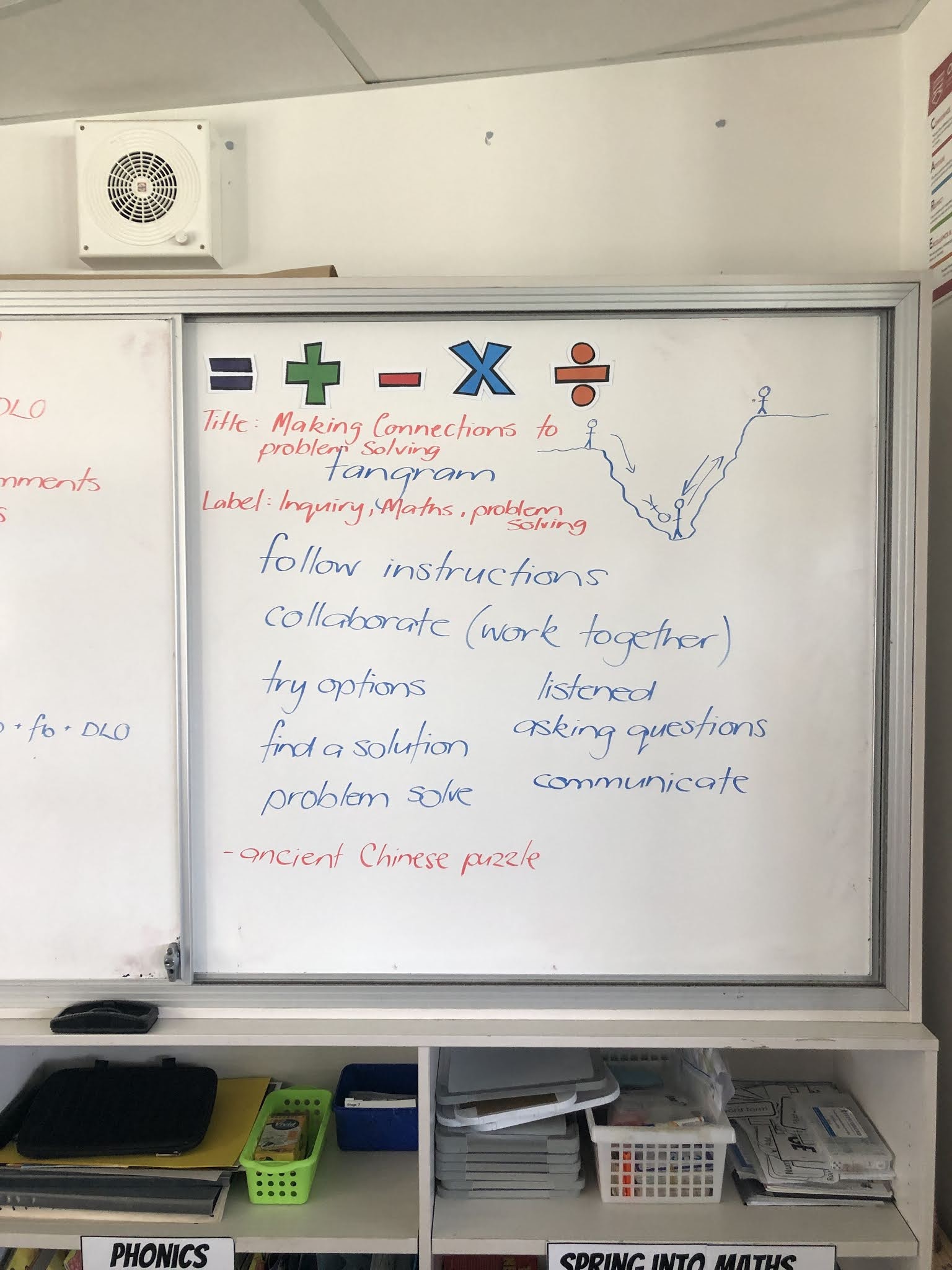
Making Connections to Problem Solving with Tangrams...

A small glitch with our internet connection this morning opened up a great opportunity to make the most of a teachable moment. Having been taken through the process of making my own tangram puzzle in a recent staff meeting I decided this was the perfect time to introduce this puzzle to LS1 and LS2. We had already come together as a block this morning for singing practise so decided to stay together for the learning experience, which meant we had a huge range of abilities as the students ranged from Y5 to Y8. There were no templates, no rulers, no pencils... just lots of smiling faces, blank pieces of A4 paper and lots of pairs of scissors. 

The instructions I gave were not written anywhere which gave me a great opportunity to remind everyone about the importance of listening carefully and asking questions. I made sure my instructions were explicit and found myself making folds and cutting along folded lines with my back to the class and my exemplar in the air, something far easier said than done! Along the way as each piece of the puzzle appeared I introduced the content language of 2d shapes so that each piece was referred to by the correct name and not 'this one' or 'that one'. 

Our students are really good at collaborating so without being asked I noticed my class immediately stepped up to support the younger ones. This learning experience was a very loud one as I encouraged everyone to talk to each other about what they needed to do at each step. Interestingly we only had two puzzles that needed to be remade. 


Organisation was one of the keys behind the success of the 'making' task and as we were using the content vocabulary collecting the offcuts was a breeze. Once all the pieces had been cut I asked everyone to mix up their puzzle (something quite hard to model in the air!) and put the pieces back together to make the original square. This is when the real conversation happened. There was a wealth of problem solving strategies being used so I took advantage of this and unpacked it further. 


After morning tea we all came back to take part in the 'fun' challenge component. Greg Wong took the students who had made their tangrams through the challenges of creating animals from the shapes while I helped the group who had been at puberty talks to make their tangram. Team teaching was then the order of the day with Greg explaining the history behind the puzzle and me process of problem solving. As a result we were all able to make connections not only to the content but also to the origin of the puzzle and the process of problem solving. The blog posts from both classes reflect the learning, the fun and the content language that was revisited today.

Monday, 27 July 2020

Professional Development: Overview of a balanced Reading program...

Last week Panmure Bridge School and Glen Taylor School had a fantastic professional development TOD lead by Sheena Cameron and Louise Dempsey. We explored and unpacked the modelled, shared, guided and independent reading approaches, with lots of great practical ideas shared that I am excited to introduce into to my reading program. Here is the link to my notes.

Some of the key ideas we explored:
  • Explicit teaching of reading is important at all levels
  • Summary, main ideas, evaluate, justify, connections, synthesising
  • Must be teaching reading across the curriculum
  • Becoming a proficient reader means decoding, self monitoring, critical thinking, evaluating
  • Self monitoring means knowing what words mean, decoding and making meaning
  • It is not ok to not understand
  • Give a picture of the word to help students make connections and move to making meaning not simply decoding without understanding
  • Think, talk, elaborate
  • We read to students to:
    • Encourage opportunities to focus and notice vocab, language or key points
    • Gift the time to think about the complexities of a text - comprehension
    • Modelling think alouds - what fluent reader do to make meaning
    • Develop a passion for reading
    • Give information
    • How words join together
My Takeaways:

                                             
(Images from The Literacy Place presentation)
  • Introduce 'tricky words'
  • Encourage students to use sticky arrows to find the example or evidence or identify tricky words
  • Introduce post its as ‘stoppers’ to avoid reading ahead in guided sessions
  • Y7/8 need attention to prefix and suffix - use white boards to add suffixes and prefixes to build words from a root word (find these in the comp. book)
  • Think/pair/share...think/pair/record
  • Shared Reading: 
    • Teacher models reading but students must be able to see the text (words)
    • Exposes students to a variety of texts (their reading diet is limited due to skill level being limited)
  • Encourage students to build on from each other's ideas by saying “I’d like to add to that because...”

Wednesday, 1 July 2020

A great way to build connections to Maths vocabulary...

Here's another game shared with us by Marie Hirst, our maths professional development provider. This game is found on the Transum site and is called 'Maths Words'. The idea is that one student stands with their back to the class while the maths word is generated. Once everyone else has seen the word the student turns around and uses the clues provided by their peers to try to work out the word in question. This is a great way for students to unpack and strengthen their connections to the vocabulary as they offer clues without actually using the word.


When I tried this with my group today it wasn't the success I had hoped. I think my students were too shy to offer clues in front of so many people. Rather than stop the game I adapted it on the spot by asking the students to get into groups of three. Once they had done that we split the roles so that one person was guessing the word and two people were giving the clues. I encouraged my students to have Maths Dictionary open to help them define the words generated and derive their clues. This was a huge success!


What I noticed is that my learners do have a good connection to content specific maths vocabulary. They enjoyed having the safety net of Maths Dictionary but tended to only use this to define new words or words they were unsure of. One size definitely does not fit all which is why it really is important to know your learners. 

I'm now looking forward to trying this activity with my more able students as I'm sure their clues will be slightly more cryptic. 

Tuesday, 30 June 2020

Capturing Student Attitudes and Understandings...


During our Level 4 lockdown I wanted to get some traction in regards to my inquiry so I began by capturing a picture of my student's attitudes and understandings linked blog commenting. What I found was that the picture I captured was quite different to the one I captured today (refer to the above DLO). There had been no face to face lead into our discussion and I could see that my inquiry group were trying to give me the responses they thought I wanted to hear. Fast forward to today and the picture looks quite different. The responses are linked to the learning and are informed (slide 3 and slide 5 of the DLO above). I believe that the student comments in the DLO above will allow me to make realistic comparisons at the end of the year.

When I captured my first picture of student voice I had initially thought of using historical blog post and comment data from their blogs, however when I looked more closely at this the numbers painted a negative picture and the disparity in numbers were too big to work with. This would not have been a great source of motivation for myself or my learners so I simply captured what was being brought to the table. This time around I used data that my learners helped me gather from their blog posts, blog comments and replies to comments in May and June. We added the data to a table which can be found on slide 7 of the DLO above. Afterwards I asked "What does this information tell us?" Their responses can be found on slide 8

I'm always looking for ways to continue to motivate my students so on this occasion I asked our top blogger and blog commenter (Student X) to join our discussion group as I know this group respond well to the element of competition. We talked to her about what motivates her to comment on others blogs and to reply to every comment she receives. Hearing her responses that were all linked to the learning resonated with my group. It made sense because they had all experienced the same learning. I noticed when she spoke about how having learning conversations with others by asking and answering questions linked to their blog posts, had helped her strengthen her connections to her peers (she is new to our school) and to the learning, heads were nodding. It made sense! 

Moving forward and with a bit of inspiration from Student X, we have decided to run a quality blog commenting competition within this group with extra points being given for replies and comment threads. I'm looking forward to seeing if this student derived idea can help these students become more motivated and feel more confident when creating comment threads linked to the learning on each others blogs.

Motivating through Competition...

This week I introduced a new activity shared by our maths facilitator Marie Hirst, into our maths warm ups. Maths Scrabble, a game designed to help learners recall maths vocabulary. The challenge to get the highest score completely won my class over. 


What I liked about this activity was the amount of maths vocabulary that was recalled that wasn't linked to a current focus. One group worked out quickly that words like 'exponent', 'equation' and equivalent' gave higher word scores. I added a component that required the spelling to be accurate so allowed 2 minutes to use the maths dictionary to check the spelling. This was a great way to remind my learners that this site gave great explanations of vocabulary. The image below shows one group waiting to see the final score to see who won. Standing back and watching I saw a wide variety of strategies being used to tally up numbers. The conversation and engagement in the photo below was really exciting to watch. I noticed the students who had already added up their word lists watching and doing quick additions to see if they were going to hold onto their positions. This is a fantastic way to bring maths vocabulary alive!


TAI 2020 WFRC #8: Self Reflection...

Plan and conduct detailed inquiry into specific aspects of your current teaching that are relevant to the hypotheses you identified in the literature. Inquiring into your teaching should give you:
  • Formative information about your current strengths and areas for development
  • Baseline information that you can use at the end of the year to provide evidence of shifts in teaching
Use multiple tools such as self- or peer-observations, analysis of your class site, student voice.

At the last COL meeting we were asked to reflect on our practise and conduct an inquiry to reflect on the strategies we use to help our learners connect to the learning. To do this I asked my learners for feedback and asked Kiri Kirkpatrick to observe a lesson (which was recorded to allow me to analyse the dialogue). If I want my students to leave quality blog comments then I need to make sure my instruction and explanations help them understand what this looks like. 


The lesson I asked Kiri to observe was a whole class lesson. It was a follow on from the guided writing sessions taken the day before where we unpacked and learnt about the prepositions we would be using when wrote blog blurbs to accompany the art we had done. The reason I chose this particular lesson was because I wanted to look closely at the words I use to see if my instructions were explicit and able to reach the wide audience. This year the ability levels in my class are wide spread. I have instructional reading levels that range from 6.5 years to 14.5+ years so when learning content is shared the message needs to be given in a way that allows everyone to make a connection. 

Having listened to student feedback earlier in the term I realised that students find writing quality blog comments is a challenge when they are unable to determine the learning or purpose behind the blog post. To help overcome this hurdle in our class there has been a huge focus on making sure we are writing quality blog posts. Behind each blog post is a learning conversation to remind ourselves of the purpose behind the learning. We co-construct the learning intention, build a content specific vocabulary list on the board (this is also visible as scaffold on our class site. My students are encouraged to make use of rewindable learning opportunities so that there are multiple opportunities to see, hear and use the vocabulary) and together write an exemplar blurb so that those who need additional support to do this are learning with and from their peers.

The example below is a snapshot of part this process. Please note the focus here is only on the words I said and not on my student's responses as my reflection is linked specifically to my instructions. I noticed I repeat the instructions a number of times, each time changing the vocabulary I use. I tend to begin by using content specific language then unpack this by simplifying the words I use. 


Teacher: "What is our learning intention? Turn to the person next to you and tell them the answer to this question."- Students offer responses and I record them all on the board. This allows us to mix and match ideas to create the most powerfully written LI.

Teacher:
"Who can remind me of the preposition words we need to try and use in our description? Talk about this in your groups." - Students offer responses and I record them on the board. As I mentioned earlier I have the exemplar list displayed on the tv screen so anyone who wants to refer to this is able to.

Teacher: "Your challenge is to include one hook to grab the reader's attention and at least three different prepositions in your description. I also want you to use two of these words 'prominent', 'reflection', ' silhouette' and 'background' as this will show me that you understand our learning from yesterday. Tell your partner what your challenge is." - Students immediately start reminding each other of the task ahead.

Teacher: "Remember we need to give our readers information about the learning so your descriptions need to written in such a way that your readers will be able to identify the different buildings. To do this we need to use the words on slide 7 that tell us the position of the buildings or landmarks. Choose one of the buildings in your cityscape and tell your partner a sentence that uses any one of the prepositions on the screen to describe where it is. See if they can identify the building you are talking about." - I broke this down by reminding my learners of the purpose behind the learning intention by saying. This was followed by a buzz of student talk that began between pairs and moved to sharing ideas with the table groups (these were mixed ability as friends sat with friends)

Teacher: "Would anyone like to share an example of how they have used a preposition? We'll try to find the building or landmark you are talking about by listening to your prepositions." - Several students confidently shared their work. I then reinforced the learning by giving my own example to tell my learners exactly what I was looking for.

Teacher: If I was using XXX's cityscape I might write something like this "The sail shaped building on the far the left of my cityscape is the Burj al Arab" which I then reworded to allow me the opportunity to repeat myself so that the students who need extra support can make a connection.

Teacher: "Remember I am looking for sentences that tell us for example that the tall building on the far the left of the picture is the Burj al Arab. Have a practise with the person sitting next to you and see if they can work out which building you are talking about" This was met with a buzz of conversation with all learners fully engaged in the task. I heard the content specific language being used, saw students looking at the exemplar slide on the tv screen to try out different prepositions and vocabulary, heard a lot of laughter and noticed most students were trying to 'stump' their partner by using more sophisticated descriptions.


With this specific example there was a balance between teacher talk and student talk but I think that I am providing too much scaffolding. I know my students who find learning a challenge want to find success and because of explicit scaffolding, they have been finding the success that is helping to break down the well established barriers they have in place. I can see here that in this dialogue I didn't allow any opportunities for my learners to seek clarity by asking questions. However I know learning conversations were happening as the follow up activity began, because this is something that happens naturally in my class as we have spent time building this into our learning culture.

Student blog posts linked to this lesson:
Going forward I need to start taking off the training wheels and remember it's ok for my learners to make mistakes as it is by making mistakes that we learn. Experience tells me that I can't approach this 'cold turkey style' as my learners who rely on this support would shy away from taking the risks that they perceive would make them lose face in front of their peers. Using the growth mindset thinking we have been exploring in our maths professional development would be a great way for me to move forward, encourage questioning and loosen my grip on the reigns. 
Tuesday, 23 June 2020

Empowering our learners...

Last week I received an email from one of our lovely Year 6 students. David chats to me each week when I'm on duty about the art he is doing at home and asks me questions about the art we are doing in Year 7/8, a connection we've had for a number of years since he spent some time in my class doing art. In the email he shared a photo of one of the drawings he had done at home, and asked if I would like him to come and teach this style of drawing to my class.

I imagine it took courage to email me and ask this question so I replied immediately saying that I would love him to come into my class and take an art lesson. On Friday we sorted out a time that worked for his teachers, and between us decided that his art lesson would take place the following week on Tuesday afternoon. He was very excited and told me he would let me know on Monday what I needed to have ready for him. This is exactly what happened and on Monday I was given my list!

I arranged for David to work with a group of my Y7/8 students. Before his visit we talked about how we needed to show him respect, and as one of my lovely students said "... and build him up because he's definitely showing one of our school values by being confident. Don't worry Mrs Anderson we'll look after him." 

Today I got everything ready and after lunch David came in armed with two exemplars and a huge smile. He loved every minute of his art lesson, as did the students he was working with. I'm so glad I said yes to this, because today I saw this boy shine.