Showing posts with label TAI 2020. Show all posts

Monday, 16 November 2020

TAI 2020 WFRC # 10 To what extent was the intervention successful in changing teaching?

I initially linked my inquiry question 'Will strengthening connections to Smart Relationships help our tamariki to understand and use content specific language and vocabulary in Maths?'  directly to our school wide professional development of maths, but due to the changes lockdown and distance learning presented, I widened my focus to incorporate the additional curriculum areas of reading and writing. This is something I see as a bonus as it afforded me the opportunity to reinforce and make connections across these curriculum areas. 

Since beginning my in-school COL teacher journey in 2017 I have realised the power knowing how to transfer learning across the curriculum areas really has. This isn't something new or something I hadn't done previously, but rather something I learnt to take time to think about and actively try to facilitate by consciously drawing attention to, and is something I feel is one of the key changes in my practice this year. 

Drawing attention to the learning intention helped us to identify the purpose behind the learning. In maths for example, the purpose of the lesson may be to 'make ten then add', and in reading might be to 'identify the main ideas', however because the word 'purpose' has been unpacked and used in context, the outcome is that my students know why they are learning what they are learning in both curriculum areas. Revisiting learning intentions (LI) to strengthen my own knowledge has meant these have become more specific. For many years I have written learning intentions on my teaching DLOs and discussed them at given points in the instructional lessons. One big change I have made this year is to record the LI's on the board, in modelling books or on whatever I am using to build the rewindable opportunities that allow visual connections to be made. I now make a conscious effort to begin each instructional lesson by introducing the learning intention. It has a dedicated place within each lesson and is referred to throughout so that I can show my learners where the connections are between the purpose of the task and the actual task. Even though I write these LIs before we begin the learning, on many occasions these are now tweaked and reconstructed with my learners using their words. The latter being highly valued as I think as teachers, it is important to embrace opportunities to learn from our students.

Identifying the learning intentions on blog posts became our point of focus when commenting on each others blogs. When I asked my learners to comment on their peer's blogs I taught them to first look for the learning. Knowing the purpose of learning intentions helped my learners to find the learning in the post. We followed this with a focus on questioning and explored the difference between open and closed questions. This enabled feedback to be given and questions to be asked that dug deeper and linked directly to that learning rather than surface level comments linked to the visual features of the DLOs. As a direct result dialogic and rich learning conversations in the form of comment threads emerged.


At the beginning of my inquiry this year I realised I needed to revisit how to write a quality blog post so that my learners had the tools they needed to work with when creating comment threads. The way I chose to do this was to create a blog post scaffold, and was something that forced me to really think about what learning I wanted my students to take away from each lesson. 
our blog post scaffold was created during our first round of distance learning and was  initially written by me, we progressed to co-construction as the year went on. Each scaffold gave my learners the title, blog post labels, the learning intention, a few points of information and / or a short co-constructed blurb that used the content specific vocabulary we had been using to unpack the learning, and a prompt to give a personal insight to the task. 

As with any class, my learners have a wide range of abilities. Some learners need a lot of scaffolding, while others use that scaffolding as a prompt, in this case, to help them write their own task description. By co-constructing these scaffolds with my learners we first get an opportunity to revisit the purpose of the learning and the content specific vocabulary we have been using, then get a further opportunity to think about the title and labels. 

By strengthening this area my students were then able to leave quality comments as they had the vocabulary tools to work with. 


I linked our cybersmart lessons directly to the learning taking place in our classroom. This allowed for immediate connections to be made. We revisited the purpose behind leaving a comment and discussed how this would help us strengthen our own connections to the learning. When I looked at the way I taught my learners to be cybersmart I realised I was skimming over components I believed my learners had already connected with and knew how to use. This was something I changed immediately. I realised that despite having participated in cybersmart lessons about how to write a quality blog post and comment since their digital learning journeys began, many of my students across all ability levels had not actually made a strong connection to this. 

To effect change here I began weaving this into all our sharing sessions. The words I used were the same, the scaffolds I used had the same structure and my expectation was that all blog posts would contain each element needed to allow our audience to make connections to our learning. Blog commenting was unpacked, scaffolded and given a place within the timetable. I found by actively planning for these opportunities they became the expected norm. 

Bullets free icon

Modelling and purposefully using the content specific vocabulary was another area I concentrated on in my own practice. In day to day classroom life often we think we are doing something, but the reality is often it this doesn't happen. To support this my observations this year have all focused on my use of content specific vocabulary (CSV) and how I am supporting my students to use this in their blog posts and comments. 

What do you want me to notice during the observation?
  • Do the student blog posts match my teaching DLO?
  • Are my instructions explicit?
  • Am I using content specific language throughout the lessons?
  • Does this language link to the task and the LI and cybersmart?
  • Are the students using CSV in their blog posts to explain their learning?
  • Do comments left use CSV reflect a connection to the learning?
Kiri Kirkpatrick observed my practice in Term 2 and then again in Term 4. Both observations had the same focus to allowed us to have a rich discussion. From these observations I see that I:
  • Provide very explicit learning intentions, both verbal and written
  • Vocabulary introduced by teacher and generated by students is recorded on the board so students can refer back to CSV
  • Students are engaged and ask questions for clarification.
  • Opportunities for peer to peer talk to strengthen connections

The most important learning I made through my inquiry is that by embracing change we strengthen our ability to provide our tamariki with the tools they need to strengthen their connections to the learning.

TAI 2020 WFRC # 9 To what extent were the changes in teaching effective to changing patterns of learning?

To gain a clear picture of the changes that have been made to patterns of learning I looked at patterns in their historical achievement data and analysed the shift data (PAT Reading and Maths, STAR and e-asTTle writing) of the Year 7 students in my focus group. To establish a norm across my classroom, I have compared their results against the remainder of my other Year 7 students whose data was captured at both time points. Additionally I have compared the student voice captured at Time Point 1 with the student voice captured at Time Point 2 as this best reflects the growth this learning journey has taken these students on. 

Assessment Data


Scale Score Shift Analysis

'The average scale score progress for each year group is described by a benchmark scale score for each year level from the Term 1 trials. They can be used as a guide to compare individual student /class progress between two assessment time points.' - source NZCER

I noticed student engagement, work completion rates and the confidence levels of my focus students increased when new learning was introduced and unpacked. This pattern was evident both in the classroom and during distance learning. This confidence did not always transfer to assessment situations. Student G71 and student G73 although both focused and engaged in class, seem to completely freeze when the task ahead is an assessment task. Their results do not reflect the work produced or quality of learning conversations I observed in class. This pattern is historic and shows me that next year I need to build self efficacy in this area.

Learning intentions gave us the purpose for the learning and once the connection was truely made to the value of understanding this, blog posts became easier to write in all curriculum areas. Content specific vocabulary was used to explain and discuss learning both in class and on blogs. This meant that comments on blogs linked specifically to the learning and threads that followed replicated learning conversations in the classroom. 

Questioning was another area we focused on. Once my students understood the power of open questions the quality of online interactions in blog comments became much richer. I noticed in class that my focus group students were the students who asked the most questions during learning time, something that became evident in emails to me to clarify understanding during distance learning time too. 

Student Voice


The Time Point 1 student voice data (captured 4/5/20) shows that all my focus students were aware of the purpose of commenting on others blogs, but when we unpacked this further I discovered that these were the words they had heard during cybersmart lessons and that they did not truly understand the value their feedback could have on their peer’s learning. The Time Point 2 slide shows these students have made a significant shift in their thinking as they have strengthened their connections to the purpose behind commenting on blogs. A possible reason for this is that blog commenting has a place and a purpose in our classroom.

B72: We comment on blogs so that we can give feedback and give them gratitude about their work (TP1)

B72: We comment on blogs to give positive feedback to someone’s blog post to help them improve their blogs. Commenting also gives us the opportunity to ask questions about their learning, by doing this we can create a comment thread (Blog Conversation). (TP2)

My initial hunch was that our students weren’t commenting because they were 'lazy' (even though they identified this as a reason in Time Point 1), but possibly because as teachers, we had not set them up for success in this area. When I saw their responses I knew that I was on the right track. This data has been unpacked in an earlier post. The Time Point 1 slide below (captured 4/5/20) . The Time Point 2 slide shows these students have made a significant shift in their thinking as they have strengthened their connections to the purpose behind commenting on blogs. A possible reason for this is that blog commenting has a place and a purpose in our classroom. 

G74:
I usually don’t comment because I’m not sure what to write. (TP1)

G74: 
For me it's not finding the L.I so I can understand the learning. This is very tricky because I can’t make a connection with them, and it is also very hard to find a question about their learning to try and help them fix their mistake. (TP2)

At the time this student voice was captured we were well into the first lockdown of 2020. I met with my target group on Google Meet. We had an open and honest discussion, and used this collaborative DLO to capture time point 1 student voice data and establish the group's understanding of how to write a quality blog comment. Posting and commenting on blogs during this time needed to be seen as a valuable part of the learning process so I set off on my quest to change their mindset and establish the purpose behind these two very important parts of our digital learning journey. Basically we reminded ourselves how to write a quality blog comment by co-constructing a collaborative comment and learnt how to create a comment thread. My learners then paired up and practised leaving comment threads on each others blog posts. As I have said earlier, I felt from the outset that this was not because they were lazy or disinterested, but rather because they were not sure of how to do this. After all if you don't know, you don't know.

One major hurdle we found as we began our challenge was that many students had become complacent when it came to including a learning intention. As one student said, ‘If I can’t find the learning, how can I comment on it?’ So rather than seeing this as a hurdle we couldn't climb over we decided that as a group we would model best practice. Baseline evidence unpacked here, had shown me that I not only needed to revisit how to write a quality blog comment, I also needed to revisit how to write a quality blog post. 

I knew from observations in my class, and other classes across our school, if students are asked to have a ‘learning conversation’ they will confidently carry out a conversation using content specific language and learning intentions to give their partner (or group) feedback and feed forward connected to a completed task. However before I could expect to see this taking place I needed to make sure that my learners were creating quality blog posts that clearly identify the purpose of the learning, a detailed explanation of the task and a personal statement linked to something they found interesting or where they feel they did something well.

.

TP1                                                      TP2

Comparisons between blog post content in the earlier part of the year and blog post content now is poles apart. 'Today we had to...', or 'Here is my my DLO of...' has been replaced with clear learning intentions and detailed explanations of tasks. I have noticed that content specific vocabulary is defined when included in a blog post, and used to build content. This shows learning in the classroom is being transferred in a way that shows connections have been made.

The challenge for my learners this year was to be able to create comment threads on blogs to help strengthen their own connections to the learning. I wanted my learners to refer to the learning intention and confidently use content specific language when giving feedback and feed forward. I wanted them to ask questions that provide opportunities for those receiving the comments to justify their thinking, and I wanted them to understand that giving and receiving blog comments is an important part of our learning. So has this happened?

In a nutshell yes! However, this success is not yet the norm for all my learners. The reflections here pertain only to my focus students. I chose to work with this group of Year 7 students this year so that I was able to move into 2021 with an 'expert' group who could both model and teach their peers how to strengthen their connections to the learning through blog commenting.

Thursday, 20 August 2020

Keeping my Inquiry going in Level 3...


Level 3 saw our weekly planned group meeting move from face to face to online. We have these meetings to reflect on the challenge from the previous week and set ourselves up for the current week's challenge. 

As I mentioned in previous posts, this term my focus students have created their own blog commenting challenges to help them develop the quality of their comments and strengthen their connections to our learning. Last week's challenge built on from the previous week's challenge of creating a comment thread of three comments, to creating a comment thread of five comments. By increasing the number of interactions my learners are now able to see this is an authentic way of having a learning conversation. 

The content below is an example of the our challenge. I have copied the comments directly form the blog to maintain anonymity but am sharing this will full permission from my learners.
                           

Comment Thread:

Kia ora G2
I liked reading your blog post today. All the information in the blurb and document makes your blog post very informative. I liked that the document consists of the information related to the topic and the blurb consists of the information on what you did in school. Did you find the concept of summarizing the text easy? If yes, than in what way and what are the advantages?
                             ___________________________________________________________________
Kia Ora G5
Thank you for commenting on my blogpost today! I think with alot of information from videos and online sites the concept (science) was quite easy to summarise. Me and my group all collaborated to complete this task. Did you and your group find this concept easy to summarise?
                             ___________________________________________________________________

Thank you for replying to my comment! Me and my group also found watching the video and learning from various sites quite informative and knowledgeable. We thought that the summary table made our work easy as well. I think that using the poster notes as a way of moving the important points ahead was the best strategy as it was new and we could write notes in a more detailed version. What were the three facts (related to science) you found most interesting in the whole task?
                            ___________________________________________________________________

I also think using the poster notes were quite helpful. In my opinion, the 3 most interesting facts about science that I found were:
Science is divided into 3 branches, Physics, Biology, and Chemistry.
Basic science is knowing something and applied science is using what we know.
Science is the knowledge behind every question.

What were the 3 facts you found interesting? Or, what were the 3 most vital information you and your group found using the poster notes?
                             ___________________________________________________________________

I agree with all the interesting facts you have said! In my opinion the three most vital and interesting facts I found were:

1. Applied science is dependent on basic science as the experiment is done first and the conclusions and discussions are done later.
2. Science can be quite dangerous as well as beneficial. It all depend on the way it is used and seen.
3. Science is used in the most basic tasks in life such as making a lime juice. Mixing lemon and sugar results in juice is chemistry, the force through which it is mixed is physics and the benefits we get from drinking it is biology.

Do you know any other experiment which includes all the three branches? (Physics, Chemistry and Biology) If yes, then what is it?
 ___________________________________________________________________

Your 3 most vital facts look very interesting! I think an experiment using all 3 branches would be making a coffee using coffee beans which comes from biology (nature) then you apply force to grind the the coffee beans together which comes under physics. Then lastly combining the grinded coffee with hot water and milk making hot coffee.

Did you know some points about science before did this task?
 ___________________________________________________________________

Wow, I never thought that making coffee also includes all the three branches of science. Yes, I knew that science is divided into three branches which are Chemistry, Physics and Biology as I have studied the various topics under it in India. I also knew the steps included in an experiment which is the things needed or requirements, method or hypotheses, experimenting or verification and at the last the conclusion or answer. Did you know that each branch is related to a different occupation? Doctors study biology, Mathematicians study physics and scientists study chemistry! Which branch do you like the most and why?
 ___________________________________________________________________

I never knew that each branch is related to a different occupation! In my opinion the branch I enjoy learning about has to be Geology and Astronomy. Even though it is not apart of the 3 branches it is still included. I think Geology and Astronomy because I enjoy learning about celestial objects and the terrestrial planet. Which branch do you like/enjoy learning about the most?
 ___________________________________________________________________

I never knew you liked geology and astronomy. I also love to study about the life outside our planet! I really like all the four branches but I enjoy learning about biology as my desired career is to be a doctor. I think that except of learning about our own body we must also learn about other living and non-living organisms as well. Biology is also my favorite branch because it still has some unsolved mysteries like the fungus and other micro-organisms are still not defined as living or non-living. I really want to find a conclusion to many such unsolved mysteries in life. Can you tell three different topics each in the three branches of science?
 ___________________________________________________________________

Wow! Becoming a doctor sounds very interesting! Three different topics for the 3 branches would be:

Physics - gravity, light and force

Chemistry - acids, bases and heat
Biology - plants, animals and humans


Thank you for commenting on my blog! It was really nice talking to you and learning about each other's opinions. I hope you feel the same way and you like my other blog posts too.


I am continually amazed with the direction this intervention is taking. The quality and content of these threads is far beyond what I initially hoped for. Our challenge over the next few weeks is to create a collaborative DLO (online) that will show others what a comment thread looks like and how they can create one. The purpose behind this challenge according to my focus students, is to create a learning tool that we can use to help all of our class understand that we can use blog comments to help us strengthen our connections to our learning by asking questions and sharing our thinking. 

Tuesday, 4 August 2020

Midway Point Data...

Last week I met with my Inquiry group to co-construct a picture of where we are at the midway point in the year. I chose to do this as I wanted my learners to be able to make a visual connection to their progress. It was a really worthwhile exercise as my group could see at a glance where they were as far as commenting and replying to comments on their blog posts. This picture shows that replies are still very much a work in progress when compared with the amount of posts published. I have not included the blogging from the Summer Learning Journey in these totals as my inquiry was not in place when this took place. 


After analysing the data together we came up with a way forward. I wrote about this and the introduction of Student X to our group in a previous post. We decided to go ahead with the competition idea suggested at our meeting at the end of Term 2. The first challenge had two parts. Part 1 was to write one comment on each member of our group's blog. That meant six comments in total. Part 2 was to reply to each comment you received. 5/7 students met the challenge, with the other two choosing to catch up immediately after we met. 


With my inquiry in mind I found a great example of a quality blog comment and reply from G3 and B1. I can see from this that the learning is the focus with evidence of the content language being used to strengthen connections to the lesson the original post was based on. However, is still not the norm for all this group. After reflecting on the weekly challenge we noticed that although we had replied to comments received there were no comment chains. This then became our motivation for this week's challenge of choosing a blogging buddy and creating a comment chain on one post each. To make the numbers fair one student has chosen a buddy from outside this group. 

A change I have made to my practice this term is to actively plan time in class to drive these challenges because every team needs a coach, opportunities to train and game time to use their skills.


Tuesday, 30 June 2020

Capturing Student Attitudes and Understandings...


During our Level 4 lockdown I wanted to get some traction in regards to my inquiry so I began by capturing a picture of my student's attitudes and understandings linked blog commenting. What I found was that the picture I captured was quite different to the one I captured today (refer to the above DLO). There had been no face to face lead into our discussion and I could see that my inquiry group were trying to give me the responses they thought I wanted to hear. Fast forward to today and the picture looks quite different. The responses are linked to the learning and are informed (slide 3 and slide 5 of the DLO above). I believe that the student comments in the DLO above will allow me to make realistic comparisons at the end of the year.

When I captured my first picture of student voice I had initially thought of using historical blog post and comment data from their blogs, however when I looked more closely at this the numbers painted a negative picture and the disparity in numbers were too big to work with. This would not have been a great source of motivation for myself or my learners so I simply captured what was being brought to the table. This time around I used data that my learners helped me gather from their blog posts, blog comments and replies to comments in May and June. We added the data to a table which can be found on slide 7 of the DLO above. Afterwards I asked "What does this information tell us?" Their responses can be found on slide 8. 

I'm always looking for ways to continue to motivate my students so on this occasion I asked our top blogger and blog commenter (Student X) to join our discussion group as I know this group respond well to the element of competition. We talked to her about what motivates her to comment on others blogs and to reply to every comment she receives. Hearing her responses that were all linked to the learning resonated with my group. It made sense because they had all experienced the same learning. I noticed when she spoke about how having learning conversations with others by asking and answering questions linked to their blog posts, had helped her strengthen her connections to her peers (she is new to our school) and to the learning, heads were nodding. It made sense! 

Moving forward and with a bit of inspiration from Student X, we have decided to run a quality blog commenting competition within this group with extra points being given for replies and comment threads. I'm looking forward to seeing if this student derived idea can help these students become more motivated and feel more confident when creating comment threads linked to the learning on each others blogs.

Tuesday, 26 May 2020

TAI 2020 WFRC #6: How I will use the data...

Explain how some of the data you have used to build a profile of the students’ learning will be used as baseline data at the end of the year.

By creating a Historical Data Pathway that reflects student achievement in the three main assessment areas of our cluster wide standardised testing, I have been able to form a clear picture of my target student's learning achievement for the last three years. What I found interesting here was that whilst many students have continued to progress upwards, a few seemed to peak in Year 5 but have not maintained this level. Possibly because there are disconnects between what they are being asked to do and their confidence in using their knowledge of content specific language that they bring to the challenge. The end of year data will give me the opportunity to look closely at the shifts between the two time points to see if increased opportunities to use and transfer content specific language has made an impact on student achievement. 

When I analysed the blog comments over the last 2 years I noticed that most students were not replying to comments received. I wanted to explore this further so I met with my target group on Google Meet. We had an open and honest discussion, and used this collaborative DLO to capture time point 1 student voice and establish the group's understanding of how to write a quality blog comment. I will repurpose this DLO at the end of the year to see if there have been shifts in attitude, understanding and the quality of content of their commenting skills.


TAI 2020 WFRC #5: Nature and Extent of the Student Challenge...

Share your findings about the nature and extent of the student challenge. Make sure it is clear what evidence from your inquiry supports each finding.

The challenge for my students this year is to continue to make shifts in the learning areas of Maths, Reading and Writing. My initial focus was linked to our school wide professional development of Maths, however lockdown and postponements in PD delivery has meant I have now widened my scope to include Reading and Writing as well. 
Last year as a school we noticed it was a lack of content vocabulary that seemed to limit assessed student achievement. In many cases what we observed in the classroom was not replicated at testing time. As a school we want students to see that learning used in one area can be transferred to another - linked to vocabulary, instruction and strategy, as this was not happening. End of year (2019) and beginning of year (2020) data is evidence of this as class based work and achievement results support this theory. Refer here to the historical data pathway I created to show my target student's achievement since Year 5.
I know from observations in my class, and other classes across our school, if students are asked to have a ‘learning conversation’ they will confidently carry out a conversation using content specific language and learning intentions to give their partner (or group) feedback and feed forward connected to a completed task. However across our school in the Summer Learning Journey it was highlighted that very few of our students were practising this when replying to blog comments. Often comments were met simply with a thank you, or not responded to. The evidence to support this statement is woven throughout the SLJ comments on my class blogs. I am unable to put specific links here as this would disregard anonymity and would identify these students.
Having looked closely at the blog posts and comments on my target student's blogs I noticed that learning intentions are often omitted and explanations of tasks (blurbs) are often reduced to 'Today we had to...', or 'Here is my my DLO of...'. The detailed content and purpsoe for learning is often actually missing from the initial post and has prompted questions like this one I was asked by one of my target students, 'Mrs Anderson how can I comment on the learning if I don't know what they were learning?'.
The challenge for my learners this year is to create comment threads on blogs to help strengthen their connections to the learning. I want my learners to refer to the learning intention and confidently use content specific language when giving feedback and feed forward. I want them to ask questions that provide opportunities for those receiving the comments to justify their thinking, and I want them to understand that giving and receiving blog comments is an important part of our learning. However if before that can take place I need to make sure that my learners are creating quality blog posts that clearly identify the purpose of the learning, a detailed explanation of the task and a personal statement linked to something they found interesting or where they feel they did something well.

Tuesday, 28 April 2020

TAI 2020 WFRC #4: Collecting evidence and data...

Begin to collect evidence and data and come to the next session ready to share your preliminary findings about the nature and extent of the student challenge i.e. using your baseline student data and evidence.

This year I will be working with a group of six Year 7 students. My thinking is that if I set these students up for success this year, they will be able to maintain this as they move into Year 8 next year. By choosing Year 7 students as target students, we will hopefully have an exemplar group who can, in their capacity of being our future school leaders, become role models for our younger bloggers. 

After analysing my data last term I was in the process of identifying my target students when we went into Alert Level 4 lockdown. Whilst for many reasons this has been a challenging journey, when looking only through my 'teacher as inquirer' eyes this has been an opportunity I have been able to use to my advantage. 

My intended inquiry focus this year was to find out if 'strengthening connections to Smart Relationships will help our tamariki to understand and use maths language and vocabulary in context', however with the current situation of distance learning I have decided to alter my focus to match our wider school focus, to find out if 'strengthening connections to Smart Relationships will help our tamariki to understand and use content specific language and vocabulary in context'. Basically this means I have widened my scope to capture a bigger picture of the curriculum as a whole. My reason for doing this is that my class have been blogging a wide variety of tasks linked to our distance learning. The group I have chosen to focus on are all connecting to different curriculum areas, so, as my strategy is to use our blog comments to promote dialogical discussion and strengthen learning, I need to adapt my thinking.

To establish a starting point for this inquiry I looked back through my target group's blogs. I noticed was that 6/6 students have a similar amount of blog posts, and post regularly as per the chart below. My plan was to make a similar visual representation so I looked back at the last post of each month of 2018, 2019 and 2020 (to date) as way of gathering a snapshot of data. What has opened my eyes is that only a very small number of these posts on 6/6 students blogs, have comments. Where there are comments I can see that these are being mostly generated as a result of participation in the SLJ. I do however, want to reiterate that this observation was made based solely on the last post of each month and does not include any other posts.


Student voice gathered through a google form tells me:
  • 6/6 students understand how to write a quality blog comment but have not yet made the connections to the purpose of receiving a quality blog comment. 
  • 6/6 students do not make time in their own time to read blog comments
  • 6/6 students reply when given class time and prompted by a teacher.
  • 6/6 students (prior to lockdown) most often reply with 'Thank you for commenting on my post.'
  • 6/6 students (during lockdown) are replying by responding to the questions asked in a comment when prompted by me in our online meetings.
  • 2/6 students (during lockdown) are replying by responding to the questions asked in a comment independently.
  • 4/6 students understand what is needed in a quality blog post.
  • 2/6 students are still at the stage of writing 'Here is my DLO of....' or 'Today we had to...'.
  • 6/6 students replied 'I forget' when asked why comments are often overlooked.

Evidence gathered from a baseline task:
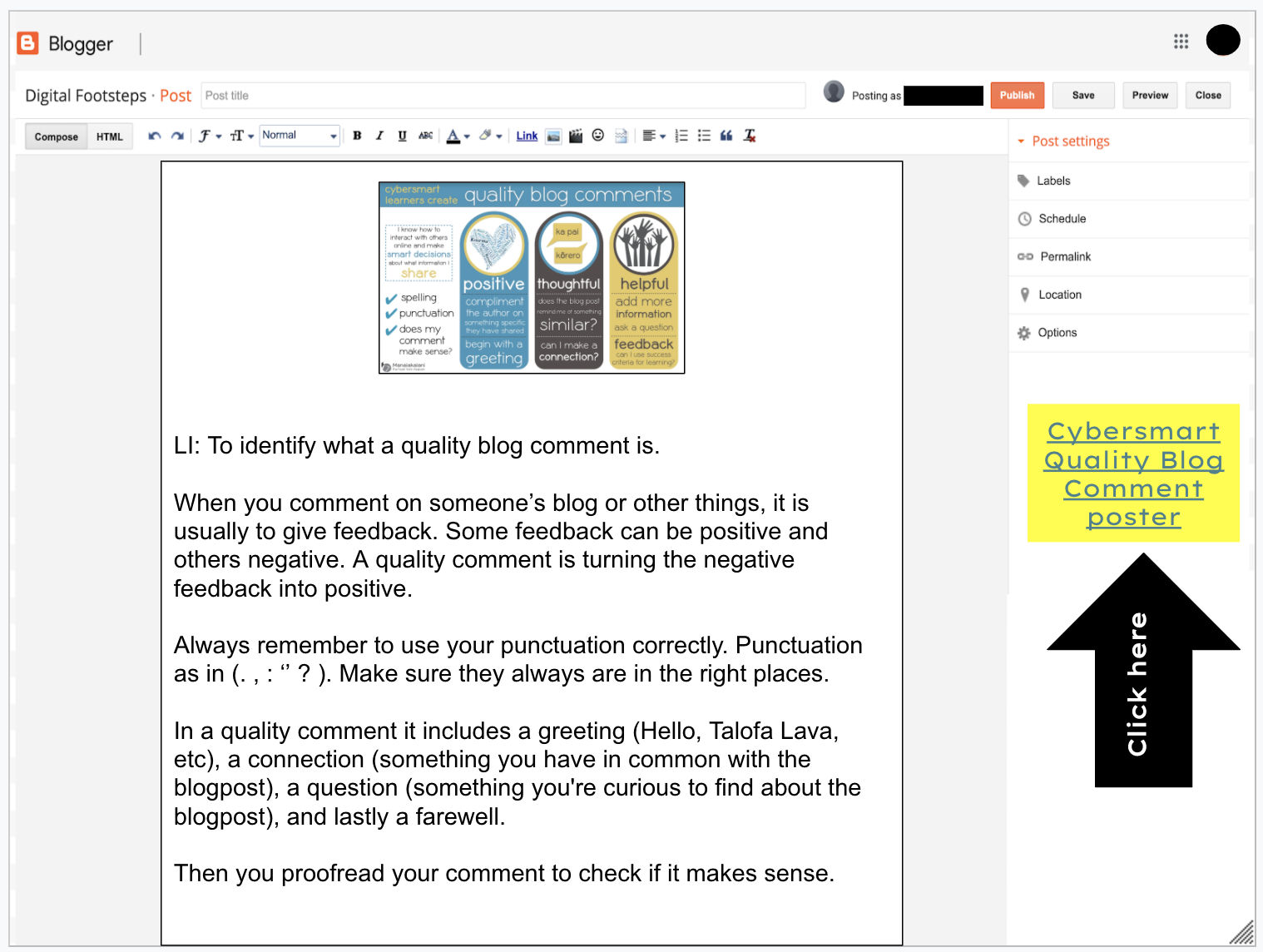
  • To enable me to measure time point one data with time point 2 data I set a task that required my learners (whole class) to write a blog post that would share the information found in the Manaiakalani Quality Blog Commenting poster. I will give them the same task at the end of the year to allow me to make comparisons. To make it authentic I got creative in a Google Draw as this gave me the added opportunity to leave a visible feedback/feed forward trail in the comments section. 
  • 3/6 students included a learning intention.
  • 2/6 students used an explanation structure with three paragraphs to express their understanding and elaborate with little or no punctuation errors.
  • 1/6 students wrote 'This DLO explains what a quality blog comment is. Read it for yourself to understand how to do this.'
  • 3/6 students wrote a paragraph to describe the contents of the poster but did not elaborate. 
  • 6/6 students used the content specific vocabulary found within the poster.

The evidence I have gained so far tells me that I need to revisit how to write a quality blog comment and how to write a quality blog post. In addition I need to make this visible in my classroom and embed time to do this in our timetable to ensure my learners are able to apply this knowledge in context. We need to be able to walk the walk not simply talk the talk.


Tuesday, 21 April 2020

Meet my focus students...


The best way to understand the students I am working with is to paint a picture with numbers. Last year I learnt that creating a historical data pathway would give me a much clearer picture of my learners, so I have taken this learning and repeated the process. In reality I have only worked with these students for seven weeks due to the Level 4 lockdown but in that time I have gained an insight of their personalities and working styles. 

Through capturing this picture of historical data I have come to understand that 4/6 students have continually achieved the top scores across the curriculum in their cohort data. This is reflected in their classroom interactions, willingness to begin work straight away, ask questions and their ability to naturally assume a leadership role. 2/6 students appear to find maths and writing a challenge, but are working at their chronological age in reading. The latter two students on the other hand shy away from leadership but always contribute actively to the learning conversations in group challenges. These girls do not like having the responsibility of deciding the direction their group will go in, but once given direction from their peers, confidently carry out their roles. They like to work in a more supportive environment with teacher or teacher aid support to get started. I have come to understand that this is where they feel most confident asking the questions they need to ask in order to make a stronger connection to the learning. This data has answered a few questions I had with these two learners. Both are popular and confident when interacting with others, both work well in any group they are put in, but neither like to share their ideas in the wider class forum, and neither want anyone to know they need a bit more support.

As mentioned in a pervious post... 'For the last 5 years Panmure Bridge School has claimed the Summer Learning Journey's overall prize for top blogging school, something we are extremely proud of and value highly. However this year the feedback from the SLJ team was that our participants had strengths in blogging, however, seemed to drop the ball when it came to the commenting component. Many of our learners either overlooked responding to comments made on their blogs, or simply replied with a thank you. 

With my inquiry focus to explore if strengthening connections to Smart Relationships will help my learners to understand and use content specific language and vocabulary in context, I have selected this group as all 6/6 students are active bloggers, all participated successfully in the SLJ, with 3/6 receiving prizes for their efforts; but none replied to comments with anything other than a 'thank you'.

Wednesday, 18 March 2020

TAI 2020 WFRC Question #2...

#2... Collaborate with your senior leadership team and colleagues to identify areas where your inquiry will make a powerful contribution to wider school and cluster goals.


For the last 5 years Panmure Bridge School has claimed the Summer Learning Journey's overall prize for top blogging school, something we are extremely proud of and value highly. The Summer Learning Journey (SLJ) is a blogging challenge that runs over the summer holidays. This programme 'was created in response to concerns about the annual drop, slide or slump in literacy achievement experienced by students in New Zealand schools' and encourages our students to use their literacy skills which helps set them up for success and by maintaining the gains made over the school year.

The feedback from the SLJ team was that our participants had strengths in blogging, however, seemed to drop the ball when it came to the commenting component. Many of our learners either overlooked responding to comments made on their blogs, or simply replied with a thank you. Why did this happen? Not because our students were 'lazy' but possibly because as teachers, we had not set them up for success in this area. With that thought in mind I want to build on the learning from my 2019 inquiry and align our school-wide professional development focus of maths to find out if 
strengthening connections to Smart Relationships will help our tamariki to understand and use maths language and vocabulary in context?

Over the next few weeks I will be working alongside all our teachers to help them create their own backwards maps. This tool helps individual teachers to narrow the inquiry pathway they wish to travel along and they personalise their connections to our wider shared focus. 

After speaking with Hannah West, who kindly shared the blogging rubric she created for her learners last year, my plan is to work with our PBS team to co-construct a rubric that is personalised to our school. This will allow our learners to see where they have met the success criteria and what it is they need to do to move their own learning to the next level. By creating a rubric specific to the shared language of Panmure Bridge School, our teachers and students will have ownership of the tool that will allow us to measure student progress, and help our tamariki see that learning linked to vocabulary, instruction and strategy used in one area can be transferred to another. 

In class we actively plan for, and teach our students how to participate actively in a dialogic learning discussion. They are skilled in this area when asked to do this in class, but as yet most of our students are not carrying this thinking through to their blog commenting. In addition to actively planning time to allow our students to use maths language and vocabulary in context a number of our teachers are participating in the Tuhi Mai Tuhi Atu ('Write to me, Write to others') programme. Tuhi Mai Tuhi Atu helps connect learners across the Manaiakalani and outreach clusters through blog commenting and will help provide authentic opportunities for learning conversations to take place under the cybersmart umbrella.

Sunday, 8 March 2020

TAI 2020 WFRC Question #1...


#1... Use the ‘inquiry stocktake’ doc to reflect on and write about what you aim to learn about inquiry this year.

This year my plan is to continue to keep a clear and detailed record of all stages of inquiry so that I am able to evaluate shifts in my own teaching and in student learning by monitoring (and tweaking) new approaches to the way I deliver the Manaiakalani Cybersmart programme. In the past I have found that using a backwards map is the best way to do this as it not only keeps me on track but also allows me to see the direction forward that I want to travel in.

During our last COL meeting we reflected on the aspects of an inquiry, what worked well, what challenges we faced and what support would be helpful. Doing this not only allowed us to tap into the successes of our colleagues but also allowed us to share challenges and reflect on areas we might benefit with additional support. I particularly liked the idea of having a central “bank” that we could all add to so we can see the breadth of reading being done and dip in. This would not only work well across our COL but as our school has a shared inquiry would definitely be something we would benefit from and should set up.

Last year after working with all our staff on their own teacher inquiries, I asked everyone to share the practices we want to carry forward. What emerged was a common thread. We all want students to see that learning used in one area can be transferred to another - linked to vocabulary, instruction and strategy. This shared understanding has helped guide our way forward and has determined our school’s focus for 2020. This year our 'umbrella focus' is to explore if 'strengthening connections to Smart Relationships help our tamariki to understand and use content specific language and vocabulary in context?' Having a broad shared focus allows us to not only learn with and from each other, but also allows us the freedom to add our own twist and try new ideas.


Teaching as Inquiry 2020


Click here to see how I align my inquiry with the Manaiakalani framework.

“Recognising and spreading sophisticated pedagogical practice across our community so that students learn in better and more powerful ways...”
The Manaiakalani Community of Learning is working together on this task using the expertise existing in of our community of learning. 


Labels:

LEvidence, LScan, LTrend, LHypothesise, LResearch, LReflect,
CPlan, CTry, CInnovate, CImplement, CReflect,
SPublish, SCoteach, SModel, SGuide, SFback, SReflect