A huge THANK YOU to everyone who was part of the Manaiakalani Community of Learning. This afternoon the CoL teachers shared our impact bursts. It was really interesting to listen to the shared struggles, innovations and successes our inquiries presented as we worked towards accelerating the learning in our classrooms. It has been an absolute privilege working alongside you all this year. I look forward to growing the connections I made, as I have learnt so much by listening to your feedback and following your inquiries.
Showing posts with label Inquiry 2017. Show all posts
Thursday, 16 November 2017
Wednesday, 15 November 2017
Reflections and Questions...
Over the year there has been a noticeable shift in the amount of dialogue each reading lesson presented. Learner engagement and agency increased through the co-construction of scaffolds and shared ownership of the learning. Participation moved from passive acceptance into active questioning as the knowledge of how to dig deeper into a text moved through the stages of mastery. The scaffolds initially introduced in reading were repurposed independently by a wide number of students across all learning areas, and grouping became more cohesive and collaborative as confidence levels grew.
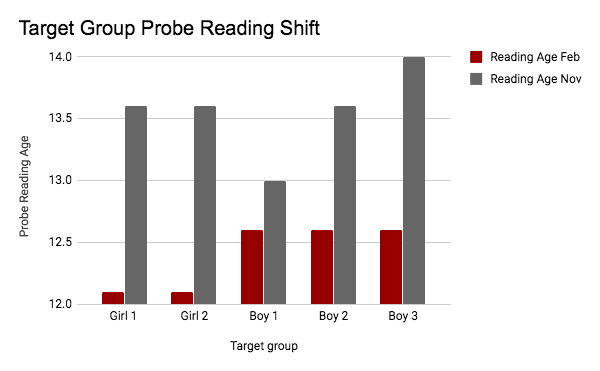
Strengthened connections to vocabulary, content and comprehension strategies have enabled significant shifts in reading age across my whole reading group. The graphics below represent the shifts made by my target students. What excites me about this picture is that 3/5 students made an 18 month shift in reading age, 1/5 students made a 12 month shift and 1/5 students made a 6 month shift when tested on both fiction and non-fiction assessments.

Aside from being able to make sense of more sophisticated texts I noticed their reading behaviours changed. My learners moved from trying to simply recall facts and re-reading a text in entirety, to skimming and scanning for key words and phrases when searching for evidence to support their thinking. The quality of the responses increased as they were able to make stronger connections to language of questioning. Simply put, this meant they knew what the question was asking them to do. I know this because I asked them to think aloud while they were processing the task ahead.
Over the year we have used talk to explore and unpack strategies and scaffolds that have helped my learners strengthen their understandings and connections to a wide variety of texts. A large part of this focussed on personalising the language of instruction and making sure that this was explicit. Making use of rewindable learning opportunities enabled my learners to see through their own eyes what they were doing right and where they still needed support. I actively planned for opportunities for talk to take place and used student created exemplars to spark their curiosity and explore new learning in context. 'Repetition without boring' was the key here as we repurposed and tapped into the known to help us access the unknown.
Disconnects with vocabulary have been our biggest stumbling blocks this year. Moving forward I will be looking at how I can continue to break down the barriers between new words and new learning by capitalising on my 2017 learner feedback to keep the talk going with my learners in 2018.
Wednesday, 25 October 2017
Manaiakalani Outreach Wananga 2017 Presentation
Today I was invited, along with five of my CoL colleagues, to share my inquiry with the principals and leaders from the Manaiakalani Outreach schools, the Manaiakalani School Leaders and Researchers from Auckland University. As a Community of Learning we are collaboratively inquiring into six achievement challenges to accelerate student achievement.
My link to my presentation with the speaker notes that summarises my inquiry to date is here.
Preparing to share...
“What has happened as a result of the changes in teaching, and what are the implications for future teaching? At last week's CoL meeting we were asked to prepare an impact statement to share what has happened in our inquiry, what evidence we have to back this up, what we did and what wonderings we may have as a result of our inquiry.
To explore this further and gather the evidence I will be revisiting Matrix 4 on the Evaluation Associates 'Student Capabilities Matrix': Promoting Further Learning to gauge my learner's perspectives on the shifts they feel they have or have not made in relation to their active involvement in our lessons.
What I have noticed is that my learners are now more willing to seek and implement feedback when they feel they need further clarification or guidance during learning time. My target group (along with the other members of our reading group), understand that we all make different connections to a topic and know it is these connections that we make, that inform our own perspectives, perspectives that may differ from others around us. Actively planning and scaffolding these learning situations has been an important part of this increased knowledge and confidence. I have watched rich learning conversations take place as each person tries to justify their own thinking through the language of argument. The biggest shift that I have observed is that my learners are intrinsically motivated towards our learning and feel confident enough to suggest the direction our learning might go in.
Moving forward I know I need to keep this talk going. The fast approaching assessment week will help me to see where the gaps are, but providing opportunities for genuine peer to peer modelling to take place, is what will help me to fill those gaps.
To explore this further and gather the evidence I will be revisiting Matrix 4 on the Evaluation Associates 'Student Capabilities Matrix': Promoting Further Learning to gauge my learner's perspectives on the shifts they feel they have or have not made in relation to their active involvement in our lessons.
What I have noticed is that my learners are now more willing to seek and implement feedback when they feel they need further clarification or guidance during learning time. My target group (along with the other members of our reading group), understand that we all make different connections to a topic and know it is these connections that we make, that inform our own perspectives, perspectives that may differ from others around us. Actively planning and scaffolding these learning situations has been an important part of this increased knowledge and confidence. I have watched rich learning conversations take place as each person tries to justify their own thinking through the language of argument. The biggest shift that I have observed is that my learners are intrinsically motivated towards our learning and feel confident enough to suggest the direction our learning might go in.
Moving forward I know I need to keep this talk going. The fast approaching assessment week will help me to see where the gaps are, but providing opportunities for genuine peer to peer modelling to take place, is what will help me to fill those gaps.
Monday, 23 October 2017
Keeping my learners engaged through talk...
Adrienne Dines' phrase 'talk is the action of learning' really resonated with me as I saw this as another way I could encourage my learners to keep talking about their learning. So as we start the term two of my groups (this includes my target students), are going to self manage their own learning conversations. To do this they will be working with revolving ‘Book Buddies’ so that they can talk about the texts they are reading. What I mean by 'revolving,' is that each text change comes with a buddy change to allow for different perspectives to be shared and heard.
The thinking behind this is that my learners will feel empowered as they continue to learn how to explain their thinking about event and character development in longer texts. The reason I have put the ownership of the learning back on these students is because they are all at the reading to learn stage, whilst one of my groups needs more guided attention as they are still moving towards the reading to learn stage. This does not mean I will be sitting back and leaving them to it; just that they will not have as much guided teacher time as the other group.
After asking my learners what content they wanted to see in our reading program at the end of last term, I created our Navigating Narratives challenges. Our texts were selected together and there is no set order the follow up tasks need to be done in as I have found learner choice leads to a stronger buy-in. The idea is that these tasks will be done in pairs. This means each pair can choose their own text, and after reading for 30 minutes (our reading blocks are 90 minutes), will decide what they want to explore at a deeper level. The follow up frameworks are consistent with the work we have done throughout the year to help to maintain and build on the connections to the learning that are already in place. The challenges have guiding questions to get the talk going and plenty of opportunities for peer led feedback to be given and listened to.
I didn't begin by introducing the site page in detail, instead I simply shared the link and asked them to explore. This strategy generated a lot of talk as each person was able to make their own connections. When I asked my learners to choose their buddy I found that this had already happened. My target group have opted to pair up with each other, but completely unexpected was who chose to work with who. I assumed the boys would work with the boys and the girls with the girls as that has been the norm so far, however this time it appears skill set with skill set have paired up.
I am excited to see where this takes us as we head into the assessments this term.
I have included the link to the site page above for anyone who would like to use any of these ideas.
Friday, 8 September 2017
Manaiakalani Boards Forum presentation
Last night the six of our Maniakalani CoL teachers presented an overview of their inquiries this year at the Maniakalani Boards Forum. The purpose of our presentations was to highlight how we are working towards each of our achievement objectives. Donna Ryan from Sommerville Special School, captured the common theme of the evening in her blog post. What stood out for me in these presentations was how clear it was that we had all very much been on this journey of shifting student achievement together. Everyone has willingly opened the both the physical and virtual doors of their classrooms allowing us all to learn from and with each other.
Photo credit +Fiona Grant
Here is my presentation from last night.
This year as the in-school CoL teacher for Panmure Bridge School I have been looking at how I can strengthen my learner’s connections to content and accelerate shift in reading through talk. I call this talk having a learning conversation. Simply put this means I encourage my learners to use evidence from the texts we are reading, to agree and disagree with one another to help them strengthen their understanding of the text.
In a typical learning situation I noticed my learners tended to accept what was said, even when they don’t fully agree with the opinions or facts shared by others. This often results in mismatches between what is correct and what is incorrect. As teachers we are always looking at different ways we can help our learners move through the learning levels. To do this we look at assessment results, think about what we have noticed in the classroom, listen to feedback from our learners and seek guidance from our colleagues.
When thinking about talk, shyness was one of the biggest hurdles I needed to help my learners climb over. Many of them lacked the confidence to say what they think, and why they think this way. I felt this shyness could be overcome if I took the time to show how to talk about their thinking.
My inquiry this year has reminded me to make sure the instructions I gave were very clear. I made sure I gave them the tools that would help them carry out the learning successfully, taught them how to use these tools and planned for opportunities for these skills to be used in real learning situations. We call this scaffolding as it is the term used for the support systems we put in place in our classrooms to allow our learners to have a go at new learning without being afraid to fail. No one, regardless of age wants to make mistakes in front of their friends.
I broke down the hard words by linking what they were asking them to do, to things they were familiar with. This is called making connections. As a result my learners now know that talking about their thinking is important and they know how to do it.
We don’t get it right every time so we revisit the same learning in different ways. What has excited me as a teacher is that the learning conversation skills we have been exploring in Reading have been transferred by my students to other learning areas. Why? Because it helps them make sense of new information.
Confidence levels have risen, and as a teacher I have been able to introduce more challenging learning opportunities as my learners have the skills to break down the challenge, to help them make sense of the new information.
As I mentioned earlier I listen to the feedback my students give me. This has helped me to design learning tasks that meet their learning needs. Our classroom is rich in talk because my students know how to talk, listen and challenge each other’s thinking.
Wednesday, 6 September 2017
Collegial Observations
This morning +Karen Ferguson from Tamaki College visited Learning Space 2 to observe a few of the ways we build connections to literacy in our Maths lessons. Karen has written a detailed account of the teaching and learning she observed on her blogpost here.
Karen taking part in our timed challenge
Purposeful group challenge to help strengthen connections to the vocabulary
Wednesday, 30 August 2017
Tapping into cluster expertise...
Today I visited Room 8 at Saint Patricks School to observe their in-school COL teacher, Adrienne Dines. I thoroughly enjoyed meeting her students and talking with them about how talk has helped them with their learning journey this year.
Adrienne uses a multimodal approach to help her learners make connections to their learning, and talk to strengthen these connections. What I saw when I stepped back and watched was a table of learners fully engaged in a dialogic discussion. Adrienne reminded them at the beginning to use their 'why' voices to question, explain and clarify their understandings.
To help keep the talk flowing Adrienne uses prompt cards that she places on the table. She then checks in with them using these prompts as the connection or provocation.
I roved around the room chatting to each group about what they were doing and how talk had helped their learning. What was really interesting was that her learners and my learners face the same obstacles when it comes to talking with others. I have followed Adrienne's inquiry this year as it aligns closely with mine. In talking to her I have found that it has taken us both a similar amount of time to build our cultures of talk. We have both used scaffolding strategies that are personal to our learners, and both realise the importance of using written, spoken and visual texts to aid comprehension.
One student said that talk helps if them engage. Another told me that it helps you clarify as you have to say why you think the way you do, and if don't understand something you can ask questions or listen to what others think. I asked them what they did if someone said something they didn't agree with. Almost everyone I spoke to said they ask questions to help them understand why they think that way.
I really enjoyed my time in Room 8. My takeaway from this visit will be to vary how I use my own scaffolded prompts, and has prompted me to revisit the reasons why talk can help strengthen our connections to the learning.
Friday, 25 August 2017
Maniakalani Hui Poster Session
Today our CoL teachers took part in a poster session to showcase and talk about our inquiries at the Manaiakalani Hui. We have all been carrying out inquiries that fall under the umbrella of the Manaiakalani CoL achievement challenges. This was a great opportunity to share our journeys with a wider audience. There was a lot of rich discussion all around as new connections were made and existing ones strengthened.
My inquiry falls under achievement challenge 4 which is to increase the achievement of Years 1-10 learners, with a focus on Years 7-10, in reading, writing and maths, as measured against National Standards and agreed targets.
The presentation below is a copy of the written content on my poster board. It is a summary of what I have inquired into, why I chose this inquiry, the actions I have taken, the setbacks I experienced, and the changes that have been made by myself and my learners as a result. For a more detailed account of my inquiry please click here.
Wednesday, 23 August 2017
Self Evaluation and Rewindable Learning
Yesterday I wrote a blog post about seizing an opportunity to film a learning conversation in action. Today I began by asking these learners to think about yesterday's reciprocal reading lesson. We talked about what they liked, what went well and what they might do differently next time; and then I shared the footage I captured. I asked my learners to look closely at their own contributions. Initially their were a few giggles but as the footage progressed I listened to the conversation that was taking place. This was rich and authentic. Afterwards I sat down to have a debrief with them. One student chose to write his observations down so was quite detailed in his responses, one was eager to share that he noticed he was really good at working collaboratively, and the others were keen to tell me that they had all been active participants.
I asked each person what they would do differently next time to make the most of the learning talk. Click here to read Daniel's blog post about his group's collaborative evaluation of their learning.
Today I repeated the process with another group. Our screen was in use and I wanted to harness the power of capturing today's footage as this group were keen to watch themselves, so I simply replayed their movie on my phone. Click here to read Jeremiah's blog post about his group's collaborative evaluation of their learning.
This is not a tool I would use all the time as the power of the novelty would wear off. However it is definitely a tool I will use to help my learner's see what their learning looks like when I need them to notice and evaluate their own learning.
Tuesday, 22 August 2017
Learning from each other
I am always looking for ways to continue to strengthen our learning conversations during Reading. As a teacher in an ILE I have observed the ongoing success Kiri is having with reciprocal reading in her reading sessions, so today invited Fridoon (from Ms Kirkpatrick's group), to share his expertise in reciprocal reading with one of my reading groups. He was an amazing 'teacher' and was able to show a group of my learners how to unpack a text using this process.
The clip above is a short snippet of their learning conversation. I saw their 'talk' evolving but was working with a different group at this time, so handed my phone to another student to film. I love the collaboration and support they give each other as they work towards making sense of a new text without any guidance from me.
Having watched the whole clip myself I was able to see the true power of tapping into the strengths of my own students to grow the learning. Fraidoon's clear and explicit instruction and this group's willingness to share their thinking, made this a rich learning conversation that allowed my learners to use talk to strengthen their understanding of newly aquired knowledge.
Tuesday, 8 August 2017
CoL Sharing with the PBS Syndicate teams
We were asked at the last CoL meeting to meet with our staff and encourage each person to select one Achievement Challenge that aligns with their Teaching as Inquiry for 2017. We then explored the blogs of each CoL teacher who has focused on the same Achievement Challenge as we have.
At Panmure Bridge School we chose to do this in syndicate meetings. This afternoon I met with the senior syndicate, and will be meeting with the junior syndicate next week. What was really valuable was the rich discussion that evolved as people connected with ideas that resonated with their own inquiries. Having a designated time to explore the cluster inquiries was a great professional development opportunity. Thank you to my fellow CoL teachers for making such a rich resource available.
Here are our responses.
Monday, 7 August 2017
Making my learners accountable...
Today during Reading I asked my learners how I would know they were actively participating in the learning. The unified response was, "Make sure we are talking about our thinking!" To make sure this actually happened, I challenged each person to write down one question they asked that contributed to the collaborative task. Our prompts were: 'What question could you ask? Will it tell you the information you want?' I knew this could be easily overlooked then hurriedly made up so I scaffolded the challenge by handing each person one brightly coloured post it note. My thinking was that if they could see a small space to record their question it wouldn't seem to onerous.
The image above reflects success! Everyone recorded a question and only two students felt too shy to share their question during our reflection time. This is a huge shift in confidence so I took a step back and asked myself why this might have happened, and thought about what I might have done/said differently. With my learners working in collaborative groups I was able to roam around the room having deep learning conversations. Upon reflection the most common message I shared was Did it tell you the information you want?
The questions below are our evidence of how each person participated actively in today's learning. The highlighted questions are from my target students.
- What did you do for the summary?
- Can you share your summary please?
- Was Kate Sheppard part of the suffrage or did she make it?
- What was the suffrage movement?
- What is the meaning of suffrage?
- What is a petition?
- Does Women’s suffrage have capital letters?
- How effective was the suffrage movement towards the men that wouldn’t allow women votes?
- Why were some women against the women’s suffrage issues?
- Why did they change their minds about women’s suffragettes?
- Did Kate Sheppard’s personality influence the men’s decisions?
- What were Kate Sheppard’s major achievements that convinced the law to allow women to vote?
- Why was the law so specific with some people not allowed to vote?
- At any point did Kate Sheppard feel like giving up on her main goal?
- How was Kate Sheppard able to keep going knowing there was hate and conflict against her?
- Were all cultures of women allowed to vote?
- Did Kate Sheppard fear that she was going to lose the fight?
- What made Kate Sheppard want to fight for women’s rights?
- Did Kate Sheppard feel like giving up?
- How did Kate Sheppard become the leader of the suffragettes?
- Is the big circle building the NZ parliament building?
- When did Kate Sheppard find out that women couldn’t vote?
- Why did Kate Sheppard decide to start campaigning to get women the right to vote?
- What convinced the men to let the women vote?
- What made Kate Sheppard keep going even though people didn’t like what she had to say?
- Why did Kate Sheppard join the suffrage movement?
- What did Kate Sheppard do to become the leader of the women’s suffrage movement?
These questions reflect strong connections are continuing to be made. The difference is my learners have a purpose for asking their questions and today they were accountable for their learning. My next step is to actively plan ways to sustain this accountability.
Wednesday, 2 August 2017
How I am engaging my learners in talk...
This week has been all about front loading so that my learners are able to begin forging connections to the content of our new learning. The screenshot of the blog post below reflects one of the ways we have done this. I was particularly drawn to her last sentence where she states that talking to her group helped her make connections.
We have done a lot of think-pair-share to encourage the learning conversations. By taking time to move around the groups I have noticed that everyone is actively participating. I reminded my learners that we learn best when we learn together and talk about our thinking. The collaborative approach removes the scary as the sharing reflects the ideas of the group and eliminates the pressure to take risks alone.
As I have mentioned in previous posts, the scaffold this group chose to use was a 'go to' rather than a 'you must use'. Clearly strong connections have been made to this as they see by identifying the key words they are able to rework the words into meaningful sentences that summarise their learning.
Since woman's rights with voting was a big issue in the olden days, our reading topic this term relates to this with the upcoming election in mind. We watched a youtube video about the suffragette movement and wrote a 25 word summary on "what the suffragette movement was". I found this quite hard because it isn't a skill that I have mastered (summary) but talking to my group helped me make my connection.
To help me scaffold my learners towards evaluating their own contributions to the learning conversations I asked each group to do this today via the comments tool. It was interesting to listen to the negotiations taking place before the final comment was devised. Some as you can see were very honest. What I celebrated was the fact my learners were able to recognise their own contributions to their learning conversations. I see too that I need to scaffold what it is I want my learner's to notice so that they have the tools to strengthen their evaluations and identify their own next steps.
Monday, 31 July 2017
Engaging and Empowering...
Photo via Good Free Photos
Today we began our journey into this terms reading challenges and I needed to get those cogs turning! I have chosen to explore the suffragette movement to help my learners make deeper connections to the upcoming elections. Understand the importance of having the right to vote, and why people in the past fought for this right underpins the texts chosen to explore this topic.
I know my learners and I knew that I needed to engage them by selling this topic in the right way. I thought that it was important to use my blog as a platform for reminding people about the importance of finding a way to bring a difficult topic back to the world of our learners to allow them to make strong personal connections.
What I did to build connections together:
I began by asking my learners to find an learning buddy and by asking the questions:
- Who is in charge of New Zealand?
- Who makes the laws and rules?
- Who is NZ's Prime Minister?
- How did he/she get this job?
Initial responses were interesting and varied, but none were correct. We then used our smart searching skills to find this information. To bring it back to our immediate world we looked at our own school. I knew I need to build vocabulary knowledge so we use our devices to define the words: vote, parliament and government.
I borrowed an idea from Adrienne Dines at St Patricks School and introduced the notion that ‘talk is the action born from thinking’. We unpacked this statement together by me asking why I was sharing this.
"So we talk about our thinking..."
"So you know we are thinking..."
"Because if we talk it kind of goes in our brain and help us understand more..."
I shared our 'Votes for Women' site and shared the fact that a long time ago it was only men who were allowed to make decisions about how we lived. Women, alcoholics, criminals, men under 18 and those classified as insane were not allowed to make any of these decisions. To say the girls in this group were shocked is an understatement! The result of this statement was a buzz of talk as I was immediately bombarded with questions as to why women weren't allowed an opinion. No answers were given as I pointed out this was what we were going to find out.
We used the learning buddy partnerships to then explore the amazing interactive timeline on the NZ parliament site. Their task was to use their skimming and scanning skills to find and briefly summarise information they found interesting. While this was happening I worked my way around each group having rich conversations about their identified points of interest. It is important to mention here that I had previously looked through this information so I was able to recall and discuss it without referring to my computer.
To capitalise on today's engagement I asked each pair to record something on the white board that they wanted to find out more about. These questions excite me as I can see that deep and critical thinking is emerging.
- Did the Queen have anything to do with the law that only men could vote?
- What convinced the men to allow women to vote?
- Why didn't men let women vote at first?
- What convinced the men to allow women to allow women to stand for parliament?
- Why were men from other countries not allowed to vote?
- Why was Wellington chosen to be the place of parliament?
- Which men agreed with Kate Sheppard and made women's rights possible?
My learners felt engaged and empowered, and I was reminded of how important it is to know your learners, know your topic and know how to make connections to your learner's immediate world.
The images used do not reflect my target students
Labels:
CImplement,
CInnovate,
CoL,
CTry,
engage,
Inquiry 2017,
Reading,
talk
Midway Reflection...
Last Thursday we met as a CoL group to share and reflect on our inquiries at the midway point. This shared check-in allowed us to talk about the successes, failures and improvements we have experienced and noticed, with colleagues who are working towards the same achievement goal.
In my class we live by the ethos that 'we learn best when we learn with and from each other', something I capitalised on myself in this meeting. By listening to Adrienne Dines share how her inquiry is progressing, I realised our inquiries crossover in many areas. We have drawn similar conclusions and have implemented similar interventions to increase the levels of talk amongst our students. Adrienne’s statement that ‘talk is the action born from thinking’ is something I will unpack with my learners as I see this as an additional way of strengthening their connections as to why having learning conversations are so important.
Wednesday, 26 July 2017
Comprehension strategies and learning conversations... Will this keep the talk going?
When putting together learning opportunities for Term 3, I not only had to think how I could capture and maintain my learner's interest but also how I could delve deeper into my teaching inquiry. I looked through a wealth of texts before selecting one I will call my anchor text, that would link to and help my learners strengthen their connections to the upcoming elections.
I plan to capitalize on our established routines and groups to open the doors of familiarity. It is my hunch that by using the peer to peer rapport in place, alongside well practised learning frameworks, the initial shyness that often inhibits my learners will dissipate far quicker than it has previously.
I refer once again back to Jason Borland's thinking in our 2015 Manaiakalani Innovative Teacher's PLG where he stated that "You can't help yourself if you can't see yourself." This thinking resonated with me when I first heard it, and after following Jason's inquiry I have often repurposed this idea to meet the learning needs of my students.
My idea is that if I record (with student permission and knowledge of purpose), our learning conversations, we can look back at our own contributions and notice when we were active participants and how we could possibly make changes to become more active participants. In my case it will help me see what changes I need to make to my teaching to help my learners understand how to become more active participants.
I realise it is sometimes the suggestions of our peers that can help us move our learning to the next level. With this being and already established routine in our class, I hope my learners will be able to strengthen their connections and understandings to the content by through talking about their reasoning for the comprehension strategies used.
I plan to capitalize on our established routines and groups to open the doors of familiarity. It is my hunch that by using the peer to peer rapport in place, alongside well practised learning frameworks, the initial shyness that often inhibits my learners will dissipate far quicker than it has previously.
I refer once again back to Jason Borland's thinking in our 2015 Manaiakalani Innovative Teacher's PLG where he stated that "You can't help yourself if you can't see yourself." This thinking resonated with me when I first heard it, and after following Jason's inquiry I have often repurposed this idea to meet the learning needs of my students.
My idea is that if I record (with student permission and knowledge of purpose), our learning conversations, we can look back at our own contributions and notice when we were active participants and how we could possibly make changes to become more active participants. In my case it will help me see what changes I need to make to my teaching to help my learners understand how to become more active participants.
I realise it is sometimes the suggestions of our peers that can help us move our learning to the next level. With this being and already established routine in our class, I hope my learners will be able to strengthen their connections and understandings to the content by through talking about their reasoning for the comprehension strategies used.
Here is the link to our reading challenges for the start of this term.
Subscribe to:
Posts (Atom)