Showing posts with label CInnovate. Show all posts

Sunday, 13 July 2025

Stocktake of my Inquiry...

We are half way through the year and I realise when taking stock of my inquiry that the PLD start delay has impacted my inquiry significantly. I haven't really been able to begin until now as we have only had 4 structured literacy PLD sessions so far. My inquiry a school leader is not just a personal one, but also a team one. The positives to date are that we have been keeping the status quo in literacy so I do know we are currently all on the same page as far as planning is concerned. We are all on the same page as far as DLO scaffolds are concerned and our current shared language of instruction is alive and well. 

Moving forward this term sees us starting to implement structured literacy practises. What is a huge plus for us is that the changes are not big ones. Our current planning is structured. It unpacks the text and explores text structures, themes and vocabulary. What we do need to do is approach the tweaks we need to make to the vocabulary instruction at our own pace. What I mean by that is we are a team with a varied range of teaching experience which ranges from 6 months to over 30 years. If we change too much too soon I can see everything unravelling quickly. The point of PLD is to build on what we know to strengthen our practice not to throw everything out and start again.

Before I think about how I can support my team I need to put my own oxygen mask on first. By that I mean I need to jump into structured literacy approaches boots and all. I know I still need to capture student voice and will do this when term 3 begins. I needed to look closely at how I will adapt and tweak my current planning. I have done that by looking at the planning exemplar provided on the structured literacy platform we are using and have then made a few changes in what I already had in place. 

The end goal was to keep a 'create' aspect which I have done. I wanted to make sure I was covering what was suggested but I also know I can do this without folding back to using the worksheets I cut my teeth on as a beginning teacher. The first screenshot below is what is suggested on our PLD provider platform. The way I have interpreted this is to use the perspective DLOs I already have in place but add a creative aspect to this by using ADOBE podcast to capture the conversation behind the end product. (The discussion and summarising aspects are covered in the guided planning.) We do have planning scaffolds that we use but the way my learners show their perspective is totally up to them. I am also making use of text sets and my learning T-shaped literacy gave me. What I have added is a skill drill game that I created using Gemini. These multi-choice tasks have been a game changer in our class. They allow for quick recall and application of new learning. Examples of these challenges can be found here.


As I said earlier I, along with my team, are very much at the start of our structured literacy journey. Ours made slightly more challenging by the year groups being separated into PLD for Y4-6 and PLD for Y7-8. What is helping keep us all aligned is the planning framework and the conversations we have as a team.

Monday, 24 March 2025

Teaching as Inquiry 2025...


Click here to see how I align my inquiry with the Manaiakalani framework.

“Recognising and spreading sophisticated pedagogical practice across our community so that students learn in better and more powerful ways...”

The Manaiakalani Community of Learning is working together on this task using the expertise existing in of our community of learning. 


Labels:

LEvidence, LScan, LTrend, LHypothesise, LResearch, LReflect,
CPlan, CTry, CInnovate, CImplement, CReflect,
SPublish, SCoteach, SModel, SGuide, SFback, SReflect

Tuesday, 5 November 2024

Describe and Explain the changes/tweaks you have made in your practice along the way...

My inquiry this year has had many twists and turns. Achieving accelerated shift in Literacy was identified as being one of the most important and catalytic issues of learning facing our students in Y4 - 8, this year, when the time point one data was analysed. Exploring how learning gained from professional development is helping to strengthen teacher practice and achievement in literacy is something I haven't looked at before so I began with one idea which over the course of the year has completely morphed into another. Not because as I mentioned in an earlier post, because it was unachievable, but because my initial idea simply wasn't working. The effect of staff changes on PLD is something I hadn't initially taken into consideration. What began as an inquiry into how we (PBS) are using PLD to accelerate shift across our school' and over the course of the year required a change of tact to inquiring into how are we building and strengthening our capability in raising student achievement outcomes in Reading for years 4-8 at PBS.

I began my journey by trying to ensure we were all on the same page. Consistency and a shared language of instruction help our students to make the connections they need to be able to access their learning with confidence and understanding. At the start this wasn't about paying no regard to the skills and knowledge my team brought to the table but rather to align our thinking. This is explained in detail with examples in an earlier blog post. This wasn't as successful as I hoped as we were all coming from such different places both literally and in knowledge gained from recent PLD, so it was back to the drawing board.

Changing Direction Icons - Free SVG & PNG Changing Direction Images - Noun  Project

After speaking with Naomi Rosedale, I realised I needed a new pathway forward, a pathway that included a framework that would bring everything together and provide clarity. Aligning what I was looking for with the Manaiakalani Reading Pillars of Practice (MRPP) was the lightbulb moment I needed. In Term 3 I used the MRPP to look closely at what and how we, my team and I, were actually teaching the tauira in front of us in our reading lessons. I looked at the data and used the initial gap analysis to help me gauge whether or not the learning planned matched the student needs. To allow for consistency I stood by my decision that if it wasn't in the planning it wasn't there. The follow up discussions were both rich and gave all of us the clarity we needed to help us meet the learning needs of our individual classes.

This process was repeated in Term 4. I am yet to complete all my follow up discussions but have them timetabled for later in the week. What I noticed was with a shared understanding and stronger knowledge of why we need to make the changes. All my team have now included multimodal text sets, are looking at the structure and language in the different text types and have put a lot of thought into the questions they are asking. There is definitely a growth in the use of our shared language of instruction, a wider variety of comprehension skills being accessed. 

Changing my inquiry focus has allowed me to introduce change in a manageable and achievable way. Mindsets where planning is concerned has moved from compliance to purpose, something I struggled to initially get buy in from. I feel that looking closely at my own planning has added the 'teacher model' element to the learning. By using the MRPP it has allowed us to all learn together but at our own pace. Sharing people's successes and valuing their ideas has afforded us opportunities to learn with and from each other. 

The big message I want to share here is that change is good, it should be embraced and we should not be afraid to walk in a different direction if what we have tried is not working. 

Wednesday, 28 August 2024

You can't help yourself if you can't see yourself...

Once again I'm tapping back to Jason Borland's thinking in our 2015 Manaiakalani Innovative Teacher's PLG where he stated that "You can't help yourself if you can't see yourself." This thinking resonated with me when I first heard it, and after following Jason's inquiry I have often repurposed this idea in the classroom but know it has reaches much further and wider than only our learners.

At the start of this term I asked my team to video themselves teaching a guided reading lesson. The idea was to help everyone to see what they were doing well and what they felt they could do in a different way. I made it clear this was for personal use only, I didn't want to see it and I definitely didn't want a written analysis of it. The only video I wanted to see was my own because I do the same as I ask my team to do. It also gives me a video to use as a resource if I need to model the process. All wanted was for everyone to take a moment to reflect on what they do in the classroom to help their learners connect to the learning. 

Initially this challenge was seen as something my team needed to do for me. However, this recording definitely wasn't for me, it was for them. Falling back on the phrase 'you can't help yourself if you can't see yourself,' was the game changer. Through observation opportunities I have been able to see each room first hand. I often record these observations for this purpose but after watching some parts together I imagine time plays a huge part in the decision to continue watching it in entirety or not. When challenged to watch and reflect in a safe way, the table below identifies areas from our team discussion that we need to strengthen. 


This picture is real and as is it co-constructed there is an element of ownership that we can all capitalise on to make the changes needed in our practice that will help accelerate student achievement.

Where am I at and how will I measure this?...

As my inquiry has now taken a new direction I needed to collect an additional set of time point 1 (TP1) data that can be used at the end of the year to provide evidence of shifts in teaching. As this is for inquiry purposes the information needed to be formative. It needed to identify our current strengths as well a identifying our areas for development. The Manaiakalani Reading Pillars of Practice (MRPP) matrix has helped me do exactly that.

After analysing my reading planning against the MRPP with Toreka, the next step was to work together to analyse her reading planning. On this occasion I took the lead but asked her to step in if I needed to relook at something. Again a rich conversation was had and a clear picture of where she is at captured. I then repeated this process with the rest of my team.


The feedback was really positive and discussions had were rich and honest. I think the high levels of trust play a huge part in this process and I want to thank my team for their parts in these conversations. This process fully was transparent and I openly shared my matrix with my gaps clearly identified. I think this helped in strengthening the buy in as it wasn't about finding out right and wrong but rather finding out where our areas of strength and areas to strengthen were. The latter have since become part of our co-constructed team PLD plan going forward.


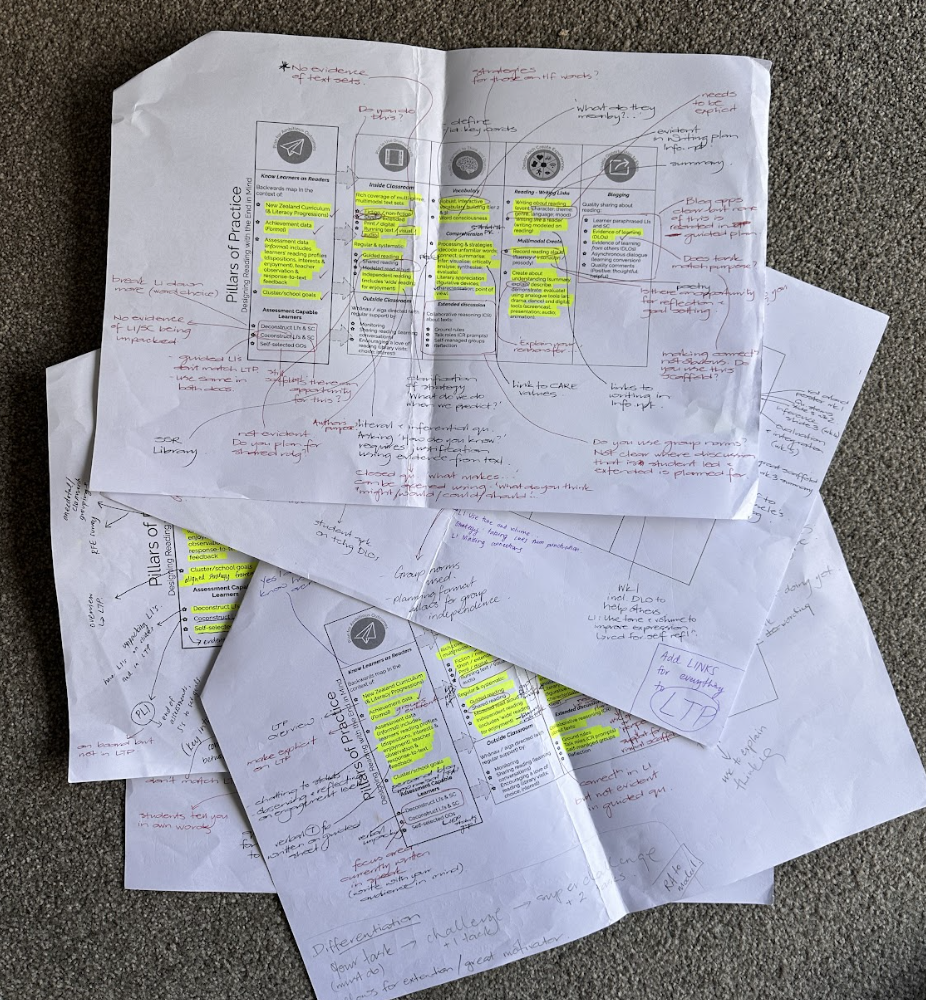
The matrix for all initial discussions was very much a working document (see image above). This gave me an opportunity to identify what I saw in the planning and my team to talk to it. Sticking firmly to the idea that 'if it wasn't in the planning it wasn't there', allowed for consistency across the board but it didn't mean I didn't listen. Using pen and paper on this occasion meant any adaptations made were clearly visible to both of us. The part of this process that I really liked was being able to celebrate and sometimes point out, people's successes. I found that by doing this first the door was opened for those more challenging conversations to take place. 

The presentation below is the formalised version of these conversations. Each teacher has their own digital copy that identifies areas of strength, areas to strengthen and next steps.

From the perspective of team leader, I now have a clear and visual picture of where we are at and what it is we need to do to help accelerate shifts in student achievement in reading. 

Stocktake of my Inquiry...

My inquiry this year has been to say the least, challenging. Not because it is unachievable, but because my initial idea just wasn't working. I had several attempts at exploring the effect of our recent Reading PLD on student achievement but soon found out this wasn't going to work as my team are are all coming at this from different places. The PLD I have had differs greatly from what the others have had. My biggest learning has been the realisation that something I think is a normal part of a lesson is not necessarily seen the same through the eyes of others. It was also a real eye opener to realise the effect of staff changes on PLD, something I'm sure all schools experience. 

After speaking with Naomi Rosedale at the last COL meeting, I realised I needed to make some changes. Once I had worked out my new pathway forward things began falling into place. I had a plan and had begun putting that plan into place, but what was missing was the framework to bring everything together. Naomi suggestion was that I align what I was looking for with the Manaiakalani Reading Pillars of Practice. That was the lightbulb moment I needed.

Light Bulb Moment Icons - Free SVG & PNG Light Bulb Moment Images - Noun  Project

Last year two of my team took part in the Reading Program Intensive (RPI) and although I didn't, I did join them in their journey through my role as a mentor. As a mentor I didn't get the explicit introduction to the Manaiakalani Reading Pillars of Practice (MRPP) so I needed to strengthen my connections. I did this by reversing the roles. This time it was me in the learning seat and Toreka in the mentor role, and turned into one of this richest learning conversations I have ever had. 

Together we analysed my long term reading plan and one randomly selected example of a guided reading plan against the MRPP.  As we unpacked each section I could see a clear picture of where my successes were and where my gaps were. Toreka was far more generous than me with this process. She kept saying 'I know you do this, I've seen you do it...' but I was of the opinion that if it wasn't in the planning it wasn't there. That decision allowed for consistency when I repeated the process with my team's planning.


The image above is the result of my conversation with Toreka. I'm sure to anyone looking at the writing all over the MRPP matrix it will look chaotic, but to me it's a rich summary of observations made, explored and discussed. I think what I liked the most in this process is that it is a true picture of my strong belief that we learn best when we learn with and from each other.

Tuesday, 23 July 2024

Teaching as Inquiry 2024


Click here
 
to see how I align my inquiry with the Manaiakalani framework.

“Recognising and spreading sophisticated pedagogical practice across our community so that students learn in better and more powerful ways...”

The Manaiakalani Community of Learning is working together on this task using the expertise existing in of our community of learning. 


Labels:

LEvidence, LScan, LTrend, LHypothesise, LResearch, LReflect,
CPlan, CTry, CInnovate, CImplement, CReflect,
SPublish, SCoteach, SModel, SGuide, SFback, SReflect

Monday, 28 August 2023

Celebrating the win...

This week the words I heard in our class speech competition completely stopped me in my tracks. Standing in front of an audience of their peers was every member of my reading groups confidently used the vocabulary we have encountered, unpacked and explored throughout our Reading units this year in context. Gone were the usual go-to's and in their place was a plethora of sophisticated vocabulary. This is a win in every sense of the word! 

To give my last sentence some context, the previous week I had taught an explicit lesson on speech writing. This lesson contained exemplars at a variety of e-asTTle writing levels. That meant my learners were exposed to a healthy mix of simple and more powerful vocabulary. One of our challenges involved applying our knowledge language features to edit an exemplar and move it to the next level. This is where my students very sound understanding of the more powerful vocabulary needed came to the fore. This then lead to a rich discussion as each group discussed their vocabulary choices and explained why they had made these changes. We applied the same strategy to levelling up the structural features.

Unfortunately the next few days saw me off sick, which meant my learners were left to work independently on their own speeches. I did share explicit instructions via email but knew these students would be working without guided teacher support. The comments tool in Google docs definitely gets a shout out here. I shared my feedback and left them to it. Move forward to today. I saw and heard the outcome of explicit teaching, creative ways of helping my learners connect to new and powerful vocabulary and a year long focus on affixes in action. 

My next step is to record some of these speeches that will be uploaded here so that I have a permanent record of what success looks like.

Tuesday, 2 May 2023

Teaching as Inquiry 2023


Click here to see how I align my inquiry with the Manaiakalani framework.

“Recognising and spreading sophisticated pedagogical practice across our community so that students learn in better and more powerful ways...”

The Manaiakalani Community of Learning is working together on this task using the expertise existing in of our community of learning. 


Labels:

LEvidence, LScan, LTrend, LHypothesise, LResearch, LReflect,
CPlan, CTry, CInnovate, CImplement, CReflect,
SPublish, SCoteach, SModel, SGuide, SFback, SReflect

Wednesday, 12 April 2023

Implement and Try #1: Digital Escape Rooms

Last term I attended the Creating Digital Escape Rooms with Donna Yates toolkit. Donna introduced us to a collection of published digital escape rooms which we had an opportunity to explore. We were also shown how to create our own escape rooms using Google forms. 

Here is the link to Donna's presentation. Slides 7-15 have clear steps to follow if you are keen to give this a try.

As a way of putting my new learning into practise and helping my students strengthen their connections to their affixes learning, we created our own affix themed digital escape rooms. The challenge was to devise 10 affix related questions that their peers would then answer in their quest to open an online game that let them apply their new learning in a fun way. The games selected were found using our smart searching skills so are not our own creations. That is one of our next challenges.

This was a fun and practical way of reinforcing learning. Dictionaries were out in full force and the discussion was rich and very loud as questions were being tested on friends orally before being recorded on the Google form. What I liked about this activity was the fact it forced my learners to draw on and recall their new learning, the dictionaries and the books they have been completing challenges in were used purposefully and the whole activity was met with a huge level of enthusiasm. 'Easy' questions were soon pushed to the side as the desire to write the 'hardest' question became the challenge of the day. This activity took two blocks of learning to complete but was absolutely worth it as the 'I've escaped' cheers showed the level of buy-in and allowed my learners to see their own success in real time, and I was able to see just how strong the connections to our new learning are.

We have created a page on our class site for our escape rooms which can be found here

Friday, 17 March 2023

Our First Footsteps into Word Consciousness...

After attending the PLD: Supporting students to become confident and competent spellers run by Louise Dempsey I put some of my new learning into place. About 1/3 of our class are participating in the STEPSWEB program which opens up a slot on our timetable for the other 2/3 of our class to focus on growing their own word knowledge.

Introducing affixes:

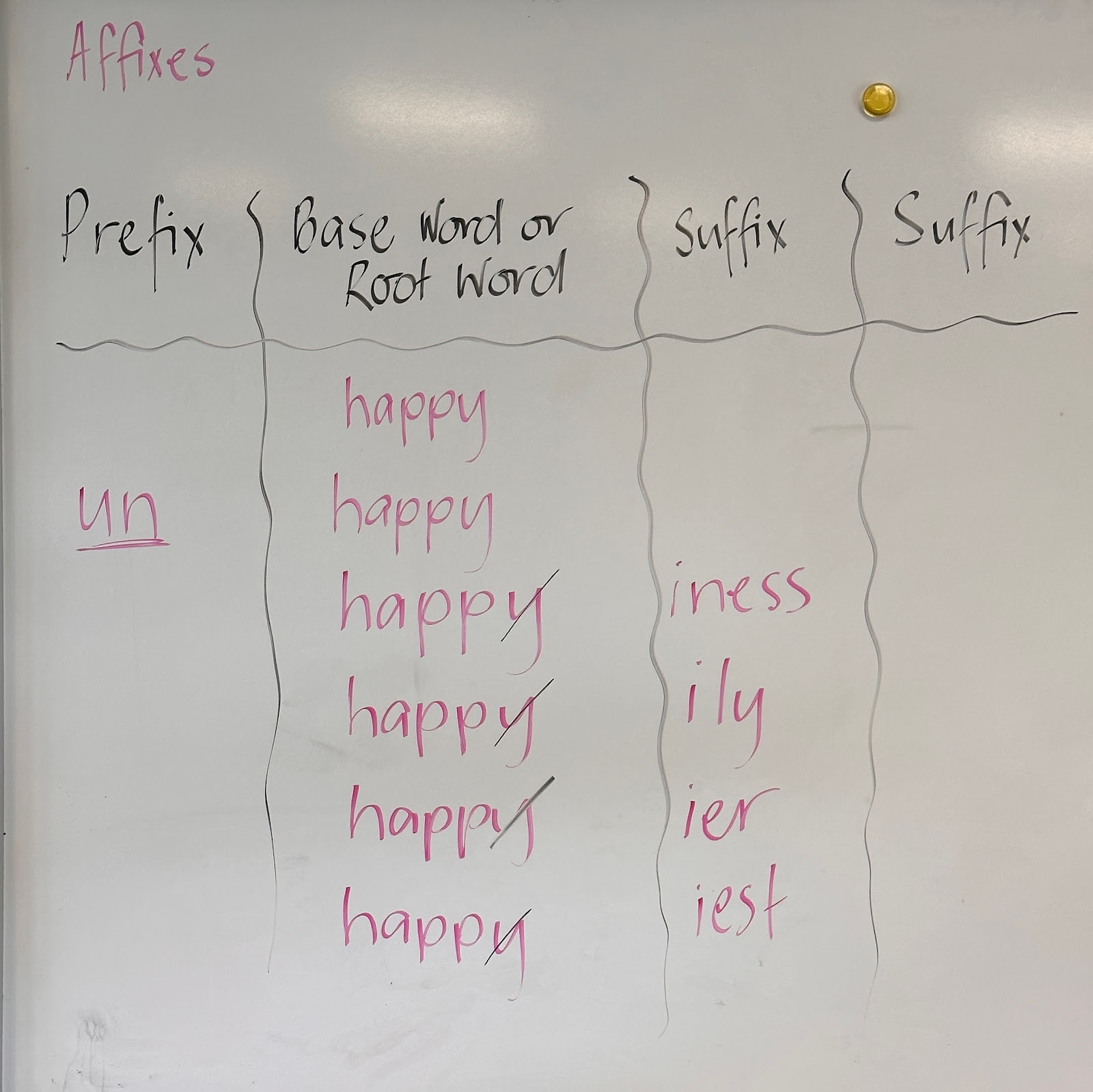
I used a template shared by Louise that shows how base words become completely different words with the introduction of prefixes and suffixes. We began by defining base words as being a complete word by itself that prefixes and suffixes can be added to make a new word. The example we used was the base word, happy. I then challenged my learners to make new words that had the word happy in them. At this stage we had only the knowledge of affixes that we brought to the lesson. As the words were generated from known words I filled in the template on the board (see image below).


We then explored possible reasons why I might have written some parts of the words in different sections of the table. A question that opened the doors for the introduction of the words prefix and suffix, and allowed us to unpack what these words might mean and what effect they had on the base word. All devices were closed at this time which gave me the opportunity to introduce the dictionaries and thesaurus' that were in all honesty, sitting on the shelf gathering dust. Having become so used to opening Chromebooks and defining words meant a quick lesson was needed on how to use a dictionary (or 'paper google' as it has now become known as).

After this I set my learners the challenge of building a word list using the base word excite. To make sure we were selecting actual words, only words generated that could be found in the dictionary were able to be recorded. We then unpacked what each of the affixes meant and explored how they changed the based word.  
Eg: the prefix over (too much or more than normal) + the base word, excite (being enthusiastic or happy) = over excite (more than normally enthusiastic or happy). 

Deziah's blog post explains this activity - (shared with permission).


Friday, 27 August 2021

Adapt and Try Alert Level 4 version...

With the move to Alert Level 4 last week my teacher inquiry pretty much came to an immediate standstill. The hardest part being for me to get my head around is that I now know all the momentum we have built so far this year will take a giant step backwards, however having been in this position once before I realised quite quickly that adapt and try was the only option available to me. So with that in mind earlier this week I set my learners the familiar maths challenge to 'find the error, explain the error and fix the error', something I unpacked earlier in this post.

Unfortunately I don't have online engagement with all my focus group at this stage. However for those who are engaging this was the challenge set ( - refer to DLO below). I noticed some students preferred to work collaboratively and others independently. I have no problem with the option they choose. There are a number of ways forward for me including a small group Google Meet and making use of applications like Screencastify, but for now this allows me to once again widen my focus to my whole maths group. 


The responses on slides 2 and 3 (above) are varied in detail and use of content specific vocabulary but as with everything we do, it is about knowing your learners and understanding how they think and speak/write. What I take from these examples is that these students understand how to add decimals and understand the concept of BEDMAS, with the part that I'm get the most information from, being the explanations of the errors. In the example above I mentioned that any errors or misunderstandings can be easily ironed out in a Google Meet or through the comments tool using Mote or by written feedback. 

I need to find ways to keep the 'talk' going in Maths. However, at this stage my priority is to maintain and build on my student's maths vocabulary and strategy knowledge by continuing to provide authentic and purposeful opportunities for my students to use and apply this knowledge. Going forward we will use this time to build on the 'familiar' by strengthening the foundations already in place. 

Wednesday, 10 March 2021

Teaching as Inquiry 2021


Click here to see how I align my inquiry with the Manaiakalani framework.

“Recognising and spreading sophisticated pedagogical practice across our community so that students learn in better and more powerful ways...”

The Manaiakalani Community of Learning is working together on this task using the expertise existing in of our community of learning. 


Labels:

LEvidence, LScan, LTrend, LHypothesise, LResearch, LReflect,
CPlan, CTry, CInnovate, CImplement, CReflect,
SPublish, SCoteach, SModel, SGuide, SFback, SReflect

Thursday, 20 August 2020

Keeping my Inquiry going in Level 3...


Level 3 saw our weekly planned group meeting move from face to face to online. We have these meetings to reflect on the challenge from the previous week and set ourselves up for the current week's challenge. 

As I mentioned in previous posts, this term my focus students have created their own blog commenting challenges to help them develop the quality of their comments and strengthen their connections to our learning. Last week's challenge built on from the previous week's challenge of creating a comment thread of three comments, to creating a comment thread of five comments. By increasing the number of interactions my learners are now able to see this is an authentic way of having a learning conversation. 

The content below is an example of the our challenge. I have copied the comments directly form the blog to maintain anonymity but am sharing this will full permission from my learners.
                           

Comment Thread:

Kia ora G2
I liked reading your blog post today. All the information in the blurb and document makes your blog post very informative. I liked that the document consists of the information related to the topic and the blurb consists of the information on what you did in school. Did you find the concept of summarizing the text easy? If yes, than in what way and what are the advantages?
                             ___________________________________________________________________
Kia Ora G5
Thank you for commenting on my blogpost today! I think with alot of information from videos and online sites the concept (science) was quite easy to summarise. Me and my group all collaborated to complete this task. Did you and your group find this concept easy to summarise?
                             ___________________________________________________________________

Thank you for replying to my comment! Me and my group also found watching the video and learning from various sites quite informative and knowledgeable. We thought that the summary table made our work easy as well. I think that using the poster notes as a way of moving the important points ahead was the best strategy as it was new and we could write notes in a more detailed version. What were the three facts (related to science) you found most interesting in the whole task?
                            ___________________________________________________________________

I also think using the poster notes were quite helpful. In my opinion, the 3 most interesting facts about science that I found were:
Science is divided into 3 branches, Physics, Biology, and Chemistry.
Basic science is knowing something and applied science is using what we know.
Science is the knowledge behind every question.

What were the 3 facts you found interesting? Or, what were the 3 most vital information you and your group found using the poster notes?
                             ___________________________________________________________________

I agree with all the interesting facts you have said! In my opinion the three most vital and interesting facts I found were:

1. Applied science is dependent on basic science as the experiment is done first and the conclusions and discussions are done later.
2. Science can be quite dangerous as well as beneficial. It all depend on the way it is used and seen.
3. Science is used in the most basic tasks in life such as making a lime juice. Mixing lemon and sugar results in juice is chemistry, the force through which it is mixed is physics and the benefits we get from drinking it is biology.

Do you know any other experiment which includes all the three branches? (Physics, Chemistry and Biology) If yes, then what is it?
 ___________________________________________________________________

Your 3 most vital facts look very interesting! I think an experiment using all 3 branches would be making a coffee using coffee beans which comes from biology (nature) then you apply force to grind the the coffee beans together which comes under physics. Then lastly combining the grinded coffee with hot water and milk making hot coffee.

Did you know some points about science before did this task?
 ___________________________________________________________________

Wow, I never thought that making coffee also includes all the three branches of science. Yes, I knew that science is divided into three branches which are Chemistry, Physics and Biology as I have studied the various topics under it in India. I also knew the steps included in an experiment which is the things needed or requirements, method or hypotheses, experimenting or verification and at the last the conclusion or answer. Did you know that each branch is related to a different occupation? Doctors study biology, Mathematicians study physics and scientists study chemistry! Which branch do you like the most and why?
 ___________________________________________________________________

I never knew that each branch is related to a different occupation! In my opinion the branch I enjoy learning about has to be Geology and Astronomy. Even though it is not apart of the 3 branches it is still included. I think Geology and Astronomy because I enjoy learning about celestial objects and the terrestrial planet. Which branch do you like/enjoy learning about the most?
 ___________________________________________________________________

I never knew you liked geology and astronomy. I also love to study about the life outside our planet! I really like all the four branches but I enjoy learning about biology as my desired career is to be a doctor. I think that except of learning about our own body we must also learn about other living and non-living organisms as well. Biology is also my favorite branch because it still has some unsolved mysteries like the fungus and other micro-organisms are still not defined as living or non-living. I really want to find a conclusion to many such unsolved mysteries in life. Can you tell three different topics each in the three branches of science?
 ___________________________________________________________________

Wow! Becoming a doctor sounds very interesting! Three different topics for the 3 branches would be:

Physics - gravity, light and force

Chemistry - acids, bases and heat
Biology - plants, animals and humans


Thank you for commenting on my blog! It was really nice talking to you and learning about each other's opinions. I hope you feel the same way and you like my other blog posts too.


I am continually amazed with the direction this intervention is taking. The quality and content of these threads is far beyond what I initially hoped for. Our challenge over the next few weeks is to create a collaborative DLO (online) that will show others what a comment thread looks like and how they can create one. The purpose behind this challenge according to my focus students, is to create a learning tool that we can use to help all of our class understand that we can use blog comments to help us strengthen our connections to our learning by asking questions and sharing our thinking. 
Thursday, 6 August 2020

Learning how to leave a Comment Thread...

The image below shows the first comment thread to appear in our 2020 learning journey. This has been a goal of mine since hearing the SLJ feedback that our student's post to comment ratio was very unbalanced with comments being an area that was not focused on. I felt from the outset that this was not because they were lazy or disinterested, but rather because they were not sure of how to do this. After all if you don't know, you don't know.


In my now weekly focus group meet up, I used the whiteboard to show my learners what a comment thread looked like, unpacked the process and identified the purpose. Explicit teaching, think alouds to promote co-construction opportunities and modelling of the task was very much the order of the day. 

Creating a comment thread is this week's blogging challenge. As a group we decided that a 6 comment thread would be achievable so that became the benchmark. Each person was buddied up by me so that when thinking about ability and confidence levels we created a tuakana teina relationship. To meet the challenge each pair needed to write quality blog comments on each other's blogs in order to have a learning conversation that allowed them to revisit and strengthen their connections to the learning. The choice of blog post was left up to the individual.

I look forward to seeing how this evolves and am curious as to what support my learners will need from me in order to sustain this momentum.

Sunday, 8 March 2020

Teaching as Inquiry 2020


Click here to see how I align my inquiry with the Manaiakalani framework.

“Recognising and spreading sophisticated pedagogical practice across our community so that students learn in better and more powerful ways...”
The Manaiakalani Community of Learning is working together on this task using the expertise existing in of our community of learning. 


Labels:

LEvidence, LScan, LTrend, LHypothesise, LResearch, LReflect,
CPlan, CTry, CInnovate, CImplement, CReflect,
SPublish, SCoteach, SModel, SGuide, SFback, SReflect

Tuesday, 24 September 2019

Current Events with a difference...

During our Manaiakalani shared staff meeting a few weeks ago I listened to a number of teachers sharing the ways they cover current events in their classrooms. This sparked my curiosity as my current approach has been to encourage my learners to explore the provocation by unpacking the content, looking at the information from both perspectives before forming an opinion based on fact. What I am aware of though, is when you complete this type of task you walk away and often never refer to it again. 

Teacher inquiry challenges you to look closely at your own practice. If what you are doing is 'missing the mark' or has become 'stale' then you need to get creative and find ways to adapt what you are doing to help your learners make stronger connections to the learning. I still wanted my learners to be able to talk about what was happening in the world, both nationally and internationally so I merged a few ideas I saw others doing and came up with a new approach.

I needed to make sure everyone understood the difference between national and international news so we began by unpacking these words. We then revisited author's purpose to consolidate that understanding before looking at the different reasons why a news editor would decide to run or print a story. These included timeliness, magnitude, oddity and emotive to name a few. (Idea sourced from here) This was a fantastic opportunity to gift and explore new vocabulary.


I then asked my learners to find a partner and set them the challenge of finding an example of each of these types of stories using national news that they read, watched or listened to. Once they had found an example they would need to talk about their reasons they felt it was best suited to the chosen category, then plot where it took place on a google map. The only written component of this task was to include the title of the news item or article and the exact location it took place in the map pin. 

This was a huge success and was something that could be achieved by all my learners, regardless of ability level. We stopped periodically throughout the lesson to share our news items and justify why these were chosen. I found that throughout these lessons I was continually modelling and reinforcing the use of the vocabulary in context.  

All completed tasks were posted on our blogs. Here is one example of the learning from Mele and Marieta. To see the interactive map you will need to follow the link to Mele and Marieta's blogs.


We repeated the challenge the following week with international current events. What impressed me was the retention of vocabulary and level of understanding behind the reasons news items are run and printed. Here is Alex, Jack, Joseph, Julian and Aung Naing's international current events map. These boys joined forces and had rich and deep conversations as they tried to persuade each other to come to a shared reasoning for their selections. To see the interactive map you will need to follow the link to Alex's blog.


Throughout this learning opportunity all my learners were on task and actively engaged. They were all eager to share their examples, with responses evolving to include a short summary of the content. I'm so glad that I took the time to adapt and change the way we explore current events in LS2!