Sunday, 4 February 2018

Setting our PBS teachers up for Inquiry success


Part of our TOD PD was ensuring we were all on the same page as far as our personal teaching inquiries are concerned. Kiri and Richard asked me to revisit the Manaiakalani inquiry framework with the staff so that this year our PBS inquiry framework aligned with the cluster inquiry framework.


For many of our teachers this means starting new inquiry blogs. Kiri, our Y4-8 Across Cluster CoL teacher and I, our PBS Within-school CoL teacher, will be there to support this journey every step of the way. 

Wednesday, 24 January 2018

The Power of Shared PD

Photo

Today Kiri and I took part in a professional development session that looked at ways to develop an effective writing programme run by Sheena Cameron and Louise Dempsy. The powerful take away from today, aside from some great ideas to add to engage and scaffold our learners, was the rich conversations between Kiri and myself. As teachers who share a learning environment having shared PD helps to cement our shared understandings, and allows us to make aligned adaptations to our own language of instruction and the resources we use in our practice.  


Wednesday, 13 December 2017

NEXT Foundation and the Summer Learning Journey


What an absolute privilege to be a part of the launch of the Summer Learning Journey today at Panmure Bridge School. A huge thank you to the NEXT Foundation and Rachel and her team at the Woolf Fisher Research Centre for inviting us to take part. Very proud of all our Learning Space 2 students who feature throughout this footage. 

Friday, 8 December 2017

Meeting our Global Audience

This week we welcomed Gian Paolo and Gabriela to LS2. Gian Paolo is a teacher in Zurich who is on a sabbatical in New Zealand from the KV ZH Business School to compare the education systems in NZ with those in Switzerland. It was very exciting to not only meet some of our global audience, but to also have the opportunity to show Learn-Create-Share in action. Ofa and Sanujan shared their blogs and took them on a tour of our LS2 site and shared how they access the learning. Both Kiri and I were very proud of how confidently our students talked about the learn-create-share process and the importance of being cybersmart. 

Thursday, 16 November 2017

Impact Bursts...


A huge THANK YOU to everyone who was part of the Manaiakalani Community of Learning. This afternoon the CoL teachers shared our impact bursts. It was really interesting to listen to the shared struggles, innovations and successes our inquiries presented as we worked towards accelerating the learning in our classrooms. It has been an absolute privilege working alongside you all this year. I look forward to growing the connections I made, as I have learnt so much by listening to your feedback and following your inquiries.


Wednesday, 15 November 2017

Reflections and Questions...


Over the year there has been a noticeable shift in the amount of dialogue each reading lesson presented. Learner engagement and agency increased through the co-construction of scaffolds and shared ownership of the learning. Participation moved from passive acceptance into active questioning as the knowledge of how to dig deeper into a text moved through the stages of mastery. The scaffolds initially introduced in reading were repurposed independently by a wide number of students across all learning areas, and grouping became more cohesive and collaborative as confidence levels grew.


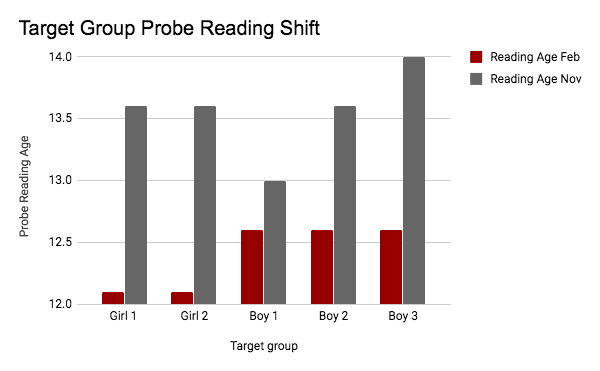
Strengthened connections to vocabulary, content and comprehension strategies have enabled significant shifts in reading age across my whole reading group. The graphics below represent the shifts made by my target students. What excites me about this picture is that 3/5 students made an 18 month shift in reading age, 1/5 students made a 12 month shift and 1/5 students made a 6 month shift when tested on both fiction and non-fiction assessments.


Aside from being able to make sense of more sophisticated texts I noticed their reading behaviours changed. My learners moved from trying to simply recall facts and re-reading a text in entirety, to skimming and scanning for key words and phrases when searching for evidence to support their thinking. The quality of the responses increased as they were able to make stronger connections to language of questioning. Simply put, this meant they knew what the question was asking them to do. I know this because I asked them to think aloud while they were processing the task ahead.


Over the year we have used talk to explore and unpack strategies and scaffolds that have helped my learners strengthen their understandings and connections to a wide variety of texts. A large part of this focussed on personalising the language of instruction and making sure that this was explicit. 
Making use of rewindable learning opportunities enabled my learners to see through their own eyes what they were doing right and where they still needed support. I actively planned for opportunities for talk to take place and used student created exemplars to spark their curiosity and explore new learning in context. 'Repetition without boring' was the key here as we repurposed and tapped into the known to help us access the unknown. 

Disconnects with vocabulary have been our biggest stumbling blocks this year. Moving forward I will be looking at how I can continue to break down the barriers between new words and new learning by capitalising on my 2017 learner feedback to keep the talk going with my learners in 2018.