Showing posts with label Panmure Bridge School. Show all posts

Saturday, 1 November 2025

Unpacking Qualitative Data - My Journey to Balancing Rigor and Transformation...

My central motivation for this inquiry stems from a concern that the necessary rigor of the Structured Literacy framework could unintentionally stifle creative expression and deep demonstration of learning. 

My perspective is rooted in my own educational experiences from a time dominated by repetitive, uninspired reading consolidation (the classic ‘duplicated worksheet’ era) where genuine engagement was rare. The moments that truly stood out were interactive like using the listening post or, more enjoyably, performing plays, especially when we could create our own costumes or masks.

This pattern continued early in my teaching career. I often defaulted to guided reading worksheets that, despite having diverse texts, asked the same predictable questions, which stifled independent thought. While I attempted to introduce new ideas, limited classroom technology and a lack of accessible Professional Learning and Development (PLD) hindered my sustained pedagogical growth.

When I joined the Manaiakalani cluster I was introduced to a culture of continuous learning and innovation that prioritises student engagement. This culture intensified my fear that the required intensity of Structured Literacy might accidentally regress our practice back to those days of ‘boring repetition.’

This concern drove my inquiry into effectively utilising the 'Create' component within our kura. A core goal of our previous PLD was moving teaching and learning 'above the line' of Dr. Ruben Puentedura's SAMR model—a framework that pushes technology use from simple enhancement (Substitution and Augmentation) toward transformation (Modification and Redefinition). My primary focus for this year was to ensure our literacy instruction maintained its rigor without sacrificing this transformational practice.
Initially, I looked at creative opportunities school-wide, quickly realizing the junior team excels in this area. For early readers, creativity is best fostered by hands-on, collaborative fun, rather than only with digital tools. This realisation saw me pivot for the first time as I couldn't limit my study to only digital affordances if I wanted to fully understand and strengthen 'Create' within Structured Literacy.
My next step was to narrow the focus to the senior team. However, I soon realised that a team embracing new PLD needs time to build confidence and implement change. Feedback from team meetings told me they certainly didn't need me critically observing the create opportunities in their reading lessons. This led to my final pivot of focussing exclusively on my own practice in my Year 7/8 classroom.

Focusing on my own Year 7/8 students (our most capable readers), provided an advantage. Given my existing literacy PLD, I wasn't entering the Structured Literacy framework completely cold. I challenged myself to incorporate the affordances of AI, alongside my well established kete of follow-up challenges, to encourage students to build on prior knowledge when showing their understanding of the new texts we unpacked.

How to use Gems - Gemini Apps Help

A clear example is the inclusion of Gemini Gems in our guided reading follow-up (unpacked in an earlier post). The resulting change has been significant as student responses now feature more extended, student-initiated, and student-led discussion.

Ultimately, when 'Create' is properly embedded, it becomes a purposeful and engaging opportunity for tauira to demonstrate understanding. As educational theorist Elwyn Richardson observed, research shows students learn by actively constructing knowledge—a process that involves breaking down, rearranging, selecting, and demonstrating their understanding so that visualised thoughts were given an opportunity to be created.

Exploring Quantitative Data...

The purpose of this inquiry was to evaluate the integration and frequency of 'Create' opportunities, a key component of the Manaiakalani ‘Learn-Create-Share’ pedagogy, within Reading instruction across our kura.

To measure the shift in practice, analysis was conducted comparing:

  1. Opportunities explicitly planned for by teaching staff.

  2. Opportunities shared via class Digital Learning Objects (DLOs).

  3. Qualitative feedback sourced from Teacher Planning in Term 2 and Term 4 

Confidentiality: Due to the identifiable nature of the small learning environment, all data is presented in aggregated and generalised form. Individual teacher or classroom data will not be shared to preserve the privacy and confidentiality of staff, ensuring the focus of this inquiry remains on collective pedagogical practices rather than individual appraisal.

Quanititative analysis of the data indicates a noticeable increase in the provision of opportunities for our tauira to consolidate their reading comprehension and literacy learning through the 'Create' component of the Manaiakalani framework.

The presentation below unpacks the increase in planned opportunities for our tauira to creatively explore their new learning. The detail in the analysis in reflected in the breakdown of the graphs on slides 4, 6, 8 and 10. It is important here to recognise the fact that our staff have a wide range of teaching experience ranging from less than one year to thirty plus years. It is also important to note that everyone has put a lot of effort into embracing a new curriculum and integrating new PLD, whilst trying hard not to throw the baby of 'create' out with the bath water.

The following factors are hypothesised to have contributed to the observed increase in 'Create' opportunities:

  • Recognition that 'Create' extends beyond digital products to encompass various non-digital outputs.
  • Completion of Structured Literacy Professional Learning and Development (PLD).
  • Targeted staff meeting on the Manaiakalani ‘Create’ principle.
  • In-class support provided by Manaiakalani facilitators.
  • Active sharing of 'Create' outcomes in team meetings.
  • Increased utilisation of blogging as an immediate output and sharing platform.
  • Elevated kaiako confidence in teaching Structured Literacy.
  • Improved kaiako confidence in utilising digital capabilities for task design.
  • Increased staff ownership of accountability for pedagogical integration.
  • Active planning for 'Create' opportunities.
  • Effective establishment of connections between new and prior learning.
  • Development of greater tauira (student) independence, enabling more complex, self-directed creation tasks.

The following factors are hypothesised to account for areas where the integration of 'Create' has seen minimal change:

  • 'Create' opportunities were not explicitly integrated into planning cycles.
  • Lower kaiako confidence in implementing Structured Literacy instructional practices.
  • Lower kaiako confidence in leveraging digital capabilities for task design.
  • Perceived pressure resulting from connecting existing practice to new PLD requirements.
  • Initial resistance to pedagogical change within some practices
  • Disconnects between teacher expectation and tauira capability, particularly concerning the complexity of independent creation tasks.
In summary, this inquiry confidently confirms that 'Create' opportunities are thriving in our kura. We acknowledge the wide spectrum of teaching experience within our staff, recognising that new pedagogical learning often generates self-doubt, leading some to initially favour highly structured, familiar methods. While there is a necessary place for less creative consolidation tasks, the key to effective literacy mastery is 'repetition without boring'. This critical element is demonstrably afforded when students are given agency, choice, and creative opportunity within their follow-up learning.

Wednesday, 19 March 2025

Student Inquiry Foci 2025...

With all our school starting or strengthening our structured literacy journeys this year, I have decided to focus on where the create aspect of the Manaiakalani pedagogy fits in and how we harnessing the digital to explore the create aspect of structured literacy. As I write this our Y4-8 team are yet to begin this journey so my hope is by voicing my hunch, we might avoid overlooking opportunities to create as we navigate our new learning.

I have been a part of the Manaiakalani cluster for many years and know the power the create component in learning has towards helping us achieve the 1.5x accelerated shift we need to ensure our learners are set up for success as they move through their individual learning journeys. 'Creative skills help students become better problem solvers, communicators and collaborators.' (Manaiakalani).

Sourced from Manaiakalani Pedagogy for DFI DLO

Students learn by actively constructing knowledge, not just absorbing it. This involves breaking down, rearranging, selecting, and demonstrating their understanding, so that  “...whatever was in their mind, whatever they could visualise, whatever they could see they created...” - Elwyn Richardson. 

The Apple curriculum supports this thinking and states 'After 40 years working alongside educators, we've seen — and research has shown — that creative thinking leads to deeper student engagement. And when students are more engaged, they take more ownership of their learning. Creative skills help students become better problem solvers, communicators and collaborators. They explore more and experiment more. They tell richer stories and find their own unique voices. They stretch their imaginations and make connections they might not otherwise make — and they carry these skills through everything they do in school. And beyond.' Why Creativity Matters - Apple Curriculum. 

The challenge of student learning is to demonstrate their understanding of a concept by creating something with the knowledge that they have unpacked and internalised. If the create process is overlooked where will we find ways to facilitate discussion and reflection? I can't imagine any student being inspired by. If students are not inspired to learn, then following a preset lesson to the letter will result in a structurally embedded underachievement issue that will see us lose the interest of those readers we have worked so hard historically to capture.

If I look back at my own time at school, with the exception of one year, I can not recall anything in reading lessons other than sitting in a circle reading a text round robin style then being sent back to my desk to answer questions in silence to demonstrate that I had gained meaning from what I had read. There were no opportunities to learn from others, no opportunities for collaboration and no opportunities to talk about the text, let alone creating anything with the information I had found. Sadly this was reading until I was about 9 years old, something I viewed as just a thing we did at school. The one year that stands out saw us being asked to draw characters in a particular scene, make information posters and redesign book covers. That was the year I saw reading at school as fun.

It is because of the very reason just mentioned, that I feel this is the the most important and catalytic issue of learning for our learners this year. I don't want to be introducing and unpacking a text verbally through preset comprehension strategies. I don't want to be the teacher who asks my students to summarise a text on a graphic organiser then leave it there. I want to be the teacher who asks a provocation and encourages talk and creativity. I want my learners to show me their connections to the aspects of the text we are unpacking using the plethora of digital tools available to us. Defaulting to substitution in response to a structured learning process does not, in my opinion, open the opportunities to 'empower my students with creative learning opportunities to help accelerate achievement'.

Wednesday, 1 May 2024

Qu. #2 - Why we judge this to be the most important and catalytic issue of learning for this group of learners this year...

Achieving accelerated shift in Literacy was identified as being one of the most important and catalytic issues of learning facing our students in Y4 - 8, this year, when the time point one data was analysed. Exploring how learning gained from professional development is helping to strengthen teacher practice and achievement in literacy is something I haven't looked at before so I am looking forward to sharing my findings.

As I am not looking specifically into my own practice it is important to maintain anonymity. This inquiry is a syndicate wide focus and therefore not a focus on individual teachers. Our starting point with professional development linked to Literacy undertaken by the senior syndicate (Y4-Y8) in the 2023/24 period consists of:

  • In Class Support (ICS) 2023
  • Reading Program Intensive 2023 teacher/mentor meetings and observations 2023
  • T Shaped Literacy 2023
  • The Code 2024
  • In Class Support (ICS) 2024
  • PRT Y1/2 teacher/mentor meetings and observations 2023/24

To measure the shift I needed clear picture of where our student's starting points were. What to collect for baseline data was something I struggled with as I couldn't decide on the best way to do this. Like many faced with a direction conundrum, the task ahead found its way to the 'I'll do it later basket'. My problem was 'later' became a hard time to find. I knew I needed help and today that help came in the form of Amy Tofa and Matt Goodwin. 

I explained my inquiry focus and together we came up with a way forward that made sense to me. A really useful piece of advice here is to talk to your colleagues as saying things out loud and getting a 2nd opinion, or 3rd in my case, is one of the most valuable resources we can tap into. Amy pointed out to me that the picture I was trying to capture was huge and suggested I focus on one group of students. I am 100% taking her advice to focus on our students who scored 'Below' on our beginning of year literacy assessments.


The data above shows the percentage of our Year 4 -8 students who scored Below expectation on the PAT Reading Comprehension and e-asTTle assessments. I will be using this data to measure the shift made between the two cluster wide assessment timepoints in my target group. 


Tuesday, 30 April 2024

Qu 1: Student Inquiry Foci...

With the Manaiakalani goals of achieving 1.5 years progress inside a year (big 3), improving teacher practice, increasing attendance and hauora in mind, Richard Johnston, (our principal), challenged me to look at 'How we (PBS) are using PLD to accelerate shift across our school'. Having inquired into my own practice for many years I was excited to embrace this much bigger school wide focus. However, when I sat down to map out the way forward I realised I could make more impact if I looked across my own team, the senior syndicate.

To do this I am going to need to drill down into student achievement and teacher planning across our syndicate and look closely at how my team is using their new knowledge to change their practice and accelerate shift in student achievement in Literacy. To ensure this new learning becomes embedded within teacher practice we capture the journey via our appraisal system. This gives both myself as the appraiser and the teacher as the appraisee, a shared vision of how we can both contribute to their professional growth moving forward. It also means I can, to quote Russell Burt, capitalise on my role as our in school COL teacher to lead the teacher inquiry process to help 'build teacher and school capability in raising student achievement outcomes by linking evidence to practice.'

When looking at our class data we already have processes in place that allow each teacher to identify where the gaps are and think about why these gaps might be there before we can begin to fill them. It is not about trying to fix everything but rather strengthen the areas that need the most focus. In our team we do this both individually at class level and collaboratively at syndicate level. It helps to identify the commonalities so that we can move forward together learning with and from each other along the way. I will share this process in my next post.

My challenge now is to find out how I can capitalise on the learning gained from professional development undertaken by my team to help accelerate shift across our Year 4 - 8 classes. When I unpacked my journey forward I realised it's not about only strengthening teacher practice but also about how we can harness the creativity and power of our new learning to strengthen student engagement and spark curiosity in literacy.


Monday, 5 June 2023

Teacher inquiry at PBS 2023...

This year Dianne Fisi'iahi and I are both in-school COL teachers for Panmure Bridge School. What I like about this is that there are two of us leading the implementation of teacher inquiries for 2023. This means neither of us are trying to find time to have the professional discussions needed with our colleagues. By sharing the responsibility we are able to manage this much more effectively than past years. I look after the teachers participating in the RPI program as I am their mentor, and our beginning teachers. Dianne looks after the more experienced teachers. This means we are playing to our strengths and guiding teacher inquiry effectively in our school.

We began our journey by using the presentation I created a few years ago which helps us set up our PBS staff for their inquiries into their own practice. With two sets of eyes we have adapted and tweaked my original slides, making our inquiry process more streamlined. I am also enjoying the fact their are two voices delivering the messages, which means we can support each other in staff meetings. 


We began by supporting our teachers to analyse their data to find the gaps in learner knowledge, then use this to identify a target group and formulate their inquiry questions. All inquiries are visible with links to professional blogs being recorded on a shared doc so that we can learn with and from each other. Our second TAI session was about creating a causal chain to help map out inquiries and stay on track. Both of these TAI staff meetings have been shared with a purpose to encourage buy-in and inform blog posts. 

Dianne and I share our inquiries as exemplars to guide those new to this process. We have also shared the link to the Manaiakalani Kahui Ako page so that teachers can find exemplars of inquiries that align with their year levels. Our next step is to encourage our PBS teachers to tap into the expertise of the Across School COL teachers. 

Friday, 17 March 2023

Our First Footsteps into Word Consciousness...

After attending the PLD: Supporting students to become confident and competent spellers run by Louise Dempsey I put some of my new learning into place. About 1/3 of our class are participating in the STEPSWEB program which opens up a slot on our timetable for the other 2/3 of our class to focus on growing their own word knowledge.

Introducing affixes:

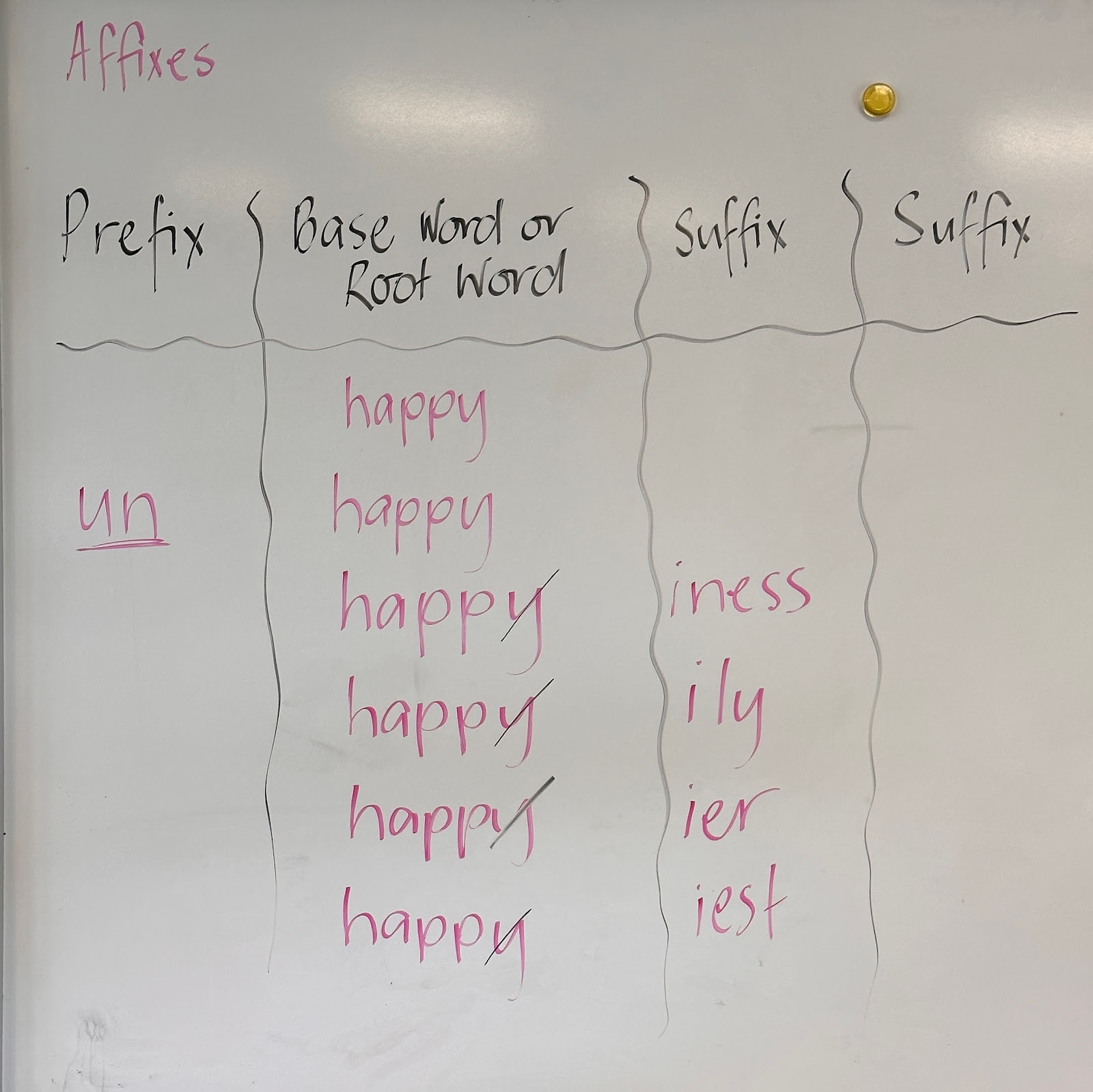
I used a template shared by Louise that shows how base words become completely different words with the introduction of prefixes and suffixes. We began by defining base words as being a complete word by itself that prefixes and suffixes can be added to make a new word. The example we used was the base word, happy. I then challenged my learners to make new words that had the word happy in them. At this stage we had only the knowledge of affixes that we brought to the lesson. As the words were generated from known words I filled in the template on the board (see image below).


We then explored possible reasons why I might have written some parts of the words in different sections of the table. A question that opened the doors for the introduction of the words prefix and suffix, and allowed us to unpack what these words might mean and what effect they had on the base word. All devices were closed at this time which gave me the opportunity to introduce the dictionaries and thesaurus' that were in all honesty, sitting on the shelf gathering dust. Having become so used to opening Chromebooks and defining words meant a quick lesson was needed on how to use a dictionary (or 'paper google' as it has now become known as).

After this I set my learners the challenge of building a word list using the base word excite. To make sure we were selecting actual words, only words generated that could be found in the dictionary were able to be recorded. We then unpacked what each of the affixes meant and explored how they changed the based word.  
Eg: the prefix over (too much or more than normal) + the base word, excite (being enthusiastic or happy) = over excite (more than normally enthusiastic or happy). 

Deziah's blog post explains this activity - (shared with permission).


Wednesday, 1 March 2023

Qu. #2 - Why we judge this to be the most important and catalytic issue of learning for this group of learners this year...

Last week after talking to the teachers I am mentoring in the RPI program I was reminded of the Reading for Enjoyment survey I did last year to get to know my learners as readers. In a conversation with Dianne afterwards, I suggested that we could try to create a similar survey that would help us get to know our learners a spellers. Our Principal understands our concerns with regards to spelling abilities in our current class and is fully supportive of our proposed inquiry into word consciousness. 

The results of this survey are below.


We judge this to be the most important and catalytic issue of learning for this group of learners this year as the results here affirm our initial thinking that a deficit in word consciousness and a 'fear' of getting words wrong, limits the level of vocabulary used in independent writing, and causes meaning to be lost in reading. It will be interesting to analyse the self efficacy rating and the spelling level given when the e-asTTle writing assessment data is complete. (NB: Our plan is to look at the current and historical data of the e-asTTle writing, PAT Reading and the Peter's spelling test to identify trends). 


Qu 1: Student Inquiry Foci...

This year Dianne Fisi'iahi and I will be undertaking a collaborative inquiry. What this will look like exactly at this stage is still on the drawing board although we do know our purpose. This year we want to find out if a focus on spelling conventions will foster an environment where word consciousness strengthens connections to the learning.

We teach a Year 7/8 class with 40 learners, all who bring a wide a varied connection to the conventions of spelling to the table. We know from past experience and from what we have observed so far this year, that our learners physically stop writing, stop reading and avoid sharing back to the class when they lose the connection to words needed to continue to make sense of the learning. There are many reasons as to why this happens but rather than focus solely on that, we want to focus on how we can prevent this pattern from continuing to evolve into a hurdle that is too challenging to get over. Our thinking is that if we begin to develop these skills and understandings, the transition to language of instruction used in Y9 may be strengthened by stronger connection to word knowledge.

Having decided on our inquiry focus this year, Dianne and I spoke with Anna Salmon, our Reading Recovery teacher about the barriers children in the junior school face with spelling, and how she helps the students she is working with to overcome these barriers. We came away from a very rich learning conversation with lots of ideas to pull together a tentative pathway forward. Here are the notes we made to help us formulate a plan going forward

'Word consciousness involves being aware and interested in words and word meanings (Anderson & Nagy, 1992; Graves & Watts-Taffe, 2002) and noticing when and how new words are used (Manzo & Manzo, 2008). Individuals who are word conscious are motivated to learn new words and able to use them skilfully '(Sourced here). Our challenge now is to find out why the links in the chain appear to be broken again. Last year I began my inquiry by getting to know my learners as readers through a survey. This year we plan to use this strategy to get to know our learners as spellers. To do this we will be looking at shift or change in:

  • Disposition
  • Data
  • Word consciousness
  • Student voice
  • Strategies used to make sense of new or unfamiliar words

Further Reading/PLD to grow my own knowledge kete:

Tuesday, 22 March 2022

Teacher Inquiry at PBS...

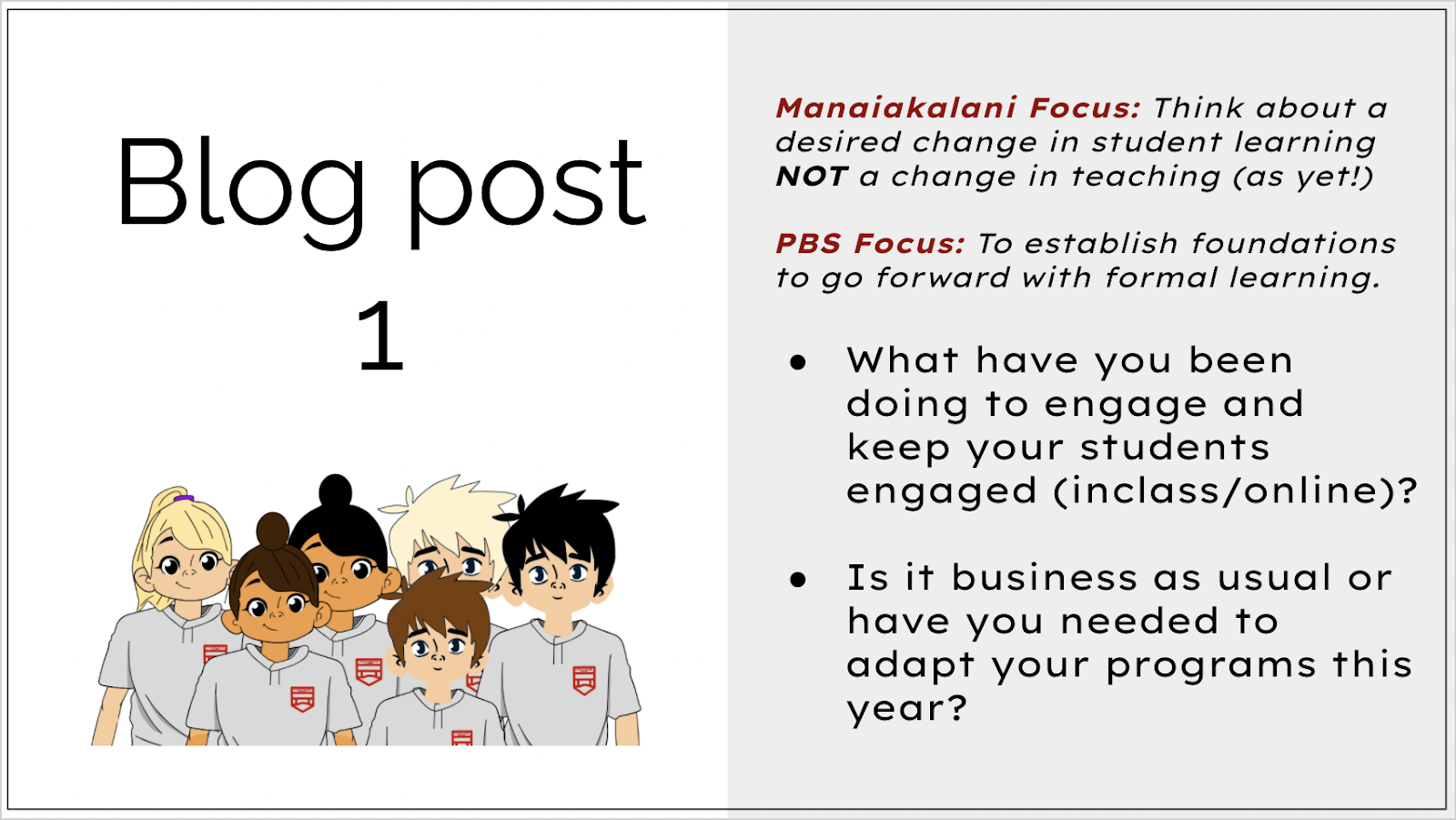
At Panmure Bridge School we decided as a school and before our students returned in February, that our initial inquiry focus would centre around student engagement by establishing foundations to go forward with formal learning. To support this at a school wide level we have started with syndicate discussions using the questions the COL teachers discussed at our first meeting.


This will then followed up with a blog post that encourages everyone to think about what it is they have been doing to engage their students and keep them engaged in class and online. We learn best we we learn from each other and in our current situation, this will be such a powerful resource to have at the end of the term because each and everyone of us is constantly changing and adapting what we are doing in our rooms.


Thinking ahead to Term 2 we will be using our data to form the basis of our individual teacher inquiries. As a school we will have an overarching focus on Reading, but at teacher and class level this picture will look quite different. Having an idea of the way forward allows teachers to start thinking about the direction they will take. As always having an overarching focus allows for the conversations to flow as we bounce ideas off one another.

Monday, 26 July 2021

How I'm helping our staff as the in-school COL teacher for PBS...

As the in-school COL teacher for PBS part of my role is to guide the teacher inquiries of our staff. I have held this role for a number of years and because of that have had the opportunity to adapt and refine the ways I do this. If you're new to this role this post might be useful to you.

In Term 1 shared an overview of the purpose behind teacher inquiry at a staff meeting. Doing this helps us all get on the same page. Like many schools we have new staff this year so giving a shared message helps get the dialogue going. Graeme Aitken asked, “How can we come together and integrate our expertise and our knowledge to address significant problems?”  At our school we look at our data and use that information to guide our overall shared focus. We have found that by doing this for a number of years we get better traction as we have each other to bounce ideas off.  

From there teachers look at their own practice along with the data from their class, and begin thinking about how they are going to move forward in a way that allows them to grow professionally. It is at this stage that teachers are reminded that an inquiry into teacher practice is about the changes we make to help our students strengthen their connections to the learning. It is our what we do and how we do it that we unpack, reflect on and adapt.

The focus for Term 2 was to form our individual focus questions, choose a focus group, capture time point 1 data, and create a causal map to guide our inquiries. All of this data is then shared in a blog post that teachers can use as a foundation to build their inquiries on. To help ensure everyone is on the same page I created a google presentation (shared below) that aligns with the one the COL teachers use. This is a step by step 'how-to' so that everyone is empowered to begin their spiral of inquiry. I chose to share this DLO with a tern by term focus as that way no one is overloaded and everyone walks the journey together. 


In addition to this I have termly 'check-in' chats with everyone. This helps us stay on track and helps teachers to keep their inquiries alive by talking about what they have done so far and what their next steps will be. It is an opportunity to ask questions and have rich and real conversations that help us work towards our goal of accelerated shifts in student achievement. 

Wednesday, 29 July 2020

Making Connections to Problem Solving with Tangrams...

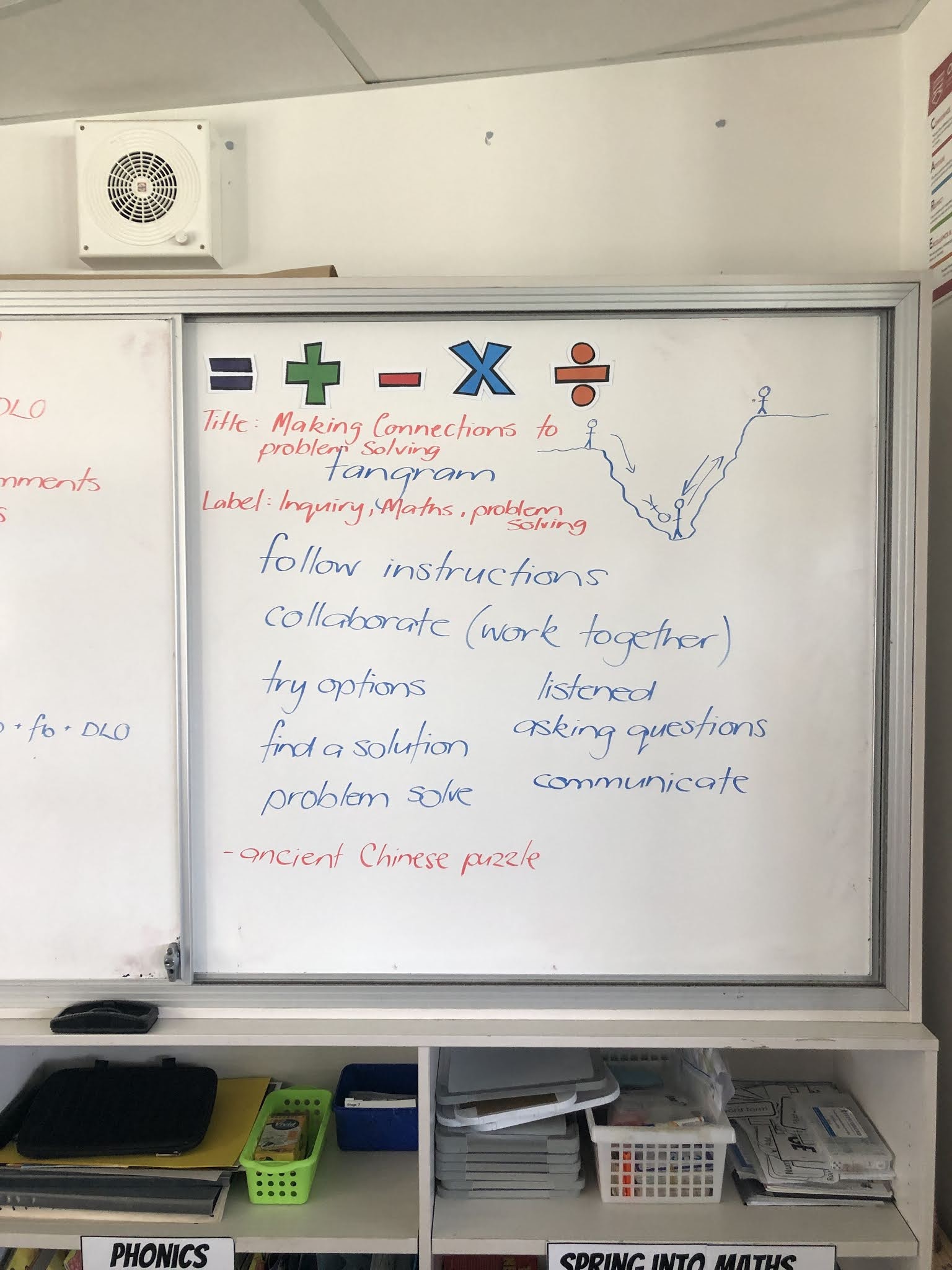
A small glitch with our internet connection this morning opened up a great opportunity to make the most of a teachable moment. Having been taken through the process of making my own tangram puzzle in a recent staff meeting I decided this was the perfect time to introduce this puzzle to LS1 and LS2. We had already come together as a block this morning for singing practise so decided to stay together for the learning experience, which meant we had a huge range of abilities as the students ranged from Y5 to Y8. There were no templates, no rulers, no pencils... just lots of smiling faces, blank pieces of A4 paper and lots of pairs of scissors. 

The instructions I gave were not written anywhere which gave me a great opportunity to remind everyone about the importance of listening carefully and asking questions. I made sure my instructions were explicit and found myself making folds and cutting along folded lines with my back to the class and my exemplar in the air, something far easier said than done! Along the way as each piece of the puzzle appeared I introduced the content language of 2d shapes so that each piece was referred to by the correct name and not 'this one' or 'that one'. 

Our students are really good at collaborating so without being asked I noticed my class immediately stepped up to support the younger ones. This learning experience was a very loud one as I encouraged everyone to talk to each other about what they needed to do at each step. Interestingly we only had two puzzles that needed to be remade. 


Organisation was one of the keys behind the success of the 'making' task and as we were using the content vocabulary collecting the offcuts was a breeze. Once all the pieces had been cut I asked everyone to mix up their puzzle (something quite hard to model in the air!) and put the pieces back together to make the original square. This is when the real conversation happened. There was a wealth of problem solving strategies being used so I took advantage of this and unpacked it further. 


After morning tea we all came back to take part in the 'fun' challenge component. Greg Wong took the students who had made their tangrams through the challenges of creating animals from the shapes while I helped the group who had been at puberty talks to make their tangram. Team teaching was then the order of the day with Greg explaining the history behind the puzzle and me process of problem solving. As a result we were all able to make connections not only to the content but also to the origin of the puzzle and the process of problem solving. The blog posts from both classes reflect the learning, the fun and the content language that was revisited today.

Friday, 24 April 2020

Distance learning with LS2... Week 2

This week has been a very busy week for LS2 as far as distance learning is concerned. My amazing students have created a wide variety of DLOs that showcase their understanding of the tasks as they keep their learning going. Each day Linda (TA), myself and the students come together as a class to set ourselves up for the day, celebrate achievements and share work. Having Linda join us has been a real blessing as the students see both their teachers everyday, and whilst I have been kept really busy marking the work she has been kept equally as busy commenting on blogs. Teamwork at it's best!

In these sessions I have been asking my students to present their work as it helps us to continue to learn with and from each other. What's lovely to hear is the feedback they give each other after the presentations. LS2 has always been a collaborative learning environment, but what has impressed me is that despite being in their own family bubbles, many have kept this collaboration going. I'm enjoying reading the conversations taking part in the comments section of DLO's, and on many occasions I've joined in to give feedback. 


Florence presenting her timelapse movie showing the process she went through to make her poppy wreath. 

We have had to iron out a few areas and set very clear expectations as far as avoiding the temptation to simply click 'resolve' when I leave feedback. After talking everyone through this, especially my new learners, there has been some very rich learning conversations taking place and I now have a wealth of evidence to feed forward into my future planning. 

Another area we needed to revisit was the need to make sure all work was filed in the correct folders in our google drives. We also run a 'completed work' spreadsheet where links to completed work are posted. We've had a few hiccups here with work that isn't filed being linked as I can't access it correctly. However, when I think that these have been our only glitches so far, I can honestly say LS2 have been fully engaged in their distance learning.

When I think about my own learning this week I have definitely strengthened my skills when it comes to explaining things, with step by step snapshots of a process and emailing them to the person who needs this support being a great go-to if Google Meets are not an option. I have also noticed that my instructions are definitely a lot clearer and more succinct. My biggest success has been when Linda and I used a Google Meet to guide a student who had prior to lockdown, only been at our school 3 days, with how to post a variety of DLOs on her blog. This student came to us from overseas and had never used Google Docs before so each step of our distance learning has been new for her. What I have loved is that she asks questions and whether these have been answered in our Google Meets, by emails sent to me or to her friends, or by both of us working on her DLO at the same time her initiative has meant she has found a huge amount of success. 


Year 8 working with Mr Grundy

This morning we had our LS2 catch up then went off to Tech with Mr Grundy and Ms Ferguson at Tamaki College. After Tech we tuned in for our first Panmure Bridge School livestream assembly. This was such a great way to end our learning week as Mr Johnston was able to present virtual certificates to students who are making a huge effort to keep their learning going from home. Richard, Kiri and Anna this was a huge success and an extremely awesome way for all our PBS family to stay connected.


Wednesday, 18 March 2020

TAI 2020 WFRC Question #2...

#2... Collaborate with your senior leadership team and colleagues to identify areas where your inquiry will make a powerful contribution to wider school and cluster goals.


For the last 5 years Panmure Bridge School has claimed the Summer Learning Journey's overall prize for top blogging school, something we are extremely proud of and value highly. The Summer Learning Journey (SLJ) is a blogging challenge that runs over the summer holidays. This programme 'was created in response to concerns about the annual drop, slide or slump in literacy achievement experienced by students in New Zealand schools' and encourages our students to use their literacy skills which helps set them up for success and by maintaining the gains made over the school year.

The feedback from the SLJ team was that our participants had strengths in blogging, however, seemed to drop the ball when it came to the commenting component. Many of our learners either overlooked responding to comments made on their blogs, or simply replied with a thank you. Why did this happen? Not because our students were 'lazy' but possibly because as teachers, we had not set them up for success in this area. With that thought in mind I want to build on the learning from my 2019 inquiry and align our school-wide professional development focus of maths to find out if 
strengthening connections to Smart Relationships will help our tamariki to understand and use maths language and vocabulary in context?

Over the next few weeks I will be working alongside all our teachers to help them create their own backwards maps. This tool helps individual teachers to narrow the inquiry pathway they wish to travel along and they personalise their connections to our wider shared focus. 

After speaking with Hannah West, who kindly shared the blogging rubric she created for her learners last year, my plan is to work with our PBS team to co-construct a rubric that is personalised to our school. This will allow our learners to see where they have met the success criteria and what it is they need to do to move their own learning to the next level. By creating a rubric specific to the shared language of Panmure Bridge School, our teachers and students will have ownership of the tool that will allow us to measure student progress, and help our tamariki see that learning linked to vocabulary, instruction and strategy used in one area can be transferred to another. 

In class we actively plan for, and teach our students how to participate actively in a dialogic learning discussion. They are skilled in this area when asked to do this in class, but as yet most of our students are not carrying this thinking through to their blog commenting. In addition to actively planning time to allow our students to use maths language and vocabulary in context a number of our teachers are participating in the Tuhi Mai Tuhi Atu ('Write to me, Write to others') programme. Tuhi Mai Tuhi Atu helps connect learners across the Manaiakalani and outreach clusters through blog commenting and will help provide authentic opportunities for learning conversations to take place under the cybersmart umbrella.

Monday, 4 February 2019

PBS TOD: Exploring 'create' through clay...

Today we had a fantastic TOD (teacher only day) that added richly to our own baskets of knowledge. Through a variety of fun challenges Richard helped us to strengthen our own connections to ways we can bring 'creativity' into our teaching programmes to help our learners strengthen their connections to the learning. 

My takeaways from this session were:
  • Creativity is a powerful tool for strengthening connections.
  • Creativity should be valued.
  • Creativity helps learners engage and inspires curiosity.
  • Creativity helps learners to choose to think instead of simply remembering.
  • Creativity stimulates imagination.
  • Creativity strengthens innovation as it allows opportunities for good ideas to be put into practise.
  • Everyone has a creative capacity. 
  • Creativity is not about reinventing the wheel, it is about refining knowledge, thus becoming a collaboration of events. 
  • Creativity promotes opportunities for rich conversations.
  • Creativity helps learners to use content vocabulary in context.

Our final session today was an opportunity for us to explore our own creativity and was definitely the most fun. We were all challenged to create clay bird figurines! Our teacher Barbara, scaffolded us and pushed us way outside most people's comfort zones. As with anything when you are trying to make connections to new learning you tap into what you already know. For me that meant realising I had a figurine at home similar to the exemplars shown. Immediately that meant I had a small connection to the learning. With that connection in mind I set about forming the body of my bird. Accidentally pressing too hard when I was forming the neck gave me the tilt in the head that I wanted. What I noticed then was that I immediately felt an increase in my own confidence. This meant I was keen to apply the new learning of attaching a tail. Attempt one was a disaster so I quickly adapted my thinking and noticed I was using a trial and error approach to improve the aesthetics and proportions. I realised I naturally asked questions to clarify both vocabulary and methods. 

(My finished bird)

The vocabulary clarification sparked my curiosity and was something I did without thinking but something I thought would be a challenge for learners who do not have English as their first language. The word in question was 'slip'. When I heard it I naturally formed an image in my head of falling over and most definitely not the mix of water and dried clay it turned out to be. The creative aspect of the learning meant I was able to gain and apply meaning in context. When I sat back and observed for a moment I realised we were all using the newly introduced content language in context...slip, grog, smooth, adhere, texture, shape... rich conversations were naturally evolving as we shared our successes and asked for guidance.


Every part of this session showed me first hand how empowering and powerful building creativity into my programme can be for my learners, and was most definitely a fun way to begin our PBS 2019 learning journey together!