Friday, 19 July 2024

Mapping out my Hunches...

Mastery, in the context of professional development, goes beyond simply acquiring new skills or knowledge. It's about achieving a deep understanding and proficiency in a specific area of your field. It's a continuous journey of improvement, fuelled by a desire to be able to use the new learning effectively. 

If I think about myself in this situation. When I am introduced new strategy or concept in maths I usually switch off or shut down because I don't immediately understand what it is that I am being asked to do. Falling back on what I know and understand feels like a much safer option than been seen to 'fail'. It's not because I don't want to jump on the learning train, it's more that where maths is concerned, it takes time for me to process, understand and internalise the new learning. This differs greatly from my teaching buddy who has the ability to simply look at the new maths learning and somehow has the knowledge of how to use it and impart it with confidence. In maths she is a quick adapter and luckily for me is always happy to walk me through the new learning at a pace that works for me. As I said earlier it's not that I don't want to embrace the new maths learning, I simply just need more support to be able to make the shift in mindset and in practise. 

To guide my direction and help me narrow my focus I asked my team:
  • What ideas from recent literacy PLD are you currently using?
  • How has this strengthened your program?
  • What encouraged you to make these changes?
  • How does the PLD help shift student achievement?
  • What stops you implementing new PLD?
From their responses I have compiled a list of hunches as to the possible reasons why teachers why choose to embrace or not embrace PLD. Although in the infographic below these are numbered, they are not listed in order of importance.


Tuesday, 16 July 2024

PLD 2024: Understanding Autism Spectrum Disorder: Knowledge to Improve Student Learning, Participation and Outcomes.

I have recently completed the online course run by Sue Larkey, Understanding Autism Spectrum Disorder: Knowledge to Improve Student Learning, Participation and Outcomes. This has given me a huge insight into the minds of those students in our kura with Autism Spectrum Disorder (ASD) and will help me as a team leader to support my team when my support is needed. 


An analogy that resonated with me was that a child in a wheelchair needs a ramp to access a building and will need this throughout life. Age is not a factor as the same need is there, regardless of age. ASD students need their ‘ramp’ to navigate successfully through all years of school so we need to leave supports in place to help these students gain and keep independence to be able to access the learning. These children need repetition and structure as their needs are the same and should not be taken away. People with ASD do not suffer from ASD they simply have a neuro diverse outlook.

My takeaways are:

  • Each child is different and one size most definitely does not fit all. 
  • ASD is the term used to encompass a neurodiverse diagnosis
  • We need to all be on the same page when it comes to supporting out tauira.
  • Communicate by starting the sentence with a name - this is the most important word as students know you are talking to them 
  • Think about the words you are using
  • Stay calm
  • Persistence and consistency are the key to effecting change
  • Choose your battles by thinking about what the educational outcome is that you are trying to achieve
  • A diagnosis allows for support but as tecahers we can not disclose a diagnosis without parental consent
  • It is easier to change the structure than its is to change the child. Teachers need to think about what can they can put in place to effect change. (eg: having extra pens for those who just can’t find one rather than having a battle each time a pencil can't be found).
  • Structures and adaptations are about equity to allow all to access the curriculum on an equal platform
  • Different people need different structures and adaptations at different times
  • If you take away the glasses from someone who wears them they replace this with body behaviour eg: squinting… if you take away the support structure they replace this with behaviour defiance
  • Visual prompts, pre warning and time to process allow for success to be achieved.
  • Embrace difference to make a difference
  • ASD children engage and socialise differently to peers so often get left out

Here are my notes


Monday, 1 July 2024

ISTE 24 Denver: Choose your own Adventures

Presenters: Belinda Howell and Dan Larson

Pick a path stories or choose your own adventures are not a new idea. What I liked about this poster session is how AI can be used to generate the text and the images. My biggest takeaway is how this activity can be used with events in history or provocations. The example I saw was asking students to choose one side and provide options/outcomes for making their choices. This can also be used to show mastery of concepts and definitions. when using AI you give the prompt feedback to change if what was generated doesn't suit your purpose, 'pretty much have a conversation with the AI you are using'.

Story Map and create adventure in Google forms


Multiple choice or select down - required response

AI to write prompts and generate images


https://sites.google.com/aldineisd.org/techededu/choose-wisely-creating-digital-choose-your-own-adventures-with-google-form/choose-your-adventure-choice-board

Independence and Empathy: enhances students’ agency and autonomy but also cultivates empathy as they navigate diverse perspectives and outcomes. Personalisation: promotes personalised learning experiences, catering to individual interests, preferences, and learning styles. Deeper Learning: Through branching storylines and interactive elements, students are motivated to explore, experiment, and collaborate, leading to deeper comprehension and retention of content. Feedback and Reflection: Facilitates immediate feedback and reflection, empowering students to learn from their choices and adapt their strategies accordingly.

https://sites.google.com/aldineisd.org/techededu/home

Canva for image generation
Focus here is to get engagement in the classroom

ISTE 24 Denver: Canva Tips and Tricks

Presenter: Kathy Schrock - Snapshot session

Sign up as educator for free
Saves time
Instructions includes
Online background remover
Screen recorders
Free stock pics + premium
Video creation
Songs available
Photo editor

Colour wheel - match and complimentary palette suggestions

Magic shortcuts - animations while presenting,
B - blur
C confetti
D rumroll
M mic drop
A quiet
U curtain call
1-9 for timing

Cartoonify - add image tap cartoonify and it changes to cartoon

AI pictures
Ai image gen
Type in what want

Add a background
Image
Edit background
Outline shadows - like drop shadow

Photo integration
Pixels/pixabay
Apps
Use search
Add app to canvas

Design size guide

This helps to size DLO for platform using

Translation
Chat gpt for phrase in other language
Import to canvas for translation back to English

Save anywhere

Share - more - save group eg drive
1100 fonts
Canva font genres will help with this
Tells what fonts go together
Magic expand

Click on photo want to edit
                                           
Magic expand
Resize and magic switch
Choose image to resize and select format of DLO - it will resize

Remove bg
Canva create design - move image direct into your project

New features
  • Removed clutter
  • Tool for lots of pic editing in one place
  • Includes AI magic grab
Screens.com for videos


ISTE 24 Denver: Discover Denver! An Inquiry Adventure Featuring the City, a Smartphone & YOU!

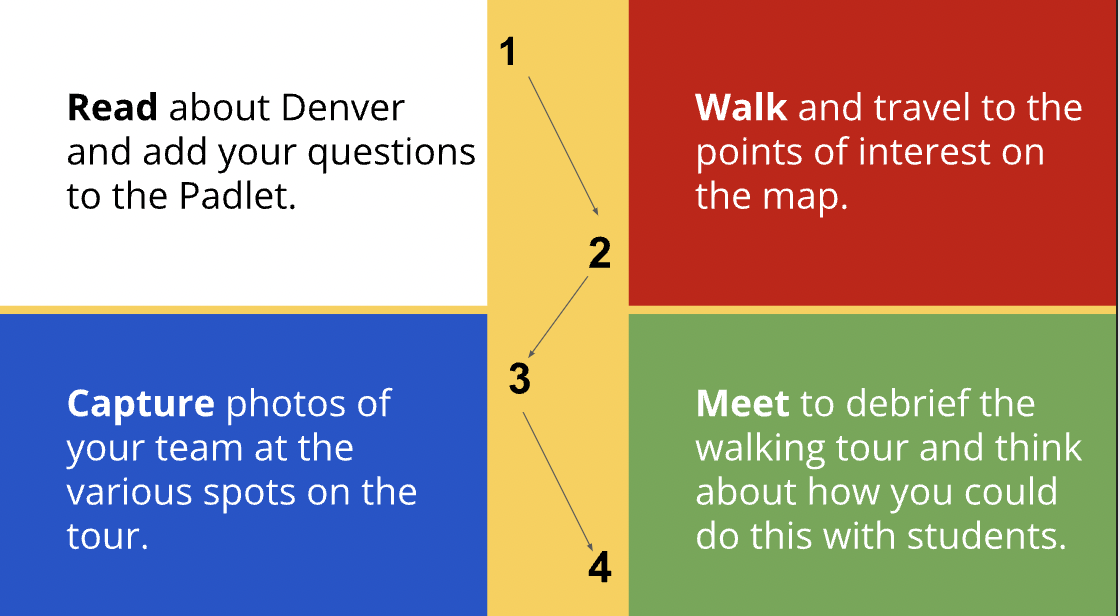
This was an inquiry based hands-on lesson that put us in the shoes of our learners. Could be used for topics eg: Our Whenua or for school trips eg: Historical Village (this would require a teacher pre visit). Due to timings this would be a great activity for anyone needing to walk new teachers through the inquiry learning process. Achievable challenge for SEN/ESOL if Padlet resources were simplified. Ours had a photography component to it which kept everyone on-task and continuously generating questions as we moved between places.


Site link


Purpose - To learn the history behind the buildings 

  • Curiosity is the strong desire to know or learn something

  • Inquiry based learning triggers curiosity

  • Inquiry positions learners in an active agent stance

  • Be an active tourist - notice things, be involved, give students a role to play and they’ll imagine and become curious

  • Look for civic pride 

  • Inspire with some photos 

  • What’s the story about who lived here before us?


Grouping Strategy:


  • Padlet - read about Denver - construct questions - decide roles

  • Self directed walk with a specific meet up point half way through

  • Padlet with multimodal resources - read, view, listen to build background knowledge


  • 10mins research before walking - show pic of point 1 


Good thinkers ask questions to ignite curiosity 

Process of the challenge:

  • Front load - generate questions and add to list on the way 

  • Collaboration

  • Take creative photos 

  • Reflect 

  • Edit photos 

  • Create a collage 

  • Add a 6 word story to describe the story behind your images


ISTE 24 Denver: Slay Vocabulary with your Student

This was my favourite session by far! Vocabulary development is a hurdle I am faced with every year. Like many of us I find the words our learners use in class never seem to appear in writing samples, and the vocabulary in PAT assessments are the catalyst to the lower scores that simply do not reflect the ability shown in the room. I am really excited to introduce the ideas below to my students as I hope this helps them make stronger connections to a wider variety of words they can recall and use independently.

Presenter: Gabriel Carillo

Session Description: Learn five vocabulary retention strategies that go deeper than just "understanding." Participants will go through these interactive and engaging strategies as a student to have the student experience. They will then create their own activities and learn how to best utilize them with students.

Great American Race/Marathon - Slides 4-12


  • Create eg: 40 blank slides - Students must have edit access

  • Give our cards… If you have card 1 go to slide 1 - each card has a word on the front and a number on the back


Sushi


1


  • Go to numbered slide and describe in own words 

    • Can find an image but can not use the word on your card

    • Can research/define

  • Give a short time limit

  • Remove edit access to stop anyone adding things after times up

  • IEP students do not get the more challenging words


Class then guess words from the clues

Go through as a class

T to edit and add to word bank - this can be topic based


  1. Pic 1 = sushi


25,000 - 25K Pyramid - Slides 12-15

  • Find a partner - one is A and one is B

  • A look at screen

  • B face back wall

  • Give clues for partner to guess words in pyramid - can’t say the words but can give clues 

  • You have 1 minute to guess all the words

  • Repeat throughout units using different words


Flashcard Factory - Slides 15-17

  • joinpd.com - takes you to pear deck - generates a code to enter - free site
  • Puts chn into partners
  • Ptnr A gets the term and definition - must write in a sentence
  • Ptnr B must draw it

You collaborate online to complete the card and it falls from the list

‘Quality control’ to share with class - review and decide if sentence makes sense then tick yes or no

Cards are anonymous

Ship - export to Gimkit Live - creates a quiz using flashcard set

Peardeck - flashcard factory - word: Democracy click on definitions in dictionary.com, or chatGPT - out words and definitions in a google sheet - copy word list/definitions and paste in peardeck


Emoji Vocabulary - Slides 18-35

  • Guess the word based only on the clues provided by the  emojis

  • Emoji + emoji + emoji + emoji + emoji (chicken + fries + ham + cheese = chicken cordon bleu)

  • Based off these emojis what moment in history, what maths, what…


Climb a Mountain - Slides 36

  • Nearpod.com

  • Free feature - like quizziz, kahoot

  • Students asked a question or given a definition.

  • They have 3-4 options to choose from

  • Students enter their response at speed

  • When the time allocated is up the avatars of those who responded quickly jump and begin the climb the mountain

  • Can pull up a report

  • Click time to climb 

    • Teacher to put in terms and definitions 

    • Will need to copy and paste can’t import 


  1. Focus on key concepts and vocab terms not the vanity of the tools

  2. Be creative as activities can be mixed and differentiated

  3. The tech tool is not the centre of the activity, the interaction is