Showing posts with label multimodal. Show all posts

Monday, 1 July 2024

ISTE 24 Denver: Discover Denver! An Inquiry Adventure Featuring the City, a Smartphone & YOU!

This was an inquiry based hands-on lesson that put us in the shoes of our learners. Could be used for topics eg: Our Whenua or for school trips eg: Historical Village (this would require a teacher pre visit). Due to timings this would be a great activity for anyone needing to walk new teachers through the inquiry learning process. Achievable challenge for SEN/ESOL if Padlet resources were simplified. Ours had a photography component to it which kept everyone on-task and continuously generating questions as we moved between places.


Site link


Purpose - To learn the history behind the buildings 

  • Curiosity is the strong desire to know or learn something

  • Inquiry based learning triggers curiosity

  • Inquiry positions learners in an active agent stance

  • Be an active tourist - notice things, be involved, give students a role to play and they’ll imagine and become curious

  • Look for civic pride 

  • Inspire with some photos 

  • What’s the story about who lived here before us?


Grouping Strategy:


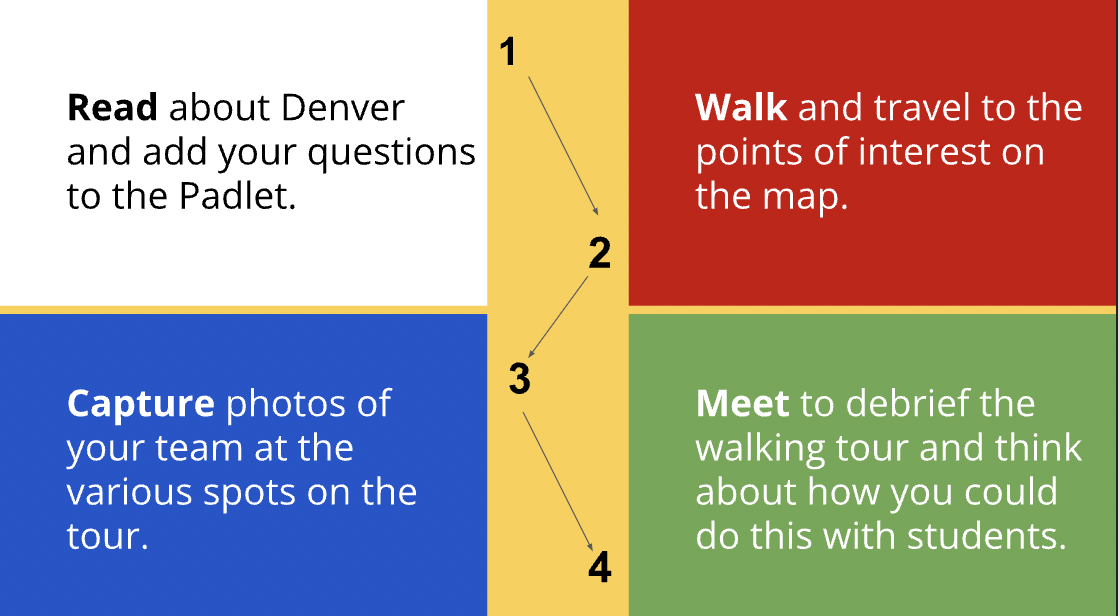
  • Padlet - read about Denver - construct questions - decide roles

  • Self directed walk with a specific meet up point half way through

  • Padlet with multimodal resources - read, view, listen to build background knowledge


  • 10mins research before walking - show pic of point 1 


Good thinkers ask questions to ignite curiosity 

Process of the challenge:

  • Front load - generate questions and add to list on the way 

  • Collaboration

  • Take creative photos 

  • Reflect 

  • Edit photos 

  • Create a collage 

  • Add a 6 word story to describe the story behind your images


Friday, 28 June 2019

Digital Fluency Intensive... Day # 5

DFI Session# 5 was about collaboration with sites. Making learning visible is part of our Manaiakalani learning kaupapa. Simply put visible learning means you can see it? Can our whanau see what their tamariki are learning? Can our tamariki see their own learning pathways? Our technology can remove the barriers that stop this from happening and will help contribute to their success in learning.

Learning shared in advance makes a difference to our learners. Modes are the methods we use to engage our learners. We need to hook our learners in so they remain curious and inspired rather than simply looking and walking on. Multimodal captures the learning of a number of learning styles rather than just one size fits all. 
“What engages one in learning doesn’t necessarily engage another...”(Chrissie Butler). When planning teachers should ask ‘Will this hook my learners?’ If not think again to avoid losing the learning connections that can be made.
 Image result for sites logo
Google Sites:
  • Sites.google.com or if in drive: New - more - sites
  • Have a folder dedicated to site with permissions set to share with everyone to avoid blocking visibility
  • Class sites must be easy to navigate so students can access learning easily (within 3 clicks) - avoids barriers to learning
  • Use post-its to map out site pages - sub pages + content etc
  • Buttons can be created within sites and/or via google drawings
  • Scroll down the 'insert' toolbar to find shortcuts to link images, charts, slides etc - all can be accessed directly from your google drive
  • Embed YouTube playlists and a twitter feed
  • Embed forms and their corresponding spreadsheets 
Angela, Sarah and I collaborated to create a multimodal site that will allow our learners to explore the storytelling of myths and legends through multi textual opportunities to extend and deepen their connections to the learning.  


The link to our site is also on this spreadsheet created by Angela Moala. The thinking behind this awesome resource is explained in detail on her blog (Angela's blog reflection). 

Tuesday, 6 December 2016

Key Competencies in action!

This morning the key competencies were alive and kicking in LS2. Using our multimodal reading site each group accessed the learning at their own pace and in their own way. This allowed for stronger connections to be made, something that was evident in the discussions that were taking place. Great collaboration LS2!


Thinking and making connections


Self managed reciprocal reading


Participating in and contributing to the learning


Understanding language, symbols and text


Relating to others


Tuesday, 22 November 2016

Making informed opinions:

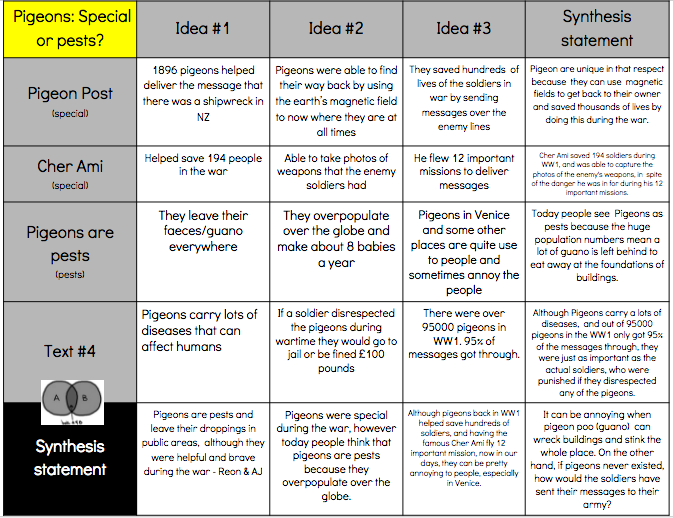
A few weeks ago I asked the question 'Are pigeons special or pests?' to my learners. Immediately I was bombarded with a variety of opinions but was met with a wall of silence when I asked them how they knew these facts. I followed the suggestions of ways to strengthen connections and accelerate the learning made by Woolf Fisher to provide a scaffolding text, a complimentary text, a challenge text and a self selected text.

The DLOs below are examples of the learning that took place as we unpacked the information. Did we get everything right? In short, no but I do know places I can make changes next time. I found this an exciting process to follow as I could see very quickly where connections had been made and where the gaps were. My learners loved the collaboration and the tasks that followed each text.

It was really interesting to observe reactions to the challenge texts. I had introduced the topic by promoting the idea that pigeons post was an important part of our history. This resulted in a lot of animated discussion about how that was possible because in their words 'most letters would be as big as the pigeons!' After reading, watching and listening to texts that explained the vital role pigeons played in message delivery I caused major confusion by introducing text that explained that pigeons were pests. I think the fact we all found hard to believe was that in the 17th century pigeon guano (droppings) was heavily guarded as it was seen as a highly sought after ingredient in the making of gunpowder! We used this as the comparison point for the opinions of many people today who are now aware of the damage the acidity in the guano can do to buildings and other structures.

Our guided sessions were focused around synthesisng facts across and between texts. We still have work to do in this area, but as everything has a 'use by' date, I chose to move on. The groups below both chose to reflect their final informed opinions in different ways. One choosing to record soundbites on vocaroo, and the other group filmed their responses. If you would like to use any of the ideas we explored all our learning is visible on our class site.


Monday, 21 November 2016

Synthesising ideas to help us form an opinion:

This morning we were revising synthesising to help us make connections between the different texts we have used to find information. To begin Harry reminded us that synthesising happens when we take the knowledge that we already know and add it to the new knowledge we have gained to create a new understanding. Revisiting what synthesising was asking my students to do was vital for making stronger connections to the learning.


The chart below reflects the synthesising from R group. I am so impressed with the connections they made but realised initially the idea of joining ideas together had slipped through the net. Most boxes had two separate ideas that were not linked by a conjunction. To overcome this we spent some time exploring conjunctions. 


Friday, 11 November 2016

Multimodal in LS2!

Last week after a staff meeting on multimodal sites I put my new learning into practise. I had already embraced suggestions made by Aaron from Woolf Fisher, that each of our learners make connections to learning in different ways. My initial planning aligned to included options for a scaffolding text, a complimentary text, a challenge text and a self selected text and was presented on a set of google slides.

Click on the image below to view this


The change to a multimodal page on our site was simplified as I had already created the content. Getting my head around html was a bit of an initial challenge but after blindly 'pushing buttons' and looking at 'help' sites our multimodal page was born. This was extremely well received by my students as they were initially hooked in by the layout. We explored the learning opportunities briefly together, before encouraging them have a closer look in pairs. The best part of this was the room was alive with a high level of excited conversation taking place as they clicked on the links. Normally I wouldn't do this but it was a first and I needed buy in.

Regrouping my students was the next task and how our mixed ability R-E-A-D groups came to be. Surprisingly there were no objections in regards to who was in each group. This highlights the importance of knowing your learners. 


 Our multimodal page - Click here to access the page

The image below reflects the high level of engagement in a reading lesson as my learners worked their way through the challenges on our new multimodal site. 


We have systematically worked our way through each task, discussing and recapping our learning and the comprehension strategies we have been using to make connections to the text. I have discovered that my learners prefer to work collaboratively. The independent task was not as successful as the opportunities for talking about the the learning were fewer. This is definitely something I will take on board. 

Our first task was the question matrix. This was an idea I adapted from my learning at the NZLA 2016 conference. Being able to write their own questions immediately personalised the learning. The idea behind the matrix is that as we answer the questions as we the find information. My intention was to turn this into a 'race', but one group took it upon themselves to begin answering their questions before I had a chance to set this task up!  

We decided to use a group follow up DLO to record our learning as we went along. This proved to be an excellent scaffold/resource that could be referred to as we explored the guided task of synthesising the ideas gained from each text. Sadly I didn't record any of this as it was one of the most powerful lessons I have seen this year. The rich dialogic discussion reflected the strong connections that had been made to the learning.

We used our learning from a earlier session taken by Mairi Ogilvie from the National Library, who reminded us how to narrow a search, to help us find a self selected text. I used one student's DLO on the site as a reference tool for this task.

Our final step is to form our opinions. Watch this space for the DLO's that reflect this and the feedback from my learners!