Showing posts with label SFeedback. Show all posts

Tuesday, 5 November 2024

Describe and Explain the changes/tweaks you have made in your practice along the way...

My inquiry this year has had many twists and turns. Achieving accelerated shift in Literacy was identified as being one of the most important and catalytic issues of learning facing our students in Y4 - 8, this year, when the time point one data was analysed. Exploring how learning gained from professional development is helping to strengthen teacher practice and achievement in literacy is something I haven't looked at before so I began with one idea which over the course of the year has completely morphed into another. Not because as I mentioned in an earlier post, because it was unachievable, but because my initial idea simply wasn't working. The effect of staff changes on PLD is something I hadn't initially taken into consideration. What began as an inquiry into how we (PBS) are using PLD to accelerate shift across our school' and over the course of the year required a change of tact to inquiring into how are we building and strengthening our capability in raising student achievement outcomes in Reading for years 4-8 at PBS.

I began my journey by trying to ensure we were all on the same page. Consistency and a shared language of instruction help our students to make the connections they need to be able to access their learning with confidence and understanding. At the start this wasn't about paying no regard to the skills and knowledge my team brought to the table but rather to align our thinking. This is explained in detail with examples in an earlier blog post. This wasn't as successful as I hoped as we were all coming from such different places both literally and in knowledge gained from recent PLD, so it was back to the drawing board.

Changing Direction Icons - Free SVG & PNG Changing Direction Images - Noun  Project

After speaking with Naomi Rosedale, I realised I needed a new pathway forward, a pathway that included a framework that would bring everything together and provide clarity. Aligning what I was looking for with the Manaiakalani Reading Pillars of Practice (MRPP) was the lightbulb moment I needed. In Term 3 I used the MRPP to look closely at what and how we, my team and I, were actually teaching the tauira in front of us in our reading lessons. I looked at the data and used the initial gap analysis to help me gauge whether or not the learning planned matched the student needs. To allow for consistency I stood by my decision that if it wasn't in the planning it wasn't there. The follow up discussions were both rich and gave all of us the clarity we needed to help us meet the learning needs of our individual classes.

This process was repeated in Term 4. I am yet to complete all my follow up discussions but have them timetabled for later in the week. What I noticed was with a shared understanding and stronger knowledge of why we need to make the changes. All my team have now included multimodal text sets, are looking at the structure and language in the different text types and have put a lot of thought into the questions they are asking. There is definitely a growth in the use of our shared language of instruction, a wider variety of comprehension skills being accessed. 

Changing my inquiry focus has allowed me to introduce change in a manageable and achievable way. Mindsets where planning is concerned has moved from compliance to purpose, something I struggled to initially get buy in from. I feel that looking closely at my own planning has added the 'teacher model' element to the learning. By using the MRPP it has allowed us to all learn together but at our own pace. Sharing people's successes and valuing their ideas has afforded us opportunities to learn with and from each other. 

The big message I want to share here is that change is good, it should be embraced and we should not be afraid to walk in a different direction if what we have tried is not working. 

Monday, 13 November 2023

Sharing time at PBS...

Over the last few weeks we have had our own PBS version of Bursts and Bubbles to share our 2023 teaching inquiries. This was really interesting to listen to as I could see the change in practice being embraced. There were many successes celebrated as we continue to work together to accelerate shift in the achievement levels of our learners.

The DLO below is a snapshot of a year of inquiry and is shared with permission. If you would like to read about the journey behind the summary, click on the teacher's name and it will take you to their professional blog.

Monday, 23 September 2019

T3 PBS Teacher Inquiry Check-in...

Today I met with all our staff to talk about their teacher inquiries. I asked everyone to share with me where they were at now, what changes had been made to their teaching practice and how I could support their inquiry moving forward into term 4. These were rich conversations and provided a great forum for sharing successes and bouncing ideas. 


The list below reflects the common themes and recurring ideas when teachers discussed the changes made in their teaching practice to help us accelerate shifts in our learners from Year 0 to Year 8: 

  • Teachers modelling/gifting language they want students to use in context across curriculum areas
  • Increase in time spent to unpack vocabulary
  • Timetable changed to cater for late students
  • Phonics programmes implemented in all classes
  • Changes/adaptations made to the way data is recorded to give a clearer picture of micro shifts
  • Drawing connections with visual scaffolds
  • Use of mentor texts as exemplars
  • Incorporating elements of critical literacy to help strengthen connections
  • Shifted locus of control to give students a more agentic experience in the classroom
  • Increase in instructional time
  • Revisiting learning when connections are not strong through rewindable opportunities and further instruction
  • Making connections to prior learning
  • Differentiation is needs based and can be supported with upskilling of TAs
  • Adapting teaching DLOs to meet the needs of learners
  • Planning for talk time
  • Making use of collegial expertise

This was a very valuable opportunity as it showed that as a staff, we are all on the same page. No one apportioned 'blame' to students where innovations tried had not been successful. Our conversations instead, focused on changes or adaptations made when these speed bumps appeared. 

Monday, 16 September 2019

Critical Friend Observations...

When carrying out an inquiry into your own teaching practice it is really helpful to have a critical friend who can see your practice from a different perspective. Their feedback and feed forward helps you to adapt your practice to continue to meet the learning needs of the students in your classroom. As I mentioned in a previous post, for me this person is Donna Ryan. I know what I think I do/say when I am teaching, but having Donna observe me taking a phonics session, and record exactly what she saw me do, was a valuable learning opportunity.

This is what I did/said to help my learners make the connections they needed to make sense of the learning:

  • Recap learning from last session
  • Check in to see if understanding is in place
  • Co-construct the learning intention (LI) and goals for the lesson
  • Asked the students "What do you need to do today to achieve this?"
  • Gave students control of the learning by giving them the opportunity to choose the follow up activity
  • Asked "Why are we doing this?" to recap on the purpose of the learning
  • Reinforced the focus/goal as a reminder
  • Modelled the learning
  • Guided/scaffolded students towards next step
  • Checked in to make sure understanding was in place
  • Identified where they had met the LI
  • Reaffirmed "I like the way you have used the commas correctly, we learnt that yesterday and this shows me you were listening carefully"
  • Asked "Can you remind me what we were focussing on today?"

From this I can see that I share control of the learning with my students, continually check that connections are being made, scaffold through questioning and teacher modelling, and reaffirm to ensure self efficacy and confidence continues to grow.

Sunday, 11 November 2018

Analysing the data (November) and Reflecting on my Inquiry...


This year I have been looking at ways stronger connections to content specific vocabulary can help overcome hindered student self efficacy in writing. In February I collated the data from the e-asTTle attitude domains for writing as a way of measuring student self efficacy in writing. My February data 'shows that my learners don't like writing at school, they don't believe they are good at writing and worryingly, most think I don't think they are very good at writing.' 

Comparative data collected in November (refer to presentation below) shows that there have been some notable changes between the time one and time two data. Most significantly is that everyone now sees themselves at being better at writing, with 3/8 students seeing being a 'good writer' as something that is 'very like me'. 7/8 students now like writing at school more and 6/8 students now believe I think they are 'good at writing'. Writing out of school is not something these students enjoy, a shift possibly influenced by age and a change in outside interests and influences. When looking using this tool as a way of measuring student self efficacy in writing I can see the shifts are positive. Additionally I know that in the classroom engagement has increased, work completion rates have increased and confidence levels have increased. 


To reflect student achievement (refer to the graphs below) I chose to show the shifts in each of the e-asTTle writing domains using the R scores as this allows me to see where the shifts were strongest. I am aware these levels are subjective, but have been assessed by the same person and moderated for validity. This is a powerful reflection tool as I can see where the strongest connections to my instruction were made

The biggest shifts are in structure and language, sentence structure, punctuation and in organisation. When I looked back on my long term planning I see that this ties in with the adaptations I made to dedicate more time to the oral language component of front-loading the vocabulary and more time to talk and use their words in context when planning. There was an increased expectation that all work would be completed and the format of each lesson the same except for the added daily challenge, something determined by peer led feedback and decided by my students

When analysing the writing samples I noticed the consistency with co-constructing the success criteria linked to structure, language, punctuation, sentence structure and organisation at the start of each lesson was replicated in the writing plans. Possibly because these students understood what they needed to do to improve their learning. Analysis of ideas and vocabulary show these areas have remained consistent with minimal movement, perhaps due to the fact the writing assessment does not allow time for front-loading and talk when planning. 

What this data does not show however, is the change in the quantity of the content nor the confidence that my learners approached this task with. It does not show that everyone wrote for the full allotted time and when asked to move onto editing, each student used the time to try their best to check their work for accuracy. A sneaky look at the revision history showed me the latter. 


Reflecting on my professional learning through this inquiry cycle...

In our focus on achievement we often overlook the power that positive reinforcement and self belief have on outcome. Strong healthy classroom relationships mean that student engagement  interwoven benefits. The best part is that the adaptations made in writing created a knock on effect across several other learning areas for many of our students.

My inquiry goal this year was to grow self efficacy in my reluctant writers, something I have tried very hard to do. Learning from Jannie, Rebecca, Aaron and Russell in our CoL meetings has played a huge part in my growth and the growth in my students this year as I come away from each meeting with a ‘takeaway’ that I tweaked to meet the learning needs of my students. Although initially challenging to do I found being asked to backward map a causal chain the most useful tool in keeping my inquiry focused. I have referred back to this many times and is something I will definitely create in my next inquiry.

Adapting Cynthia Greenleaf’s research into student self efficacy in reading to writing in my classroom has given me an increased empathy towards my reluctant writers. These students are not simply disengaged or disruptive, they are, in many cases masking their perceived historical failures by seeking negative attention. 'I always muck around cos then you won't ask me anything cos you'll think I haven't done my work. I always do that every year Miss.' (Boy 8, June 2018) This was the response I got after I had purposely ignored his behaviour for a period of time and focused on strengthening my rapport with him. From then on I made a point of asking for his input. In turn I noticed over time that he had become far more engaged in the learning, he was happy to share his thinking (as long as I didn't ask him first), and from mid way through term 3 took pride in letting me know his finished work was on his blog. Russell reminded us in one of our CoL meetings that success comes with completing a task, something I have seen first hand is vital if we are looking to grow student self efficacy, and one of the most successful adaptations I have made across all my teaching this year.

I can see that the way forward for me is to replicate the changes in how I deliver my instruction as it has given these students the knowledge to approach writing with confidence. 'Repetition without boring' allows key learning points to be revisited so that stronger connections can be made. Planning time for talk and front-loading means new learning is unpacked and new vocabulary used in context. I noticed that the students who said the words used the language. This required a lot of teacher modeling, think alouds and scaffolding initially but allowing my learners the time to process the new, meant I was able to build in challenges that promoted the risk taking I was after. Ignoring behaviour, praising success and setting the expectation that all work will be finished helped to change 'This is boring!' into 'Miss, can you check my work?'.

Tuesday, 28 August 2018

Manaiakalani Hui - Sharing our inquiry journey...

This year as part of the Manaiakalani Hui the CoL teachers were invited to share their inquiries so far through a 1 minute video followed by more detailed round table discussions. 


Here is the video I created which gives a snapshot of what I have been doing in my inquiry this year. As I have been focussing on developing student self-efficacy I chose not to use images from my classroom, instead decided to use images that capture the message I was delivering. 


Wednesday, 15 November 2017

Reflections and Questions...


Over the year there has been a noticeable shift in the amount of dialogue each reading lesson presented. Learner engagement and agency increased through the co-construction of scaffolds and shared ownership of the learning. Participation moved from passive acceptance into active questioning as the knowledge of how to dig deeper into a text moved through the stages of mastery. The scaffolds initially introduced in reading were repurposed independently by a wide number of students across all learning areas, and grouping became more cohesive and collaborative as confidence levels grew.


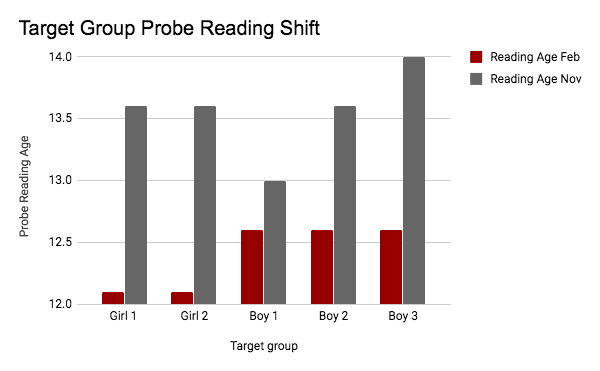
Strengthened connections to vocabulary, content and comprehension strategies have enabled significant shifts in reading age across my whole reading group. The graphics below represent the shifts made by my target students. What excites me about this picture is that 3/5 students made an 18 month shift in reading age, 1/5 students made a 12 month shift and 1/5 students made a 6 month shift when tested on both fiction and non-fiction assessments.


Aside from being able to make sense of more sophisticated texts I noticed their reading behaviours changed. My learners moved from trying to simply recall facts and re-reading a text in entirety, to skimming and scanning for key words and phrases when searching for evidence to support their thinking. The quality of the responses increased as they were able to make stronger connections to language of questioning. Simply put, this meant they knew what the question was asking them to do. I know this because I asked them to think aloud while they were processing the task ahead.


Over the year we have used talk to explore and unpack strategies and scaffolds that have helped my learners strengthen their understandings and connections to a wide variety of texts. A large part of this focussed on personalising the language of instruction and making sure that this was explicit. 
Making use of rewindable learning opportunities enabled my learners to see through their own eyes what they were doing right and where they still needed support. I actively planned for opportunities for talk to take place and used student created exemplars to spark their curiosity and explore new learning in context. 'Repetition without boring' was the key here as we repurposed and tapped into the known to help us access the unknown. 

Disconnects with vocabulary have been our biggest stumbling blocks this year. Moving forward I will be looking at how I can continue to break down the barriers between new words and new learning by capitalising on my 2017 learner feedback to keep the talk going with my learners in 2018.