Showing posts with label Teaching as Inquiry. Show all posts

Friday, 13 February 2015

Creating something that is going to help somebody else learn:

Today the Manaiakalani Innovative Teachers 2015 (MIT15) group met to share the focus of our inquiries. It was inspiring to be a part of this discussion and to have the opportunity share this process with such talented educators.

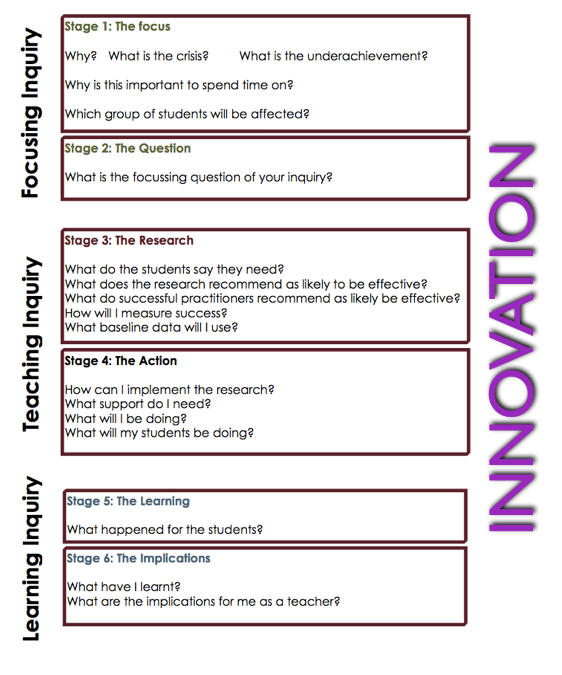
Stage #1:

I am very passionate about shifting student achievement and know that by empowering my learners with the tools to help them reach those ever changing ‘next levels of learning success’ is one way of achieving this.

Student success in Writing is quantified against a series of levelled national standards and national norms. The achievement levels of our own priority learners are measured against the achievement levels of all New Zealand students at the same year level, and sadly our data continues to reflect noticeable disparities. Last year an assignment for university provided me with an insight to the power that peer led feedback had on shifting student achievement in Reading when it was given and received in real time and context. This year MIT15 is allowing me an opportunity to explore if by drawing on this knowledge, I am able equip my students with some of the metacognitive tools that will allow them to strengthen their own understanding of the language features and structures needed to reach national levels in Writing.

The ‘Comments’ tool in Google Docs, when used as a forum for the learning conversations peer led feedback facilitates, will afford my learners opportunities to learn with and from each other in a safe place, where successes and errors are noticed; and ideas can be suggested, challenged and resolved, as opportunities to 'create something that is going to help somebody else learn' are actively sought.


                                            William Glasser

Stage #2:

I will ask the questions:
  • ‘Are the feedback skills and knowledge in one curriculum area transferrable to another?’
  • ‘Are all learners able to notice and feedback on the deeper features of their peer’s writing?’
  • ‘Is the feedback justified and interactive?’


Shifts in student achievement will not happen simply because the concept of critical friendships is introduced. Attaching a name to something will not cement understanding. To build and strengthen the content knowledge of my priority learners I need to borrow from Dorothy Brown’s idea by providing opportunities for ‘repetition without boring’ so that real connections can be made and understandings strengthened through informed learning discussions.
Wednesday, 11 February 2015

Sparking Student Interest:


This week saw the start of my MIT inquiry. I selected a group of talented young writers who will become not only my target group, but also our resident Room 5 'experts'. The group challenges will provide opportunities to work independently, collaboratively and with me on writing tasks that will challenge the students to move their writing to the next level. Taking a forensic (really close look) at what their peers have written is what will help each student in their 'critical friend' role to give focused feedback and feed forward. 

Learning from and with each other will help increase our overall understanding of structure and language features as our Room 5 writing programs evolves this year. The students are expected to take risks by trying to incorporate new learning into their independent tasks and when asked justify (say why) this new learning was used when responding to feed back.


Friday, 12 December 2014

Outline of proposed innovation in 2015:


To use the ‘Comments’ feature in Google Docs to extend and accelerate my learners’ levels of cognitive engagement and achievement, through peer led feedback in Writing. This will leave a digital trail of evidence of genuine student voice (as a wider audience will be able to contribute their thinking in real time and in context), notify me via email so that I can monitor the quality of interactions and provide guidance in real time. Additionally it will create an online forum where successes and errors can be highlighted, ideas can be suggested, challenged and resolved; and changes implemented immediately. Something that could not be done without the affordances of technology. My inquiry would ask the questions:

  • ‘Are the feedback skills and knowledge in one curriculum area transferrable to another?’
  • ‘Are all learners able to notice and feedback on the deeper features of their peer’s writing?’
  • ‘Is the feedback justified and interactive?’
I will monitor the learning gains that can be made with my Maori and Pacific students as they make connections between their established understandings and new learning in a different subject area. Writing could be seen as a challenge as it is a subjective, subtle and sophisticated medium. In 2015 it will be supported by ongoing school wide professional development that will provide a scaffolded platform for not only my knowledge and awareness to grow, but also that of my students.

Innovation in 2014:

I carried out a case study this year with a group of targeted Maori students in my class as part of the course requirements for the ‘EDCURRIC 740: Accelerating Digital Learning’ paper. The thinking behind this was that I would be able to accelerate learning in Reading by providing a platform, in this case an online forum, where the students would critically reflect on each others responses to a text and provide evidence to justify the reasons for their thinking. The aim of this intervention was to facilitate a dialogic environment where the students used the medium of discussion to become responsible for their own learning and drive their own shifts towards their next level of achievement. The link to the critical analysis has been provided for you to see the shifts made in the students thinking and achievement. Having deemed this ‘tool’ a success with a small group in Term 3, I introduced it to a wider audience in Term 4 that combined all of our Year 7 and Year 8 pupils. It was renamed I.R.C. (Independent Reading Challenge) and through emulation, guidance and shifts in their own learning has been running successfully for the last six weeks. It is important to note here that while shifts in e-asTTle data were not significant, shifts in STAR and Probe data have been, showing the value of student agency in raising student achievement. The success came as it allowed for peer led feedback to be given and received in real time and was in context. The ‘Comments’ tool in Google Docs allows for a wider and more varied audience to be reached quickly, something that could definitely not be achieved without being part of a 1:1 digital environment. Additionally it has allowed the students to access their learning and feedback anytime, any where and from any place. Thus allowing the students to drive their own challenge.


This pathway of student learning was created by two students in my class. It shows how my students access their learning and how they use peer led feedback to help them have self directed reflective learning conversations as part of our ‘learn-create-share’ process.