
Showing posts with label problem solving. Show all posts

Wednesday, 29 July 2020

Making Connections to Problem Solving with Tangrams...

A small glitch with our internet connection this morning opened up a great opportunity to make the most of a teachable moment. Having been taken through the process of making my own tangram puzzle in a recent staff meeting I decided this was the perfect time to introduce this puzzle to LS1 and LS2. We had already come together as a block this morning for singing practise so decided to stay together for the learning experience, which meant we had a huge range of abilities as the students ranged from Y5 to Y8. There were no templates, no rulers, no pencils... just lots of smiling faces, blank pieces of A4 paper and lots of pairs of scissors. 

The instructions I gave were not written anywhere which gave me a great opportunity to remind everyone about the importance of listening carefully and asking questions. I made sure my instructions were explicit and found myself making folds and cutting along folded lines with my back to the class and my exemplar in the air, something far easier said than done! Along the way as each piece of the puzzle appeared I introduced the content language of 2d shapes so that each piece was referred to by the correct name and not 'this one' or 'that one'. 

Our students are really good at collaborating so without being asked I noticed my class immediately stepped up to support the younger ones. This learning experience was a very loud one as I encouraged everyone to talk to each other about what they needed to do at each step. Interestingly we only had two puzzles that needed to be remade. 


Organisation was one of the keys behind the success of the 'making' task and as we were using the content vocabulary collecting the offcuts was a breeze. Once all the pieces had been cut I asked everyone to mix up their puzzle (something quite hard to model in the air!) and put the pieces back together to make the original square. This is when the real conversation happened. There was a wealth of problem solving strategies being used so I took advantage of this and unpacked it further. 
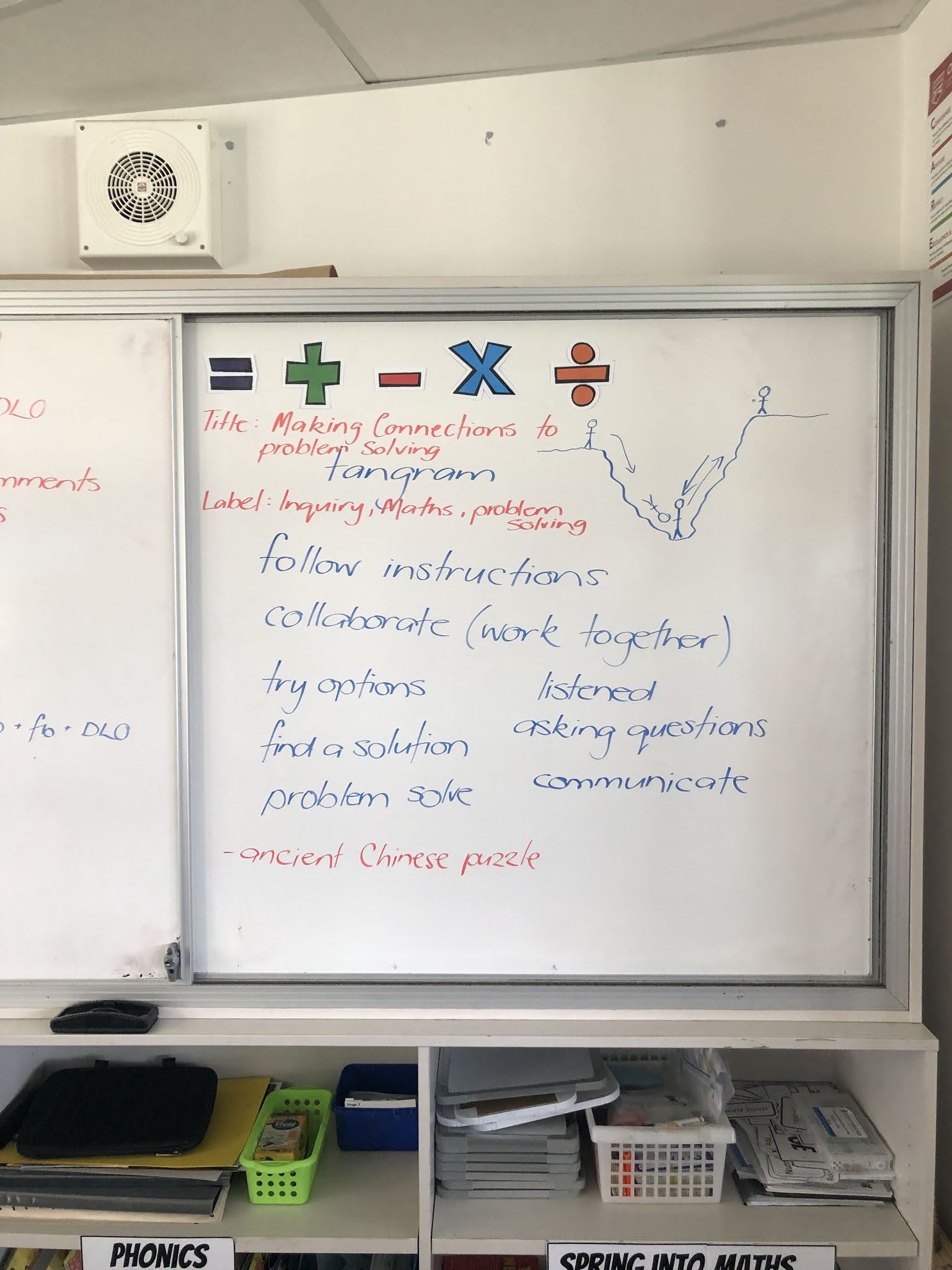

After morning tea we all came back to take part in the 'fun' challenge component. Greg Wong took the students who had made their tangrams through the challenges of creating animals from the shapes while I helped the group who had been at puberty talks to make their tangram. Team teaching was then the order of the day with Greg explaining the history behind the puzzle and me process of problem solving. As a result we were all able to make connections not only to the content but also to the origin of the puzzle and the process of problem solving. The blog posts from both classes reflect the learning, the fun and the content language that was revisited today.

Tuesday, 4 April 2017

Putting my new learning into practise... Awesome!

Last week I went to my first session of maths professional development with Bobbie Hunter. What a fabulous opportunity! So much of what she said made so much sense to me with light bulb after light bulb going on as the session progressed. This year it would be fair to say that the low levels of mathematical ability in my groups have challenged me week after week. I have gone back to the drawing board so many times as I endeavour to help my learners make the important connections to the skills and knowledge needed to allow them to operate at the Year 7/8 level. However despite my continued efforts I have remained completely perplexed with this situation.

A discussion I had with Bobbie forced me to take a step back and think about how my low expectations were affecting the outcomes in my maths lessons. I am very aware of the need to provide learning opportunities that my learners can resonate with, but for some reason I have overlooked the obvious when thinking about what needed to change. Me!

She suggested I let go of the desire to build number knowledge to a level that I felt my learners could cope with and actually provide learning opportunities that ticked the Level 4 boxes of the NZ maths curriculum. By lowering my expectations I was actually hampering my learner's progress. Whilst I have used thinking groups successfully in the past, this year I have completely overlooked this as a teaching tool as I thought (wrongly), that my learners would not be able to actively participate. I definitely had not thought about the fact that regardless of level (in this case ranging from JAM stage 1- 4) that there is so much that can be gained by providing opportunities to 'argue' reasoning and thinking. At no point had I thought about the importance of allowing my learners to engage with their errors in a peer protected environment. 

By embracing the idea that if my learners could explain and justify their thinking they could understand and use I introduced todays problem...


The question(s) I posed were linked to my learner's own worlds through our cluster wide inquiry and our recent camp at Hunua Falls. This empowered everyone from the outset as they could relate to what I was asking them to do. The affirmation came in the form of one student who said, "I understand why you need us to work this out Mrs Anderson. We have to help Auckland save water."

To set the scene I read out and showed a recent mailer I received with my water bill. We tapped into our inquiry knowledge to make connections to the topic then met our new thinking groups. To make sure everyone knew what 1 litre looked like we created a list of what we knew that came in 1 litre amounts. Coke was the most popular so that is the image I grabbed.

With initial connections made my learners took their first tiny steps into the world of problem solving. I told them they could use any strategy, number knowledge or maths equipment they wanted to find the answer. After a slow start this lesson took off. We celebrated every answer regardless of how the answer was found. Then in groups had our first dialogic maths conversations to decide as a group which strategy was the best one. The only scaffolding I put in place was the word 'because' and used the think aloud strategy to model how to state an opinion then use the word 'because' to support my thinking. Surprisingly each group had a different opinion.


Finding out how many litres of water we could save individually per week if we saved 20 litres per day was answered first. After the discussions I outlined above I posed the second part of the problem. 'How many litres of water would LS2 save per week if all 50 students saved 20 litres per day?' Once again I noticed a wide variety of strategies being used. Interestingly a few students were experimenting with the thinking shared in the first problem. I am excited to see where this journey takes us tomorrow...

Friday, 4 November 2016

Silent Challenges...

Some of my favourite lessons this year have been our silent challenges. The idea behind this is that instead of me 'telling' my learners what it it I want them to do, they need to read and understand from a series of written instructions what their task is. By doing this I have encouraged my learners to read for meaning and shown them the importance of making sure they understand what it is they have read. These tasks allowed the collaboration between my learners to shine at it's best.

The challenge below was set only for my reading group. One of the gaps in their learning was reading for meaning when a text is not scaffolded and unpacked. I decided this would be a fun way to show them why this was important and how they could make sense of a text that they had little connection to. To make sure everyone found success I created mixed ability groups so they could support each other. The learning arguments or dialogic discussions that took place were rich and afforded me great opportunities to make some important anecdotal observations.


The rest of the class saw asked for a similar challenge so I created one that embraced our learning in maths and inquiry. Never would I have imagined that 52 Year 7 and 8 learners would be outside testing flight distances and be so on task! The discussions I heard were based on adaptations that could be made to get more distance and were accompanied by laughter, team spirit and outstanding group collaboration.