Showing posts with label CTry. Show all posts

Tuesday, 7 October 2025

Implementing Structured Literacy one step at a time: Step #4 - Reading

After attending a toolkit on Gemini Gems run by Matt Goodwin I decided that introducing this in my learning time this might spark another layer of curiosity with my learners. I followed the prompts shared by Matt and jumped in boots and all to help my learners gain a deeper insight to our guided text 'Malala Yousafzai Speech at United Nations Assembly 2013'. 

Below are screen shots of the Gem we used that show my initial prompt and the students interactions with the Gem to support their reading. I used the prompt that Mat gave as the example in his toolkit, so need to acknowledge that it is not my original idea.

I found this to be a really creative way to help my learners make sense of the response questions in ways that helped guide them to where they might find the information rather than simply giving the answer. 

The way this ran in our room was after introducing and modelling how Gemini Gems worked, I put the Gem on my computer and left it available for student use on a central table. This was both a great resource and a really creative way to capture my learners interest in the topic. A bonus was that once the Gem had been used the conversation in groups was richer as new perspectives were shared when some students disagreed with the initial collaborative responses. The learning 'arguments' were evidence based and allowed for the skill of negotiation to be used authentically in context.

I used a Gemini Gem with two guided texts last term and found on both occasions this was a very effective way of strengthening my student's connections with texts they were not familiar with. The feedback from my learners has been captured below.

Wednesday, 10 September 2025

Create in Inquiry...

Once again with 'create' in mind I planned my Inquiry unit on Dinosaurs with these activities in mind. Pretty much I started at the end of each learning task and worked backwards. What I found throughout this unit of learning was the retention of facts was much more than usual. I know Dinosaurs is always a fun topic to unpack but this time around, student voice told me the activities we did to show our learning were fun and made the facts stick. 

We started by making our very own dinosaur eggs out of salt dough. Who knew an activity usually found in the junior classes would engage my Y7/8 learners so much!


We then hatched our eggs. This roughly translated to opening the eggs and placing them somewhere in the garden for photographing. After discovering our dinosaur fossils we used Adobe Express AI to reimagine our photos to reflect what a real ‘find’ might look like based on where our research of where similar fossils have been found in the past. These 'finds' gave each pair a focus dinosaur to do a deeper research on.

Our dinosaur eggs reimagined using Adobe Express


Kaleb shared an idea that I loved so I changed my planning. He suggested that we show some of our dinosaur research by creating a movie using AI. For this task we used  https://hailuoai.video. The learning here was in the prompts. 


Responding to a question in exactly 50 words. A fun way to encourage students to be succinct in their responses and provides a great opportunity for rich discussion to evolve.


Brooke and Mareta's Google Vid to showcase their research on Mary Anning


Implementing Structured Literacy one step at a time: Step #3 - Reading

Using texts suggested in the Refreshed English Curriculum for Year 7-8 this term has allowed me to experiment with aligning my learning in structured literacy Reading with the curriculum. To be honest my years of Reading PLD has afforded me the luxury of making very few changes to my practice. I have had to make changes in a few areas like vocabulary and text structure, but for the most part not a lot has changed.

Rather than explaining how I teach reading I have decided to showcase how we capitalised on the create aspect of learn - create - share to strengthen my learner's connections to the content in the text and the learning that ran along side it. As you can see create opportunities are easy to include in a structured reading program. They don't need to be 'perfect' but they do need to provide opportunities for our tamariki to take ownership of the learning and make the connections they need to make sense of the wide variety of multimodal texts in a reading program.

All these lessons have been taught as a whole class. Some students have needed further opportunities to unpack the text and all follow up activities are done collaboratively in groups or pairs. At this stage working independently on follow up activities is something we are working towards. I find that collaboration makes new learning seem less scary and helps my learners take risks they would usually shy away from.


A focus on dialogue and the structure and purpose of graphic texts


A focus on rich discussion and forming an opinion by exploring both sides of a provocation

Enhance Speech from Adobe | Free AI filter for cleaning up spoken audio

Group discussion and text responses captured on Adobe Podcast


AI generated posters using Adobe Express to showcase important quotes


Google Vid and Adobe Express to capture an illustrated DLO of my learners reading a poem 

You can see examples here in my learner's blogs, which have all been shared with permission.

Implementing Structured Literacy one step at a time: Step #2 - Writing

As I have said before I am on a mission this year to both successfully implement structured literacy and to keep the create opportunities alive. I jumped in with both feet. No delicate toes dipped in the water, just a giant splash! One way I have capitalised on the affordances of 'create' in writing was to start at the end and probelm solve our way to the start.

By this I mean instead of starting with the exemplars of what a text type looks like, unpacking the structure and language features and exploring the vocabulary needed I tapped into our Inquiry topic of Dinosaurs and challenged my learners to begin by constructing a prototype of the skeleton of their focus dinosaur. 


The prototype... Each pair was given a 1 sheet of coloured A3 paper, 2 sheets of newsprint, a vivid, a pencil, a ruler, a pair of scissors and access to the sellotape. I explained that apart of constructing their prototype I needed them to write down the steps they followed to create their model. This was hilarious to watch! The conversation was rich and purposeful as work arounds for dilemmas were suggested. The outcome, slightly wonky models with some very creatively written steps. 

The teaching... To demonstrate the need for clarity and simplicity in the instructions I asked to use one of the sets of instructions that they would be happy to let me follow in front of the class. My learners had so much fun with this task I ended up having to put names in a randomiser to choose. Everyone wanted their instructions followed. To be fair I let everyone have 15 minutes to fine tune their set of instructions before I started. As always to prove a point I needed to over exaggerate what I was being asked to do. Once again we had so much fun! I did manage to construct a model that resembled a dinosaur but as I had no accurate measurements it looked nothing like the one I was trying to replicate.

The learning... We need to be specific. We need to be clear and our steps need to be written so that they can be followed accurately. We explored the 'bossy' verbs and made our adaptations. All learning that would have taken place had I taken a more formal approach, but wouldn't have been nearly as much fun. Connections to the task were made all round. I need to mention here that this was a whole class lesson for 54 students. I did have Dianne, my buddy teacher and Mat our wonderful TA as well but I led the learning. No extra scaffolding, no simplified work, just pitched at the right level because I know my learners. We used the power of collaboration and the power visual and tactile opportunities provide. Everyone regardless of ability understood the purpose of the task and knew what they needed to do. I noticed at each step of this challenge that my learners were helping each other too.  


The outcome... We made the tweaks to our instructions and repeated the process. This time there was more attention paid to precision and detail. Wording of instructions were road tested on another pair, and more refined models constructed. We then formalised our learning using a scaffold for a procedural text which allowed me to reinforce the structure and language needed to be successful. To add a fun element we then had a go at creating a different dinosaur model following a set of instructions created by another pair.

The process illustrated...


Implementing Structured Literacy one step at a time: Step #1 - Handwriting...

With the challenge of keeping the 'create' aspect alive in our kura, I made the conscious decision to lead by example. Last term we began our structured literacy journey. The first three PLD sessions were huge! The cognitive overload was real. I am a teacher with many years classroom experience both in Aotearoa and in the UK and I found making sense of all the new learning a genuine challenge. I found myself quickly realising why the 'create' component of our learning was pushed to the back. 

The big message behind everything is that the learning should be taking place at a 'perky pace'. That's doable once you have made your own connection but when I first attempted a structured literacy handwriting lesson it took 35 minutes! Not 35 minutes because my learners were off task or because I didn't understand the goal of the lesson, but 35 minutes because my learners were focusing of being meticulously neat. No one wanted to make  an error, no one wanted messy work. I genuinely ran out of motivating phrases to say! As for the spelling, well lets just say that was another time consuming disaster. My experience told me I needed something to change and it had to be fast. The first thing I changed was to ditch the preplanned resources and use my own. I needed to make my connection through my ownership of the learning. So how did I do this?

  • I co-constructed a handwriting resource with my learners by giving them each a letter and asking them to come up with the practise sentence to accompany the letter formation learning.
  • I introduced the digital timer. What a life saver this turned out to be. It added a fun challenge element that kept us all on our toes and helped us meet the brief of having a 'perky pace'. We vary times now from 5 minutes to 10 minutes. This allows the person keeping time to randomly challenge the pace of fluency. I do need to remind people here that Year 7/8 students in the main do not need to be taught letter formation so that removes one of the challenges our junior team have.
  • As I said earlier we needed an element of ownership in the learning. I wanted my students to monitor their own progress and set their own goals. We did this by creating a marking sticker. My learners now evaluate their own work by considering the size, shape, slope, speed and space. It allows them to easily see where they have been successful and what areas they need to focus on. This has now evolved to our very own stamp thanks to the awesome design skills of April Song, who helped me bring my idea to life. We use a buddy system to share our successes and our next steps at the end of each handwriting session and at the start of the next one. This also helps me see at a glance what it is I am looking for when I am roving around the room giving feedback or when I'm starting a lesson and need a focus point.


  • We alternate handwriting lessons with keyboard lessons to build keyboard fluency. Doing this has been a huge hit with my learners. We use this site for the keyboard challenges.

To remind myself why we need a handwriting focus I have added this last part from notes I made during one of our initial training days (source unknown). Fluency in handwriting helps to enhance critical thinking. Writing fluency encourages students to think critically about their ideas and how to present them, ultimately deepening their understanding of the subject matter.


Sunday, 13 July 2025

Stocktake of my Inquiry...

We are half way through the year and I realise when taking stock of my inquiry that the PLD start delay has impacted my inquiry significantly. I haven't really been able to begin until now as we have only had 4 structured literacy PLD sessions so far. My inquiry a school leader is not just a personal one, but also a team one. The positives to date are that we have been keeping the status quo in literacy so I do know we are currently all on the same page as far as planning is concerned. We are all on the same page as far as DLO scaffolds are concerned and our current shared language of instruction is alive and well. 

Moving forward this term sees us starting to implement structured literacy practises. What is a huge plus for us is that the changes are not big ones. Our current planning is structured. It unpacks the text and explores text structures, themes and vocabulary. What we do need to do is approach the tweaks we need to make to the vocabulary instruction at our own pace. What I mean by that is we are a team with a varied range of teaching experience which ranges from 6 months to over 30 years. If we change too much too soon I can see everything unravelling quickly. The point of PLD is to build on what we know to strengthen our practice not to throw everything out and start again.

Before I think about how I can support my team I need to put my own oxygen mask on first. By that I mean I need to jump into structured literacy approaches boots and all. I know I still need to capture student voice and will do this when term 3 begins. I needed to look closely at how I will adapt and tweak my current planning. I have done that by looking at the planning exemplar provided on the structured literacy platform we are using and have then made a few changes in what I already had in place. 

The end goal was to keep a 'create' aspect which I have done. I wanted to make sure I was covering what was suggested but I also know I can do this without folding back to using the worksheets I cut my teeth on as a beginning teacher. The first screenshot below is what is suggested on our PLD provider platform. The way I have interpreted this is to use the perspective DLOs I already have in place but add a creative aspect to this by using ADOBE podcast to capture the conversation behind the end product. (The discussion and summarising aspects are covered in the guided planning.) We do have planning scaffolds that we use but the way my learners show their perspective is totally up to them. I am also making use of text sets and my learning T-shaped literacy gave me. What I have added is a skill drill game that I created using Gemini. These multi-choice tasks have been a game changer in our class. They allow for quick recall and application of new learning. Examples of these challenges can be found here.


As I said earlier I, along with my team, are very much at the start of our structured literacy journey. Ours made slightly more challenging by the year groups being separated into PLD for Y4-6 and PLD for Y7-8. What is helping keep us all aligned is the planning framework and the conversations we have as a team.

Monday, 24 March 2025

Teaching as Inquiry 2025...


Click here to see how I align my inquiry with the Manaiakalani framework.

“Recognising and spreading sophisticated pedagogical practice across our community so that students learn in better and more powerful ways...”

The Manaiakalani Community of Learning is working together on this task using the expertise existing in of our community of learning. 


Labels:

LEvidence, LScan, LTrend, LHypothesise, LResearch, LReflect,
CPlan, CTry, CInnovate, CImplement, CReflect,
SPublish, SCoteach, SModel, SGuide, SFback, SReflect

Wednesday, 28 August 2024

You can't help yourself if you can't see yourself...

Once again I'm tapping back to Jason Borland's thinking in our 2015 Manaiakalani Innovative Teacher's PLG where he stated that "You can't help yourself if you can't see yourself." This thinking resonated with me when I first heard it, and after following Jason's inquiry I have often repurposed this idea in the classroom but know it has reaches much further and wider than only our learners.

At the start of this term I asked my team to video themselves teaching a guided reading lesson. The idea was to help everyone to see what they were doing well and what they felt they could do in a different way. I made it clear this was for personal use only, I didn't want to see it and I definitely didn't want a written analysis of it. The only video I wanted to see was my own because I do the same as I ask my team to do. It also gives me a video to use as a resource if I need to model the process. All wanted was for everyone to take a moment to reflect on what they do in the classroom to help their learners connect to the learning. 

Initially this challenge was seen as something my team needed to do for me. However, this recording definitely wasn't for me, it was for them. Falling back on the phrase 'you can't help yourself if you can't see yourself,' was the game changer. Through observation opportunities I have been able to see each room first hand. I often record these observations for this purpose but after watching some parts together I imagine time plays a huge part in the decision to continue watching it in entirety or not. When challenged to watch and reflect in a safe way, the table below identifies areas from our team discussion that we need to strengthen. 


This picture is real and as is it co-constructed there is an element of ownership that we can all capitalise on to make the changes needed in our practice that will help accelerate student achievement.

Where am I at and how will I measure this?...

As my inquiry has now taken a new direction I needed to collect an additional set of time point 1 (TP1) data that can be used at the end of the year to provide evidence of shifts in teaching. As this is for inquiry purposes the information needed to be formative. It needed to identify our current strengths as well a identifying our areas for development. The Manaiakalani Reading Pillars of Practice (MRPP) matrix has helped me do exactly that.

After analysing my reading planning against the MRPP with Toreka, the next step was to work together to analyse her reading planning. On this occasion I took the lead but asked her to step in if I needed to relook at something. Again a rich conversation was had and a clear picture of where she is at captured. I then repeated this process with the rest of my team.


The feedback was really positive and discussions had were rich and honest. I think the high levels of trust play a huge part in this process and I want to thank my team for their parts in these conversations. This process fully was transparent and I openly shared my matrix with my gaps clearly identified. I think this helped in strengthening the buy in as it wasn't about finding out right and wrong but rather finding out where our areas of strength and areas to strengthen were. The latter have since become part of our co-constructed team PLD plan going forward.


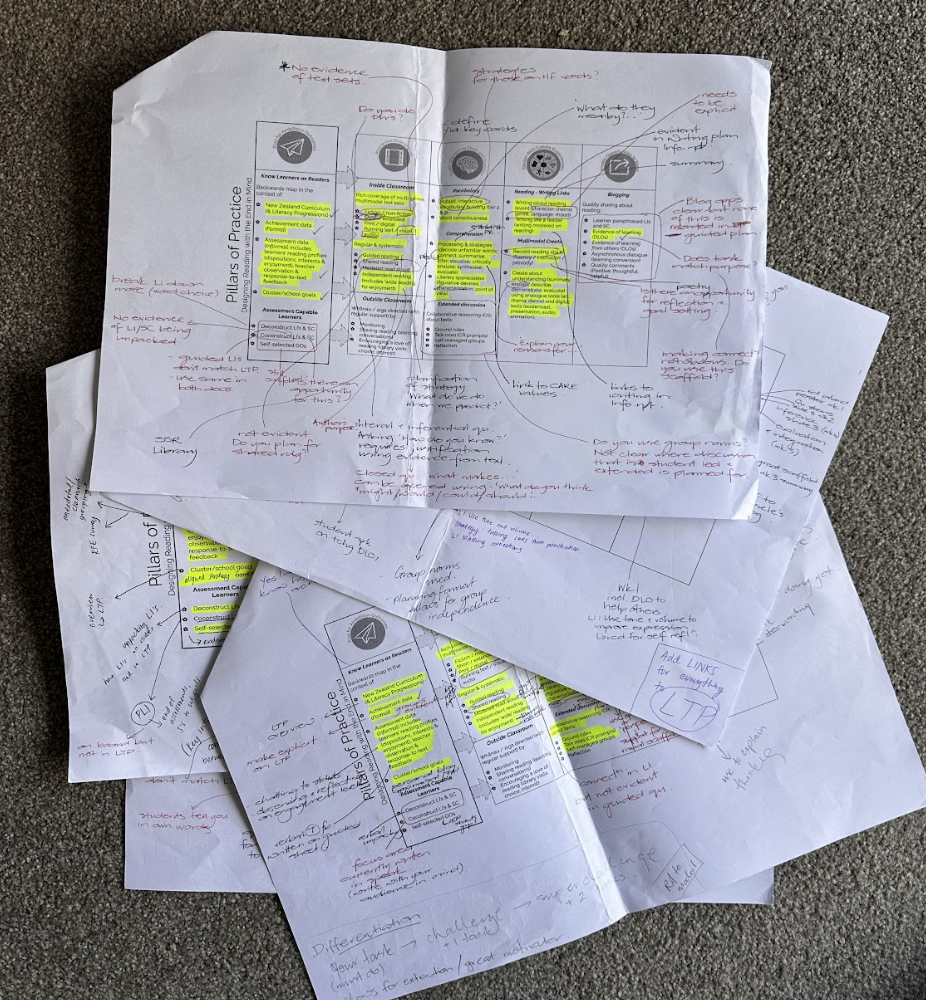
The matrix for all initial discussions was very much a working document (see image above). This gave me an opportunity to identify what I saw in the planning and my team to talk to it. Sticking firmly to the idea that 'if it wasn't in the planning it wasn't there', allowed for consistency across the board but it didn't mean I didn't listen. Using pen and paper on this occasion meant any adaptations made were clearly visible to both of us. The part of this process that I really liked was being able to celebrate and sometimes point out, people's successes. I found that by doing this first the door was opened for those more challenging conversations to take place. 

The presentation below is the formalised version of these conversations. Each teacher has their own digital copy that identifies areas of strength, areas to strengthen and next steps.

From the perspective of team leader, I now have a clear and visual picture of where we are at and what it is we need to do to help accelerate shifts in student achievement in reading. 

Stocktake of my Inquiry...

My inquiry this year has been to say the least, challenging. Not because it is unachievable, but because my initial idea just wasn't working. I had several attempts at exploring the effect of our recent Reading PLD on student achievement but soon found out this wasn't going to work as my team are are all coming at this from different places. The PLD I have had differs greatly from what the others have had. My biggest learning has been the realisation that something I think is a normal part of a lesson is not necessarily seen the same through the eyes of others. It was also a real eye opener to realise the effect of staff changes on PLD, something I'm sure all schools experience. 

After speaking with Naomi Rosedale at the last COL meeting, I realised I needed to make some changes. Once I had worked out my new pathway forward things began falling into place. I had a plan and had begun putting that plan into place, but what was missing was the framework to bring everything together. Naomi suggestion was that I align what I was looking for with the Manaiakalani Reading Pillars of Practice. That was the lightbulb moment I needed.

Light Bulb Moment Icons - Free SVG & PNG Light Bulb Moment Images - Noun  Project

Last year two of my team took part in the Reading Program Intensive (RPI) and although I didn't, I did join them in their journey through my role as a mentor. As a mentor I didn't get the explicit introduction to the Manaiakalani Reading Pillars of Practice (MRPP) so I needed to strengthen my connections. I did this by reversing the roles. This time it was me in the learning seat and Toreka in the mentor role, and turned into one of this richest learning conversations I have ever had. 

Together we analysed my long term reading plan and one randomly selected example of a guided reading plan against the MRPP.  As we unpacked each section I could see a clear picture of where my successes were and where my gaps were. Toreka was far more generous than me with this process. She kept saying 'I know you do this, I've seen you do it...' but I was of the opinion that if it wasn't in the planning it wasn't there. That decision allowed for consistency when I repeated the process with my team's planning.


The image above is the result of my conversation with Toreka. I'm sure to anyone looking at the writing all over the MRPP matrix it will look chaotic, but to me it's a rich summary of observations made, explored and discussed. I think what I liked the most in this process is that it is a true picture of my strong belief that we learn best when we learn with and from each other.

Tuesday, 23 July 2024

Teaching as Inquiry 2024


Click here
 
to see how I align my inquiry with the Manaiakalani framework.

“Recognising and spreading sophisticated pedagogical practice across our community so that students learn in better and more powerful ways...”

The Manaiakalani Community of Learning is working together on this task using the expertise existing in of our community of learning. 


Labels:

LEvidence, LScan, LTrend, LHypothesise, LResearch, LReflect,
CPlan, CTry, CInnovate, CImplement, CReflect,
SPublish, SCoteach, SModel, SGuide, SFback, SReflect

Monday, 22 July 2024

Implement and Try #1...

I am a firm believer when it comes to the effectiveness of professional learning development (PLD) is that when a team walks the journey together it becomes a journey that has life. PLD done alone or in isolation is much harder to keep going as there is no one to bounce ideas off, share successes, problem solve when it doesn't quite go to plan or to keep you on track.

With new team members there is always the challenge of getting everyone on the same page. With this thinking in mind at the end of Term 1 I got my team together and suggested the idea of an 'in house' literacy PLD day. In my team leader role I spend time in each room coaching and supporting my team in their literacy practice. This traditionally was always on a 1:1 basis which meant I wasn't using my time effectively and ended up repeating myself a lot. We all agreed to use a CRT day, and despite the logistical nightmare of ensuring everyone was released on the same day, we went ahead with the full support of our management team. 

With a wide range of teaching experience in my team I chose to start at the beginning by looking at how we are using the data to inform our planning through to the scaffolds and words we are using in front of our tamariki. You learn better when you physically do the task so I asked my team to see the learning through the eyes of our learners by taking them through the lessons. This provided us with clarity, a shared understanding of what procedural writing looked like and how to use the strategies I was sharing in context. I would like to take this opportunity to thank my team for approaching the day with open minds and a willingness to actively participate.

The DLO below shows what we covered. Some links are restricted to keep student anonymity. The aim of the day was to set us up for success in Term 2 by leading a guided planning session for the first three weeks of literacy. 


As with anything you try for the first time there is always an element of risk. I didn't want to undervalue what my team was bringing to the table but I did want to streamline our process by helping everyone make connections to our 'why' as well as our 'how'. 

At the end of the day I asked my team what their takeaways were. Their anonymous responses are below:

Teacher A 

  • How explicit things are if you show and tell - you learn by doing it
  • Foundational basics are important
  • Refer back to the data
Teacher B
  • How to unpack a text type - going back to basics
  • Tapping into prior knowledge and data
  • Gallery walk
  • Working in pairs
  • The power of talk
Teacher C
  • Prior knowledge shows me what the students already know
  • How to model explicitly eg- time connectives
  • How we can combine reading and writing together - integration
  • What to focus on when you teach a text type
  • How to use the data

    Teacher D

    • Going back to basics
    • Integration of planning
    • Clarity in planning transfers to the lesson
    • How to use the data

    As you can see the responses were different as we connect best to what resonates with us and what we needed to learn or be reminded of. Going forward as a team we have decided to continue with this type of PLD, only this time covered in our team meetings. It won't always be a literacy focus and it won't always be led by me. We have a great skills set in our team that we can tap into, after all we learn better when we learn together.

    Saturday, 4 November 2023

    Restating my inquiry question and chain of events...

    This year I want to find out if a focus on spelling conventions foster an environment where word consciousness strengthens connections to the learning? Creating a causal chain helps me stay focused on the purpose of my teacher inquiry. We all know how easy to fall down many rabbit holes along the way so having a causal chain to look back on helps to keep me on track and visualise the end point. My initial post to introduce my causal chain is here.

    At the start of term 2 my role in our school changed dramatically. I went from being one of three deputy principals to being the only DP. This change aligned perfectly with the start of my ERO journey so as I'm sure everyone will appreciate, my focus and time was spent co-constructing our matrix evidence. I found I was spending less time in the classroom and more time meeting the commitments of my DP role. Fortunately our students weren't bounced from reliever to reliever as Dianne took on the leadership of our day to day teaching component and I tried as hard as I could to be both a teacher and a leader. I quickly realised that I needed to let go of many of the lessons I loved teaching. The only one I held steadfastly to was literacy. That part was non negotiable. I was one year and one term into my T shaped literacy journey and didn't want to let that go so I had to learn how to be present in both roles. The flip side of this was that although I was using my teaching time to work towards increasing my learner's confidence using more powerful vocabulary and exploring affixes in an attempt to strengthen phonological and spelling awareness I did not blog my journey formally. Instead I had a Google doc full of notes that I knew I would be able to transcribe at a later date.

    I capitalised on the PD provided as part of the T shaped literacy initiative and attended a number of online PD sessions run by The Literacy Place. This helped me grow as a teacher who knew I needed to model what I wanted my students to replicate. Looking back at the 'intervention' box on my causal chain kept me on track. I ended up using this like a checklist which meant I had a plan and was able to stick to it to help me achieve the goals I set for myself. When looking through my student's eyes, the reading responses both oral and written, to questions and provocations provided by our T shaped units, has continued throughout the year to be our record of their shifts in the complexity of their vocabulary choices from experimental to mastery. 


    Monday, 28 August 2023

    Celebrating the win...

    This week the words I heard in our class speech competition completely stopped me in my tracks. Standing in front of an audience of their peers was every member of my reading groups confidently used the vocabulary we have encountered, unpacked and explored throughout our Reading units this year in context. Gone were the usual go-to's and in their place was a plethora of sophisticated vocabulary. This is a win in every sense of the word! 

    To give my last sentence some context, the previous week I had taught an explicit lesson on speech writing. This lesson contained exemplars at a variety of e-asTTle writing levels. That meant my learners were exposed to a healthy mix of simple and more powerful vocabulary. One of our challenges involved applying our knowledge language features to edit an exemplar and move it to the next level. This is where my students very sound understanding of the more powerful vocabulary needed came to the fore. This then lead to a rich discussion as each group discussed their vocabulary choices and explained why they had made these changes. We applied the same strategy to levelling up the structural features.

    Unfortunately the next few days saw me off sick, which meant my learners were left to work independently on their own speeches. I did share explicit instructions via email but knew these students would be working without guided teacher support. The comments tool in Google docs definitely gets a shout out here. I shared my feedback and left them to it. Move forward to today. I saw and heard the outcome of explicit teaching, creative ways of helping my learners connect to new and powerful vocabulary and a year long focus on affixes in action. 

    My next step is to record some of these speeches that will be uploaded here so that I have a permanent record of what success looks like.

    Monday, 21 August 2023

    Implement and Try#2: Word Gifting...

    I have been approaching my inquiry into word consciousness as a whole language focus and not simply looking for opportunities to strengthen spelling skills. This term I have actively planned for opportunities to adopt the word gifting strategy that Sylvia Ashton-Warner used to elicit key vocabulary. 

    Making Reading Meaningful - Sylvia Ashton-Warner and the Language Experience Approach by Sherron Killingsworth Roberts points out that by embracing some of the guiding principles for practice of Sylvia Ashton-Warner’s work in developing the Language Experience Approach (LEA) we can strengthen the connections our tauira have to the more challenging topic based vocabulary needed to make sense of new learning. The principle that resonates most with me is to offer ongoing, authentic language and literacy experiences, including lots of opportunities to speak, listen, read, write, and think about their own and others’ words.

    In my reading program this term I have been focusing on the concept of representation in texts. This unit was designed as part of the T-Shaped literacy PLD that I have been on with the University of Auckland for the past two years. In each unit there is a vocabulary component that we up until now have unpacked as a class. This time around I decided to make a few changes, with the most powerful change being to gift the content specific vocabulary to my learners. 

    The first thing I did was to create a list of the words and their definitions. These were then cut up and placed face down in front of the groups. After everyone physically selected their card the next challenge was to find the their partner by matching the word to its meaning. We needed to establish ownership of these words so the challenge to use their specific words twice each reading lesson was laid down. To ensure this happened my learners were asked to bring their word to every time we had reading. These word cards were not pretty or laminated but became a part of every reading lesson as along with ownership came a sense of responsibility.


    No one immediately connects to a word so each pair was given the challenge of introducing their word to us. The details of the challenge are on the slide below.


    What I found was that strong connections were made by the owners of these words. This was evident in reading responses, extended discussions and questions asked. What I wasn't expecting was that every student in the group could use every word accurately and in context. The example below from team 1 shows how these words were used in context accurately and effectively.

    With the success I found in reading using this strategy, I decided to transfer this challenge to our science inquiry. Again, ownership meant connections and connections meant explanations of experiment outcomes were explicit. This is definitely an activity I would use again as it was unique, purposeful and fun.

    Tuesday, 2 May 2023

    Teaching as Inquiry 2023


    Click here to see how I align my inquiry with the Manaiakalani framework.

    “Recognising and spreading sophisticated pedagogical practice across our community so that students learn in better and more powerful ways...”

    The Manaiakalani Community of Learning is working together on this task using the expertise existing in of our community of learning. 


    Labels:

    LEvidence, LScan, LTrend, LHypothesise, LResearch, LReflect,
    CPlan, CTry, CInnovate, CImplement, CReflect,
    SPublish, SCoteach, SModel, SGuide, SFback, SReflect

    Wednesday, 12 April 2023

    Implement and Try #1: Digital Escape Rooms

    Last term I attended the Creating Digital Escape Rooms with Donna Yates toolkit. Donna introduced us to a collection of published digital escape rooms which we had an opportunity to explore. We were also shown how to create our own escape rooms using Google forms. 

    Here is the link to Donna's presentation. Slides 7-15 have clear steps to follow if you are keen to give this a try.

    As a way of putting my new learning into practise and helping my students strengthen their connections to their affixes learning, we created our own affix themed digital escape rooms. The challenge was to devise 10 affix related questions that their peers would then answer in their quest to open an online game that let them apply their new learning in a fun way. The games selected were found using our smart searching skills so are not our own creations. That is one of our next challenges.

    This was a fun and practical way of reinforcing learning. Dictionaries were out in full force and the discussion was rich and very loud as questions were being tested on friends orally before being recorded on the Google form. What I liked about this activity was the fact it forced my learners to draw on and recall their new learning, the dictionaries and the books they have been completing challenges in were used purposefully and the whole activity was met with a huge level of enthusiasm. 'Easy' questions were soon pushed to the side as the desire to write the 'hardest' question became the challenge of the day. This activity took two blocks of learning to complete but was absolutely worth it as the 'I've escaped' cheers showed the level of buy-in and allowed my learners to see their own success in real time, and I was able to see just how strong the connections to our new learning are.

    We have created a page on our class site for our escape rooms which can be found here. 

    Sunday, 21 August 2022

    The impact of reading 20 mins each day...

    'Children who read for just 20 minutes per day see 1.8 million words each year and have scores on standardised tests in the 90th percentile (because they have experienced so many words!). Compare this with the child who is reading for just 1 minute per day, they only see 8000 words each year and have scores in the 10th percentile on standardised tests. A small amount of reading each day makes an incredible difference!' (Nagy and Herman, 1987) Infographic sourced here.

    I saw this poster online and shared it with my class last week then asked them to talk about the purpose of the message in the poster. We didn't focus on the test scores rather the amount of word knowledge you gain if you find 20 minutes a day to read. This resulted in a rich discussions as connections were made as to why reading is so important. 

    How Maths helped my students see their true RFE picture...

    Giving my students and authentic purpose to carry out a statistical inquiry strengthens their connections to the task as a whole. This year we have been trying to increase the time we spend reading for enjoyment (RFE). After chatting with Fiona about my inquiry I realised I needed to be regularly monitoring my intervention so that I had concrete data to allow me to measure shifts over smaller periods of time. 

    I wanted to find out:

    • How much time do you RFE each week?
    • What time we are reading?
    • Where we read?
    The Process:


    I found out:


    To allow me to gather a fair picture of the time spent RFE I used the data from the 22 students who were present at school for the time period 30/7 - 12/8. This meant that my data was clean as it put everyone on an even playing field as no one had extra time to read, or missed the opportunities that were given in class to read.

    From the data I collected I can see that evenings are the most popular time for reading for enjoyment in LS2, with bedrooms being the preferred space. When we unpacked this further I found out that this is the time of day when chores are done, younger siblings are in bed and RFE is used to get some downtime in a quiet space. What I didn't include in this data was that 7/22 students choose to RFE on a rainy day. 

    Hours spent RFE increased by 129 hours from 143 hours in week 1 to 273 hours in week 2. This is probably a direct result of our focus on RFE. I can see from data not included that the students who were absent during this measurement period, RFE was not something that is embedded in the reading habits of my students. The overall data paints a good picture as shift did occur. My goal now is to explore ways I can keep this momentum going.

    Restating my inquiry question and chain of events...

    'Will a focus on Reading for Enjoyment increase student self efficacy and capability in Reading?' This is the question that is guiding my inquiry this year and is the question I keep coming back to when I need to refocus myself. My thinking behind this question has been if I open the doors that lead to opportunities for my learners to read for enjoyment I will open the doors that self efficacy is hiding behind. A few weeks ago I was chatting with Fiona about where I was at in my inquiry when she asked me how I was changing minds and ideas...


    My earlier blogpost about my causal chain is here. I use this tool to keep myself on track and focused on my inquiry. Taking the time to evaluate where I'm at to write this blogpost, shows me that I'm meeting the goals I set. I have needed to reset timeframes a few times and this is something I think needs to be shared. Things happen along the way that cause us to lose focus or traction. It is how we get back on those tracks that counts, not how long it took us. 


    Term 2 was a challenge for me as far as my inquiry was concerned. Erratic attendance, timetable changes and staff absences meant we weren't able to get the traction I had hoped we would at this stage in the year due to disconnects in continuity. Not an excuse just a real picture of the current climate many schools find themselves in. At the end of the term I worked alongside a group of students to help them create our LS2 RFE Holiday Challenge to help reignite my inquiry for both myself and my students. We 'sold' the idea to our parents at our student led conferences by having a wall display that each student explained to their whanau. Having such a visible display was the key to opening rich and purposeful dialogue about what reading for enjoyment is and why it is so important. It worked! My students and their families bought into the challenge and I was motivated after watching the challenge evolve online. 


    Fast forward to Term 3... Reading for enjoyment (RFE) is firmly embedded into our timetable. We begin each learning day with all of us stopping and reading for enjoyment for 15 minutes. To help us keep track of the time we use a large purple egg timer as this not only ensures no short cuts with time but also gives those who need a visual guide, exactly that. 


    I made sure I introduced the book I'm reading with the class and told them what made me want to read it. My current book is Bastion Point 507 Days on Takaparawha, Auckland, 1977-78 by Tania Roxborogh. All our students know that I love history so by sharing that I chose to read this text because I want to see the event from a different perspective (- I explained here that I only knew what I heard my parents talking about from what the papers reported at the time) I am also showing my learners that I am a lifelong learner. This text has lead to a number of chats with my students who have shared how some of their whanau were there and have told me about their memories of the protest. One student has even asked to read the book after me because her nan was there and she wants to talk to her about what she remembers. 


    I had collected baseline data using Naomi Rosedale's RFE survey in Term 1 and knew that I was going to give my students the same Google form in Term 4 then compare the data, but realised the gap between time point 1 and time point 2 would be too long to wait to see if any change is taking place. I knew if wanted to capture a true picture I would need to get buy in from the class so I created a purpose for our challenge (statistics) and asked the students how we could record the time spent we reading for enjoyment over the next seven days. A number of suggestions were made with the most popular being that I create a chart to put on the board that the students would fill in each morning. 


    This worked really well as everyone was able to add at least 15 minutes to the chart every day. The visibility of the chart kept it alive in the classroom and the larger times being recorded by some, motivated others. At the end of week 2 we had a set of data that we transferred to individual Google spreadsheets, graphed and analysed. To allow for comparisons to be made and measured we decided to collect data for the following week. A task made much easier when we harnessed the digital affordances. The end result had a number of outcomes:

    1. Each student was able to see the progress in time spent reading for enjoyment. Those that had gaps were able to explain why, making everyone accountable to themselves.
    2. I got a rich overall picture of the amount of time the class as a whole spend RFE.
    3. We had an authentic purpose for our maths task that made the learning meaningful and purposeful.
    4. The data collection served as an intrinsic motivator to encourage everyone to find time to read for enjoyment.
    5. I realised that my students enjoy talking to me about the books they are reading so I need to continue to make time for this to happen.
    6. My class respond well to reading challenges.
    7. This challenge reminded me that I needed to drive it constantly. RFE is not an embedded habit in our classroom so I need to continue to motivate and encourage my students if I want them to pick a book and enjoy it.
    Have a look at David, Farzana and Fotu's blogs to see what they discovered about their RFE habits.