Showing posts with label SModel. Show all posts

Monday, 24 March 2025

Teaching as Inquiry 2025...


Click here to see how I align my inquiry with the Manaiakalani framework.

“Recognising and spreading sophisticated pedagogical practice across our community so that students learn in better and more powerful ways...”

The Manaiakalani Community of Learning is working together on this task using the expertise existing in of our community of learning. 


Labels:

LEvidence, LScan, LTrend, LHypothesise, LResearch, LReflect,
CPlan, CTry, CInnovate, CImplement, CReflect,
SPublish, SCoteach, SModel, SGuide, SFback, SReflect

Tuesday, 5 November 2024

Describe and Explain the changes/tweaks you have made in your practice along the way...

My inquiry this year has had many twists and turns. Achieving accelerated shift in Literacy was identified as being one of the most important and catalytic issues of learning facing our students in Y4 - 8, this year, when the time point one data was analysed. Exploring how learning gained from professional development is helping to strengthen teacher practice and achievement in literacy is something I haven't looked at before so I began with one idea which over the course of the year has completely morphed into another. Not because as I mentioned in an earlier post, because it was unachievable, but because my initial idea simply wasn't working. The effect of staff changes on PLD is something I hadn't initially taken into consideration. What began as an inquiry into how we (PBS) are using PLD to accelerate shift across our school' and over the course of the year required a change of tact to inquiring into how are we building and strengthening our capability in raising student achievement outcomes in Reading for years 4-8 at PBS.

I began my journey by trying to ensure we were all on the same page. Consistency and a shared language of instruction help our students to make the connections they need to be able to access their learning with confidence and understanding. At the start this wasn't about paying no regard to the skills and knowledge my team brought to the table but rather to align our thinking. This is explained in detail with examples in an earlier blog post. This wasn't as successful as I hoped as we were all coming from such different places both literally and in knowledge gained from recent PLD, so it was back to the drawing board.

Changing Direction Icons - Free SVG & PNG Changing Direction Images - Noun  Project

After speaking with Naomi Rosedale, I realised I needed a new pathway forward, a pathway that included a framework that would bring everything together and provide clarity. Aligning what I was looking for with the Manaiakalani Reading Pillars of Practice (MRPP) was the lightbulb moment I needed. In Term 3 I used the MRPP to look closely at what and how we, my team and I, were actually teaching the tauira in front of us in our reading lessons. I looked at the data and used the initial gap analysis to help me gauge whether or not the learning planned matched the student needs. To allow for consistency I stood by my decision that if it wasn't in the planning it wasn't there. The follow up discussions were both rich and gave all of us the clarity we needed to help us meet the learning needs of our individual classes.

This process was repeated in Term 4. I am yet to complete all my follow up discussions but have them timetabled for later in the week. What I noticed was with a shared understanding and stronger knowledge of why we need to make the changes. All my team have now included multimodal text sets, are looking at the structure and language in the different text types and have put a lot of thought into the questions they are asking. There is definitely a growth in the use of our shared language of instruction, a wider variety of comprehension skills being accessed. 

Changing my inquiry focus has allowed me to introduce change in a manageable and achievable way. Mindsets where planning is concerned has moved from compliance to purpose, something I struggled to initially get buy in from. I feel that looking closely at my own planning has added the 'teacher model' element to the learning. By using the MRPP it has allowed us to all learn together but at our own pace. Sharing people's successes and valuing their ideas has afforded us opportunities to learn with and from each other. 

The big message I want to share here is that change is good, it should be embraced and we should not be afraid to walk in a different direction if what we have tried is not working. 
Tuesday, 23 July 2024

Teaching as Inquiry 2024


Click here
 
to see how I align my inquiry with the Manaiakalani framework.

“Recognising and spreading sophisticated pedagogical practice across our community so that students learn in better and more powerful ways...”

The Manaiakalani Community of Learning is working together on this task using the expertise existing in of our community of learning. 


Labels:

LEvidence, LScan, LTrend, LHypothesise, LResearch, LReflect,
CPlan, CTry, CInnovate, CImplement, CReflect,
SPublish, SCoteach, SModel, SGuide, SFback, SReflect

Tuesday, 2 May 2023

Teaching as Inquiry 2023


Click here to see how I align my inquiry with the Manaiakalani framework.

“Recognising and spreading sophisticated pedagogical practice across our community so that students learn in better and more powerful ways...”

The Manaiakalani Community of Learning is working together on this task using the expertise existing in of our community of learning. 


Labels:

LEvidence, LScan, LTrend, LHypothesise, LResearch, LReflect,
CPlan, CTry, CInnovate, CImplement, CReflect,
SPublish, SCoteach, SModel, SGuide, SFback, SReflect

Wednesday, 10 March 2021

Teaching as Inquiry 2021


Click here to see how I align my inquiry with the Manaiakalani framework.

“Recognising and spreading sophisticated pedagogical practice across our community so that students learn in better and more powerful ways...”

The Manaiakalani Community of Learning is working together on this task using the expertise existing in of our community of learning. 


Labels:

LEvidence, LScan, LTrend, LHypothesise, LResearch, LReflect,
CPlan, CTry, CInnovate, CImplement, CReflect,
SPublish, SCoteach, SModel, SGuide, SFback, SReflect

Sunday, 8 March 2020

Teaching as Inquiry 2020


Click here to see how I align my inquiry with the Manaiakalani framework.

“Recognising and spreading sophisticated pedagogical practice across our community so that students learn in better and more powerful ways...”
The Manaiakalani Community of Learning is working together on this task using the expertise existing in of our community of learning. 


Labels:

LEvidence, LScan, LTrend, LHypothesise, LResearch, LReflect,
CPlan, CTry, CInnovate, CImplement, CReflect,
SPublish, SCoteach, SModel, SGuide, SFback, SReflect

Friday, 15 March 2019

Teaching as Inquiry 2019


Click here to see how I align my inquiry with the Manaiakalani framework.

“Recognising and spreading sophisticated pedagogical practice across our community so that students learn in better and more powerful ways...”The Manaiakalani Community of Learning is working together on this task using the expertise existing in of our community of learning. In 2018 for my inquiry I selected the following CoL achievement challenge that I will be looking at through a 'Language in Abundance' lens: 

#4. Increase the achievement of Years 1-10 learners, with a focus on Years 7-10, in reading, writing and maths, as measured against National Standards and agreed targets.       


Labels:

LEvidence, LScan, LTrend, LHypothesise, LResearch, LReflect,
CPlan, CTry, CInnovate, CImplement, CReflect,
SPublish, SCoteach, SModel, SGuide, SFback, SReflect

Thursday, 8 February 2018

Teaching as Inquiry 2018


Click here to see how I align my inquiry with the Manaiakalani framework.

“Recognising and spreading sophisticated pedagogical practice across our community so that students learn in better and more powerful ways...”The Manaiakalani Community of Learning is working together on this task using the expertise existing in of our community of learning. In 2018 for my inquiry I selected the following CoL achievement challenge that I will be looking at through a 'Language in Abundance' lens: 

#4. Increase the achievement of Years 1-10 learners, with a focus on Years 7-10, in reading, writing and maths, as measured against National Standards and agreed targets.       


Labels:

LEvidence, LScan, LTrend, LHypothesise, LResearch, LReflect,
CPlan, CTry, CInnovate, CImplement, CReflect,
SPublish, SCoteach, SModel, SGuide, SFback, SReflect

Wednesday, 25 October 2017

Manaiakalani Outreach Wananga 2017 Presentation


Today I was invited, along with five of my CoL colleagues, to share my inquiry with the principals and leaders from the Manaiakalani Outreach schools, the Manaiakalani School Leaders and Researchers from Auckland University. As a Community of Learning we are collaboratively inquiring into six achievement challenges to accelerate student achievement. 

My link to my presentation with the speaker notes that summarises my inquiry to date is here.


Wednesday, 5 July 2017

Sharing and Modeling

Photo: @Karen0986

Earlier this term Karen Ferguson, one of my CoL colleagues from Tamaki College came to visit us in LS2. She spoke to my learners about how we use self assessment in our learning. Karen's blog post about her visit can be found here.  Although initially a bit shy, it was great to see how my learners were able to talk confidently about their learning. I was able to see from Karen's conversation with my learners that I scaffold this quite a lot, and perhaps need to lessen this to promote increased independence. My take away is to visit Karen and have a similar conversation with her Year 9/10 learners. Doing this will help me blend into my instruction, some of the self assessment language she uses to set our students moving on to Tamaki College, up for success.


Today Dot Apelu, another of my CoL colleagues from Tamaki College came to observe us in LS2. Dot had seen a previous post I wrote and contacted me about sharing my practise. Her summary of our initial discussion is here. I explained to my learners that Dot was here to see how we used some of our learning strategies to strengthen our understanding to new learning. 

To model our dialogic learning in practise, I asked my learners to identify and summarise the main points of our learning linked to our work with Tamaki Wrap the previous day. I explained that we needed to hear their learning talk so it was important to use their words, and as we moved around the groups I observed something that was new to us at the beginning of the year, is now something perceived by my learners to be the norm. They were able to explain their thinking and use examples from the available information (including our rewindable example of the flipgrid they created yesterday) to support their reasoning. 

The well established collegial connections we have in place in Manaiakalani are definitely as asset to both our teachers and our learners as we work towards bridging the transition gaps between Year 8 and Year 9. My take away from today is to make time to observe more of my colleagues across our cluster, as the best professional development is available right on my doorstep.


Wednesday, 24 May 2017

What my inquiry looks like in LS2...

I was asked to share and model my inquiry process by creating a DLO that shows what my spiral of inquiry looks like in practise. This will be shared next week as a scaffold to help our teacher strengthen their own connections to the inquiry process. This was a great opportunity for me to see exactly what my inquiry looked like through other's eyes and reflect.

Positives
  • Routines established
  • Repetition without boring
  • Transparent learning
  • Multimodal learning opportunities
  • Actively listen to learner feedback
  • Observations of good practise across PBS (LS2, Room 3, LS1 done)
Negatives

  • Talk doesn’t flow as readily as I hoped
  • Most able not engaging
  • Gender/cultural shyness?


What are my next steps?

  • Week 5 observation with COL across school teacher (Matt).
  • Exploring published research
  • Accessing literacy facilitator
  • Continue to actively plan for dialogic learning opportunities
  • Observations of good practise across PBS (Room 1 and Room 5 booked for Week 6)


Thursday, 2 February 2017

Teaching as Inquiry 2017


Click here to see how I align my inquiry with the Manaiakalani framework.


“Recognising and spreading sophisticated pedagogical practice across our community so that students learn in better and more powerful ways...”


The Manaiakalani Community of Learning is working together on this task using the expertise existing in of our community of learning. In 2017 for my inquiry I selected the following CoL achievement challenge: 


  • #4. Increase the achievement of Years 1-10 learners, with a focus on Years 7-10, in reading, writing and maths, as measured against National Standards and agreed targets.

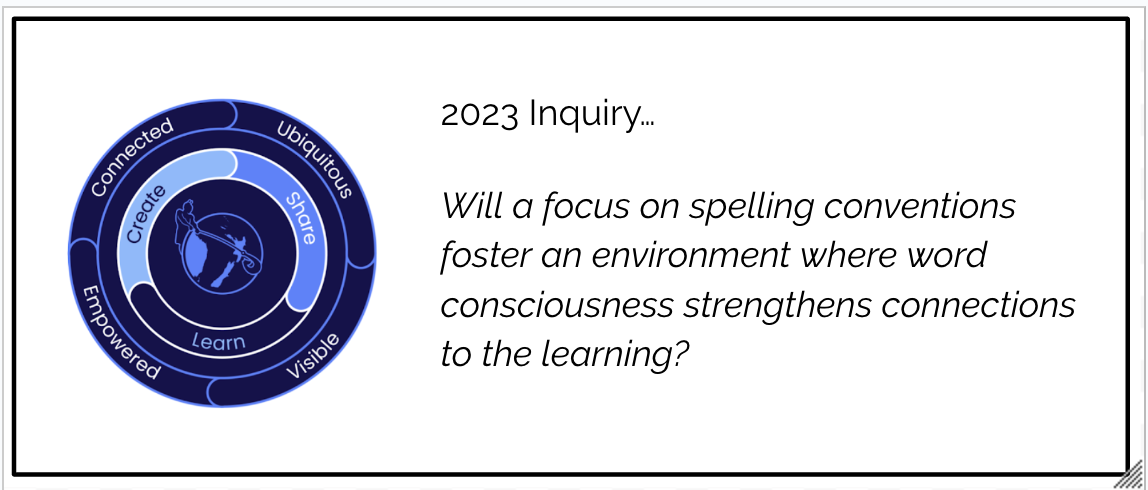
The teaching as inquiry framework I will be using in 2017 has been specifically co-constructed for Manaiakalani schools using our familiar Learn Create Share structure.
The elements in this framework share close similarities with other models New Zealand teachers use.


I will be labelling my posts as I update my inquiry throughout the year to make the content easy to access.

Labels:
LEvidence, LScan, LTrend, LHypothesise, LResearch, LReflect,
 CPlan, CTry, CInnovate, CImplement, CReflect,
SPublish, SCoteach, SModel, SGuide, SFback, SReflect

Label Key:


LEvidence
Learn - Gather Evidence
CPlan
Create - Make a plan
SPublish
Share - Publish
LScan
Learn - Scan
CTry
Create - Try new things
SCoteach
Share - Co-teach
LTrend
Learn - Identify Trends
CInnovate
Create - Innovate
SModel
Share - Model
LHypothesise
Learn - Hypothesise
CImplement
Create - Implement
SGuide
Share - Guide
LResearch
Learn - Research
CReflect
Create - Reflect
SFback
Share - Feedback
LReflect
Learn - Reflect


SReflect
Share - Reflect