A huge THANK YOU to everyone who was part of the Manaiakalani Community of Learning. This afternoon the CoL teachers shared our impact bursts. It was really interesting to listen to the shared struggles, innovations and successes our inquiries presented as we worked towards accelerating the learning in our classrooms. It has been an absolute privilege working alongside you all this year. I look forward to growing the connections I made, as I have learnt so much by listening to your feedback and following your inquiries.
Showing posts with label Cluster Inquiry. Show all posts
Thursday, 16 November 2017
Wednesday, 15 November 2017
Reflections and Questions...
Over the year there has been a noticeable shift in the amount of dialogue each reading lesson presented. Learner engagement and agency increased through the co-construction of scaffolds and shared ownership of the learning. Participation moved from passive acceptance into active questioning as the knowledge of how to dig deeper into a text moved through the stages of mastery. The scaffolds initially introduced in reading were repurposed independently by a wide number of students across all learning areas, and grouping became more cohesive and collaborative as confidence levels grew.
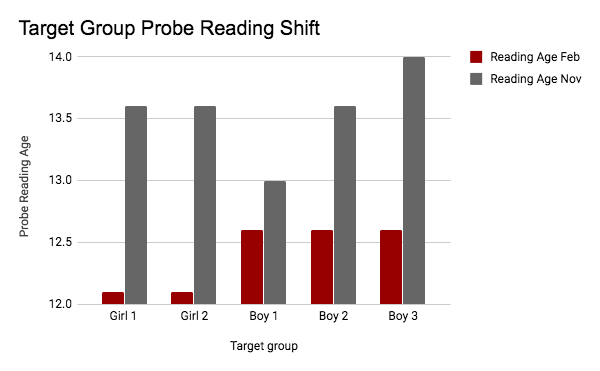
Strengthened connections to vocabulary, content and comprehension strategies have enabled significant shifts in reading age across my whole reading group. The graphics below represent the shifts made by my target students. What excites me about this picture is that 3/5 students made an 18 month shift in reading age, 1/5 students made a 12 month shift and 1/5 students made a 6 month shift when tested on both fiction and non-fiction assessments.

Aside from being able to make sense of more sophisticated texts I noticed their reading behaviours changed. My learners moved from trying to simply recall facts and re-reading a text in entirety, to skimming and scanning for key words and phrases when searching for evidence to support their thinking. The quality of the responses increased as they were able to make stronger connections to language of questioning. Simply put, this meant they knew what the question was asking them to do. I know this because I asked them to think aloud while they were processing the task ahead.
Over the year we have used talk to explore and unpack strategies and scaffolds that have helped my learners strengthen their understandings and connections to a wide variety of texts. A large part of this focussed on personalising the language of instruction and making sure that this was explicit. Making use of rewindable learning opportunities enabled my learners to see through their own eyes what they were doing right and where they still needed support. I actively planned for opportunities for talk to take place and used student created exemplars to spark their curiosity and explore new learning in context. 'Repetition without boring' was the key here as we repurposed and tapped into the known to help us access the unknown.
Disconnects with vocabulary have been our biggest stumbling blocks this year. Moving forward I will be looking at how I can continue to break down the barriers between new words and new learning by capitalising on my 2017 learner feedback to keep the talk going with my learners in 2018.
Wednesday, 2 August 2017
How I am engaging my learners in talk...
This week has been all about front loading so that my learners are able to begin forging connections to the content of our new learning. The screenshot of the blog post below reflects one of the ways we have done this. I was particularly drawn to her last sentence where she states that talking to her group helped her make connections.
We have done a lot of think-pair-share to encourage the learning conversations. By taking time to move around the groups I have noticed that everyone is actively participating. I reminded my learners that we learn best when we learn together and talk about our thinking. The collaborative approach removes the scary as the sharing reflects the ideas of the group and eliminates the pressure to take risks alone.
As I have mentioned in previous posts, the scaffold this group chose to use was a 'go to' rather than a 'you must use'. Clearly strong connections have been made to this as they see by identifying the key words they are able to rework the words into meaningful sentences that summarise their learning.
Since woman's rights with voting was a big issue in the olden days, our reading topic this term relates to this with the upcoming election in mind. We watched a youtube video about the suffragette movement and wrote a 25 word summary on "what the suffragette movement was". I found this quite hard because it isn't a skill that I have mastered (summary) but talking to my group helped me make my connection.
To help me scaffold my learners towards evaluating their own contributions to the learning conversations I asked each group to do this today via the comments tool. It was interesting to listen to the negotiations taking place before the final comment was devised. Some as you can see were very honest. What I celebrated was the fact my learners were able to recognise their own contributions to their learning conversations. I see too that I need to scaffold what it is I want my learner's to notice so that they have the tools to strengthen their evaluations and identify their own next steps.
Monday, 31 July 2017
Midway Reflection...
Last Thursday we met as a CoL group to share and reflect on our inquiries at the midway point. This shared check-in allowed us to talk about the successes, failures and improvements we have experienced and noticed, with colleagues who are working towards the same achievement goal.
In my class we live by the ethos that 'we learn best when we learn with and from each other', something I capitalised on myself in this meeting. By listening to Adrienne Dines share how her inquiry is progressing, I realised our inquiries crossover in many areas. We have drawn similar conclusions and have implemented similar interventions to increase the levels of talk amongst our students. Adrienne’s statement that ‘talk is the action born from thinking’ is something I will unpack with my learners as I see this as an additional way of strengthening their connections as to why having learning conversations are so important.
Wednesday, 12 April 2017
Te Taiao o Tamaki Hangouts
What a great morning we are having in LS2! Today our Manaiakalani schools are celebrating our cluster wide inquiry at Te Oro with presentations and performances. Not all of us were able to attend so the wonderful hangouts have enabled us all to be a part of the learning celebrations. We began by watching Glenbrae students present their inquiry. It was really interesting to see the learning other schools have been doing. When it was time for the PBS performance we all sat glued to our screens.
Listening to the Glenbrae students present their learning.
Watching our own Panmure Bridge School performance.
Watching Tamaki College students present their learning
Subscribe to:
Posts (Atom)