Sunday, 13 July 2025

Causal Chain - mapping my inquiry...

As a part of the Manaiakalani Kahui Ako we are challenged to think about what we want to achieve then work backwards to map our steps. This is called a causal chain and is the logical thought process we follow to help us stay focused on on track throughout the entirety of our inquiries. As I completed my causal chain for 2025 I realised I was actually building on from the inquiry I began last year. This is exciting as it is an opportunity to see how the team alignment we worked so hard on last year strengthens our team when staff members change and a new program (structured literacy) is introduced.


A causal chain is when a cause leads to an effect and that effect becomes the cause of another effect - A leads to B. B leads to C. C leads to D...start from D and work backwards Any intervention you design will (consciously or not) be based on a causal chain you have in mind - this is your theory of action.... To really understand deeply how teaching (as a cause) leads to a valued student outcome (effect), we need to know about more than just the first cause in the chain and the final - we need to know about each link.' - Dr Aaron Wilson

Building an accurate profile of students' learning - tools, measures and approaches...

Describe the tools/measures/approaches you plan to use to get a more detailed and accurate profile of students’ learning in relation to that challenge. Justify why you chose these approaches and tools.


My challenge is to explore 
how the create aspect of the Manaiakalani pedagogy fits in and how we harnessing the digital to explore the create aspect of structured literacy. Our Junior team is currently running a structured literacy program and our Senior team are one week away from beginning our own structured literacy journey. As indicated in a previous post, I am very aware that 'creative skills help students become better problem solvers, communicators and collaborators.' (Manaiakalani). If a student can effectively use their DLO to teach it to someone else, then their own level of understanding and critical thought patterns (specifically analysis) are significantly strengthened.

To capture our starting point I chatted to our teaching team about how they currently use create in Reading and then followed this up by exploring the teaching slides on our class sites and a random selection of individual student blogs. The presentation below reflects my initial findings. Classes are randomly positioned on these graphs to preserve anonymity. My objective here is not to identify anyone or any class publicly as everyone is grappling with the challenges new learning brings.


One point I did not consider at the start of the year was the difference in learning needs between the students who are learning to read and those who are reading to learn. I have since discovered that with our newest learners the create aspect is very much 'hands- on' rather than digitally focused. 

With my Year 7/8 class in mind I will be continuing to use what I already know to build on my new learning. Having participated in the T-shaped literacy PLD for the last few years I can see where the ideas I learnt there can be capitalised on here. What is important for our senior team is that we follow the same line of thinking. We don't need to disregard for example, the summarising DLO and shared language of instruction we already use. This alignment that has been across the syndicate for the last few years is paying off in our room this year as our learners already have the knowledge needed to summarise a text. My role is to remind our team as we begin our structured literacy journey, to use what we know to unpack the new learning. We don't need to take our learners back to the start when they're already finding success in what they use now.

My Planning Focus:
  • This year I changed the word 'changes' to 'focus' in this section as I am aware if create opportunities are to stay alive in my literacy program I need to ensure they are well thought out and actively planned for. I absolutely can not see the point in throwing the baby out with the bathwater to ensure I am following a structured literacy program.
  • Looking ahead at the planning exemplars on the platform we are using I see that there are opportunities for our learners to summarise, find the main idea, identify the theme, make connections and see things from different perspectives. All follow up challenges I already do. What I won't be doing is using the provided worksheets as I have a wide range of strategies in my kete that will allow me to align with the planning but also keep create alive in my classrom.

Monday, 24 March 2025

Teaching as Inquiry 2025...


Click here to see how I align my inquiry with the Manaiakalani framework.

“Recognising and spreading sophisticated pedagogical practice across our community so that students learn in better and more powerful ways...”

The Manaiakalani Community of Learning is working together on this task using the expertise existing in of our community of learning. 


Labels:

LEvidence, LScan, LTrend, LHypothesise, LResearch, LReflect,
CPlan, CTry, CInnovate, CImplement, CReflect,
SPublish, SCoteach, SModel, SGuide, SFback, SReflect

Engage, Empower, Inspire... Setting Group Norms

Setting group norms at the beginning of the year is one of the most crucial parts of a successful guided reading lesson, in my opinion. Students struggle to work effectively in a group if they don't know how to interact with their group or why they actually need to do this. 

This year I made a huge change and rather than doing this group by group I chose to take on the challenge of doing this as whole class lessons with all my learners sitting in their reading groups. The first lesson was an extremely structured step by step lesson with lots of teacher guidance. What I noticed is having the opportunity to look at how other groups were interacting helped strengthen the confidence of all the groups, regardless of ability.

I selected a text that linked explicitly to our inquiry topic which meant everyone was able to make an immediate connection to it. We began with a multimodal dive into the front loading texts. The first one, a short 3 minute video, was unpacked with me having the locus of control. This meant I was able to model and guide every step of the process. What I noticed was I had an immediate buy-in. It was evident that I knew the content and was able to respond to questions asked without referring to the texts. 

We kept it simple and during the first viewing simply just watched it. I then asked each group leader to ask everyone in the group to share something they found interesting. When we watched it a second time every student had a vivid and access to the group note taking paper. The challenge this time was to write down any words that were interesting, new or unknown. I made it clear this wasn't a spelling or handwriting lesson so encouraged the words to be recorded the way they sounded if the correct spelling was unknown. Following this challenge the leaders were once again asked to ask everyone in the group to share a word and say why that word had been recorded. The final independent challenge for this text was to watch the video again, this time in groups not on the TV, and record any facts that were deemed important or interesting. Once this had been completed (short time limits were given) the leaders were asked to get the talk going with the final group challenge being to share what has been written then co-construct 5 questions they may have about the text. What was happening here was a gradual shift in the locus of control.

With all our vocabulary, facts and questions recorded we moved onto the balcony for a very loud speed dating style activity. The noise level and laughter that came as a direct result of the speed of the partner changes everyone enjoyed the opportunity to move and to share their new learning. 


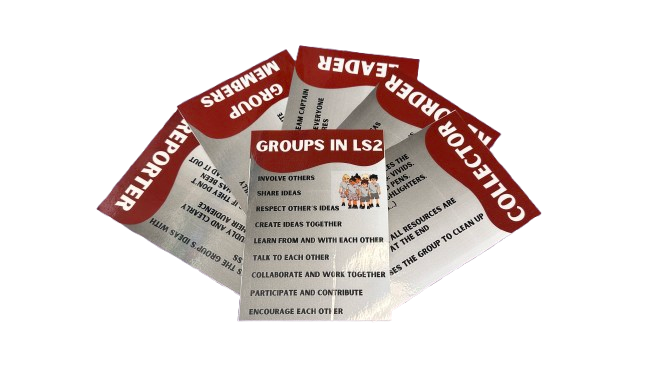
Having stretched our legs and made the most of the opportunity to learn with and from each other we used the same process to unpack the next set of short texts. This time I gave both written and spoken instructions and let the groups take control and work at their own paces. We Have a set of group norm cards which were displayed and unpacked as we went along so everyone knew their role. As always in LS2 their are no passengers in group challenges. In my favour was the fact that two weeks before we had been on camp where both individual and group challenges were the order of the day.

Day 2 saw a small blip in the flow as we changed leaders. I let each group select their leader each time. The message given was that at this time of the year we are all learning how to lead and how to be a member of a group so supporting each other was the order of the day. Groups were encouraged to use the group norm cards in their group boxes to help guide them. During this time I moved around the room while Dianne (my buddy teacher), worked closely with our group who find reading a challenge. We persevered and with guidance found success in the lesson. What impressed me was the richness of the talk that was taking place.

Fast forward a week and the norms set in place last week were alive and kicking! What I observed was that the groups had naturally reverted to those they saw as leaders and with that 'security' in place for learning, confidently took on the additional roles that are needed to be filled if groups are to work together collaboratively and productively. 

We are definitely still at early days but my big message to myself is take time to set things up because the wheel turns when everyone understands the 'why' behind the challenge.


Wednesday, 19 March 2025

Student Inquiry Foci 2025...

With all our school starting or strengthening our structured literacy journeys this year, I have decided to focus on where the create aspect of the Manaiakalani pedagogy fits in and how we harnessing the digital to explore the create aspect of structured literacy. As I write this our Y4-8 team are yet to begin this journey so my hope is by voicing my hunch, we might avoid overlooking opportunities to create as we navigate our new learning.

I have been a part of the Manaiakalani cluster for many years and know the power the create component in learning has towards helping us achieve the 1.5x accelerated shift we need to ensure our learners are set up for success as they move through their individual learning journeys. 'Creative skills help students become better problem solvers, communicators and collaborators.' (Manaiakalani).

Sourced from Manaiakalani Pedagogy for DFI DLO

Students learn by actively constructing knowledge, not just absorbing it. This involves breaking down, rearranging, selecting, and demonstrating their understanding, so that  “...whatever was in their mind, whatever they could visualise, whatever they could see they created...” - Elwyn Richardson. 

The Apple curriculum supports this thinking and states 'After 40 years working alongside educators, we've seen — and research has shown — that creative thinking leads to deeper student engagement. And when students are more engaged, they take more ownership of their learning. Creative skills help students become better problem solvers, communicators and collaborators. They explore more and experiment more. They tell richer stories and find their own unique voices. They stretch their imaginations and make connections they might not otherwise make — and they carry these skills through everything they do in school. And beyond.' Why Creativity Matters - Apple Curriculum. 

The challenge of student learning is to demonstrate their understanding of a concept by creating something with the knowledge that they have unpacked and internalised. If the create process is overlooked where will we find ways to facilitate discussion and reflection? I can't imagine any student being inspired by. If students are not inspired to learn, then following a preset lesson to the letter will result in a structurally embedded underachievement issue that will see us lose the interest of those readers we have worked so hard historically to capture.

If I look back at my own time at school, with the exception of one year, I can not recall anything in reading lessons other than sitting in a circle reading a text round robin style then being sent back to my desk to answer questions in silence to demonstrate that I had gained meaning from what I had read. There were no opportunities to learn from others, no opportunities for collaboration and no opportunities to talk about the text, let alone creating anything with the information I had found. Sadly this was reading until I was about 9 years old, something I viewed as just a thing we did at school. The one year that stands out saw us being asked to draw characters in a particular scene, make information posters and redesign book covers. That was the year I saw reading at school as fun.

It is because of the very reason just mentioned, that I feel this is the the most important and catalytic issue of learning for our learners this year. I don't want to be introducing and unpacking a text verbally through preset comprehension strategies. I don't want to be the teacher who asks my students to summarise a text on a graphic organiser then leave it there. I want to be the teacher who asks a provocation and encourages talk and creativity. I want my learners to show me their connections to the aspects of the text we are unpacking using the plethora of digital tools available to us. Defaulting to substitution in response to a structured learning process does not, in my opinion, open the opportunities to 'empower my students with creative learning opportunities to help accelerate achievement'.

Thursday, 28 November 2024

COL Interview 2025...

What achievement challenge are you considering as an area of focus in 2025 and why? Include in your WHY both evidence and your own passion/expertise.

I would stay with Achievement Challenge 3 of lifting achievement in Reading for students in Years 1-13.

This is particularly relevant as we are all making the shift towards a structured literacy approach. For some of us this is a very real step into the unknown. When we meet our new classes we will meet a new array of learning challenges.

My belief is that one size does not fit all. I know personalising the instruction is vital to breaking down the barriers that prevent our tamariki from accessing their learning. There is a plethora of pre-made resources available but it is also vital that we do not lose sight of the need to plan purposefully so that the teaching aligns with the analysed data pictures of the learners in our individual classes.

What learnings from the 2017 - 2024 CoL teacher inquiries have informed or inspired your thinking.

Learning with and from my fellow CoL teachers has meant I have collected many ideas from others along the way that have become embedded in my practice. I really like the conversations and connections we make with eachother.

How would your work support Manaiakalani pedagogy and kaupapa?

The move from compliance to purpose in planning is a personal journey that needs to be guided and supported in bite sized chunks to make the growth meaningful. It's not about disregarding or undervaluing what individual teachers bring to the table, but rather helping them to see that one size does not fit all.

We need to take ownership of the focus of the lesson to ensure we are meeting the learning needs of the students we teach. Each class is different and each plan should reflect this difference.

No one wants to navigate these seas alone so a collaborative learning journey provides us with the shared focus needed to learn with and from each other. Our goal being to drive the 1.5 times shift by giving our learners the tools they need to find success in all learning opportunities. It's not just finding a 'how' but also about understanding the 'why'.

Which elements of the extensive Manaiakalani research findings inform or challenge you as you think about this?

The picture the data paints shows that our learners continue to struggle to grow and strengthen their connections to the academic literacy that allows them to access their learning. Teacher planning is crucial to the success of this. My inquiry this year has identified one of the biggest challenges leaders face, the challenge of shifting mindsets in planning.

How would you like to be supported in 2025 as you undertake this inquiry?

The support I would like in 2025 is to continue our collaborative inquiry approach as each year this has enabled us to build on and strengthen the processes we already have in place. I find the talanoa opportunities with both the Kahui Ako and the MET Research Team to be extremely valuable as I learn a lot from other's feedback and experiences.

How would you plan to support your colleagues in your school with their inquiries and/or teaching in the area you are exploring?

I have modelled my inquiry on my blog since 2017. All my inquiries are visible and honest. Not all have been a success, and I feel it is very important to reflect this openly as it's the tweaks that are made that we learn the most from.

Having held the Within School Kahui Ako role for the last seven years I believe the best support I can offer my colleagues with their inquiries is to guide them through the inquiry process term by term as this is both rewindable and manageable.

Several years ago I created our PBS Teacher Inquiry DLO, which is our version of a ‘how to’ process and is shared with staff in termly chunks. In term 4 we come together and have our own sharing session. Something I have driven as our PBS within school kahui ako is to ensure opportunities to focus and discuss our teacher inquiries are planned for, in order to keep the process alive throughout the year.

Thursday, 21 November 2024

Bursts and Bubbles 2024...

My inquiry this year has had many twists and turns. Achieving accelerated shift in Literacy was identified as being one of the most important issues facing our Y4 - 8 team, this year, when the time point one data was analysed. What began as an inquiry into how learning gained from professional development was helping to strengthen teacher practice and student achievement in literacy, completely morphed into the one you can see on the screen behind me. Why? Because it simply wasn't working.

The effect of staff changes on PLD is something I hadn't initially taken into consideration and I found myself going round in circles. I began my journey by trying to ensure we were all on the same page. I knew consistency and a shared language of instruction would help our students to make the connections they need to be able to access their learning with confidence and understanding.

This wasn’t about disregarding what my team brought to the table, but rather about aligning our thinking. However, as we were all coming from such different places, both literally and in knowledge gained from recent PLD, I hit a wall I couldn’t get over.

Midway through the year I spoke to Naomi Rosedale to get her advice on why this wasn’t coming together for me. To be honest, by this time I had pretty much lost interest as I was going round in circles. It’s amazing the power one conversation can have. I left totally reinspired with a completely new inquiry focus and my new best friend, the Manaiakalani Reading Pillars of Practice sitting comfortably in my Google drive. Aligning what I was looking for with the Pillars of Practice was the lightbulb moment I needed. In Term 3 I used the pillars to look closely at what and how we, that is my team and I, were actually teaching the tamariki in front of us, in our reading lessons. Time point one data analysis helped me gauge whether or not the learning planned met the learning needs. To allow for consistency, I took the stance that if it wasn't in the planning it wasn't happening. The follow up discussions were both rich and gave all of us the clarity we needed to help us move forward in our quests to meet the learning needs of our individual classes. This process was repeated in Term 4 and Time point 2 data analysed alongside it. What I noticed was with a shared understanding and stronger knowledge of why we need to make changes, changes had been made. These findings and the student shift we are celebrating are all explained in detail on my blog. Changing my inquiry focus has allowed me to introduce change in a manageable and achievable way. Mindsets where planning is concerned, have moved from compliance to purpose, something I struggled to initially get buy in from. I feel that looking closely at my own planning put us all on an even playing field. Having a framework allowed us to all learn together but at our own pace. The big message I want to share here is that change is good, it should be embraced and we should not be afraid to walk in a different direction if what we have tried is not working.