Showing posts with label Manaiakalani COL. Show all posts

Friday, 7 November 2025

Bursts and Bubbles 2025...


My concern that the rigor Structured Literacy brings would unintentionally lead us back to the uninspired consolidation tasks of the "duplicated worksheet" era was my why behind this inquiry. This was a time that stifled creative expression and deep, transformational demonstrations of learning, so my goal was to ensure creativity thrived alongside the new structured literacy framework.

To explore this I compared the planned Create opportunities across our kura between Terms 2 and 4 by analysing teacher planning, staff feedback, class sites and student blogs. I wanted to see not just what was planned, but what was actually happening in classrooms. 

Early observations showed very quickly that our junior team already excels in hands-on, collaborative creativity. This insight prompted me to shift my focus to the senior team. However, it soon became clear to me that no one needed added pressure from me when they were implementing new learning for the first time. So I decided to refine my focus to my own Year 7 and 8 classroom, where I could explore creative practice with our most confident readers.

In my classroom, the introduction of AI tools such as Gemini Gems, alongside our established follow-up challenges, enabled students to build on prior knowledge and engage in richer, more independent learning conversations.

By narrowing my focus or, as I like to call it, “taking a selfie”, I was able to demonstrate that maintaining a creative emphasis within a structured curriculum is not only possible, but highly effective.

The findings were encouraging and I was able to see that Create oportunites are firmly embedded at PBS without explicit intervention from me. They just needed to be viewed in an alternative way.

The greatest challenge throughout this process has been adapting to the various course changes my inquiry has taken. My journey has reminded me that Create must be purposeful and engaging. It is not an optional add-on; it is a vital vehicle through which students construct, represent, and deepen their understanding.

I will move into 2026 recognising that: 

Create extends beyond digital tools; hands-on, collaborative approaches are equally powerful.

And finally, student agency drives academic rigour; when learners have creative choice -  engagement and independence increase, because this is when learning becomes truly transformative.


Tuesday, 7 October 2025

What the Research says...

With technology at my fingertips and time not on my side, I prompted Gemini to undertake a deep research to find out more about why teacher confidence levels drop when faced with implementing new learning. 

Click on image to hear the audio overview of full research findings

Volume Icon, Transparent Volume.PNG ...

This is my summary of the findings...

The decline in teacher confidence during the implementation of new learning initiatives is a predictable reaction caused by challenges to personal competence and structural deficiencies like planning time pressures and knowledge gaps. Teachers initially find themselves juggling  anxieties where they worry about the changes needed to be made to routines, alongside professional fears associated with the uncertainty that comes with stepping into the unknown. 

As implementation begins, the concern shifts to logistical and structural constraints where concern connects to the amount of time needed to be prepared to teach the new approach. This efficacy dip is often worsened by perceived external and internal pressures to find the success quickly. PLD must be ongoing, curriculum-specific, and designed to close identified content and pedagogical knowledge gaps, moving away from generic, one-size-fits-all training. Time for reflection, implementation, peer and self observation, and skill practice should be allowed. Everyone learns at their own pace and recognising this is important. What has made the implementation of sound practice in structured literacy more fragmented for my team is the fact the Year 4-6 kaiako have had separate sessions from the year 7/8 kaiako. Different online delivery options has meant a similar message has been shared but as I attend one and most of my team the other, there are bound to be gaps in our shared learning which in turn has lead to levels of uncertainty being higher as I have always been two days behind in my own learning and unable to effectively support my team as they begin each new learning journey.

As a leader fostering a buffer against the cognitive and emotional load is vital is success is to be found and a genuine buy-in to be established. Allowing my team complete agency and control over their implementation decisions within their classrooms has meant we have come back together again with a stronger connection to our new learning. Confidence is emerging and as a result mentor observations to gather a baseline picture have begun. It is only now that I can begin to look for the opportunities being provided for their learners to be creative when undertaking structured literacy learning. I look forward to see where this takes us as the term progresses.

Describe and Explain the changes/tweaks you have made in your practice along the way...

I began with a focus of how we (PBS) are harnessing the digital to explore the create aspect of structured literacy. Students learn by actively constructing knowledge, not just absorbing it. This involves breaking down, rearranging, selecting, and demonstrating their understanding, so that  as Elwyn Richardson stated, “...whatever was in their mind, whatever they could visualise, whatever they could see, they created...” It is because of the very reason just mentioned, that I felt this is the the most important and catalytic issue of learning for our learners this year. I didn't want to introduce and unpack a text verbally through preset comprehension strategies. I didn't want to be the teacher who asked my students to summarise a text on a graphic organiser then leave it there. I am the teacher who asks a provocation and encourages talk and creativity. I want my learners to show me their connections to the aspects of the text we are unpacking using the plethora of digital tools available to us. Defaulting to substitution in response to a structured learning process does not, in my opinion, open the opportunities to 'empower my students with creative learning opportunities to help accelerate achievement'.

At the start of my inquiry I thought I would look at our school as a whole. This was when I realised I was comparing apples with pears. Many of our junior team facilitate amazing opportunities for their students to create to show their understanding of a text. Their learners are fully engaged and excited to share what they have been doing any time I walk into one of their rooms. The difference between what they do, and what the senior team do is that many of their create challenges are not limited to capitalising on the affordances digital tools provide. Changing my focus to just the senior team was my first tweak. 

When we began our structured learning PLD in Term 2 with our introduction to the program. We then moved forward into Term 3 for our Community of Practice (COP) sessions and began implementing our structured literacy programs. I made the decision from the outset to lead from the front. By that I mean I made a point of finding ways to include opportunities for my learners to show their understanding of the texts read by being creative. What I noticed other members of my team doing was simply trying to get it right with our new learning. I do have the advantage here of having taught structured literacy for a number of years in the UK. I was definitely 'rusty' but felt confident to add in the new elements to my program. Term 3 was not the time to push the 'create' as I needed a team who were strengthening their own connections and that was more important. This was my second tweak as I took the focus of others and focused purely on myself.

When we met to plan for term 4 I jumped on my 'create' bandwagon. With a number of examples under my belt and on my blog I was able to lead by example. Being able to visualise the outcome has seen a huge change in planning content in my team in literacy this term. I am now looking forward to seeing how these initial ideas look when they are finished. The change here is in my thinking. I now realise that adding create opportunities that capitalise on the digital tools we have at our fingertips comes when teachers feel confident of the challenge ahead. 

Wednesday, 19 March 2025

Student Inquiry Foci 2025...

With all our school starting or strengthening our structured literacy journeys this year, I have decided to focus on where the create aspect of the Manaiakalani pedagogy fits in and how we harnessing the digital to explore the create aspect of structured literacy. As I write this our Y4-8 team are yet to begin this journey so my hope is by voicing my hunch, we might avoid overlooking opportunities to create as we navigate our new learning.

I have been a part of the Manaiakalani cluster for many years and know the power the create component in learning has towards helping us achieve the 1.5x accelerated shift we need to ensure our learners are set up for success as they move through their individual learning journeys. 'Creative skills help students become better problem solvers, communicators and collaborators.' (Manaiakalani).

Sourced from Manaiakalani Pedagogy for DFI DLO

Students learn by actively constructing knowledge, not just absorbing it. This involves breaking down, rearranging, selecting, and demonstrating their understanding, so that  “...whatever was in their mind, whatever they could visualise, whatever they could see they created...” - Elwyn Richardson. 

The Apple curriculum supports this thinking and states 'After 40 years working alongside educators, we've seen — and research has shown — that creative thinking leads to deeper student engagement. And when students are more engaged, they take more ownership of their learning. Creative skills help students become better problem solvers, communicators and collaborators. They explore more and experiment more. They tell richer stories and find their own unique voices. They stretch their imaginations and make connections they might not otherwise make — and they carry these skills through everything they do in school. And beyond.' Why Creativity Matters - Apple Curriculum. 

The challenge of student learning is to demonstrate their understanding of a concept by creating something with the knowledge that they have unpacked and internalised. If the create process is overlooked where will we find ways to facilitate discussion and reflection? I can't imagine any student being inspired by. If students are not inspired to learn, then following a preset lesson to the letter will result in a structurally embedded underachievement issue that will see us lose the interest of those readers we have worked so hard historically to capture.

If I look back at my own time at school, with the exception of one year, I can not recall anything in reading lessons other than sitting in a circle reading a text round robin style then being sent back to my desk to answer questions in silence to demonstrate that I had gained meaning from what I had read. There were no opportunities to learn from others, no opportunities for collaboration and no opportunities to talk about the text, let alone creating anything with the information I had found. Sadly this was reading until I was about 9 years old, something I viewed as just a thing we did at school. The one year that stands out saw us being asked to draw characters in a particular scene, make information posters and redesign book covers. That was the year I saw reading at school as fun.

It is because of the very reason just mentioned, that I feel this is the the most important and catalytic issue of learning for our learners this year. I don't want to be introducing and unpacking a text verbally through preset comprehension strategies. I don't want to be the teacher who asks my students to summarise a text on a graphic organiser then leave it there. I want to be the teacher who asks a provocation and encourages talk and creativity. I want my learners to show me their connections to the aspects of the text we are unpacking using the plethora of digital tools available to us. Defaulting to substitution in response to a structured learning process does not, in my opinion, open the opportunities to 'empower my students with creative learning opportunities to help accelerate achievement'.

Thursday, 21 November 2024

Bursts and Bubbles 2024...

My inquiry this year has had many twists and turns. Achieving accelerated shift in Literacy was identified as being one of the most important issues facing our Y4 - 8 team, this year, when the time point one data was analysed. What began as an inquiry into how learning gained from professional development was helping to strengthen teacher practice and student achievement in literacy, completely morphed into the one you can see on the screen behind me. Why? Because it simply wasn't working.

The effect of staff changes on PLD is something I hadn't initially taken into consideration and I found myself going round in circles. I began my journey by trying to ensure we were all on the same page. I knew consistency and a shared language of instruction would help our students to make the connections they need to be able to access their learning with confidence and understanding.

This wasn’t about disregarding what my team brought to the table, but rather about aligning our thinking. However, as we were all coming from such different places, both literally and in knowledge gained from recent PLD, I hit a wall I couldn’t get over.

Midway through the year I spoke to Naomi Rosedale to get her advice on why this wasn’t coming together for me. To be honest, by this time I had pretty much lost interest as I was going round in circles. It’s amazing the power one conversation can have. I left totally reinspired with a completely new inquiry focus and my new best friend, the Manaiakalani Reading Pillars of Practice sitting comfortably in my Google drive. Aligning what I was looking for with the Pillars of Practice was the lightbulb moment I needed. In Term 3 I used the pillars to look closely at what and how we, that is my team and I, were actually teaching the tamariki in front of us, in our reading lessons. Time point one data analysis helped me gauge whether or not the learning planned met the learning needs. To allow for consistency, I took the stance that if it wasn't in the planning it wasn't happening. The follow up discussions were both rich and gave all of us the clarity we needed to help us move forward in our quests to meet the learning needs of our individual classes. This process was repeated in Term 4 and Time point 2 data analysed alongside it. What I noticed was with a shared understanding and stronger knowledge of why we need to make changes, changes had been made. These findings and the student shift we are celebrating are all explained in detail on my blog. Changing my inquiry focus has allowed me to introduce change in a manageable and achievable way. Mindsets where planning is concerned, have moved from compliance to purpose, something I struggled to initially get buy in from. I feel that looking closely at my own planning put us all on an even playing field. Having a framework allowed us to all learn together but at our own pace. The big message I want to share here is that change is good, it should be embraced and we should not be afraid to walk in a different direction if what we have tried is not working.


Wednesday, 1 May 2024

Qu. #2 - Why we judge this to be the most important and catalytic issue of learning for this group of learners this year...

Achieving accelerated shift in Literacy was identified as being one of the most important and catalytic issues of learning facing our students in Y4 - 8, this year, when the time point one data was analysed. Exploring how learning gained from professional development is helping to strengthen teacher practice and achievement in literacy is something I haven't looked at before so I am looking forward to sharing my findings.

As I am not looking specifically into my own practice it is important to maintain anonymity. This inquiry is a syndicate wide focus and therefore not a focus on individual teachers. Our starting point with professional development linked to Literacy undertaken by the senior syndicate (Y4-Y8) in the 2023/24 period consists of:

  • In Class Support (ICS) 2023
  • Reading Program Intensive 2023 teacher/mentor meetings and observations 2023
  • T Shaped Literacy 2023
  • The Code 2024
  • In Class Support (ICS) 2024
  • PRT Y1/2 teacher/mentor meetings and observations 2023/24

To measure the shift I needed clear picture of where our student's starting points were. What to collect for baseline data was something I struggled with as I couldn't decide on the best way to do this. Like many faced with a direction conundrum, the task ahead found its way to the 'I'll do it later basket'. My problem was 'later' became a hard time to find. I knew I needed help and today that help came in the form of Amy Tofa and Matt Goodwin. 

I explained my inquiry focus and together we came up with a way forward that made sense to me. A really useful piece of advice here is to talk to your colleagues as saying things out loud and getting a 2nd opinion, or 3rd in my case, is one of the most valuable resources we can tap into. Amy pointed out to me that the picture I was trying to capture was huge and suggested I focus on one group of students. I am 100% taking her advice to focus on our students who scored 'Below' on our beginning of year literacy assessments.


The data above shows the percentage of our Year 4 -8 students who scored Below expectation on the PAT Reading Comprehension and e-asTTle assessments. I will be using this data to measure the shift made between the two cluster wide assessment timepoints in my target group. 


Tuesday, 30 April 2024

Qu 1: Student Inquiry Foci...

With the Manaiakalani goals of achieving 1.5 years progress inside a year (big 3), improving teacher practice, increasing attendance and hauora in mind, Richard Johnston, (our principal), challenged me to look at 'How we (PBS) are using PLD to accelerate shift across our school'. Having inquired into my own practice for many years I was excited to embrace this much bigger school wide focus. However, when I sat down to map out the way forward I realised I could make more impact if I looked across my own team, the senior syndicate.

To do this I am going to need to drill down into student achievement and teacher planning across our syndicate and look closely at how my team is using their new knowledge to change their practice and accelerate shift in student achievement in Literacy. To ensure this new learning becomes embedded within teacher practice we capture the journey via our appraisal system. This gives both myself as the appraiser and the teacher as the appraisee, a shared vision of how we can both contribute to their professional growth moving forward. It also means I can, to quote Russell Burt, capitalise on my role as our in school COL teacher to lead the teacher inquiry process to help 'build teacher and school capability in raising student achievement outcomes by linking evidence to practice.'

When looking at our class data we already have processes in place that allow each teacher to identify where the gaps are and think about why these gaps might be there before we can begin to fill them. It is not about trying to fix everything but rather strengthen the areas that need the most focus. In our team we do this both individually at class level and collaboratively at syndicate level. It helps to identify the commonalities so that we can move forward together learning with and from each other along the way. I will share this process in my next post.

My challenge now is to find out how I can capitalise on the learning gained from professional development undertaken by my team to help accelerate shift across our Year 4 - 8 classes. When I unpacked my journey forward I realised it's not about only strengthening teacher practice but also about how we can harness the creativity and power of our new learning to strengthen student engagement and spark curiosity in literacy.


Tuesday, 21 November 2023

Bursts and Bubbles 2023

Last week the Manaiakalani COL teachers shared the impact of their 2023 Teacher Inquiry. The link to all the inquiry bursts can be found here. 

Here is my journey...


Here’s a question that frustrates me each time I mark easttle writing samples… Why have you used that word? Yes, the words change, but the question stays the same. 

We model, unpack and provide rich opportunities for a wide variety of vocabulary to be explored and used, yet at the end of 2022 and again at the start of this year, most of my learners reverted back to using simple everyday words in their independent writing. I thought this was the catalyst for the low vocabulary and spelling scores. Scores, I thought, we could improve with a concentrated focus on spelling conventions and rules.

The time point 1 data analysis showed that my learners were using words they could spell, instead of the words they wanted to use, but couldn’t spell. 

However, as we all know, some ideas don’t go the way you want them to. I thought, if we knew how to spell the words, we would use them. Wrong! Yes my learners could easily spell and define the vocabulary we explored in class, but unless directed to, simply did not use them. 

This all changed when Dr Jacinta Oldehaver sent me a professional reading that unpacked the word gifting journey Sylvia Ashton Warner had been on many years before me. In a nutshell, what began as a focus on spelling conventions and rules, quickly morphed into an inquiry into word consciousness which involved my learners being aware of new words, their meanings, and how these words are used. 

My students were conscious of the words they were meeting in their T shaped literacy units because they owned them. When I say owned them, it is because I physically gifted them a word each. A word on a square of paper that they had to keep alive by looking after them and bringing with them physically, to each literacy lesson. 

The motivation to learn these words, and more importantly use them in context came through daily challenges that as a group they were expected to meet. Who would have ever thought these small squares of paper would encourage 15 students to make sure each word had been used by its owner twice each lesson! This group knew when a word had only been used by it’s owner once, and got very creative in their ways to ensure the daily target had been met. Intrinsic motivation at its best.

Ironically I started hearing these words used in discussions across the curriculum and noticed they were spelt correctly when used in written responses, which was something we never actually focused on. 

The inclusion of these words in the T4 easttle writing samples resulted in a noticeable change in vocabulary and spelling scores when time point 2 data was analysed. Student voice collected at both time points shows the fear of making a mistake remains the biggest hurdle. However for these students, the journey towards overcoming this has begun.

The most important learning I made in regards to fostering a culture of word consciousness, is that sometimes things don’t go to plan so don’t be afraid to start again if it all goes wrong. Drive the change and find ways to give your students ownership of the change you want to effect by making it purposeful and fun.


Friday, 17 March 2023

Our First Footsteps into Word Consciousness...

After attending the PLD: Supporting students to become confident and competent spellers run by Louise Dempsey I put some of my new learning into place. About 1/3 of our class are participating in the STEPSWEB program which opens up a slot on our timetable for the other 2/3 of our class to focus on growing their own word knowledge.

Introducing affixes:

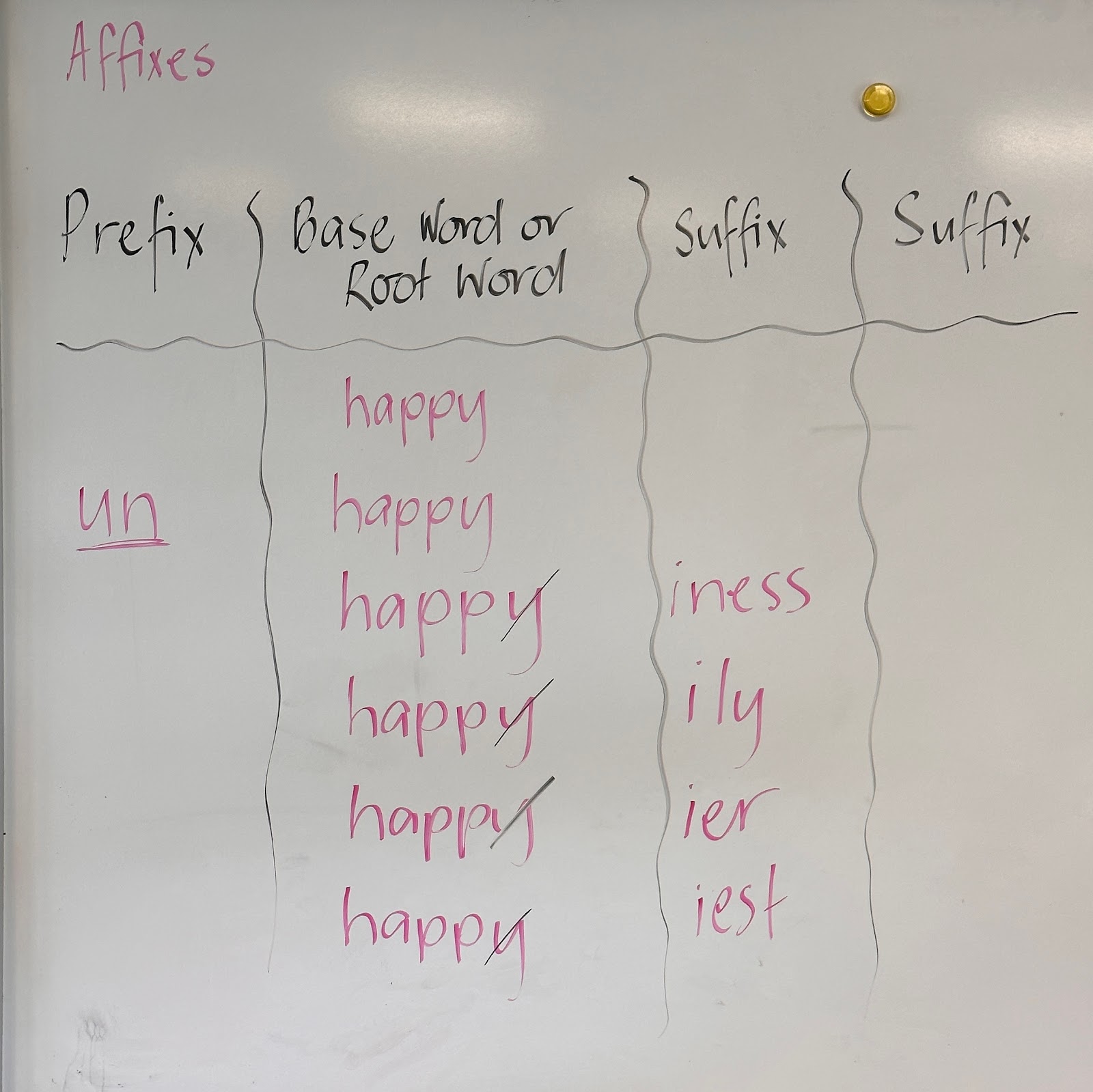
I used a template shared by Louise that shows how base words become completely different words with the introduction of prefixes and suffixes. We began by defining base words as being a complete word by itself that prefixes and suffixes can be added to make a new word. The example we used was the base word, happy. I then challenged my learners to make new words that had the word happy in them. At this stage we had only the knowledge of affixes that we brought to the lesson. As the words were generated from known words I filled in the template on the board (see image below).


We then explored possible reasons why I might have written some parts of the words in different sections of the table. A question that opened the doors for the introduction of the words prefix and suffix, and allowed us to unpack what these words might mean and what effect they had on the base word. All devices were closed at this time which gave me the opportunity to introduce the dictionaries and thesaurus' that were in all honesty, sitting on the shelf gathering dust. Having become so used to opening Chromebooks and defining words meant a quick lesson was needed on how to use a dictionary (or 'paper google' as it has now become known as).

After this I set my learners the challenge of building a word list using the base word excite. To make sure we were selecting actual words, only words generated that could be found in the dictionary were able to be recorded. We then unpacked what each of the affixes meant and explored how they changed the based word.  
Eg: the prefix over (too much or more than normal) + the base word, excite (being enthusiastic or happy) = over excite (more than normally enthusiastic or happy). 

Deziah's blog post explains this activity - (shared with permission).


Wednesday, 1 March 2023

Qu. #2 - Why we judge this to be the most important and catalytic issue of learning for this group of learners this year...

Last week after talking to the teachers I am mentoring in the RPI program I was reminded of the Reading for Enjoyment survey I did last year to get to know my learners as readers. In a conversation with Dianne afterwards, I suggested that we could try to create a similar survey that would help us get to know our learners a spellers. Our Principal understands our concerns with regards to spelling abilities in our current class and is fully supportive of our proposed inquiry into word consciousness. 

The results of this survey are below.


We judge this to be the most important and catalytic issue of learning for this group of learners this year as the results here affirm our initial thinking that a deficit in word consciousness and a 'fear' of getting words wrong, limits the level of vocabulary used in independent writing, and causes meaning to be lost in reading. It will be interesting to analyse the self efficacy rating and the spelling level given when the e-asTTle writing assessment data is complete. (NB: Our plan is to look at the current and historical data of the e-asTTle writing, PAT Reading and the Peter's spelling test to identify trends). 


Qu 1: Student Inquiry Foci...

This year Dianne Fisi'iahi and I will be undertaking a collaborative inquiry. What this will look like exactly at this stage is still on the drawing board although we do know our purpose. This year we want to find out if a focus on spelling conventions will foster an environment where word consciousness strengthens connections to the learning.

We teach a Year 7/8 class with 40 learners, all who bring a wide a varied connection to the conventions of spelling to the table. We know from past experience and from what we have observed so far this year, that our learners physically stop writing, stop reading and avoid sharing back to the class when they lose the connection to words needed to continue to make sense of the learning. There are many reasons as to why this happens but rather than focus solely on that, we want to focus on how we can prevent this pattern from continuing to evolve into a hurdle that is too challenging to get over. Our thinking is that if we begin to develop these skills and understandings, the transition to language of instruction used in Y9 may be strengthened by stronger connection to word knowledge.

Having decided on our inquiry focus this year, Dianne and I spoke with Anna Salmon, our Reading Recovery teacher about the barriers children in the junior school face with spelling, and how she helps the students she is working with to overcome these barriers. We came away from a very rich learning conversation with lots of ideas to pull together a tentative pathway forward. Here are the notes we made to help us formulate a plan going forward

'Word consciousness involves being aware and interested in words and word meanings (Anderson & Nagy, 1992; Graves & Watts-Taffe, 2002) and noticing when and how new words are used (Manzo & Manzo, 2008). Individuals who are word conscious are motivated to learn new words and able to use them skilfully '(Sourced here). Our challenge now is to find out why the links in the chain appear to be broken again. Last year I began my inquiry by getting to know my learners as readers through a survey. This year we plan to use this strategy to get to know our learners as spellers. To do this we will be looking at shift or change in:

  • Disposition
  • Data
  • Word consciousness
  • Student voice
  • Strategies used to make sense of new or unfamiliar words

Further Reading/PLD to grow my own knowledge kete:

Friday, 18 November 2022

2022 Teacher Inquiry Evaluation...

This year I set out to find out if focusing on Reading for Enjoyment would increase student self efficacy and capability in Reading?

My reason for choosing this inquiry and the shifts between time point 1 testing and time point 2 testing are explained in detail in the previous two posts. The changes/tweaks I made are shared here and the picture the data paints is here. These posts explore both the qualitative and quantitative measures undertaken this year.

Summarise evidence about key changes in teaching and other factors that influence student learning.

Creating a causal chain helps you to stay focused on the purpose of your teacher inquiry. It is so easy to fall down many rabbit holes along the way so having a causal chain to look back on helps to keep you on track. My biggest takeaway from looking at a variety of readings is if we are to develop reading for pleasure habits in students we need a collective and collaborative approach that allows our tamariki to see role models at school and at home who value reading.

I wanted my students to want to read a wide variety of texts because they want to. My aim this year was to help the students in LS2 to see our weekly library visit as both fun and to quote one of my learners, understand 'that opening the covers of books you haven't read books is a fun way to find new ideas or even learn a thing or two.... It's like a supermarket for the brain' - quote taken with student permission from this year's T1 writing sample. My challenge was to find out why the links in the chain appeared to be broken again. I work in an ILE and share a class with Dianne Fisi’iahi and knew that if my inquiry was to become a success it needed to become our inquiry.

We began by:
  • Actively planning time in class for reading for enjoyment, after all if you want something to happen you need to make time for it to happen.
  • Getting to know our learners as readers by gathering student voice through Naomi Rosedale’s Reading for Enjoyment survey.
  • Analysing beginning of year data to give us a clear picture of what our students can do and where our knowledge gaps are.
  • Connecting with whanau to foster support for reading for enjoyment at home
  • Using our student leaders as role models to promote reading for enjoyment across our school
  • Creating our own LS2 Reading Challenge to motivate our learners to read a wider variety of texts.
  • Making reading for enjoyment visible in our class
  • Researching the benefits of RFE and ways other schools have grown this culture

Write an overall evaluation of your intervention in terms of the causal chain you had theorised. To what extent was the intervention successful in changing factors such as teaching? To what extent were those changes in teaching effective in changing patterns of student learning?

At the end of Term 2 I looked back at my causal chain and realised through our weekly RFE tips shared at assemblies by our student leaders and our Leaders in the Library initiative, my students are seen as readers. More importantly they are beginning to see themselves as readers as we are actively reading for enjoyment in our classroom each day. To reinforce this latter point I made a point of capturing all of this in photos which were prominently displayed in our classroom. However because I was always beyond the lens I had not been allowing my learners to consistently see me as a reader.

I was introduced to my students as readers when they completed RFE survey at the start of the year and got to know them better by observing what books they were choosing to read then taking time to talk to them about their chosen texts. I also asked for text recommendations and made sure my learners saw me reading the texts they had suggested I read. This served two purposes, one showed that I was an active reader and the second that I valued their input.

We turned the results of our monitored time we spent RFE and the RFE survey into purposeful statistical inquiries by using the data gathered to identify the problem areas and offer possible solutions. This gave all of us ownership of our shared goal of increasing the time we spent reading for enjoyment.

The RFE display in the classroom not only gave my learners the opportunity to see themselves as readers but also the opportunity to talk about the importance of RFE to their whanau during our student-led conferences. The parents/caregivers enjoyed seeing not only their children in LS2 reading but also their younger children. Listening to some of the conversations taking place during this time I realised that our learners understood what RFE was and were able to talk about why they needed to be encouraged to do this at home. As a result most of the parents/caregivers leaving the room promised to help keep the reading for enjoyment going at home.

Timetable opportunities for RFE so students read the books they take out of the library and introduce LS2 RFE challenge to encourage students to RFE in their own time helped us to drive this initially, however whilst the timetabling remained in place, our reading challenge fell by the wayside. After several attempts to reignite this we understood that our 2022 were not motivated by the follow up challenges. We wanted them to want to read so readily removed any barriers that may have prevented this from happening. What was a success however was our RFE Holiday Challenge. A reading challenge created and managed by two of our student leaders. What was exciting to see was who participated and what they have posted on their blogs, even more amazing was the interaction that took place in the blog comments. 38% of our class took part in this challenge which may look like a low number, but in my mind that's 38% of our class that we know of who made time to read for enjoyment over the holiday break.

As I stated in a previous inquiry, in all assessments our students are required to read and respond to questions. Often our students are often not literate in their own language so the gaps that emerge when questions are written in English are getting wider, thus causing bigger disconnects in the learning. Sharing an infographic I saw online with our class last helped to strengthen connections and understandings to the importance of RFE. We didn't focus on the test scores rather the amount of word knowledge gained by finding 20 minutes a day to read.

Creating and referring back to my causal chain has resulted in this intervention successfully changing my thinking around the value of RFE in the classroom. I am now seen as a reader and know that if this is to continue I need to continue to motivate my learners and plan time for this to happen within our class program. The changes in teaching have been effective in changing patterns of student learning as our students now open the covers of the books that once simply stayed in their trays. The data analysed in my previous two posts are evidence of the shifts in both mindset and learning. I do see a change in attitude towards reading, strengthened connections to new learning, increased vocabulary awareness which has been transferred to personal writing, higher levels of self efficacy and an overall shift in achievement which has resulted in a higher number of our learners achieving at or above the expected norms in literacy.

Write a reflection on your own professional learning through this inquiry cycle.

One of the most important changes I made in my teaching was to make sure my students saw me as a reader. Chrissy Smith put it best when she said ‘by not reading with our students we are not valuing what we are asking them to do’. I am definitely now a teacher who actively opens a book when my students open a book. My biggest takeaway from looking at a variety of readings earlier in the year was that if we were to develop reading for pleasure habits in students we needed a collective and collaborative approach that allowed our tamariki to see role models at school and at home who value reading. Leaders in the Library, whanau support and sharing RFE tips at assemblies has helped achieve this and are initiatives I want to keep in place when we move into our 2023 learning journey.

I have summarised my own learning in my Bursts in Bubbles presentation which can be read  here. My journey this year reminded me if you want something to become a success you need to be walking the walk and talking the talk. Plan for it, drive it and find ways to give your students ownership of the change you want to effect.

Tuesday, 14 December 2021

2021 Teacher Inquiry Evaluation

This year I set out to find out if a focus on oral language in maths would accelerate student confidence and capability to use spoken and written maths vocabulary and language.


In order to be able to do something, you need to have access to the tools you need and the understanding of how to use them. This is no different in a classroom. The challenge for my students this year was to make accelerated shift in Maths by being able to talk about their learning in thinking groups, explain it on their blogs and create comment threads that invite others to respond by talking/writing about their learning in maths. This was something I quickly realised that I had to unpack fully, as my initial analysis of my target group’s thinking group conversation showed that my students were not able to access the content vocabulary they needed to be able to have a rich learning conversation. The quieter students chose to remain silent which resulted in the more confident students filling the void with ideas that lacked detail eg: “I did this and then I moved that number…”. They did try to initiate a discussion however, “What did you do?” was the only question I heard being asked. Simply put, my students were not able to talk in depth about their learning.


Being silent is not an option if acceleration is to take place so I realised quickly that I needed to model the language of explanation eg: “I saw that the question was asking me to… so I knew I needed to think about…” or “Groups of means… so I…”; and support the use of questions that encourage justification, eg: “How do you know it works?”, “So what happens if you…”, “What about if you say…does that still work”, “So if we…”  if I wanted rich learning conversations to become the norm.


Summarise evidence about key changes in teaching and other factors that influence student learning.


When asked specific questions eg; “What is this question asking us to do with the numbers?” or “How did you find your answer?” The learned go-to was to remain silent, however being silent is not an option if acceleration is to take place. My initial thinking was that a lack of comprehension remained one of our biggest obstacles. After listening and observing from a distance I realised my students were just not confident when using maths vocabulary as the connections between the words and the strategies had not been made. 


I began breaking down the barriers by:


  • Introducing the Talk Moves framework into our maths program so that the discussion stems could become the norm within our learning time. This didn’t work for us because we simply did not use or connect to the words in the stems in. Our solution was to repurpose the Talk Moves idea by co-constructing and implementing a framework that we could connect to because it used our own words. We called it LS2 Moves.

  • Modelling the language and supported the use of questions which lead to justification like “How do you know it works?”, “So what happens if you…”, “What about if you say…does that still work”, “So if we…”. 

  • Unpacking Jo Boaler’s positive classroom norms.

  • Stepping my students through the Talk Moves framework by explaining each component and giving individual students different roles within the group.

  • Explaining the purpose behind having a learning conversation.

  • Actively planning for talking about and reflecting on our learning in each lesson.

  • Actively planning time in class, for students to create blog posts, comment on each other's blogs and respond to comments on their own blogs. This allowed me to see where connections to the learning content were strong, and where the gaps in knowledge were evident.

  • Acknowledging individual success in talk time regardless of how big or small that success was.

  • Setting the expectation that during our talk time, everybody in the group needed to participate actively.

  • Modelling how to bring someone into a conversation in a way that wasn’t seen as ‘scary’.


Summarise evidence about key shifts in the problem of student learning:


Due to the impact of lockdown the shifts in my student’s learning this year are based on OTJs and observations. I collected detailed baseline data in Term 1 and student voice in Term 1 and 2, but am unable to make any time point 1/time point 2 comparative shift analysis this year as lockdown forced me to draw a line under my original inquiry. I literally lost contact with half of my focus group. Due to the length of time we had been learning from home, as a school we decided not to formally assess our students at the end of the year. Because of both these reasons I can not make accurate measures in academic shifts this year. I have additionally chosen not to use the three student voice comparisons I did manage to get as this does not paint a true picture of the change in my learner’s perspectives on maths. 


Write an overall evaluation of your intervention in terms of the causal chain you had theorised. To what extent was the intervention successful in changing factors such as teaching? To what extent were those changes in teaching effective in changing patterns of student learning?


In all assessments our students are required to read and respond to questions. Often our students are not literate in their own language so the gaps that emerge when questions are written in English are getting wider, thus causing bigger disconnects in the learning. This year I want to implement the strategy of Talk Moves in Maths. Talk Moves is a strategy that promotes classroom conversations centred on maths that helps to improve students' understanding of mathematical concepts. It is a framework to prompt the discussion, and will allow me to capitalise on the learning I got from my inquiry in 2020 by providing authentic opportunities to use this 'talk' within blog posts and blog comments to help strengthen connections.


What I had begun to notice in class was that there was a stronger connection to the maths language used in written questions. The evidence I have for this I have taken from my observations in class lessons (T1/2), GLOSS testing (T2) and online collaborations (T3/4). 


I noticed that my target group approached a written question by immediately looking at what the question was asking. (eg: This says XXX had 3 times as many XXX… that means we need to times it). By doing this, the talk then moved quickly to which strategy would help them solve this in the most efficient way. On this occasion I saw this group all solve the problem using their preferred multiplication strategy, then share their ideas with the group. Student G83 then took on the leadership role, cast our LS2 Moves framework to the TV and asked everyone to share their strategy. What was interesting to see was that without a teacher involved the discussion flowed much better. Possibly because these students feel less pressure when talking in front of their familiar group of peers. Acceptance of all contributions was the key to the success on this occasion, with student B82 taking on the role of affirming each response.


During GLoSS testing all these students repeated the question I had asked aloud, then set to work to find the answer. What impressed me here was no one ‘worked it out in my head’ - the usual go-to when they don’t have the words to explain what they did. There were calculation errors but the foundations for the Y8 students were much stronger than I remember in the previous year. What I wasn’t expecting was all these students asked questions for clarification when their connections to the strategy they had chosen weren’t as strong. I asked each person what they felt they needed help with and got quite specific responses (eg: I want to learn more words that mean addition… I think I need more help with XXX strategy… I need to learn my times tables so I can use them to help me with the bigger numbers… I need to practise my place value…) 


The online environment was completely different. The talk just stopped. This meant I had to think carefully about how I could keep the thinking going. I did this through skill drill challenges, which for some reason got huge buy in,  by basing our maths questions around popular topics/themes and by introducing the idea of ‘find the error, fix the error, explain the error’. My thinking here was that if I couldn’t hear the talk I could still read it. My students shared with me that they collaborated on the maths tasks so behind the scenes talk was happening, but most importantly they remained connected as a group.


Write a reflection on your own professional learning through this inquiry cycle.


This year’s inquiry into my own practice as a teacher has highlighted the importance of being creative and making adaptations that work for the tamariki in front of me. One size definitely does not fit all and in our case using Talk Moves did not work. Rather than discarding the idea of using a talking framework, I asked my students why they felt this wasn’t working. We came up with the theory that we simply didn’t speak this way, so we worked together to co-construct a framework we felt would work for us. A week later LS2 Moves had evolved and had become visible in our learning environment.


We were on a roll when lockdown happened this all changed. I have summarised my own learning in my Bursts in Bubbles presentation which can be read and/or watched here. My journey this year reminded me you need to continually think outside the box. You need to adapt and try, then try again. If something doesn’t work, look for the why then find a how.... then repeat.