Showing posts with label Reading. Show all posts

Saturday, 1 November 2025

Unpacking Qualitative Data - My Journey to Balancing Rigor and Transformation...

My central motivation for this inquiry stems from a concern that the necessary rigor of the Structured Literacy framework could unintentionally stifle creative expression and deep demonstration of learning. 

My perspective is rooted in my own educational experiences from a time dominated by repetitive, uninspired reading consolidation (the classic ‘duplicated worksheet’ era) where genuine engagement was rare. The moments that truly stood out were interactive like using the listening post or, more enjoyably, performing plays, especially when we could create our own costumes or masks.

This pattern continued early in my teaching career. I often defaulted to guided reading worksheets that, despite having diverse texts, asked the same predictable questions, which stifled independent thought. While I attempted to introduce new ideas, limited classroom technology and a lack of accessible Professional Learning and Development (PLD) hindered my sustained pedagogical growth.

When I joined the Manaiakalani cluster I was introduced to a culture of continuous learning and innovation that prioritises student engagement. This culture intensified my fear that the required intensity of Structured Literacy might accidentally regress our practice back to those days of ‘boring repetition.’

This concern drove my inquiry into effectively utilising the 'Create' component within our kura. A core goal of our previous PLD was moving teaching and learning 'above the line' of Dr. Ruben Puentedura's SAMR model—a framework that pushes technology use from simple enhancement (Substitution and Augmentation) toward transformation (Modification and Redefinition). My primary focus for this year was to ensure our literacy instruction maintained its rigor without sacrificing this transformational practice.
Initially, I looked at creative opportunities school-wide, quickly realizing the junior team excels in this area. For early readers, creativity is best fostered by hands-on, collaborative fun, rather than only with digital tools. This realisation saw me pivot for the first time as I couldn't limit my study to only digital affordances if I wanted to fully understand and strengthen 'Create' within Structured Literacy.
My next step was to narrow the focus to the senior team. However, I soon realised that a team embracing new PLD needs time to build confidence and implement change. Feedback from team meetings told me they certainly didn't need me critically observing the create opportunities in their reading lessons. This led to my final pivot of focussing exclusively on my own practice in my Year 7/8 classroom.

Focusing on my own Year 7/8 students (our most capable readers), provided an advantage. Given my existing literacy PLD, I wasn't entering the Structured Literacy framework completely cold. I challenged myself to incorporate the affordances of AI, alongside my well established kete of follow-up challenges, to encourage students to build on prior knowledge when showing their understanding of the new texts we unpacked.

How to use Gems - Gemini Apps Help

A clear example is the inclusion of Gemini Gems in our guided reading follow-up (unpacked in an earlier post). The resulting change has been significant as student responses now feature more extended, student-initiated, and student-led discussion.

Ultimately, when 'Create' is properly embedded, it becomes a purposeful and engaging opportunity for tauira to demonstrate understanding. As educational theorist Elwyn Richardson observed, research shows students learn by actively constructing knowledge—a process that involves breaking down, rearranging, selecting, and demonstrating their understanding so that visualised thoughts were given an opportunity to be created.

Exploring Quantitative Data...

The purpose of this inquiry was to evaluate the integration and frequency of 'Create' opportunities, a key component of the Manaiakalani ‘Learn-Create-Share’ pedagogy, within Reading instruction across our kura.

To measure the shift in practice, analysis was conducted comparing:

  1. Opportunities explicitly planned for by teaching staff.

  2. Opportunities shared via class Digital Learning Objects (DLOs).

  3. Qualitative feedback sourced from Teacher Planning in Term 2 and Term 4 

Confidentiality: Due to the identifiable nature of the small learning environment, all data is presented in aggregated and generalised form. Individual teacher or classroom data will not be shared to preserve the privacy and confidentiality of staff, ensuring the focus of this inquiry remains on collective pedagogical practices rather than individual appraisal.

Quanititative analysis of the data indicates a noticeable increase in the provision of opportunities for our tauira to consolidate their reading comprehension and literacy learning through the 'Create' component of the Manaiakalani framework.

The presentation below unpacks the increase in planned opportunities for our tauira to creatively explore their new learning. The detail in the analysis in reflected in the breakdown of the graphs on slides 4, 6, 8 and 10. It is important here to recognise the fact that our staff have a wide range of teaching experience ranging from less than one year to thirty plus years. It is also important to note that everyone has put a lot of effort into embracing a new curriculum and integrating new PLD, whilst trying hard not to throw the baby of 'create' out with the bath water.

The following factors are hypothesised to have contributed to the observed increase in 'Create' opportunities:

  • Recognition that 'Create' extends beyond digital products to encompass various non-digital outputs.
  • Completion of Structured Literacy Professional Learning and Development (PLD).
  • Targeted staff meeting on the Manaiakalani ‘Create’ principle.
  • In-class support provided by Manaiakalani facilitators.
  • Active sharing of 'Create' outcomes in team meetings.
  • Increased utilisation of blogging as an immediate output and sharing platform.
  • Elevated kaiako confidence in teaching Structured Literacy.
  • Improved kaiako confidence in utilising digital capabilities for task design.
  • Increased staff ownership of accountability for pedagogical integration.
  • Active planning for 'Create' opportunities.
  • Effective establishment of connections between new and prior learning.
  • Development of greater tauira (student) independence, enabling more complex, self-directed creation tasks.

The following factors are hypothesised to account for areas where the integration of 'Create' has seen minimal change:

  • 'Create' opportunities were not explicitly integrated into planning cycles.
  • Lower kaiako confidence in implementing Structured Literacy instructional practices.
  • Lower kaiako confidence in leveraging digital capabilities for task design.
  • Perceived pressure resulting from connecting existing practice to new PLD requirements.
  • Initial resistance to pedagogical change within some practices
  • Disconnects between teacher expectation and tauira capability, particularly concerning the complexity of independent creation tasks.
In summary, this inquiry confidently confirms that 'Create' opportunities are thriving in our kura. We acknowledge the wide spectrum of teaching experience within our staff, recognising that new pedagogical learning often generates self-doubt, leading some to initially favour highly structured, familiar methods. While there is a necessary place for less creative consolidation tasks, the key to effective literacy mastery is 'repetition without boring'. This critical element is demonstrably afforded when students are given agency, choice, and creative opportunity within their follow-up learning.

Tuesday, 7 October 2025

Implementing Structured Literacy one step at a time: Step #4 - Reading

After attending a toolkit on Gemini Gems run by Matt Goodwin I decided that introducing this in my learning time this might spark another layer of curiosity with my learners. I followed the prompts shared by Matt and jumped in boots and all to help my learners gain a deeper insight to our guided text 'Malala Yousafzai Speech at United Nations Assembly 2013'. 

Below are screen shots of the Gem we used that show my initial prompt and the students interactions with the Gem to support their reading. I used the prompt that Mat gave as the example in his toolkit, so need to acknowledge that it is not my original idea.

I found this to be a really creative way to help my learners make sense of the response questions in ways that helped guide them to where they might find the information rather than simply giving the answer. 

The way this ran in our room was after introducing and modelling how Gemini Gems worked, I put the Gem on my computer and left it available for student use on a central table. This was both a great resource and a really creative way to capture my learners interest in the topic. A bonus was that once the Gem had been used the conversation in groups was richer as new perspectives were shared when some students disagreed with the initial collaborative responses. The learning 'arguments' were evidence based and allowed for the skill of negotiation to be used authentically in context.

I used a Gemini Gem with two guided texts last term and found on both occasions this was a very effective way of strengthening my student's connections with texts they were not familiar with. The feedback from my learners has been captured below.

Wednesday, 10 September 2025

Implementing Structured Literacy one step at a time: Step #3 - Reading

Using texts suggested in the Refreshed English Curriculum for Year 7-8 this term has allowed me to experiment with aligning my learning in structured literacy Reading with the curriculum. To be honest my years of Reading PLD has afforded me the luxury of making very few changes to my practice. I have had to make changes in a few areas like vocabulary and text structure, but for the most part not a lot has changed.

Rather than explaining how I teach reading I have decided to showcase how we capitalised on the create aspect of learn - create - share to strengthen my learner's connections to the content in the text and the learning that ran along side it. As you can see create opportunities are easy to include in a structured reading program. They don't need to be 'perfect' but they do need to provide opportunities for our tamariki to take ownership of the learning and make the connections they need to make sense of the wide variety of multimodal texts in a reading program.

All these lessons have been taught as a whole class. Some students have needed further opportunities to unpack the text and all follow up activities are done collaboratively in groups or pairs. At this stage working independently on follow up activities is something we are working towards. I find that collaboration makes new learning seem less scary and helps my learners take risks they would usually shy away from.


A focus on dialogue and the structure and purpose of graphic texts


A focus on rich discussion and forming an opinion by exploring both sides of a provocation

Enhance Speech from Adobe | Free AI filter for cleaning up spoken audio

Group discussion and text responses captured on Adobe Podcast


AI generated posters using Adobe Express to showcase important quotes


Google Vid and Adobe Express to capture an illustrated DLO of my learners reading a poem 

You can see examples here in my learner's blogs, which have all been shared with permission.

Sunday, 13 July 2025

Stocktake of my Inquiry...

We are half way through the year and I realise when taking stock of my inquiry that the PLD start delay has impacted my inquiry significantly. I haven't really been able to begin until now as we have only had 4 structured literacy PLD sessions so far. My inquiry a school leader is not just a personal one, but also a team one. The positives to date are that we have been keeping the status quo in literacy so I do know we are currently all on the same page as far as planning is concerned. We are all on the same page as far as DLO scaffolds are concerned and our current shared language of instruction is alive and well. 

Moving forward this term sees us starting to implement structured literacy practises. What is a huge plus for us is that the changes are not big ones. Our current planning is structured. It unpacks the text and explores text structures, themes and vocabulary. What we do need to do is approach the tweaks we need to make to the vocabulary instruction at our own pace. What I mean by that is we are a team with a varied range of teaching experience which ranges from 6 months to over 30 years. If we change too much too soon I can see everything unravelling quickly. The point of PLD is to build on what we know to strengthen our practice not to throw everything out and start again.

Before I think about how I can support my team I need to put my own oxygen mask on first. By that I mean I need to jump into structured literacy approaches boots and all. I know I still need to capture student voice and will do this when term 3 begins. I needed to look closely at how I will adapt and tweak my current planning. I have done that by looking at the planning exemplar provided on the structured literacy platform we are using and have then made a few changes in what I already had in place. 

The end goal was to keep a 'create' aspect which I have done. I wanted to make sure I was covering what was suggested but I also know I can do this without folding back to using the worksheets I cut my teeth on as a beginning teacher. The first screenshot below is what is suggested on our PLD provider platform. The way I have interpreted this is to use the perspective DLOs I already have in place but add a creative aspect to this by using ADOBE podcast to capture the conversation behind the end product. (The discussion and summarising aspects are covered in the guided planning.) We do have planning scaffolds that we use but the way my learners show their perspective is totally up to them. I am also making use of text sets and my learning T-shaped literacy gave me. What I have added is a skill drill game that I created using Gemini. These multi-choice tasks have been a game changer in our class. They allow for quick recall and application of new learning. Examples of these challenges can be found here.


As I said earlier I, along with my team, are very much at the start of our structured literacy journey. Ours made slightly more challenging by the year groups being separated into PLD for Y4-6 and PLD for Y7-8. What is helping keep us all aligned is the planning framework and the conversations we have as a team.

Monday, 24 March 2025

Engage, Empower, Inspire... Setting Group Norms

Setting group norms at the beginning of the year is one of the most crucial parts of a successful guided reading lesson, in my opinion. Students struggle to work effectively in a group if they don't know how to interact with their group or why they actually need to do this. 

This year I made a huge change and rather than doing this group by group I chose to take on the challenge of doing this as whole class lessons with all my learners sitting in their reading groups. The first lesson was an extremely structured step by step lesson with lots of teacher guidance. What I noticed is having the opportunity to look at how other groups were interacting helped strengthen the confidence of all the groups, regardless of ability.

I selected a text that linked explicitly to our inquiry topic which meant everyone was able to make an immediate connection to it. We began with a multimodal dive into the front loading texts. The first one, a short 3 minute video, was unpacked with me having the locus of control. This meant I was able to model and guide every step of the process. What I noticed was I had an immediate buy-in. It was evident that I knew the content and was able to respond to questions asked without referring to the texts. 

We kept it simple and during the first viewing simply just watched it. I then asked each group leader to ask everyone in the group to share something they found interesting. When we watched it a second time every student had a vivid and access to the group note taking paper. The challenge this time was to write down any words that were interesting, new or unknown. I made it clear this wasn't a spelling or handwriting lesson so encouraged the words to be recorded the way they sounded if the correct spelling was unknown. Following this challenge the leaders were once again asked to ask everyone in the group to share a word and say why that word had been recorded. The final independent challenge for this text was to watch the video again, this time in groups not on the TV, and record any facts that were deemed important or interesting. Once this had been completed (short time limits were given) the leaders were asked to get the talk going with the final group challenge being to share what has been written then co-construct 5 questions they may have about the text. What was happening here was a gradual shift in the locus of control.

With all our vocabulary, facts and questions recorded we moved onto the balcony for a very loud speed dating style activity. The noise level and laughter that came as a direct result of the speed of the partner changes everyone enjoyed the opportunity to move and to share their new learning. 


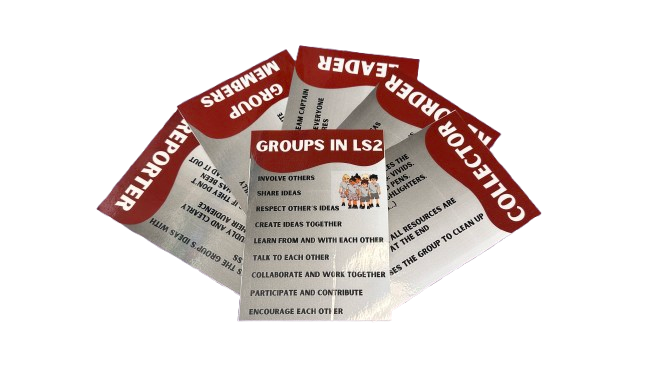
Having stretched our legs and made the most of the opportunity to learn with and from each other we used the same process to unpack the next set of short texts. This time I gave both written and spoken instructions and let the groups take control and work at their own paces. We Have a set of group norm cards which were displayed and unpacked as we went along so everyone knew their role. As always in LS2 their are no passengers in group challenges. In my favour was the fact that two weeks before we had been on camp where both individual and group challenges were the order of the day.

Day 2 saw a small blip in the flow as we changed leaders. I let each group select their leader each time. The message given was that at this time of the year we are all learning how to lead and how to be a member of a group so supporting each other was the order of the day. Groups were encouraged to use the group norm cards in their group boxes to help guide them. During this time I moved around the room while Dianne (my buddy teacher), worked closely with our group who find reading a challenge. We persevered and with guidance found success in the lesson. What impressed me was the richness of the talk that was taking place.

Fast forward a week and the norms set in place last week were alive and kicking! What I observed was that the groups had naturally reverted to those they saw as leaders and with that 'security' in place for learning, confidently took on the additional roles that are needed to be filled if groups are to work together collaboratively and productively. 

We are definitely still at early days but my big message to myself is take time to set things up because the wheel turns when everyone understands the 'why' behind the challenge.


Tuesday, 5 November 2024

Describe and Explain the changes/tweaks you have made in your practice along the way...

My inquiry this year has had many twists and turns. Achieving accelerated shift in Literacy was identified as being one of the most important and catalytic issues of learning facing our students in Y4 - 8, this year, when the time point one data was analysed. Exploring how learning gained from professional development is helping to strengthen teacher practice and achievement in literacy is something I haven't looked at before so I began with one idea which over the course of the year has completely morphed into another. Not because as I mentioned in an earlier post, because it was unachievable, but because my initial idea simply wasn't working. The effect of staff changes on PLD is something I hadn't initially taken into consideration. What began as an inquiry into how we (PBS) are using PLD to accelerate shift across our school' and over the course of the year required a change of tact to inquiring into how are we building and strengthening our capability in raising student achievement outcomes in Reading for years 4-8 at PBS.

I began my journey by trying to ensure we were all on the same page. Consistency and a shared language of instruction help our students to make the connections they need to be able to access their learning with confidence and understanding. At the start this wasn't about paying no regard to the skills and knowledge my team brought to the table but rather to align our thinking. This is explained in detail with examples in an earlier blog post. This wasn't as successful as I hoped as we were all coming from such different places both literally and in knowledge gained from recent PLD, so it was back to the drawing board.

Changing Direction Icons - Free SVG & PNG Changing Direction Images - Noun  Project

After speaking with Naomi Rosedale, I realised I needed a new pathway forward, a pathway that included a framework that would bring everything together and provide clarity. Aligning what I was looking for with the Manaiakalani Reading Pillars of Practice (MRPP) was the lightbulb moment I needed. In Term 3 I used the MRPP to look closely at what and how we, my team and I, were actually teaching the tauira in front of us in our reading lessons. I looked at the data and used the initial gap analysis to help me gauge whether or not the learning planned matched the student needs. To allow for consistency I stood by my decision that if it wasn't in the planning it wasn't there. The follow up discussions were both rich and gave all of us the clarity we needed to help us meet the learning needs of our individual classes.

This process was repeated in Term 4. I am yet to complete all my follow up discussions but have them timetabled for later in the week. What I noticed was with a shared understanding and stronger knowledge of why we need to make the changes. All my team have now included multimodal text sets, are looking at the structure and language in the different text types and have put a lot of thought into the questions they are asking. There is definitely a growth in the use of our shared language of instruction, a wider variety of comprehension skills being accessed. 

Changing my inquiry focus has allowed me to introduce change in a manageable and achievable way. Mindsets where planning is concerned has moved from compliance to purpose, something I struggled to initially get buy in from. I feel that looking closely at my own planning has added the 'teacher model' element to the learning. By using the MRPP it has allowed us to all learn together but at our own pace. Sharing people's successes and valuing their ideas has afforded us opportunities to learn with and from each other. 

The big message I want to share here is that change is good, it should be embraced and we should not be afraid to walk in a different direction if what we have tried is not working. 

Wednesday, 28 August 2024

You can't help yourself if you can't see yourself...

Once again I'm tapping back to Jason Borland's thinking in our 2015 Manaiakalani Innovative Teacher's PLG where he stated that "You can't help yourself if you can't see yourself." This thinking resonated with me when I first heard it, and after following Jason's inquiry I have often repurposed this idea in the classroom but know it has reaches much further and wider than only our learners.

At the start of this term I asked my team to video themselves teaching a guided reading lesson. The idea was to help everyone to see what they were doing well and what they felt they could do in a different way. I made it clear this was for personal use only, I didn't want to see it and I definitely didn't want a written analysis of it. The only video I wanted to see was my own because I do the same as I ask my team to do. It also gives me a video to use as a resource if I need to model the process. All wanted was for everyone to take a moment to reflect on what they do in the classroom to help their learners connect to the learning. 

Initially this challenge was seen as something my team needed to do for me. However, this recording definitely wasn't for me, it was for them. Falling back on the phrase 'you can't help yourself if you can't see yourself,' was the game changer. Through observation opportunities I have been able to see each room first hand. I often record these observations for this purpose but after watching some parts together I imagine time plays a huge part in the decision to continue watching it in entirety or not. When challenged to watch and reflect in a safe way, the table below identifies areas from our team discussion that we need to strengthen. 


This picture is real and as is it co-constructed there is an element of ownership that we can all capitalise on to make the changes needed in our practice that will help accelerate student achievement.

Where am I at and how will I measure this?...

As my inquiry has now taken a new direction I needed to collect an additional set of time point 1 (TP1) data that can be used at the end of the year to provide evidence of shifts in teaching. As this is for inquiry purposes the information needed to be formative. It needed to identify our current strengths as well a identifying our areas for development. The Manaiakalani Reading Pillars of Practice (MRPP) matrix has helped me do exactly that.

After analysing my reading planning against the MRPP with Toreka, the next step was to work together to analyse her reading planning. On this occasion I took the lead but asked her to step in if I needed to relook at something. Again a rich conversation was had and a clear picture of where she is at captured. I then repeated this process with the rest of my team.


The feedback was really positive and discussions had were rich and honest. I think the high levels of trust play a huge part in this process and I want to thank my team for their parts in these conversations. This process fully was transparent and I openly shared my matrix with my gaps clearly identified. I think this helped in strengthening the buy in as it wasn't about finding out right and wrong but rather finding out where our areas of strength and areas to strengthen were. The latter have since become part of our co-constructed team PLD plan going forward.


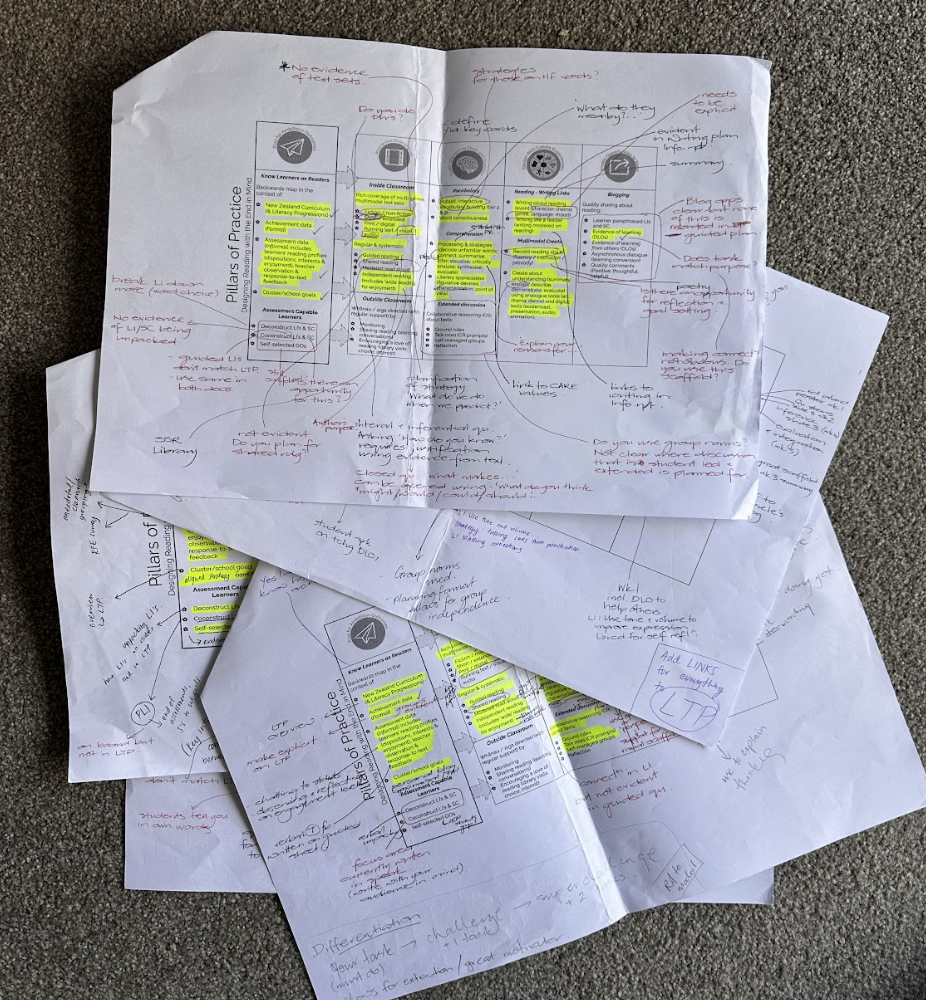
The matrix for all initial discussions was very much a working document (see image above). This gave me an opportunity to identify what I saw in the planning and my team to talk to it. Sticking firmly to the idea that 'if it wasn't in the planning it wasn't there', allowed for consistency across the board but it didn't mean I didn't listen. Using pen and paper on this occasion meant any adaptations made were clearly visible to both of us. The part of this process that I really liked was being able to celebrate and sometimes point out, people's successes. I found that by doing this first the door was opened for those more challenging conversations to take place. 

The presentation below is the formalised version of these conversations. Each teacher has their own digital copy that identifies areas of strength, areas to strengthen and next steps.

From the perspective of team leader, I now have a clear and visual picture of where we are at and what it is we need to do to help accelerate shifts in student achievement in reading. 

Stocktake of my Inquiry...

My inquiry this year has been to say the least, challenging. Not because it is unachievable, but because my initial idea just wasn't working. I had several attempts at exploring the effect of our recent Reading PLD on student achievement but soon found out this wasn't going to work as my team are are all coming at this from different places. The PLD I have had differs greatly from what the others have had. My biggest learning has been the realisation that something I think is a normal part of a lesson is not necessarily seen the same through the eyes of others. It was also a real eye opener to realise the effect of staff changes on PLD, something I'm sure all schools experience. 

After speaking with Naomi Rosedale at the last COL meeting, I realised I needed to make some changes. Once I had worked out my new pathway forward things began falling into place. I had a plan and had begun putting that plan into place, but what was missing was the framework to bring everything together. Naomi suggestion was that I align what I was looking for with the Manaiakalani Reading Pillars of Practice. That was the lightbulb moment I needed.

Light Bulb Moment Icons - Free SVG & PNG Light Bulb Moment Images - Noun  Project

Last year two of my team took part in the Reading Program Intensive (RPI) and although I didn't, I did join them in their journey through my role as a mentor. As a mentor I didn't get the explicit introduction to the Manaiakalani Reading Pillars of Practice (MRPP) so I needed to strengthen my connections. I did this by reversing the roles. This time it was me in the learning seat and Toreka in the mentor role, and turned into one of this richest learning conversations I have ever had. 

Together we analysed my long term reading plan and one randomly selected example of a guided reading plan against the MRPP.  As we unpacked each section I could see a clear picture of where my successes were and where my gaps were. Toreka was far more generous than me with this process. She kept saying 'I know you do this, I've seen you do it...' but I was of the opinion that if it wasn't in the planning it wasn't there. That decision allowed for consistency when I repeated the process with my team's planning.


The image above is the result of my conversation with Toreka. I'm sure to anyone looking at the writing all over the MRPP matrix it will look chaotic, but to me it's a rich summary of observations made, explored and discussed. I think what I liked the most in this process is that it is a true picture of my strong belief that we learn best when we learn with and from each other.

Wednesday, 14 August 2024

Engage, Empower, Inspire... Reading around the Room

I have been thinking about creating a space on my blog to record the lessons that simply just work. These will be ideas (both old and new) that I have tweaked or reworked to appeal to my learners and help them make authentic and purposeful connections to their learning. 'Engage and inspire: Lessons that work!' is what I have decided to call this section and will be easy to find by clicking on the link in the page tabs under the header.

Today I decided to revive an oldie but a goodie. Reading around the Room was an activity I loved as a child because I got to choose what I wanted to read and I didn't have to sit at my desk or do a boring worksheet. It also gave me an opportunity to look at how others had done something and think about how their work was different to mine. At the time I didn't know that's what I was doing, but I do remember changing the way I did something based on other's work. 

We have recently created some great DLOs about the Ancient Olympics that have been shared on our blogs and displayed on the wall in the classroom. This activity was a collaborative research challenge and can be found here. I was really impressed with how well this activity was done and wanted to think of a way we could capitalise on it as we moved through the term. So rather than simply having a 'decoration' on the wall I turned it into an interactive learning space. 


The challenge I set this time is called the LS2 Quiz Challenge. It is actually a way of getting my learners to practise writing questions and answering them by using evidence from the text to support their thinking. 

I introduced this by modelling how I could use a ruler to help me focus on the words I was reading in the information held in this display. Dianne (my teaching buddy), was my partner and together we modelled what we wanted our ākonga to do. Their challenge is to read the information in pairs, co-construct a set of 10 questions using whiteboards then join up with another pair to co-construct and create a quiz where all the information can be found or inferred from what is on the display. This allows for rewindable opportunities as I saw today when one group had already moved onto answering a quiz, that they were running back to the wall to check their facts before recording their responses. That part was not something I reminded them they could do.

I am currently in the process of adding all the quiz links to our site and will timetable an opportunity for everyone to try out the different quizzes. With any new challenge I find if I limit the create options to ones everyone will find success with, I get the best buy in. This also allows for my learners to suggest their own ideas. Kahoot and Pear Deck have already been suggested to me as ways we could do this differently next time,


We must have 'sold' this challenge really well as there was a constant rotation of groups wanting to try the challenge. The next steps with this idea are to extend this challenge to encompass all the walls. I will think of further challenges to support our 'new' Reading around the Room activity as I see this as a great way to strengthen connections to learning whilst practising a wide variety of comprehension strategies. 

Monday, 22 July 2024

Implement and Try #1...

I am a firm believer when it comes to the effectiveness of professional learning development (PLD) is that when a team walks the journey together it becomes a journey that has life. PLD done alone or in isolation is much harder to keep going as there is no one to bounce ideas off, share successes, problem solve when it doesn't quite go to plan or to keep you on track.

With new team members there is always the challenge of getting everyone on the same page. With this thinking in mind at the end of Term 1 I got my team together and suggested the idea of an 'in house' literacy PLD day. In my team leader role I spend time in each room coaching and supporting my team in their literacy practice. This traditionally was always on a 1:1 basis which meant I wasn't using my time effectively and ended up repeating myself a lot. We all agreed to use a CRT day, and despite the logistical nightmare of ensuring everyone was released on the same day, we went ahead with the full support of our management team. 

With a wide range of teaching experience in my team I chose to start at the beginning by looking at how we are using the data to inform our planning through to the scaffolds and words we are using in front of our tamariki. You learn better when you physically do the task so I asked my team to see the learning through the eyes of our learners by taking them through the lessons. This provided us with clarity, a shared understanding of what procedural writing looked like and how to use the strategies I was sharing in context. I would like to take this opportunity to thank my team for approaching the day with open minds and a willingness to actively participate.

The DLO below shows what we covered. Some links are restricted to keep student anonymity. The aim of the day was to set us up for success in Term 2 by leading a guided planning session for the first three weeks of literacy. 


As with anything you try for the first time there is always an element of risk. I didn't want to undervalue what my team was bringing to the table but I did want to streamline our process by helping everyone make connections to our 'why' as well as our 'how'. 

At the end of the day I asked my team what their takeaways were. Their anonymous responses are below:

Teacher A 

  • How explicit things are if you show and tell - you learn by doing it
  • Foundational basics are important
  • Refer back to the data
Teacher B
  • How to unpack a text type - going back to basics
  • Tapping into prior knowledge and data
  • Gallery walk
  • Working in pairs
  • The power of talk
Teacher C
  • Prior knowledge shows me what the students already know
  • How to model explicitly eg- time connectives
  • How we can combine reading and writing together - integration
  • What to focus on when you teach a text type
  • How to use the data

    Teacher D

    • Going back to basics
    • Integration of planning
    • Clarity in planning transfers to the lesson
    • How to use the data

    As you can see the responses were different as we connect best to what resonates with us and what we needed to learn or be reminded of. Going forward as a team we have decided to continue with this type of PLD, only this time covered in our team meetings. It won't always be a literacy focus and it won't always be led by me. We have a great skills set in our team that we can tap into, after all we learn better when we learn together.

    Monday, 28 August 2023

    Celebrating the win...

    This week the words I heard in our class speech competition completely stopped me in my tracks. Standing in front of an audience of their peers was every member of my reading groups confidently used the vocabulary we have encountered, unpacked and explored throughout our Reading units this year in context. Gone were the usual go-to's and in their place was a plethora of sophisticated vocabulary. This is a win in every sense of the word! 

    To give my last sentence some context, the previous week I had taught an explicit lesson on speech writing. This lesson contained exemplars at a variety of e-asTTle writing levels. That meant my learners were exposed to a healthy mix of simple and more powerful vocabulary. One of our challenges involved applying our knowledge language features to edit an exemplar and move it to the next level. This is where my students very sound understanding of the more powerful vocabulary needed came to the fore. This then lead to a rich discussion as each group discussed their vocabulary choices and explained why they had made these changes. We applied the same strategy to levelling up the structural features.

    Unfortunately the next few days saw me off sick, which meant my learners were left to work independently on their own speeches. I did share explicit instructions via email but knew these students would be working without guided teacher support. The comments tool in Google docs definitely gets a shout out here. I shared my feedback and left them to it. Move forward to today. I saw and heard the outcome of explicit teaching, creative ways of helping my learners connect to new and powerful vocabulary and a year long focus on affixes in action. 

    My next step is to record some of these speeches that will be uploaded here so that I have a permanent record of what success looks like.

    Monday, 21 August 2023

    T Shaped Literacy Unit 2 - Representation...

    This T shaped literacy unit focused on representations in a text. Our students asked if we could do this unit as a whole class so we listened. I lead the sessions and was able to incorporate differentiation with Dianne reinforcing the learning with her groups. The only time we separated was for the introduction of the content specific vocabulary. I have discussed my word gifting strategy in an earlier post. This meant once again we were able to be creative and strengthen our own teaching styles. 

    We began by introducing the vocabulary to give our tauira the resources they needed to help them unpack and make sense of the new learning. Our next step was to revisit the learning from the Characterisation unit before we built our own connections to the topic of representation by drawing on our prior knowledge and personal biases when looking at how scientists are depicted in a wide variety of texts. We then looked at well known scientists and concluded that our biases clouded our judgements.

    Our topic this time was Superheroes. I chose comics as the text type and selected pre 1980 Spiderman, Superman, Batman and their female counterparts to help us compare and contrast the gender bias that was reflected a representation of the time. I chose the comics from this time as the later ones explore issues that would not be suitable for all my learners. As with my other T shaped units I chose to collate all my lessons in one DLO so that everything was easy to find and easy to access for both myself and my learners. The presentation below has the links to all teaching points, texts used, follow up tasks and student responses.


    The DLOs below reflect the student responses and show their strong connections to the topic and content specific vocabulary. What they don't show however, is the rich discussions that took place as each concept was explored and unpacked.


    Listening to my Learners...

    Collecting student voice is one of the most powerful forms of feedback. As the strategy of word gifting was new for us I wanted to see if my thoughts aligned with the thoughts of my learners. To capture this I shared a Google form with the students in my reading groups. The slides reflect the responses.

    The questions I asked were:

    • What did you like about the vocabulary gifting in Reading?
    • What might you do differently to get to know the new words in Reading?
    • How did this help you in the Representation topic?


    Implement and Try#2: Word Gifting...

    I have been approaching my inquiry into word consciousness as a whole language focus and not simply looking for opportunities to strengthen spelling skills. This term I have actively planned for opportunities to adopt the word gifting strategy that Sylvia Ashton-Warner used to elicit key vocabulary. 

    Making Reading Meaningful - Sylvia Ashton-Warner and the Language Experience Approach by Sherron Killingsworth Roberts points out that by embracing some of the guiding principles for practice of Sylvia Ashton-Warner’s work in developing the Language Experience Approach (LEA) we can strengthen the connections our tauira have to the more challenging topic based vocabulary needed to make sense of new learning. The principle that resonates most with me is to offer ongoing, authentic language and literacy experiences, including lots of opportunities to speak, listen, read, write, and think about their own and others’ words.

    In my reading program this term I have been focusing on the concept of representation in texts. This unit was designed as part of the T-Shaped literacy PLD that I have been on with the University of Auckland for the past two years. In each unit there is a vocabulary component that we up until now have unpacked as a class. This time around I decided to make a few changes, with the most powerful change being to gift the content specific vocabulary to my learners. 

    The first thing I did was to create a list of the words and their definitions. These were then cut up and placed face down in front of the groups. After everyone physically selected their card the next challenge was to find the their partner by matching the word to its meaning. We needed to establish ownership of these words so the challenge to use their specific words twice each reading lesson was laid down. To ensure this happened my learners were asked to bring their word to every time we had reading. These word cards were not pretty or laminated but became a part of every reading lesson as along with ownership came a sense of responsibility.


    No one immediately connects to a word so each pair was given the challenge of introducing their word to us. The details of the challenge are on the slide below.


    What I found was that strong connections were made by the owners of these words. This was evident in reading responses, extended discussions and questions asked. What I wasn't expecting was that every student in the group could use every word accurately and in context. The example below from team 1 shows how these words were used in context accurately and effectively.

    With the success I found in reading using this strategy, I decided to transfer this challenge to our science inquiry. Again, ownership meant connections and connections meant explanations of experiment outcomes were explicit. This is definitely an activity I would use again as it was unique, purposeful and fun.

    Sunday, 11 June 2023

    T Shaped Literacy Unit 1 - Great Beginnings...

    This T shaped literacy unit focused on the the beginning of a text. Dianne and I decided that we would split our class into two groups. We kept these groups separate so that both of us had the opportunity to teach these lessons in the way we wanted to without having to run an idea past each other before implementing it. This meant we were able to be creative and strengthen our own teaching styles. I lead the introduction with the whole class so that we were all starting from the same point. The lesson I followed is on slides 16 -21 on the presentation below and was the same lesson we were taken through by Aaron and Selena. What was hugely beneficial for me was that Dianne observed me doing this and gave me some great feedback and feed forward. It also showed us clearly which areas we needed to reinforce in the following lesson. 

    We began by introducing the idea that a narrative text is broken into three parts, Act 1 (the beginning), Act 2 (the middle) and Act 3 (the end), so that everyone understood what is was that we would be focusing on. As our focus was the beginning or Act 1 we unpacked the type of information we would find in this section of the text. This is what we used to help our learners visualise the learning and make their own connections. I think this was the most used slide in the DLO as both myself and my group referred to it often and reminded me of the power of having a rewindable resource. This is on slide 11 of the presentation below.

    I chose to collate all my lessons in one DLO so that everything was easy to find and easy to access for both myself and my learners. The presentation below has the links to all teaching points, texts used, follow up tasks and student responses.


    I began by splitting my group into two teams. No particular reason for the grouping as my idea was that each time we worked together different people would take on a different role in the group. This worked brilliantly as I began each reading lesson by asking who the leader was. What I loved seeing was how the rest of group supported each other and respected the roles they were undertaking for the day. 

    After our introductory lesson which had no links to our actual topic I began with a couple of front loading lesson (slide 22 -26) to introduce my learners to our topic of 'Refugees" and help them build their own connections. I chose this topic because I am very aware of the need for all my learners to see themselves in the texts we unpack. This topic can be a sensitive issue but I talked to my students who identify as refugees about what the texts were and what the follow up work would look like. They were all excited to share the stories many of their families have been through and added valuable contributions to our learning that we never have got from just reading a text. 

    With our first text I asked both groups to use the same Google doc to record their thinking in the comments tool. Response challenges on the shared doc were identified through the use of a different coloured font, meaning we learnt with and from each other. The most valuable learning I carried over from 2022 was to include a 'Questions we have' slide and a 'Vocabulary we don’t understand' slide. Discussing the content of these slides at the start of each lesson meant that we learnt with and from each other the whole way through. The slides on the DLO shared are not filled in as often the questions and vocabulary the groups identified as needing further discussion were recorded on paper. 

    After the first text, we decided that each group would have their own Google doc to record their responses on. Follow up responses for each text were the same which helped to reinforce the purpose behind the learning. As I mentioned earlier slide 11 was referred back to each lesson as it enabled my learners to use the content specific language I was looking for when formulating and sharing their responses. 

    My biggest takeaway going forward however from this unit is to continue to include the synthesis responses in each individual text response. This allowed for ideas to be quickly transferred to our framework and enabled my learners to discuss and synthesise the information effectively.

    The image above shows how I included this in the reading response tasks.


    This image is the framework that we use to help us synthesise ideas across the texts. After comparing and contrasting the information from the three texts we used, Team 2 responded to the challenge of writing an argument convincing other students why one of the story beginnings is better than the other(s) with this response:

    Our group has made a definite choice that Abbas’ Story, ‘From Afghanistan to Aotearoa’ had a preferable exposition as they used short and meaningful quotes such as. Imagine having to make an impossible choice and face misery after misery or start a new life.’ They also used the techniques called ‘rhetorical questions’ to make the readers think about the questions. Another technique is using dramatic and effective words to build the tension. In the story in the last few parts of act 1, the question in the first line has been answered when they had a catastrophic conundrum between staying in their motherland and being miserable or risking their lives to escape their misery and hope of a new era. Would you risk everything  for freedom?

    I really enjoyed teaching this unit and am looking forward to seeing if the deeper understanding my learners have for narrative beginnings transfers to our upcoming written challenges.