Showing posts with label Inquiry Questions 2025. Show all posts

Tuesday, 7 October 2025

What the Research says...

With technology at my fingertips and time not on my side, I prompted Gemini to undertake a deep research to find out more about why teacher confidence levels drop when faced with implementing new learning. 

Click on image to hear the audio overview of full research findings

Volume Icon, Transparent Volume.PNG ...

This is my summary of the findings...

The decline in teacher confidence during the implementation of new learning initiatives is a predictable reaction caused by challenges to personal competence and structural deficiencies like planning time pressures and knowledge gaps. Teachers initially find themselves juggling  anxieties where they worry about the changes needed to be made to routinesalongside professional fears associated with the uncertainty that comes with stepping into the unknown. 

As implementation begins, the concern shifts to logistical and structural constraints where concern connects to the amount of time needed to be prepared to teach the new approach. This efficacy dip is often worsened by perceived external and internal pressures to find the success quickly. PLD must be ongoing, curriculum-specific, and designed to close identified content and pedagogical knowledge gaps, moving away from generic, one-size-fits-all training. Time for reflection, implementation, peer and self observation, and skill practice should be allowed. Everyone learns at their own pace and recognising this is important. What has made the implementation of sound practice in structured literacy more fragmented for my team is the fact the Year 4-6 kaiako have had separate sessions from the year 7/8 kaiako. Different online delivery options has meant a similar message has been shared but as I attend one and most of my team the other, there are bound to be gaps in our shared learning which in turn has lead to levels of uncertainty being higher as I have always been two days behind in my own learning and unable to effectively support my team as they begin each new learning journey.

As a leader fostering a buffer against the cognitive and emotional load is vital is success is to be found and a genuine buy-in to be established. Allowing my team complete agency and control over their implementation decisions within their classrooms has meant we have come back together again with a stronger connection to our new learning. Confidence is emerging and as a result mentor observations to gather a baseline picture have begun. It is only now that I can begin to look for the opportunities being provided for their learners to be creative when undertaking structured literacy learning. I look forward to see where this takes us as the term progresses.

Describe and Explain the changes/tweaks you have made in your practice along the way...

I began with a focus of how we (PBS) are harnessing the digital to explore the create aspect of structured literacy. Students learn by actively constructing knowledge, not just absorbing it. This involves breaking down, rearranging, selecting, and demonstrating their understanding, so that  aElwyn Richardson stated, “...whatever was in their mind, whatever they could visualise, whatever they could see, they created...” It is because of the very reason just mentioned, that I felt this is the the most important and catalytic issue of learning for our learners this year. I didn't want to introduce and unpack a text verbally through preset comprehension strategies. I didn't want to be the teacher who asked my students to summarise a text on a graphic organiser then leave it there. I am the teacher who asks a provocation and encourages talk and creativity. I want my learners to show me their connections to the aspects of the text we are unpacking using the plethora of digital tools available to us. Defaulting to substitution in response to a structured learning process does not, in my opinion, open the opportunities to 'empower my students with creative learning opportunities to help accelerate achievement'.

At the start of my inquiry I thought I would look at our school as a whole. This was when I realised I was comparing apples with pears. Many of our junior team facilitate amazing opportunities for their students to create to show their understanding of a text. Their learners are fully engaged and excited to share what they have been doing any time I walk into one of their rooms. The difference between what they do, and what the senior team do is that many of their create challenges are not limited to capitalising on the affordances digital tools provide. Changing my focus to just the senior team was my first tweak. 

When we began our structured learning PLD in Term 2 with our introduction to the program. We then moved forward into Term 3 for our Community of Practice (COP) sessions and began implementing our structured literacy programs. I made the decision from the outset to lead from the front. By that I mean I made a point of finding ways to include opportunities for my learners to show their understanding of the texts read by being creative. What I noticed other members of my team doing was simply trying to get it right with our new learning. I do have the advantage here of having taught structured literacy for a number of years in the UK. I was definitely 'rusty' but felt confident to add in the new elements to my program. Term 3 was not the time to push the 'create' as I needed a team who were strengthening their own connections and that was more important. This was my second tweak as I took the focus of others and focused purely on myself.

When we met to plan for term 4 I jumped on my 'create' bandwagon. With a number of examples under my belt and on my blog I was able to lead by example. Being able to visualise the outcome has seen a huge change in planning content in my team in literacy this term. I am now looking forward to seeing how these initial ideas look when they are finished. The change here is in my thinking. I now realise that adding create opportunities that capitalise on the digital tools we have at our fingertips comes when teachers feel confident of the challenge ahead. 

Sunday, 13 July 2025

Research 1: Why 'create' so important...

To explore the importance of creativity in education I asked Gemini to carry out a deep research for me based on the prompts I gave it. The findings below are my words but are based on what Gemini generated. Sites I retrieved information from have been linked but this summary of my reading does not reflect all the sites I visited as a result of my initial search.

Creativity is a core building block in education. It affects how students think and turns learning from simply remembering facts into a fluid connection to the learning. When looking at it through the lens of school, creativity means a student's ability to come up with new and valuable ideas, solutions, or tasks. This often involves thinking outside the box, using their imagination, and being willing to take risks and try new things. It empowers students to think differently, look at problems from all perspectives, and create original answers that strengthen their connections to the learning. 

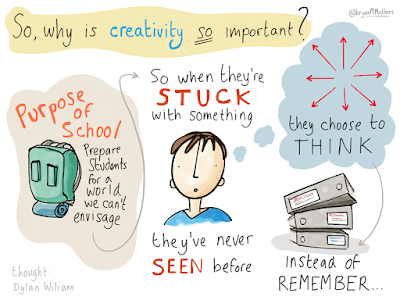
Image retrieved from here

Creativity helps prepare students for the future. In our ever-changing world, the ability to adapt, innovate, and solve problems creatively is essential if the students we teach today are going to find success tomorrow. Creativity improves learning outcomes when the learning is engaging, meaningful, and relevant. This is the catalyst to keeping our students motivated as it provides the opportunities needed to deepen their connections to the new learning.

In the past, literacy was seen as a foundational set of reading, writing, and counting skills. The 21st century has transformed this thinking to meet the demands of an increasingly digital, interconnected, and information-rich world. UNESCO defines literacy as a continuous process of learning and proficiency in reading, writing, and using numbers throughout life. This encompasses the ability to identify, understand, interpret, create, and communicate information effectively in a rapidly changing global environment. This leads to a deeper comprehension than simply processing words and phrases at a linguistic level.

The article 'What is creativity in education?' by Tim Patston, retrieved from the The Education Hub, states that 'Creativity is producing something new, relevant and useful to the person or people who created the product within their own social context.... Something that is very creative to a Year One student – for example, the discovery that a greater incline on a ramp causes objects to roll faster – would not be considered creative in a university student.... Creativity is valuable in education because it builds cognitive complexity... it relies on having deep knowledge and being able to use it .... with an existing set of knowledge or skills... to increase both knowledge and skills. It develops over time and is more successful if the creative process begins at a point where people have at least some knowledge and skills'. The sentence in bold is the one that resonates most with me when I apply it to my structured literacy context. I refer back to my previous post where I explain how we are using creativity to build on the known.

Nicole Krueger's ISTE blog post from 2022 states that creativity motivates kids to learn because 'when students are focused on a creative goal, they become more absorbed in their learning and more driven to acquire the skills they need to accomplish it'. This post reaffirms my initial thinking that we need to continue to harness the digital affordances a 1:1 chromebook class has to offer as we navigate our structured literacy journey by stating that 'teachers who frequently assign classwork involving creativity are more likely to observe higher-order cognitive skills — problem solving, critical thinking, making connections between subjects — in their students. And when teachers combine creativity with transformative technology use, they see even better outcomes'.

This deep research has allowed me to gain a deeper understanding of my topic. I will be continuing my journey to explore the importance of creativity in learning in my next post. 


Building an accurate profile of students' learning - tools, measures and approaches...

Describe the tools/measures/approaches you plan to use to get a more detailed and accurate profile of students’ learning in relation to that challenge. Justify why you chose these approaches and tools.


My challenge is to explore 
how the create aspect of the Manaiakalani pedagogy fits in and how we harnessing the digital to explore the create aspect of structured literacy. Our Junior team is currently running a structured literacy program and our Senior team are one week away from beginning our own structured literacy journey. As indicated in a previous post, I am very aware that 'creative skills help students become better problem solvers, communicators and collaborators.' (Manaiakalani). If a student can effectively use their DLO to teach it to someone else, then their own level of understanding and critical thought patterns (specifically analysis) are significantly strengthened.

To capture our starting point I chatted to our teaching team about how they currently use create in Reading and then followed this up by exploring the teaching slides on our class sites and a random selection of individual student blogs. The presentation below reflects my initial findings. Classes are randomly positioned on these graphs to preserve anonymity. My objective here is not to identify anyone or any class publicly as everyone is grappling with the challenges new learning brings.


One point I did not consider at the start of the year was the difference in learning needs between the students who are learning to read and those who are reading to learn. I have since discovered that with our newest learners the create aspect is very much 'hands- on' rather than digitally focused. 

With my Year 7/8 class in mind I will be continuing to use what I already know to build on my new learning. Having participated in the T-shaped literacy PLD for the last few years I can see where the ideas I learnt there can be capitalised on here. What is important for our senior team is that we follow the same line of thinking. We don't need to disregard for example, the summarising DLO and shared language of instruction we already use. This alignment that has been across the syndicate for the last few years is paying off in our room this year as our learners already have the knowledge needed to summarise a text. My role is to remind our team as we begin our structured literacy journey, to use what we know to unpack the new learning. We don't need to take our learners back to the start when they're already finding success in what they use now.

My Planning Focus:
  • This year I changed the word 'changes' to 'focus' in this section as I am aware if create opportunities are to stay alive in my literacy program I need to ensure they are well thought out and actively planned for. I absolutely can not see the point in throwing the baby out with the bathwater to ensure I am following a structured literacy program.
  • Looking ahead at the planning exemplars on the platform we are using I see that there are opportunities for our learners to summarise, find the main idea, identify the theme, make connections and see things from different perspectives. All follow up challenges I already do. What I won't be doing is using the provided worksheets as I have a wide range of strategies in my kete that will allow me to align with the planning but also keep create alive in my classrom.