Showing posts with label Approaches. Show all posts

Sunday, 13 July 2025

Stocktake of my Inquiry...

We are half way through the year and I realise when taking stock of my inquiry that the PLD start delay has impacted my inquiry significantly. I haven't really been able to begin until now as we have only had 4 structured literacy PLD sessions so far. My inquiry a school leader is not just a personal one, but also a team one. The positives to date are that we have been keeping the status quo in literacy so I do know we are currently all on the same page as far as planning is concerned. We are all on the same page as far as DLO scaffolds are concerned and our current shared language of instruction is alive and well. 

Moving forward this term sees us starting to implement structured literacy practises. What is a huge plus for us is that the changes are not big ones. Our current planning is structured. It unpacks the text and explores text structures, themes and vocabulary. What we do need to do is approach the tweaks we need to make to the vocabulary instruction at our own pace. What I mean by that is we are a team with a varied range of teaching experience which ranges from 6 months to over 30 years. If we change too much too soon I can see everything unravelling quickly. The point of PLD is to build on what we know to strengthen our practice not to throw everything out and start again.

Before I think about how I can support my team I need to put my own oxygen mask on first. By that I mean I need to jump into structured literacy approaches boots and all. I know I still need to capture student voice and will do this when term 3 begins. I needed to look closely at how I will adapt and tweak my current planning. I have done that by looking at the planning exemplar provided on the structured literacy platform we are using and have then made a few changes in what I already had in place. 

The end goal was to keep a 'create' aspect which I have done. I wanted to make sure I was covering what was suggested but I also know I can do this without folding back to using the worksheets I cut my teeth on as a beginning teacher. The first screenshot below is what is suggested on our PLD provider platform. The way I have interpreted this is to use the perspective DLOs I already have in place but add a creative aspect to this by using ADOBE podcast to capture the conversation behind the end product. (The discussion and summarising aspects are covered in the guided planning.) We do have planning scaffolds that we use but the way my learners show their perspective is totally up to them. I am also making use of text sets and my learning T-shaped literacy gave me. What I have added is a skill drill game that I created using Gemini. These multi-choice tasks have been a game changer in our class. They allow for quick recall and application of new learning. Examples of these challenges can be found here.


As I said earlier I, along with my team, are very much at the start of our structured literacy journey. Ours made slightly more challenging by the year groups being separated into PLD for Y4-6 and PLD for Y7-8. What is helping keep us all aligned is the planning framework and the conversations we have as a team.

Causal Chain - mapping my inquiry...

As a part of the Manaiakalani Kahui Ako we are challenged to think about what we want to achieve then work backwards to map our steps. This is called a causal chain and is the logical thought process we follow to help us stay focused on on track throughout the entirety of our inquiries. As I completed my causal chain for 2025 I realised I was actually building on from the inquiry I began last year. This is exciting as it is an opportunity to see how the team alignment we worked so hard on last year strengthens our team when staff members change and a new program (structured literacy) is introduced.


A causal chain is when a cause leads to an effect and that effect becomes the cause of another effect - A leads to B. B leads to C. C leads to D...start from D and work backwards Any intervention you design will (consciously or not) be based on a causal chain you have in mind - this is your theory of action.... To really understand deeply how teaching (as a cause) leads to a valued student outcome (effect), we need to know about more than just the first cause in the chain and the final - we need to know about each link.' - Dr Aaron Wilson

Building an accurate profile of students' learning - tools, measures and approaches...

Describe the tools/measures/approaches you plan to use to get a more detailed and accurate profile of students’ learning in relation to that challenge. Justify why you chose these approaches and tools.


My challenge is to explore 
how the create aspect of the Manaiakalani pedagogy fits in and how we harnessing the digital to explore the create aspect of structured literacy. Our Junior team is currently running a structured literacy program and our Senior team are one week away from beginning our own structured literacy journey. As indicated in a previous post, I am very aware that 'creative skills help students become better problem solvers, communicators and collaborators.' (Manaiakalani). If a student can effectively use their DLO to teach it to someone else, then their own level of understanding and critical thought patterns (specifically analysis) are significantly strengthened.

To capture our starting point I chatted to our teaching team about how they currently use create in Reading and then followed this up by exploring the teaching slides on our class sites and a random selection of individual student blogs. The presentation below reflects my initial findings. Classes are randomly positioned on these graphs to preserve anonymity. My objective here is not to identify anyone or any class publicly as everyone is grappling with the challenges new learning brings.


One point I did not consider at the start of the year was the difference in learning needs between the students who are learning to read and those who are reading to learn. I have since discovered that with our newest learners the create aspect is very much 'hands- on' rather than digitally focused. 

With my Year 7/8 class in mind I will be continuing to use what I already know to build on my new learning. Having participated in the T-shaped literacy PLD for the last few years I can see where the ideas I learnt there can be capitalised on here. What is important for our senior team is that we follow the same line of thinking. We don't need to disregard for example, the summarising DLO and shared language of instruction we already use. This alignment that has been across the syndicate for the last few years is paying off in our room this year as our learners already have the knowledge needed to summarise a text. My role is to remind our team as we begin our structured literacy journey, to use what we know to unpack the new learning. We don't need to take our learners back to the start when they're already finding success in what they use now.

My Planning Focus:
  • This year I changed the word 'changes' to 'focus' in this section as I am aware if create opportunities are to stay alive in my literacy program I need to ensure they are well thought out and actively planned for. I absolutely can not see the point in throwing the baby out with the bathwater to ensure I am following a structured literacy program.
  • Looking ahead at the planning exemplars on the platform we are using I see that there are opportunities for our learners to summarise, find the main idea, identify the theme, make connections and see things from different perspectives. All follow up challenges I already do. What I won't be doing is using the provided worksheets as I have a wide range of strategies in my kete that will allow me to align with the planning but also keep create alive in my classrom.

Tuesday, 5 November 2024

Describe and Explain the changes/tweaks you have made in your practice along the way...

My inquiry this year has had many twists and turns. Achieving accelerated shift in Literacy was identified as being one of the most important and catalytic issues of learning facing our students in Y4 - 8, this year, when the time point one data was analysed. Exploring how learning gained from professional development is helping to strengthen teacher practice and achievement in literacy is something I haven't looked at before so I began with one idea which over the course of the year has completely morphed into another. Not because as I mentioned in an earlier post, because it was unachievable, but because my initial idea simply wasn't working. The effect of staff changes on PLD is something I hadn't initially taken into consideration. What began as an inquiry into how we (PBS) are using PLD to accelerate shift across our school' and over the course of the year required a change of tact to inquiring into how are we building and strengthening our capability in raising student achievement outcomes in Reading for years 4-8 at PBS.

I began my journey by trying to ensure we were all on the same page. Consistency and a shared language of instruction help our students to make the connections they need to be able to access their learning with confidence and understanding. At the start this wasn't about paying no regard to the skills and knowledge my team brought to the table but rather to align our thinking. This is explained in detail with examples in an earlier blog post. This wasn't as successful as I hoped as we were all coming from such different places both literally and in knowledge gained from recent PLD, so it was back to the drawing board.

Changing Direction Icons - Free SVG & PNG Changing Direction Images - Noun  Project

After speaking with Naomi Rosedale, I realised I needed a new pathway forward, a pathway that included a framework that would bring everything together and provide clarity. Aligning what I was looking for with the Manaiakalani Reading Pillars of Practice (MRPP) was the lightbulb moment I needed. In Term 3 I used the MRPP to look closely at what and how we, my team and I, were actually teaching the tauira in front of us in our reading lessons. I looked at the data and used the initial gap analysis to help me gauge whether or not the learning planned matched the student needs. To allow for consistency I stood by my decision that if it wasn't in the planning it wasn't there. The follow up discussions were both rich and gave all of us the clarity we needed to help us meet the learning needs of our individual classes.

This process was repeated in Term 4. I am yet to complete all my follow up discussions but have them timetabled for later in the week. What I noticed was with a shared understanding and stronger knowledge of why we need to make the changes. All my team have now included multimodal text sets, are looking at the structure and language in the different text types and have put a lot of thought into the questions they are asking. There is definitely a growth in the use of our shared language of instruction, a wider variety of comprehension skills being accessed. 

Changing my inquiry focus has allowed me to introduce change in a manageable and achievable way. Mindsets where planning is concerned has moved from compliance to purpose, something I struggled to initially get buy in from. I feel that looking closely at my own planning has added the 'teacher model' element to the learning. By using the MRPP it has allowed us to all learn together but at our own pace. Sharing people's successes and valuing their ideas has afforded us opportunities to learn with and from each other. 

The big message I want to share here is that change is good, it should be embraced and we should not be afraid to walk in a different direction if what we have tried is not working. 

Wednesday, 28 August 2024

You can't help yourself if you can't see yourself...

Once again I'm tapping back to Jason Borland's thinking in our 2015 Manaiakalani Innovative Teacher's PLG where he stated that "You can't help yourself if you can't see yourself." This thinking resonated with me when I first heard it, and after following Jason's inquiry I have often repurposed this idea in the classroom but know it has reaches much further and wider than only our learners.

At the start of this term I asked my team to video themselves teaching a guided reading lesson. The idea was to help everyone to see what they were doing well and what they felt they could do in a different way. I made it clear this was for personal use only, I didn't want to see it and I definitely didn't want a written analysis of it. The only video I wanted to see was my own because I do the same as I ask my team to do. It also gives me a video to use as a resource if I need to model the process. All wanted was for everyone to take a moment to reflect on what they do in the classroom to help their learners connect to the learning. 

Initially this challenge was seen as something my team needed to do for me. However, this recording definitely wasn't for me, it was for them. Falling back on the phrase 'you can't help yourself if you can't see yourself,' was the game changer. Through observation opportunities I have been able to see each room first hand. I often record these observations for this purpose but after watching some parts together I imagine time plays a huge part in the decision to continue watching it in entirety or not. When challenged to watch and reflect in a safe way, the table below identifies areas from our team discussion that we need to strengthen. 


This picture is real and as is it co-constructed there is an element of ownership that we can all capitalise on to make the changes needed in our practice that will help accelerate student achievement.

Where am I at and how will I measure this?...

As my inquiry has now taken a new direction I needed to collect an additional set of time point 1 (TP1) data that can be used at the end of the year to provide evidence of shifts in teaching. As this is for inquiry purposes the information needed to be formative. It needed to identify our current strengths as well a identifying our areas for development. The Manaiakalani Reading Pillars of Practice (MRPP) matrix has helped me do exactly that.

After analysing my reading planning against the MRPP with Toreka, the next step was to work together to analyse her reading planning. On this occasion I took the lead but asked her to step in if I needed to relook at something. Again a rich conversation was had and a clear picture of where she is at captured. I then repeated this process with the rest of my team.


The feedback was really positive and discussions had were rich and honest. I think the high levels of trust play a huge part in this process and I want to thank my team for their parts in these conversations. This process fully was transparent and I openly shared my matrix with my gaps clearly identified. I think this helped in strengthening the buy in as it wasn't about finding out right and wrong but rather finding out where our areas of strength and areas to strengthen were. The latter have since become part of our co-constructed team PLD plan going forward.


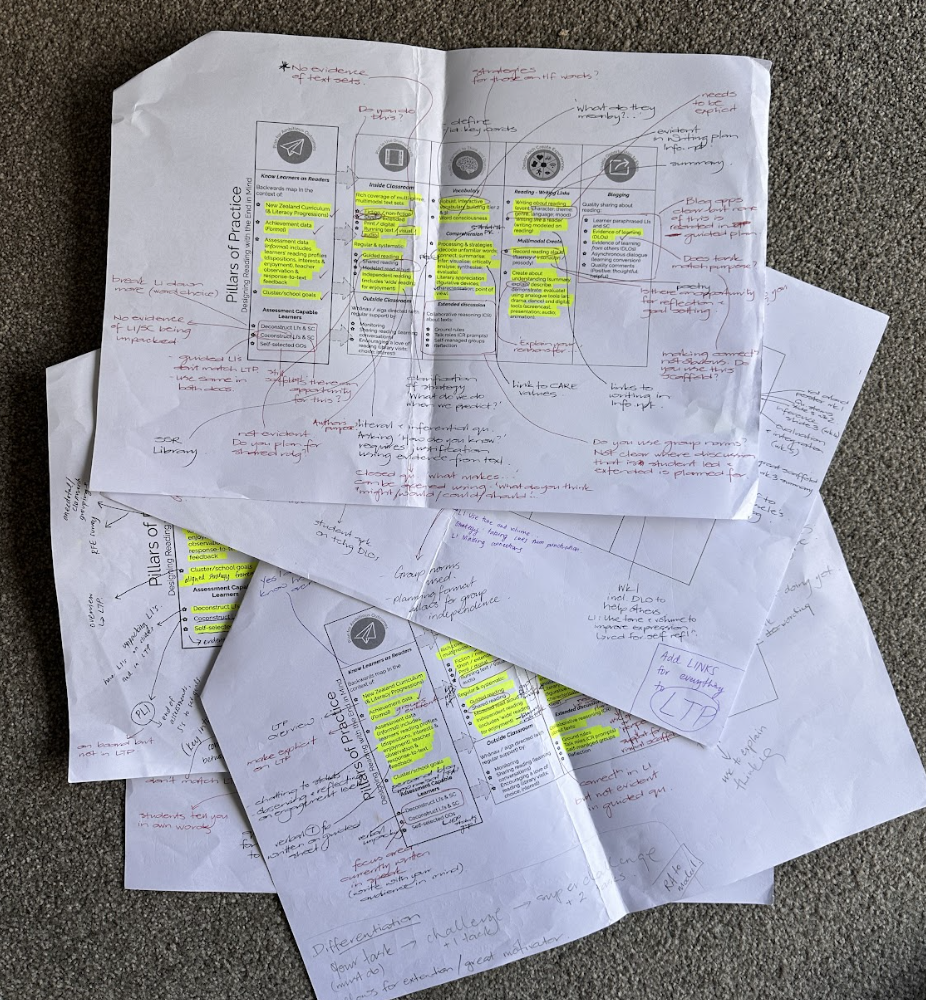
The matrix for all initial discussions was very much a working document (see image above). This gave me an opportunity to identify what I saw in the planning and my team to talk to it. Sticking firmly to the idea that 'if it wasn't in the planning it wasn't there', allowed for consistency across the board but it didn't mean I didn't listen. Using pen and paper on this occasion meant any adaptations made were clearly visible to both of us. The part of this process that I really liked was being able to celebrate and sometimes point out, people's successes. I found that by doing this first the door was opened for those more challenging conversations to take place. 

The presentation below is the formalised version of these conversations. Each teacher has their own digital copy that identifies areas of strength, areas to strengthen and next steps.

From the perspective of team leader, I now have a clear and visual picture of where we are at and what it is we need to do to help accelerate shifts in student achievement in reading. 

Stocktake of my Inquiry...

My inquiry this year has been to say the least, challenging. Not because it is unachievable, but because my initial idea just wasn't working. I had several attempts at exploring the effect of our recent Reading PLD on student achievement but soon found out this wasn't going to work as my team are are all coming at this from different places. The PLD I have had differs greatly from what the others have had. My biggest learning has been the realisation that something I think is a normal part of a lesson is not necessarily seen the same through the eyes of others. It was also a real eye opener to realise the effect of staff changes on PLD, something I'm sure all schools experience. 

After speaking with Naomi Rosedale at the last COL meeting, I realised I needed to make some changes. Once I had worked out my new pathway forward things began falling into place. I had a plan and had begun putting that plan into place, but what was missing was the framework to bring everything together. Naomi suggestion was that I align what I was looking for with the Manaiakalani Reading Pillars of Practice. That was the lightbulb moment I needed.

Light Bulb Moment Icons - Free SVG & PNG Light Bulb Moment Images - Noun  Project

Last year two of my team took part in the Reading Program Intensive (RPI) and although I didn't, I did join them in their journey through my role as a mentor. As a mentor I didn't get the explicit introduction to the Manaiakalani Reading Pillars of Practice (MRPP) so I needed to strengthen my connections. I did this by reversing the roles. This time it was me in the learning seat and Toreka in the mentor role, and turned into one of this richest learning conversations I have ever had. 

Together we analysed my long term reading plan and one randomly selected example of a guided reading plan against the MRPP.  As we unpacked each section I could see a clear picture of where my successes were and where my gaps were. Toreka was far more generous than me with this process. She kept saying 'I know you do this, I've seen you do it...' but I was of the opinion that if it wasn't in the planning it wasn't there. That decision allowed for consistency when I repeated the process with my team's planning.


The image above is the result of my conversation with Toreka. I'm sure to anyone looking at the writing all over the MRPP matrix it will look chaotic, but to me it's a rich summary of observations made, explored and discussed. I think what I liked the most in this process is that it is a true picture of my strong belief that we learn best when we learn with and from each other.

Tuesday, 23 July 2024

Causal Chain - mapping my inquiry...

As a part of the Manaiakalani Kahui Ako we are challenged to think about what we want to achieve then work backwards to map our steps. This is called a causal chain and is the logical thought process we follow to help us stay focused on on track throughout the entirety of our inquiries.


A causal chain is when a cause leads to an effect and that effect becomes the cause of another effect - A leads to B. B leads to C. C leads to D...start from D and work backwards Any intervention you design will (consciously or not) be based on a causal chain you have in mind - this is your theory of action.... To really understand deeply how teaching (as a cause) leads to a valued student outcome (effect), we need to know about more than just the first cause in the chain and the final - we need to know about each link.' - Dr Aaron Wilson


Thursday, 2 May 2024

Qu 3: Building an accurate profile of students' learning - tools, measures and approaches...

Students who have achieved at a level considered to be 'below' the level they should be, are approximately a year behind the level they need to be at to make sense of the new learning. These are the students who with encouragement, scaffolding and explicit teaching will often make the gains needed to reach expectation.

Professional development empowers teachers with the skills to improve classroom practises, by introducing them to new learning which can make the changes needed in their practice to help strengthen the connections their students have to the learning. On occasions PLD is something that is simply attended so that a box can be ticked, but when embraced, can make a real difference. Sometimes despite having all the I's dotted and all the T's crossed shift does not take place. 

The conversations that often follow these results tend to apportion blame towards the student.... We have all at one stage or another heard phrases like '...did not connect to the test...'didn't read the questions carefully'... 'ran out of time'... 'was having a bad day...' It is only in recent times that we have been hearing teachers truly reflecting on their practice. What excites me as a team leader is hearing teachers identify where the gaps are in their own practice, then actively explore ways to try and fill these gaps. It the teachers who see student shift as a collaborative journey who make the most difference.

After the beginning of year data was collected and analysed at class level, this data was then shared at team level. As a group we celebrated our successes and looked at what teachers were doing in their classrooms to achieve these results. These strategies were then shared with examples that helped people see what it looked like in practise. Collectively we identified the support we would need to make both big and small changes in our practices, that would help to accelerate shift in all our learners, and together we formulated a plan that will help us get there.

The tools/measures/approaches:
  • Planning 
    • Long term
    • Site DLOs
    • Shared format
  • Sharing time at syndicate meetings
    • 10 minute quick tips that can be used in literacy
  • Feedback from PLD and resources shared
  • Classroom observations 
    • linked to literacy
  • Peer observations
    • linked to literacy
    • noticing ideas that are working and are embedded in the program
  • Surveys
    • Teachers
    • Students - target group
  • Time point 1/2 data analysis

Monday, 5 June 2023

Causal Chain... A tool for planning and reflecting...


This year I want to find out if a focus on spelling conventions foster an environment where word consciousness strengthens connections to the learning? Creating a causal chain helps me stay focused on the purpose of my teacher inquiry. As I have said before, it is so easy to fall down many rabbit holes along the way so having a causal chain to look back on helps to keep me on track. Creating a causal chain allows me to visualise where I want my students to be at the end of the learning year, then map backwards the steps I will take to strengthen our (mine and my learner's) connections to the topic. 

My 'crusade' this year is to grow the vocabulary knowledge of akonga in my literacy groups. This year Dianne and I are undertaking a collaborative inquiry as we share a learning space. Although we are approaching this challenge in different ways, the reason behind it remains aligned. We have seen our students fall back on the familiar and simple words like 'went' when writing independently, possibly because don't  have the confidence to draw on the more powerful words that would move their writing to the next level. Our hunch is that reliance on the 'known' maybe due to the 'fear' of making mistakes when spelling the more challenging words expected at a Year 7/8 level. Spending time focussing on identifying meaningful chunks in words (root words, base words and affixes) might be the key that unlocks the door to the 'unknown' and may help my learners strengthen their vocabulary, spelling and decoding development in literacy so they are able to use and apply this knowledge when working independently..


Wednesday, 12 April 2023

Qu 3: Building an accurate profile of students' learning - tools, measures and approaches...

Describe the tools/measures/approaches you plan to use to get a more detailed and accurate profile of students’ learning in relation to that challenge. Justify why you chose these approaches and tools.

Vocabulary refers to the knowledge of words and word meanings. Helping students become word conscious is a crucial endeavour for teachers across all levels, and more so for teachers working with students whose prior vocabulary exposure may be limited. One of the biggest hurdles I have observed when I ask my learners to complete a writing task is their problem solving skills when it comes to vocabulary choice. At some point in their learning journeys so far our learners have formed the mindset that making a mistake when spelling is not ok. This deficit mindset causes problems when it comes to experimenting and/or taking risks with new vocabulary. Additionally it stops the flow of writing and results in many students just giving up or embracing the idea that they simply are not good at writing or spelling. 

Dianne and I are carrying out a collaborative inquiry this year but have chosen at this point to work independently with different groups. Dianne chose the students who find spelling a challenge which has left me with the students who are more able spellers. Having collected the baseline data and captured student voice (shared in an earlier post), we have decided to adopt the strategy of divide and conquer. Our ongoing conversations about the spelling hurdles we need to 'knock down' have opened our eyes to the fact our students who struggle with spelling need a different intervention than those who have some understanding. We want our students to take risks but are fully aware that those who see themselves as 'not good at spelling' need to revisit the basics in a safe space where they feel empowered. 

The analysis below reflects the responses of the attitude towards spelling of the 25 students in our class who have shown in our data to be our more able spellers. When responding to the e-asTTle attitude question, ‘I am good at spelling’. 70% of these students see themselves as being good spellers, while in contrast 30% do not. It is the mindset of the 40% who’s thinking I need to change.


The tools/measures/approaches:

Planning changes:

Making time to implement anything needs to become a reality if any success is to be achieved. We have a dedicated time for Word Consciousness in our timetable so that we are accountable for teaching it and our students see this as something we value. In my group I have a mix of book work and digital work. We use dictionaries and thesaurus' to build skills and work both independently and collaboratively.

Student Voice:

Gathering student voice is a vital part of teaching. It gives us a clear picture of where our students are at, what they're thinking and what we need to do to allow of learners to make their individual connections to the learning. We have devised a Spelling survey which will completed at the end of each term, allowing us to measure both the small and big changes. 

Peters/e-asTTLE Assessments:

Analysing these results gives us a clear picture of what our students can do and where our knowledge gaps are.  We will use these results to inform our planning and identify shifts in achievement. 

Next steps:

  • Explore creative and fun ways we can grow our word consciousness culture in our class
  • Make word consciousness visible in our class
  • Explore success in our school, other schools and other clusters 
  • Professional Readings/ PLD
  • Use student created DLOs as exemplars 


To sum up, we think limited word knowledge is the problem and now need to find out why it is the problem. It is not about weekly spelling lists, but rather meeting, noticing, unpacking, understanding, exploring and using a wider variety of words across the curriculum that will hopefully strengthen the spelling ability and word consciousness of the students in LS2 2023. Looking forward we feel that by addressing this now we will open the doors of learning wider when it comes to the transition into Year 9.


Sunday, 17 July 2022

Causal Chain... A tool for planning and reflecting...

This year I want to find out if a focus on Reading for Enjoyment increase student self efficacy and capability in Reading? Creating a causal chain helps you to stay focused on the purpose of your teacher inquiry. It is so easy to fall down many rabbit holes along the way so having a causal chain to look back on helps to keep you on track. My biggest takeaway from looking at a variety of readings is if we are to develop reading for pleasure habits in students we need a collective and collaborative approach that allows our tamariki to see role models at school and at home who value reading. 

Looking back at my causal chain I realise my students are seen as readers through our Leaders in the Library initiative, through sharing reading tips at our school assemblies and by actively reading for enjoyment in the classroom. It is important that my learners see themselves as readers too so I have made a point of capturing all of this in photos which are clearly displayed in our classroom. However when I look back at my causal chain I can see that because I'm always taking photos I have not been allowing my learners to consistently see me as a reader. As we approach Term 3 I know exactly what my goal is... make sure my learners see me as a reader too.


Link to causal chain

Wednesday, 4 May 2022

Qu 3: Building an accurate profile of students' learning - tools, measures and approaches...

Describe the tools/measures/approaches you plan to use to get a more detailed and accurate profile of students’ learning in relation to that challenge. Justify why you chose these approaches and tools.

Motivation is intrinsically related to engagement so learner engagement is vital if I am to establish a culture in my class where my learners are motivated to read for enjoyment and understand the benefits that reading outside of the classroom will bring them. My challenge now is to find out why the links in the chain appear to be broken again. To do this I will be looking at shift or change in:

  • Disposition
  • Data
  • Reading mileage
  • Student voice
  • Vocabulary changes in personal writing
The tools/measures/approaches:

Planning changes:

  • My initial approach will be to actively plan time in class for reading for enjoyment and the avenues of possible discussions this opens. This will help me to see where connections to the value of reading for enjoyment are being made. I realise if I want to encourage an intrinsically motivated habit I need to provide opportunities that allow my students to see the benefits that reading for enjoyment can bring.

Student Voice:

  • Gathering student voice is a vital part of teaching. It gives us a clear picture of where our students are at, what they're thinking and what we need to do to allow of learners to make their individual connections to the learning. Naomi's reading for enjoyment survey is how I will measure progress and will be completed at the end of each term, allowing me to measure both the small and big changes.

PAT/Probe/e-asTTLE Assessments:

  • Analysing these results gives me a clear picture of what my students can do and where our knowledge gaps are. I will use these results to inform my planning and identify shifts in achievement.


Learning Conversations:

  • Learning conversations are a huge part of our learning time as it provides authentic opportunities for new ideas to be used in context. Sharing books that you have read allows you to tell someone why you found the story/content interesting. Being able to talk about a book in detail strengthens your connections to the text. After completing the baseline survey I was explaining that a part of our reading challenge will be to recommend the book to someone else when one of my students suggested we do more than that by identifying the person we think might also like to read the text and selling the text to them... Her idea was to make this a part of our library time and call it 'book chains'.  
  • To do this effectively I will need to create speaking frames to scaffold those who need a bit more support to do this effectively.


Introduce a class Reading Challenge:

  • LS2 Reading Challenge - This has been created to encourage my learners to read a wide variety of genres. I know that if this is to be successful I need to walk the walk and talk the talk. Going forward I want my learners to see me as a reader too, so I will be actively participating, cheerleading and motivating my learners in both this challenge and the book chains we will be introducing.  
  • I will write a more detailed post about this idea once it has been introduced.

My next steps:

  • Explore success in other schools/ clusters 

  • Panmure Bridge School - What's happening already in our own backyard?

  • Professional Readings

  • Connect with public librarians 

  • Connect with whanau to foster support for reading for enjoyment at home

  • Use role models/student leaders to promote reading for enjoyment 

  • Explore creative and fun ways we can grow our reading culture at PBS

  • Make reading for enjoyment visible in our class

Wednesday, 5 May 2021

Qu 3: Building an accurate profile of students' learning - tools, measures and approaches...

Describe the tools/measures/approaches you plan to use to get a more detailed and accurate profile of students’ learning in relation to that challenge. Justify why you chose these approaches and tools.

My challenge this year is to strengthen the language and learning in maths that our students need to be able to actively participate in Talk Moves, so this can be harnessed and replicated in blog posts and comments. 


In all assessments our students are required to read and respond to questions. Often our students are not literate in their own language so the gaps that emerge when questions are written in english are getting wider, thus causing bigger disconnects in the learning. This year I want to implement the strategy of Talk Moves in Maths. Talk Moves is a strategy that promotes classroom conversations centred on maths that helps to improve students' understanding of mathematical concepts. It is a framework to prompt the discussion, and will allow me to capitalise on the learning I got from my inquiry in 2020 by providing authentic opportunities to use this 'talk' within blog posts and blog comments to help strengthen connections.

The tools/measures/approaches:

Planning changes:

My first step will be to introduce the Talk Moves framework into our maths program so that the discussion stems become the norm within our learning time. Being silent is not an option if acceleration is to take place so I need to model the language and support the use of questions which lead to justification like ‘How do you know it works?’, ‘So what happens if you...’, ‘What about if you say…does that still work’, ‘So if we...' 

Additionally I need to continue to actively plan time in class, for students to create blog posts, comment on each others blogs and respond to comments on their own blogs. This will help me to see where connections to the learning content are strong, and where gaps in knowledge are evident.

Instructional lessons:

I need to create opportunities for my learners to focus, notice and use the words that help us make sense of the learning, and not only model this, but also prompt the use of these words by providing opportunities for explaining strategy choice and use in groups within the lessons.

I need to use Jo Boaler's strategy of setting up positive norms in my classroom. Actively strengthening the growth mindset in my students might help to break down some of the barriers that stop them taking risks when solving maths problems or sharing their thinking.

Provide visible scaffold frameworks and rubrics to support the talk moves process that are used across the school. 

Observation:

After speaking to Kiri Kirkpatrick (MET) about the best way to gather baseline evidence she suggested I measure the amount of teacher talk compared with student talk in a maths lesson. To help me get an accurate picture, I have asked Kiri to observe me at time point one and time point two. Having the same observer will be a huge benefit as the continuity will be in place.

PAT/IKAN/GLoSS Assessments:

Analysing these results gives me a clear picture of what my students can do and where our knowledge gaps are. I use these results to inform my planning and identify shifts in achievement. I need to look closely at the language of questioning and the content specific language that is used in these assessments to ensure my instructional language aligns. I do not want my choice of vocabulary to be a reason that any student loses their connection to the learning.

Student Voice:

Gathering student voice is a vital part of teaching. It gives us a clear picture of where our students are at, what our tamariki are thinking and what we need to do to allow our learners to make their individual connections to the learning. I need to ask my learners what the barriers are that stops them commenting on blogs, replying to blog comments and contributing their thinking to class and small group discussions. It is only by identifying these barriers that I can devise a plan to help break them down. This is not a time for me to assume and act, it is a time for me to listen then act on the information I have heard.

Peer to peer talk:

Peer to peer talk continues to be huge part of our learning time as it provides authentic opportunities for new words to be used in context. I can see that buddying my learners up they can talk through a blog post then collaboratively decide the appropriate feedback and feed forward through dialogic discussion before leaving their individual comments.

This will also provide the opportunity for my learners to buddy up and talk through comments received before responding.

To do this effectively I will need to:

  • Strengthen my own knowledge to the strategy of Talk Moves with professional readings
  • Strengthen my own knowledge of the growth mindset process 
  • Teach my students how to use Talk Moves 
  • Teach my students what growth mindset looks like
  • Co-construct group norms so there is a shared understanding of the expectations
  • Provide lessons that allow for this to take place
  • Monitor, observe and listen to my students as they are sharing and/or recording their thinking in their groups 
  • Consider the times different students need for processing when grouping my students
  • Gather accurate time point one and time point two data for comparison.


Tuesday, 28 April 2020

TAI 2020 WFRC #3: Building an accurate profile of students' learning - tools, measures and approaches...

Describe the tools/measures/approaches you plan to use to get a more detailed and accurate profile of students’ learning in relation to that challenge. Justify why you chose these approaches and tools.

My challenge is to explore if strengthening connections to Smart Relationships will help my learners to understand and use content specific language and vocabulary in context. I feel that by doing this it will help my learners to make accelerated shifts across the board in reading, writing and maths. In all assessments our students are required to read and respond to questions. As with my previous inquiries I am very aware that it is often the content specific language along with the language of questioning that causes disconnects in learning. My idea this year is to use their blog posts and blog comments to help strengthen these connections.


The tools/measures/approaches:

Planning changes:
  • My initial approach will be to actively plan time in class, (and now in our current distance learning situation), for students to comment on each others blogs and respond to comments on their own blogs. This will help me to see where connections to the learning content are strong and where gaps in knowledge are evident.
  • Adapt lesson formats so that regardless of curriculum area we spend time thinking about how we can share our learning effectively on our blogs, and time thinking about giving and responding to blog comments that are linked to our learning. 


Instructional lessons:
  • I need to create opportunities for my learners to focus, notice and use the words that help us make sense of the learning, and model this.
  • Teach and model the Manaiakalani cybersmart lessons inside core subject areas to help my learners strengthen their understanding of the blogging process and understand how paying attention to the feedback received in blog comments can help them move their learning to the next level in context.
  • Provide scaffold frameworks and rubrics to support this process that are used across the school. 

PAT/STAR/Probe/IKAN/GLoSS/e-asTTLE Assessments:

  • Analysing these results gives me a clear picture of what my students can do and where our knowledge gaps are. I use these results to inform my planning and identify shifts in achievement.


Student Voice:
  • Gathering student voice is a vital part of teaching. It gives us a clear picture of where our students are at, what they're thinking and what we need to do to allow of learners to make their individual connections to the learning.

Feedback:
  • I need to fall back on the known by repurposing an idea I used in 2015 to help my learners understand what feedback looked like. This was done by sharing the story of Austin's Butterfly to help my learners see that by paying attention to the feedback given by his peers, Austin was able to make the changes he needed in his drawing to make it more scientifically accurate. By showing this clip again and unpacking the learning within, I hope to help my current students see the power giving and receiving feedback has in strengthening their connections to the learning.

Peer to peer talk:
  • Peer to peer talk continues to be huge part of our learning time as it provides authentic opportunities for new words to be used in context. I can see that buddying my learners up they can talk through a blog post then collaboratively decide the appropriate feedback and feed forward through dialogic discussion before leaving their individual comments.
  • This will also provide the opportunity for my learners to buddy up and talk through comments received before responding.
  • To do this effectively I will need to create speaking frames.


Explore success in schools/ cluster initiatives:
  • Panmure Bridge School 
  • Manaiakalani and Outreach schools
  • Manaiakalani Cybersmart resources
  • Tuhi Mai Tuhi Atu
  • Wairakei School - Link here  
  • MIT/COL inquiries

Tuesday, 16 April 2019

WFRC #4: Building an accurate profile of students' learning - tools, measures and approaches...

Describe the tools/measures/approaches you plan to use to get a more detailed and accurate profile of students’ learning in relation to that challenge. Justify why you chose these approaches and tools.


My hunch is that some issues with my students’ math achievement are related to issues they have with reading instructions and tasks. The students in my class who achieved higher scores in the PAT reading, STAR and Probe running record assessments also achieved higher scores in the PAT maths and IKAN assessments. My target group's data showed the exact opposite. With the exception of student B2 who scored slightly higher in the maths assessments than the reading assessments. The tools/measures/approaches I plan to use are:


PAT/STAR/Probe/IKAN Assessments:
  • Analysing these results gives me a clear picture of what my students can do and where our knowledge gaps are. I use these results to inform my planning. This year I have been looking closely at the vocabulary used in the questions, and will be incorporating this into my lessons so that connections can be made to what these words are asking my learners to do. With my inquiry in mind I need to introduce, unpack and use the words: calculate, recognise, identify, find, plot, solve, estimate, visualise, interpret, percentage, fraction, proportion, decimal

Student Voice:
  • Gathering student voice is a vital part of teaching so at the end of the term I asked all my students to complete our T1 evaluation using a google form questionnaire. I find this type of evaluation really useful as it gives me an insight into their honest responses, and not responses influenced by what their friends are saying. With my inquiry in mind I asked my learners what they enjoyed in writing, reading and maths to give me an insight into how I can capitalise on learning where student self efficacy is high as this shows me which teaching approaches were a success. Additionally I asked if there was anything they still needed help with in these learning areas. This information quickly shows me where student self efficacy is lower, and most importantly informs my planning.

Check in chats:
  • I have been focussing on building student self efficacy this term so each week I have a 'check in chat' with all my instructional groups. I have found this really useful as I get immediate feedback and am able to see quickly where confidence levels are lower. During this time I give each of my students a vivid and give them 2 'teacher' minutes to write down any questions they may have, or any words they don't understand. This part is proving to be successful as I don't intervene (unless asked), and it is all done anonymously. I have noticed during this time that

Feedback:
  • Continue to use the comments tool in G suite so my learners can see where I notice their success (this is something these students have told me they want to know), and can ask me questions or let me know if I need to spend some 1:1 time strengthening knowledge gaps. For this tool to be successful I need to allow time for my learners to reply to my comments. My target students still need support in doing this and I have found if they write their replies with scaffolding from our teacher aid or from each other, they are more likely to give me an honest response, rather than a response they think I want to read.

Peer to peer talk:
  • Peer to peer talk is a huge part of our learning time as it provides authentic opportunities for new words to be used in context. I noticed my learners also used this time to seek clarification from each other so I have added in a 'fun' component of timed challenges to share knowledge with a partner.

Instructional lessons:
  • Planning opportunities for time to unpack new vocabulary or revisit known vocabulary is embedded into all lessons and gives us an opportunity to focus and notice the words that help us make sense of the learning.

Spring into Maths/Rainbow Reading:
  • At our school these groups are run as withdrawal groups. They provide the students who attend opportunities to grow confidence and strengthen their connections to the learning in a supportive small group environment. The teacher who runs these sessions aligns her programs with the planning on our sites.
Lesson format:
  • I adapted my lesson formats so that regardless of curriculum area, the structure is the same. This will help to ensure I am actively planning time to introduce and unpack new vocabulary and/or revisit known vocabulary; actively planning 'fun' warm up challenges to strengthen skills/strategies/knowledge; and actively planning time for talk so the language can be defined/used/explored in context. By doing this I am hoping that my learners will see that the language of instruction we use in one area can be transferred to another.