Showing posts with label Create. Show all posts

Saturday, 1 November 2025

Unpacking Qualitative Data - My Journey to Balancing Rigor and Transformation...

My central motivation for this inquiry stems from a concern that the necessary rigor of the Structured Literacy framework could unintentionally stifle creative expression and deep demonstration of learning. 

My perspective is rooted in my own educational experiences from a time dominated by repetitive, uninspired reading consolidation (the classic ‘duplicated worksheet’ era) where genuine engagement was rare. The moments that truly stood out were interactive like using the listening post or, more enjoyably, performing plays, especially when we could create our own costumes or masks.

This pattern continued early in my teaching career. I often defaulted to guided reading worksheets that, despite having diverse texts, asked the same predictable questions, which stifled independent thought. While I attempted to introduce new ideas, limited classroom technology and a lack of accessible Professional Learning and Development (PLD) hindered my sustained pedagogical growth.

When I joined the Manaiakalani cluster I was introduced to a culture of continuous learning and innovation that prioritises student engagement. This culture intensified my fear that the required intensity of Structured Literacy might accidentally regress our practice back to those days of ‘boring repetition.’

This concern drove my inquiry into effectively utilising the 'Create' component within our kura. A core goal of our previous PLD was moving teaching and learning 'above the line' of Dr. Ruben Puentedura's SAMR model—a framework that pushes technology use from simple enhancement (Substitution and Augmentation) toward transformation (Modification and Redefinition). My primary focus for this year was to ensure our literacy instruction maintained its rigor without sacrificing this transformational practice.
Initially, I looked at creative opportunities school-wide, quickly realizing the junior team excels in this area. For early readers, creativity is best fostered by hands-on, collaborative fun, rather than only with digital tools. This realisation saw me pivot for the first time as I couldn't limit my study to only digital affordances if I wanted to fully understand and strengthen 'Create' within Structured Literacy.
My next step was to narrow the focus to the senior team. However, I soon realised that a team embracing new PLD needs time to build confidence and implement change. Feedback from team meetings told me they certainly didn't need me critically observing the create opportunities in their reading lessons. This led to my final pivot of focussing exclusively on my own practice in my Year 7/8 classroom.

Focusing on my own Year 7/8 students (our most capable readers), provided an advantage. Given my existing literacy PLD, I wasn't entering the Structured Literacy framework completely cold. I challenged myself to incorporate the affordances of AI, alongside my well established kete of follow-up challenges, to encourage students to build on prior knowledge when showing their understanding of the new texts we unpacked.

How to use Gems - Gemini Apps Help

A clear example is the inclusion of Gemini Gems in our guided reading follow-up (unpacked in an earlier post). The resulting change has been significant as student responses now feature more extended, student-initiated, and student-led discussion.

Ultimately, when 'Create' is properly embedded, it becomes a purposeful and engaging opportunity for tauira to demonstrate understanding. As educational theorist Elwyn Richardson observed, research shows students learn by actively constructing knowledge—a process that involves breaking down, rearranging, selecting, and demonstrating their understanding so that visualised thoughts were given an opportunity to be created.

Exploring Quantitative Data...

The purpose of this inquiry was to evaluate the integration and frequency of 'Create' opportunities, a key component of the Manaiakalani ‘Learn-Create-Share’ pedagogy, within Reading instruction across our kura.

To measure the shift in practice, analysis was conducted comparing:

  1. Opportunities explicitly planned for by teaching staff.

  2. Opportunities shared via class Digital Learning Objects (DLOs).

  3. Qualitative feedback sourced from Teacher Planning in Term 2 and Term 4 

Confidentiality: Due to the identifiable nature of the small learning environment, all data is presented in aggregated and generalised form. Individual teacher or classroom data will not be shared to preserve the privacy and confidentiality of staff, ensuring the focus of this inquiry remains on collective pedagogical practices rather than individual appraisal.

Quanititative analysis of the data indicates a noticeable increase in the provision of opportunities for our tauira to consolidate their reading comprehension and literacy learning through the 'Create' component of the Manaiakalani framework.

The presentation below unpacks the increase in planned opportunities for our tauira to creatively explore their new learning. The detail in the analysis in reflected in the breakdown of the graphs on slides 4, 6, 8 and 10. It is important here to recognise the fact that our staff have a wide range of teaching experience ranging from less than one year to thirty plus years. It is also important to note that everyone has put a lot of effort into embracing a new curriculum and integrating new PLD, whilst trying hard not to throw the baby of 'create' out with the bath water.

The following factors are hypothesised to have contributed to the observed increase in 'Create' opportunities:

  • Recognition that 'Create' extends beyond digital products to encompass various non-digital outputs.
  • Completion of Structured Literacy Professional Learning and Development (PLD).
  • Targeted staff meeting on the Manaiakalani ‘Create’ principle.
  • In-class support provided by Manaiakalani facilitators.
  • Active sharing of 'Create' outcomes in team meetings.
  • Increased utilisation of blogging as an immediate output and sharing platform.
  • Elevated kaiako confidence in teaching Structured Literacy.
  • Improved kaiako confidence in utilising digital capabilities for task design.
  • Increased staff ownership of accountability for pedagogical integration.
  • Active planning for 'Create' opportunities.
  • Effective establishment of connections between new and prior learning.
  • Development of greater tauira (student) independence, enabling more complex, self-directed creation tasks.

The following factors are hypothesised to account for areas where the integration of 'Create' has seen minimal change:

  • 'Create' opportunities were not explicitly integrated into planning cycles.
  • Lower kaiako confidence in implementing Structured Literacy instructional practices.
  • Lower kaiako confidence in leveraging digital capabilities for task design.
  • Perceived pressure resulting from connecting existing practice to new PLD requirements.
  • Initial resistance to pedagogical change within some practices
  • Disconnects between teacher expectation and tauira capability, particularly concerning the complexity of independent creation tasks.
In summary, this inquiry confidently confirms that 'Create' opportunities are thriving in our kura. We acknowledge the wide spectrum of teaching experience within our staff, recognising that new pedagogical learning often generates self-doubt, leading some to initially favour highly structured, familiar methods. While there is a necessary place for less creative consolidation tasks, the key to effective literacy mastery is 'repetition without boring'. This critical element is demonstrably afforded when students are given agency, choice, and creative opportunity within their follow-up learning.

Tuesday, 7 October 2025

What the Research says...

With technology at my fingertips and time not on my side, I prompted Gemini to undertake a deep research to find out more about why teacher confidence levels drop when faced with implementing new learning. 

Click on image to hear the audio overview of full research findings

Volume Icon, Transparent Volume.PNG ...

This is my summary of the findings...

The decline in teacher confidence during the implementation of new learning initiatives is a predictable reaction caused by challenges to personal competence and structural deficiencies like planning time pressures and knowledge gaps. Teachers initially find themselves juggling  anxieties where they worry about the changes needed to be made to routinesalongside professional fears associated with the uncertainty that comes with stepping into the unknown. 

As implementation begins, the concern shifts to logistical and structural constraints where concern connects to the amount of time needed to be prepared to teach the new approach. This efficacy dip is often worsened by perceived external and internal pressures to find the success quickly. PLD must be ongoing, curriculum-specific, and designed to close identified content and pedagogical knowledge gaps, moving away from generic, one-size-fits-all training. Time for reflection, implementation, peer and self observation, and skill practice should be allowed. Everyone learns at their own pace and recognising this is important. What has made the implementation of sound practice in structured literacy more fragmented for my team is the fact the Year 4-6 kaiako have had separate sessions from the year 7/8 kaiako. Different online delivery options has meant a similar message has been shared but as I attend one and most of my team the other, there are bound to be gaps in our shared learning which in turn has lead to levels of uncertainty being higher as I have always been two days behind in my own learning and unable to effectively support my team as they begin each new learning journey.

As a leader fostering a buffer against the cognitive and emotional load is vital is success is to be found and a genuine buy-in to be established. Allowing my team complete agency and control over their implementation decisions within their classrooms has meant we have come back together again with a stronger connection to our new learning. Confidence is emerging and as a result mentor observations to gather a baseline picture have begun. It is only now that I can begin to look for the opportunities being provided for their learners to be creative when undertaking structured literacy learning. I look forward to see where this takes us as the term progresses.

Describe and Explain the changes/tweaks you have made in your practice along the way...

I began with a focus of how we (PBS) are harnessing the digital to explore the create aspect of structured literacy. Students learn by actively constructing knowledge, not just absorbing it. This involves breaking down, rearranging, selecting, and demonstrating their understanding, so that  aElwyn Richardson stated, “...whatever was in their mind, whatever they could visualise, whatever they could see, they created...” It is because of the very reason just mentioned, that I felt this is the the most important and catalytic issue of learning for our learners this year. I didn't want to introduce and unpack a text verbally through preset comprehension strategies. I didn't want to be the teacher who asked my students to summarise a text on a graphic organiser then leave it there. I am the teacher who asks a provocation and encourages talk and creativity. I want my learners to show me their connections to the aspects of the text we are unpacking using the plethora of digital tools available to us. Defaulting to substitution in response to a structured learning process does not, in my opinion, open the opportunities to 'empower my students with creative learning opportunities to help accelerate achievement'.

At the start of my inquiry I thought I would look at our school as a whole. This was when I realised I was comparing apples with pears. Many of our junior team facilitate amazing opportunities for their students to create to show their understanding of a text. Their learners are fully engaged and excited to share what they have been doing any time I walk into one of their rooms. The difference between what they do, and what the senior team do is that many of their create challenges are not limited to capitalising on the affordances digital tools provide. Changing my focus to just the senior team was my first tweak. 

When we began our structured learning PLD in Term 2 with our introduction to the program. We then moved forward into Term 3 for our Community of Practice (COP) sessions and began implementing our structured literacy programs. I made the decision from the outset to lead from the front. By that I mean I made a point of finding ways to include opportunities for my learners to show their understanding of the texts read by being creative. What I noticed other members of my team doing was simply trying to get it right with our new learning. I do have the advantage here of having taught structured literacy for a number of years in the UK. I was definitely 'rusty' but felt confident to add in the new elements to my program. Term 3 was not the time to push the 'create' as I needed a team who were strengthening their own connections and that was more important. This was my second tweak as I took the focus of others and focused purely on myself.

When we met to plan for term 4 I jumped on my 'create' bandwagon. With a number of examples under my belt and on my blog I was able to lead by example. Being able to visualise the outcome has seen a huge change in planning content in my team in literacy this term. I am now looking forward to seeing how these initial ideas look when they are finished. The change here is in my thinking. I now realise that adding create opportunities that capitalise on the digital tools we have at our fingertips comes when teachers feel confident of the challenge ahead. 

Implementing Structured Literacy one step at a time: Step #4 - Reading

After attending a toolkit on Gemini Gems run by Matt Goodwin I decided that introducing this in my learning time this might spark another layer of curiosity with my learners. I followed the prompts shared by Matt and jumped in boots and all to help my learners gain a deeper insight to our guided text 'Malala Yousafzai Speech at United Nations Assembly 2013'. 

Below are screen shots of the Gem we used that show my initial prompt and the students interactions with the Gem to support their reading. I used the prompt that Mat gave as the example in his toolkit, so need to acknowledge that it is not my original idea.

I found this to be a really creative way to help my learners make sense of the response questions in ways that helped guide them to where they might find the information rather than simply giving the answer. 

The way this ran in our room was after introducing and modelling how Gemini Gems worked, I put the Gem on my computer and left it available for student use on a central table. This was both a great resource and a really creative way to capture my learners interest in the topic. A bonus was that once the Gem had been used the conversation in groups was richer as new perspectives were shared when some students disagreed with the initial collaborative responses. The learning 'arguments' were evidence based and allowed for the skill of negotiation to be used authentically in context.

I used a Gemini Gem with two guided texts last term and found on both occasions this was a very effective way of strengthening my student's connections with texts they were not familiar with. The feedback from my learners has been captured below.

Wednesday, 10 September 2025

Create in Inquiry...

Once again with 'create' in mind I planned my Inquiry unit on Dinosaurs with these activities in mind. Pretty much I started at the end of each learning task and worked backwards. What I found throughout this unit of learning was the retention of facts was much more than usual. I know Dinosaurs is always a fun topic to unpack but this time around, student voice told me the activities we did to show our learning were fun and made the facts stick. 

We started by making our very own dinosaur eggs out of salt dough. Who knew an activity usually found in the junior classes would engage my Y7/8 learners so much!


We then hatched our eggs. This roughly translated to opening the eggs and placing them somewhere in the garden for photographing. After discovering our dinosaur fossils we used Adobe Express AI to reimagine our photos to reflect what a real ‘find’ might look like based on where our research of where similar fossils have been found in the past. These 'finds' gave each pair a focus dinosaur to do a deeper research on.

Our dinosaur eggs reimagined using Adobe Express


Kaleb shared an idea that I loved so I changed my planning. He suggested that we show some of our dinosaur research by creating a movie using AI. For this task we used  https://hailuoai.video. The learning here was in the prompts. 


Responding to a question in exactly 50 words. A fun way to encourage students to be succinct in their responses and provides a great opportunity for rich discussion to evolve.


Brooke and Mareta's Google Vid to showcase their research on Mary Anning


Implementing Structured Literacy one step at a time: Step #3 - Reading

Using texts suggested in the Refreshed English Curriculum for Year 7-8 this term has allowed me to experiment with aligning my learning in structured literacy Reading with the curriculum. To be honest my years of Reading PLD has afforded me the luxury of making very few changes to my practice. I have had to make changes in a few areas like vocabulary and text structure, but for the most part not a lot has changed.

Rather than explaining how I teach reading I have decided to showcase how we capitalised on the create aspect of learn - create - share to strengthen my learner's connections to the content in the text and the learning that ran along side it. As you can see create opportunities are easy to include in a structured reading program. They don't need to be 'perfect' but they do need to provide opportunities for our tamariki to take ownership of the learning and make the connections they need to make sense of the wide variety of multimodal texts in a reading program.

All these lessons have been taught as a whole class. Some students have needed further opportunities to unpack the text and all follow up activities are done collaboratively in groups or pairs. At this stage working independently on follow up activities is something we are working towards. I find that collaboration makes new learning seem less scary and helps my learners take risks they would usually shy away from.


A focus on dialogue and the structure and purpose of graphic texts


A focus on rich discussion and forming an opinion by exploring both sides of a provocation

Enhance Speech from Adobe | Free AI filter for cleaning up spoken audio

Group discussion and text responses captured on Adobe Podcast


AI generated posters using Adobe Express to showcase important quotes


Google Vid and Adobe Express to capture an illustrated DLO of my learners reading a poem 

You can see examples here in my learner's blogs, which have all been shared with permission.

Implementing Structured Literacy one step at a time: Step #2 - Writing

As I have said before I am on a mission this year to both successfully implement structured literacy and to keep the create opportunities alive. I jumped in with both feet. No delicate toes dipped in the water, just a giant splash! One way I have capitalised on the affordances of 'create' in writing was to start at the end and probelm solve our way to the start.

By this I mean instead of starting with the exemplars of what a text type looks like, unpacking the structure and language features and exploring the vocabulary needed I tapped into our Inquiry topic of Dinosaurs and challenged my learners to begin by constructing a prototype of the skeleton of their focus dinosaur. 


The prototype... Each pair was given a 1 sheet of coloured A3 paper, 2 sheets of newsprint, a vivid, a pencil, a ruler, a pair of scissors and access to the sellotape. I explained that apart of constructing their prototype I needed them to write down the steps they followed to create their model. This was hilarious to watch! The conversation was rich and purposeful as work arounds for dilemmas were suggested. The outcome, slightly wonky models with some very creatively written steps. 

The teaching... To demonstrate the need for clarity and simplicity in the instructions I asked to use one of the sets of instructions that they would be happy to let me follow in front of the class. My learners had so much fun with this task I ended up having to put names in a randomiser to choose. Everyone wanted their instructions followed. To be fair I let everyone have 15 minutes to fine tune their set of instructions before I started. As always to prove a point I needed to over exaggerate what I was being asked to do. Once again we had so much fun! I did manage to construct a model that resembled a dinosaur but as I had no accurate measurements it looked nothing like the one I was trying to replicate.

The learning... We need to be specific. We need to be clear and our steps need to be written so that they can be followed accurately. We explored the 'bossy' verbs and made our adaptations. All learning that would have taken place had I taken a more formal approach, but wouldn't have been nearly as much fun. Connections to the task were made all round. I need to mention here that this was a whole class lesson for 54 students. I did have Dianne, my buddy teacher and Mat our wonderful TA as well but I led the learning. No extra scaffolding, no simplified work, just pitched at the right level because I know my learners. We used the power of collaboration and the power visual and tactile opportunities provide. Everyone regardless of ability understood the purpose of the task and knew what they needed to do. I noticed at each step of this challenge that my learners were helping each other too.  


The outcome... We made the tweaks to our instructions and repeated the process. This time there was more attention paid to precision and detail. Wording of instructions were road tested on another pair, and more refined models constructed. We then formalised our learning using a scaffold for a procedural text which allowed me to reinforce the structure and language needed to be successful. To add a fun element we then had a go at creating a different dinosaur model following a set of instructions created by another pair.

The process illustrated...


Sunday, 13 July 2025

Hanga - Create: TOD Presentation by Dorthy Burt

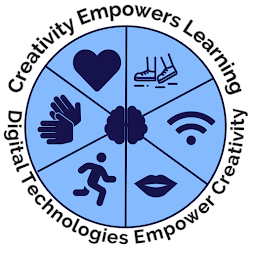
Dorthy Burt reminded us at our cluster-wide TOD that 'creativity empowers learning and digital technologies empower creativity'. This is my summary of the notes I took from her presentation and much of it was either a direct copy or a paraphrase of Dorothy's message.


Create is designed as a hook for our learners to motivate our learners to ENGAGE with the curriculum. Teachers are navigating a new curriculum and many are feeling the pressure that comes with delivery. This means the idea of empowering our learners to create falls directly into the 'too hard, too much' basket. O’Connor pointed out that when 'Aotearoa New Zealand led the world in literacy in the 1970s, the curriculum contained a heavy diet of the arts, especially at primary school level'...  “We chucked the arts out, and what we've done is continue to focus on these literacy and numeracy projects, which have got absolutely nowhere,”  

The creation process requires students to actively manipulate information rather than passively receive it. Our learners need to be the creators of content, not just the consumers who swipe to view content that is created by others. We need to provide learning opportunities that allow our tamariki to reorganise information in new ways, make decisions about what is included or excluded by being able to explain their thinking. Create is about engagement. It is about hooking our learners into learning so they benefit from what we teach and the way we teach it explicitly.

Providing opportunities for our learners to create allows for learning environments that foster engagement, motivation and curiosity so that new learning may be applied in meaningful ways by capitalising on opportunities for conversation and collaboration.

In Manaiakalani we have powerful create tools that are easily accessed by every learner. It is our job to harness these to help ourselves and our learners make sense of the new learning  Te Mātaiaho present us with.

Research 1: Why 'create' so important...

To explore the importance of creativity in education I asked Gemini to carry out a deep research for me based on the prompts I gave it. The findings below are my words but are based on what Gemini generated. Sites I retrieved information from have been linked but this summary of my reading does not reflect all the sites I visited as a result of my initial search.

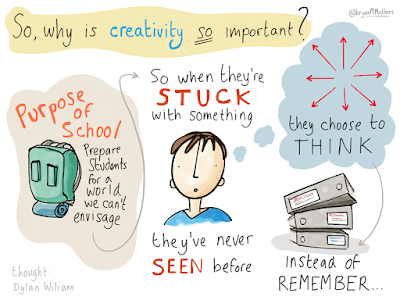
Creativity is a core building block in education. It affects how students think and turns learning from simply remembering facts into a fluid connection to the learning. When looking at it through the lens of school, creativity means a student's ability to come up with new and valuable ideas, solutions, or tasks. This often involves thinking outside the box, using their imagination, and being willing to take risks and try new things. It empowers students to think differently, look at problems from all perspectives, and create original answers that strengthen their connections to the learning. 

Image retrieved from here

Creativity helps prepare students for the future. In our ever-changing world, the ability to adapt, innovate, and solve problems creatively is essential if the students we teach today are going to find success tomorrow. Creativity improves learning outcomes when the learning is engaging, meaningful, and relevant. This is the catalyst to keeping our students motivated as it provides the opportunities needed to deepen their connections to the new learning.

In the past, literacy was seen as a foundational set of reading, writing, and counting skills. The 21st century has transformed this thinking to meet the demands of an increasingly digital, interconnected, and information-rich world. UNESCO defines literacy as a continuous process of learning and proficiency in reading, writing, and using numbers throughout life. This encompasses the ability to identify, understand, interpret, create, and communicate information effectively in a rapidly changing global environment. This leads to a deeper comprehension than simply processing words and phrases at a linguistic level.

The article 'What is creativity in education?' by Tim Patston, retrieved from the The Education Hub, states that 'Creativity is producing something new, relevant and useful to the person or people who created the product within their own social context.... Something that is very creative to a Year One student – for example, the discovery that a greater incline on a ramp causes objects to roll faster – would not be considered creative in a university student.... Creativity is valuable in education because it builds cognitive complexity... it relies on having deep knowledge and being able to use it .... with an existing set of knowledge or skills... to increase both knowledge and skills. It develops over time and is more successful if the creative process begins at a point where people have at least some knowledge and skills'. The sentence in bold is the one that resonates most with me when I apply it to my structured literacy context. I refer back to my previous post where I explain how we are using creativity to build on the known.

Nicole Krueger's ISTE blog post from 2022 states that creativity motivates kids to learn because 'when students are focused on a creative goal, they become more absorbed in their learning and more driven to acquire the skills they need to accomplish it'. This post reaffirms my initial thinking that we need to continue to harness the digital affordances a 1:1 chromebook class has to offer as we navigate our structured literacy journey by stating that 'teachers who frequently assign classwork involving creativity are more likely to observe higher-order cognitive skills — problem solving, critical thinking, making connections between subjects — in their students. And when teachers combine creativity with transformative technology use, they see even better outcomes'.

This deep research has allowed me to gain a deeper understanding of my topic. I will be continuing my journey to explore the importance of creativity in learning in my next post. 


Thursday, 20 August 2020

Student Design for Learning: Naomi Rosedale

Our T3 Manaiakalani 'create' staff meeting began with Naomi Rosedale sharing some of the findings of her PhD research. There were two of the key messages that resonated with me and became my takeaways. 

Firstly, I realised that I had not ever given thought to mismatched images and text. This very quickly became our next planned cybersmart lesson as I need my learners see what this looks like. After exploring this online and strengthening our connections to why our text and images needed to have a connection we decided this was an important message to share.

Fau and Liletina 

Chris and Sakshi

Secondly I was stunned by the graph that showed how often we fall back on the known of slide presentations. I had recently made a point of driving home the missed opportunities of voice recordings so thought while it was fresh in my mind I would revisit this in depth. I borrowed one of the online references in Naomi's presentation as it fit in perfectly with our science/reading focus. 

The challenge for my learners was to create a Screencastify that focused on the learning of why scientists must carry out fair tests when experimenting. I reminded my learners that the voice I wanted to capture was not about the process they went through on the online challenge but rather about the knowledge they acquired from completing the task. The slide below is from my teaching DLO.


Florence, Haylee and Sakina have given me permission to share their DLO.


Screencastify recording of the girls' thinking


Friday, 14 June 2019

Digital Fluency Intensive... Day # 3


DFI Session# 3 had a media focus. My animation reflects the content we explored today to will help us help our tamariki become ‘creators of content not merely consumers’. We need to make sure our learners are safe in an online environment, something that is no different to the way we make sure our learners are safe in an EOTC environment. As teachers in a 1:1 environment we can do this by ensuring the settings in YouTube and Blogger are in place.

‘Creativity is not about doing something better than others, it's about thinking, discovering, exploring and imagining’, Kohl (2008). Joining us in our session today were three of my skilled creators Jack, Alex and Nyjah who confidently shared with their amazing digital drawing skills. They began with a 'how to' presentation that they had created then took us step by step through creating an animation in Google Slides and creating a drawing using the line tools in Google Draw. This part of my reflection is unashamedly a boast post!


My takeaways from today are:

  • To make time to make sure the safety settings on blogger and YouTube are in place so that my learners can operate safely in an online environment.
  • To share the online safety reminders with our PBS staff.
  • To think about the opportunities my learners have to create.
  • To share the possibilities of introducing of rewindable learning that our drone can offer sport training. Thank you Kent for this tip.
  • To share the possibilities that our drone can offer for live streaming and delayed coverage so we can strengthen whanau connections.
  • To use the Google Slides to create my own pick a path style maths challenges to help strengthen my learners number knowledge and vocabulary connections.
  • To use the Google Slides to encourage my learners to create pick a path DLOs that reflect their understandings and connections to the learning.
  • To strengthen my own digital drawing skills by completing my own digital portrait.

Monday, 27 May 2019

Collaborating and Creating...

This week are capitalising on the power being able to 'create' can bring to our learning. For the last few weeks I have used my guided reading sessions to help my groups strengthen their connections to our inquiry focus of Space. To do this we have explored new vocabulary in context, identified the main ideas in the text, summarised the key points, searched for information, made connections between ourselves, other texts and the wider world, formed opinions and made evaluations. In addition to this I encouraged my more able learners to participate in dialogic learning conversations to help move their understanding to the next level. All strategies that are embedded into our reading program and help us make sense of new learning.

What excited me were the connections made during our visit to the Stardome. The conversations around the displays were rich, and the curiosities sparked during our reading time, explored further through the many rich questions that were asked of the experts. Luckily for us the Stardome educators were very happy to engage in these conversations over and over again, especially the ones that took place around the display of Yuri Gargarin parachuting onto the farmland. 

When I saw how much knowledge and content vocabulary my students were recalling and using without any prompting from me, I saw an opportunity to build on this further by providing an equally rich platform of opportunity to create DLOs that would enable them to share their new knowledge in an authentic way. So with that in mind, our literacy sessions this week are affording us the time to do this. 

We began today by recalling facts, skimming and scanning to find the information in our texts that supported our opinions, planning our storyboards (most groups have chosen to create an animation or an explainer movie), collaboratively writing scripts and purposefully using the content vocabulary needed to make connections to the learning in our inquiry lessons. The best part... every student was focused, engaged and on task! I can't wait to see the finished products.


Update: Here is an example of one of our finished DLOs...


Monday, 4 February 2019

PBS TOD: Exploring 'create' through clay...

Today we had a fantastic TOD (teacher only day) that added richly to our own baskets of knowledge. Through a variety of fun challenges Richard helped us to strengthen our own connections to ways we can bring 'creativity' into our teaching programmes to help our learners strengthen their connections to the learning. 

My takeaways from this session were:
  • Creativity is a powerful tool for strengthening connections.
  • Creativity should be valued.
  • Creativity helps learners engage and inspires curiosity.
  • Creativity helps learners to choose to think instead of simply remembering.
  • Creativity stimulates imagination.
  • Creativity strengthens innovation as it allows opportunities for good ideas to be put into practise.
  • Everyone has a creative capacity. 
  • Creativity is not about reinventing the wheel, it is about refining knowledge, thus becoming a collaboration of events. 
  • Creativity promotes opportunities for rich conversations.
  • Creativity helps learners to use content vocabulary in context.

Our final session today was an opportunity for us to explore our own creativity and was definitely the most fun. We were all challenged to create clay bird figurines! Our teacher Barbara, scaffolded us and pushed us way outside most people's comfort zones. As with anything when you are trying to make connections to new learning you tap into what you already know. For me that meant realising I had a figurine at home similar to the exemplars shown. Immediately that meant I had a small connection to the learning. With that connection in mind I set about forming the body of my bird. Accidentally pressing too hard when I was forming the neck gave me the tilt in the head that I wanted. What I noticed then was that I immediately felt an increase in my own confidence. This meant I was keen to apply the new learning of attaching a tail. Attempt one was a disaster so I quickly adapted my thinking and noticed I was using a trial and error approach to improve the aesthetics and proportions. I realised I naturally asked questions to clarify both vocabulary and methods. 

(My finished bird)

The vocabulary clarification sparked my curiosity and was something I did without thinking but something I thought would be a challenge for learners who do not have English as their first language. The word in question was 'slip'. When I heard it I naturally formed an image in my head of falling over and most definitely not the mix of water and dried clay it turned out to be. The creative aspect of the learning meant I was able to gain and apply meaning in context. When I sat back and observed for a moment I realised we were all using the newly introduced content language in context...slip, grog, smooth, adhere, texture, shape... rich conversations were naturally evolving as we shared our successes and asked for guidance.


Every part of this session showed me first hand how empowering and powerful building creativity into my programme can be for my learners, and was most definitely a fun way to begin our PBS 2019 learning journey together!