Showing posts with label Making connections. Show all posts

Wednesday, 14 August 2024

Engage, Empower, Inspire... Reading around the Room

I have been thinking about creating a space on my blog to record the lessons that simply just work. These will be ideas (both old and new) that I have tweaked or reworked to appeal to my learners and help them make authentic and purposeful connections to their learning. 'Engage and inspire: Lessons that work!' is what I have decided to call this section and will be easy to find by clicking on the link in the page tabs under the header.

Today I decided to revive an oldie but a goodie. Reading around the Room was an activity I loved as a child because I got to choose what I wanted to read and I didn't have to sit at my desk or do a boring worksheet. It also gave me an opportunity to look at how others had done something and think about how their work was different to mine. At the time I didn't know that's what I was doing, but I do remember changing the way I did something based on other's work. 

We have recently created some great DLOs about the Ancient Olympics that have been shared on our blogs and displayed on the wall in the classroom. This activity was a collaborative research challenge and can be found here. I was really impressed with how well this activity was done and wanted to think of a way we could capitalise on it as we moved through the term. So rather than simply having a 'decoration' on the wall I turned it into an interactive learning space. 


The challenge I set this time is called the LS2 Quiz Challenge. It is actually a way of getting my learners to practise writing questions and answering them by using evidence from the text to support their thinking. 

I introduced this by modelling how I could use a ruler to help me focus on the words I was reading in the information held in this display. Dianne (my teaching buddy), was my partner and together we modelled what we wanted our Äkonga to do. Their challenge is to read the information in pairs, co-construct a set of 10 questions using whiteboards then join up with another pair to co-construct and create a quiz where all the information can be found or inferred from what is on the display. This allows for rewindable opportunities as I saw today when one group had already moved onto answering a quiz, that they were running back to the wall to check their facts before recording their responses. That part was not something I reminded them they could do.

I am currently in the process of adding all the quiz links to our site and will timetable an opportunity for everyone to try out the different quizzes. With any new challenge I find if I limit the create options to ones everyone will find success with, I get the best buy in. This also allows for my learners to suggest their own ideas. Kahoot and Pear Deck have already been suggested to me as ways we could do this differently next time,


We must have 'sold' this challenge really well as there was a constant rotation of groups wanting to try the challenge. The next steps with this idea are to extend this challenge to encompass all the walls. I will think of further challenges to support our 'new' Reading around the Room activity as I see this as a great way to strengthen connections to learning whilst practising a wide variety of comprehension strategies. 

Friday, 26 July 2019

Digital Fluency Intensive... Day # 6


DFI Session# 6 reminded us about connecting with Manaiakalani. Being connected digitally empowers our learners. The default is VISIBLE so connections can be made. We are connected to a powerful network. 


Connectivity is a way of life for our students if we take it from them and they will check out. If you are all paddling in the same direction, you have greater power, you are more efficient. There is an impact on the nature of teaching and learning because if the teacher and student each know what it is you’re meant to be focusing on you are more likely to reach your goals.  Dorothy Burt 


Connected learners share. To make a connection both parties need to SHARE. Sites help close the geographical gaps of the wider connected network. Twitter and G+ increase the audience for our blog posts and helps connect our learners and our teachers. Tuhi Mai, Tuhi Atu (Write to me, write to others) creates a connection with a meaningful audience  for our learners and online toolkits allow us to share good practice.

Google Sites

Clarelle Carruthers shared a few insights into the rationale behind creating a google site. When thinking about putting together a class site you need to think about:

  • Who your learners are
  • How they are accessing the site
  • What your theme is
  • Why you are using the site


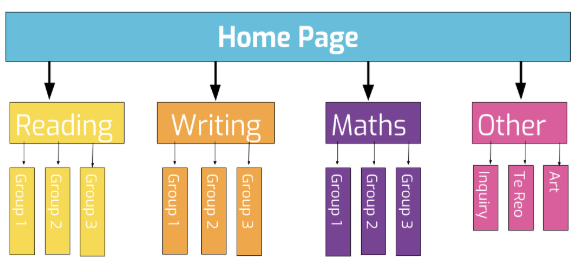
Designing your layout and having a plan before you begin will keep your site organised and easy for the user to navigate. Here is the link to the presentation Clarelle shared. We then explored each others class sites and left feedback. It is both interesting and valuable to find out suggested changes from your colleagues. It was suggested to me that I include an image of myself so that visitors to my site can make an immediate visual connection to who the teacher of LS2 is. It was also suggested that the images of my students also needed to be more visible. This lead to a bit of rearranging and organising but I love the fact that regardless of where we are in our digital journey, we are always learning and adapting. As you can see in the image below our landing page now has a photo of me, my contact details and an image carousal that reflects student life in LS2.


Useful Takeaways:
  • Think about colour, layout and font
  • Think about whitespace to avoid cluttering
  • Put all site docs etc in one folder with open sharing permissions to ensure its visible on your site
  • Need to access links within 3 clicks
  • Use a layout (in site tools) to ensure buttons are aligned
  • Create a Screencastify to show new students how our site works. This will create an excellent rewindable opportunity that can be shared at home as well.

Monday, 4 February 2019

PBS TOD: Exploring 'create' through clay...

Today we had a fantastic TOD (teacher only day) that added richly to our own baskets of knowledge. Through a variety of fun challenges Richard helped us to strengthen our own connections to ways we can bring 'creativity' into our teaching programmes to help our learners strengthen their connections to the learning. 

My takeaways from this session were:
  • Creativity is a powerful tool for strengthening connections.
  • Creativity should be valued.
  • Creativity helps learners engage and inspires curiosity.
  • Creativity helps learners to choose to think instead of simply remembering.
  • Creativity stimulates imagination.
  • Creativity strengthens innovation as it allows opportunities for good ideas to be put into practise.
  • Everyone has a creative capacity. 
  • Creativity is not about reinventing the wheel, it is about refining knowledge, thus becoming a collaboration of events. 
  • Creativity promotes opportunities for rich conversations.
  • Creativity helps learners to use content vocabulary in context.

Our final session today was an opportunity for us to explore our own creativity and was definitely the most fun. We were all challenged to create clay bird figurines! Our teacher Barbara, scaffolded us and pushed us way outside most people's comfort zones. As with anything when you are trying to make connections to new learning you tap into what you already know. For me that meant realising I had a figurine at home similar to the exemplars shown. Immediately that meant I had a small connection to the learning. With that connection in mind I set about forming the body of my bird. Accidentally pressing too hard when I was forming the neck gave me the tilt in the head that I wanted. What I noticed then was that I immediately felt an increase in my own confidence. This meant I was keen to apply the new learning of attaching a tail. Attempt one was a disaster so I quickly adapted my thinking and noticed I was using a trial and error approach to improve the aesthetics and proportions. I realised I naturally asked questions to clarify both vocabulary and methods. 

(My finished bird)

The vocabulary clarification sparked my curiosity and was something I did without thinking but something I thought would be a challenge for learners who do not have English as their first language. The word in question was 'slip'. When I heard it I naturally formed an image in my head of falling over and most definitely not the mix of water and dried clay it turned out to be. The creative aspect of the learning meant I was able to gain and apply meaning in context. When I sat back and observed for a moment I realised we were all using the newly introduced content language in context...slip, grog, smooth, adhere, texture, shape... rich conversations were naturally evolving as we shared our successes and asked for guidance.


Every part of this session showed me first hand how empowering and powerful building creativity into my programme can be for my learners, and was most definitely a fun way to begin our PBS 2019 learning journey together!

Monday, 5 March 2018

Noticing, connecting to and using the words around us...

Written words are all around us in a school but how many of these words do our learners have a connection to? How many of these words do they notice and use? During a class discussion I discovered that although most of our class could say our school whakatauki, I quickly realised personal connections to the meaning behind these words was missing. This made me think about how I could help my learners to notice, understand and use the language around them.

During our first CoL meeting this year Dr Jannie Van Hees reminded us of the rich language opportunities available to us in our local area. Our own school seemed like the perfect place to start building my learner's vocabulary kete. After unpacking our school whakatauki by looking at the history and purpose behind these words I introduced combination of think-pair-share and small group discussions to allow my learners to use the language in an authentic context. Working with a buddy to search for other whakatauki and the meaning behind them, resulted in connections and comparisons being made. 'Manaaki whenua, Manaaki tangata, Haere whakamua' are no longer simply words we see and can say. 'Care for the land, Care for the people, Go forward' are all words that each of my learners understand and have formed their own connections to. We captured this learning by creating DLOs to reflect our understanding and grow our print rich learning environment. Jeremiah is happy for me to share his example. Jeremiah's blog


Following on from this we looked at a phrase commonly used at our school, 'Agents of Change'. I know that I have personally unpacked this phrase each year with my learners as it is a powerful way for them to grow their leadership. This year we looked at how we could become 'Agents of Change' in our own 2018 learning journeys. This was goal setting wrapped up in the language around us. It provided an authentic purpose for my learners to strengthen their connections to these words by using them in a personalised context. Jack is happy for me to share his example. Jack's blog


We took this a step further by bringing the language, personal to our school, into our assembly time. I have been working with our student leaders when they write their assembly scripts, so together we have begun to weave our PBS language into their weekly reports. After all we learn best when we learn with and from each other, and who better to grow this learning and sense of ownership than our own student role models. 

Wednesday, 31 May 2017

So excited to see this...

Earlier this week I set my learners a task that involved viewing a YouTube clip that explained in Samoan, the importance of observing the correct level of respect when talking part in Samoan cultural practises. Most of my learners are not able to access the learning through the language at this level but all of my learners were able to read and understand the subtitles. 

The language used was in places sophisticated, but as we unpacked the content together I knew the learning could be accessed. I then asked them to get into groups or pairs, their choice, and create a DLO that identified the main idea in the text. I'm not sure what I was expecting to be honest but I do know I was not expecting to see learning conversations in actions as they debated the purpose of the author's message. Nor did I expect to see the scaffolds we have used in guided reading lessons suddenly pop up on Chromebook screens. This is exactly what I have been striving towards achieving and it all unfolded in front of me with absolutely no prompting!

Why did this happen? I have many assumptions ranging from the fact I have helped my learners make strong connections through explicit teaching to transference of learning was taking place. To clarify my own understanding I asked my learners why they had chosen to use these strategies to help them respond to the task. 


Girl 1 + partner: We used the summary strategy because we wanted to see what the main idea was by thinking about what the most important words were. I knew if I could find these words we could write our own summary of what the learning was. Then from that we would be able to see the main idea because it would be somehow linked to the most important words.

Girl 2 + partner: Me and my partner had a learning conversation so we could agree or disagree on the information we felt was the most important. We did this by looking at both sides of the message then we thought about what we would think was the most important if it was our culture.

Boy 1/2/3: We did the negotiation game because it helps us find the important ideas, then the very important ideas and then the vital ideas. It was good to do this in a group because we could all add different ideas and learn from each other. After we did that we checked our thinking by doing a summary and look Miss, it was kind of the same.

This is definitely a woohoo moment for me because I saw that with explicit teaching and by embedding something in your practice, strong connections can and will be made. My learners were adapting and using new knowledge and skills to make sense of the task ahead. This is especially so when they are seen as purposeful tools that can be adapted to fit the learning across the curriculum. 'Transfer of Learning—the application of skills, knowledge, and/or attitudes that were learned in one situation to another learning situation.' (Perkins, 1992). I am most proud of the fact that this occurred with absolutely no prompting from me!


Examples of the scaffolds that supported the deep learning conversations.


Saturday, 20 May 2017

SparkshopAKL 17


Feeling inspired after SparkshopAKL 17. Thank you Fiona, Justine and everyone who shared today.


Loved this session lead by Karen Ferguson as it allowed me to strengthen my own connections to SOLO in a very visual way. SOLO maps allow our learners to see the learning. We are all on a different learning curve and the continuum shows it is ok to start with no knowledge then build on learning as we make deeper connections. Thank you @karen0968 for the excellent resources you shared https://goo.gl/cnTBHC.


I wasn't able to attend this session but I loved these questions! Will definitely be introducing this dialogue to help my learners strengthen their connections to self evaluations. Great idea! Thank you @stuartkellynz.


Had so much fun attempting to create my own digital world with cospaces.io. Was immediately hooked in by the 360 images option in thinglink. Can't wait to use this! Thank you Angela Lee @nzleeangela for sharing.


Monday, 21 November 2016

Synthesising ideas to help us form an opinion:

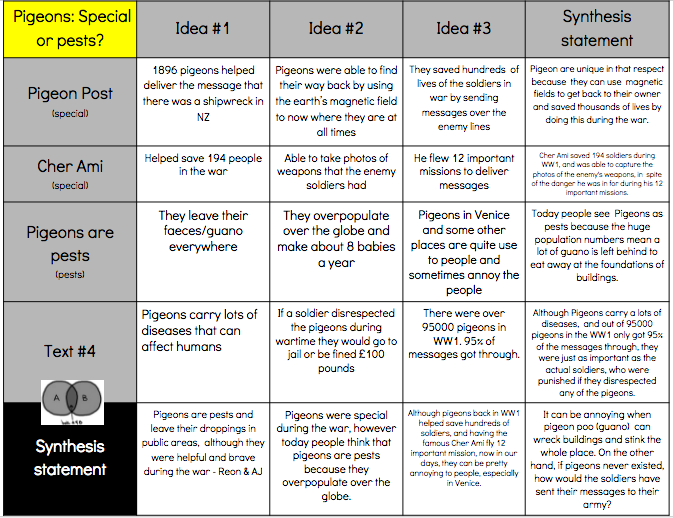
This morning we were revising synthesising to help us make connections between the different texts we have used to find information. To begin Harry reminded us that synthesising happens when we take the knowledge that we already know and add it to the new knowledge we have gained to create a new understanding. Revisiting what synthesising was asking my students to do was vital for making stronger connections to the learning.


The chart below reflects the synthesising from R group. I am so impressed with the connections they made but realised initially the idea of joining ideas together had slipped through the net. Most boxes had two separate ideas that were not linked by a conjunction. To overcome this we spent some time exploring conjunctions. 


Wednesday, 31 August 2016

Setting ourselves up for success is a step by step process...

Making connections with the learning is the key to genuinely deepening understanding. By tapping into the knowledge gained across multiple learning areas we can encourage our learners to merge these various knowledge bites of independent information. Our task today was to do exactly that. Earlier in the year we explored the ways personification and the 5 senses can help us see things from a different perspective (-the original task link is on slide 2 of the teaching DLO below). This term our inquiry focus has been Olympic based. Over the last five weeks we have looked closely at how elements of Hauora, Diet and Training can affect an athlete's performance. By viewing the 2016 Olympic games through the eyes of an athlete standing on the medal dias, I hoped that my learner's would make stronger and deeper connections to our topic.

The images below show the process we went through to help us retell an event through someone else's eyes.


Merging images to make personal connections had everyone hooked. As a class that lives and breathes the ethos of collaboration, I noticed at least half of my learners chose to 'stand on the podium' with a buddy. Another interesting observation is that the colour of the medal was invisible. National and personal pride completely overshadowed the gold, silver, bronze hues.


With the imaginary eyes of the world on us we now needed to fill our knowledge 'ketes'. After all you can't describe something you have never seen if you don't have the tools to grow and foster an imagination. Our tool for this was 'Sketchnote'. I had read Karen Ferguson's post about her own experience of picking out the main ideas and focusing on them by 'sketchnoting', and decided to afford my learners the same opportunity. The image below reflects the way one of my learners added to her own 'kete' using this method. 


Sketchnoting allows us to record information using our own words or pictures. This learning tool is helping my learners make notes that make sense to them rather than simply copying what someone else has written in their own handwriting. Being able to retell their very personal 'sketchnote' stories to a friend underpinned the understanding and allowed those strong connections to be made.

Where did this information come from? The answer, multiple sources. I provided links to online newspaper articles and challenged my learners to use their smart searching skills to find supporting information that they read, watched and listened to. It is very rewarding to watch the seamless interchanging of their subject specific 'thinking hats' as knowledge gained during these lessons was synthesised and recalled to meet the learning needs of this lesson. 

Being given the choice of selecting the way they want to approach the 'create' aspect of this learning has both engaged and empowered my learners. Some chose to show their understanding through interviews or conversations using ifaketext.com; others have opted to write narratives; one learner has decided to write an email home to their family and two groups are in the beginning stages of storyboarding their movies. 

Were connections made today? The simple answer is yes! 


Thursday, 25 June 2015

Making Connections

These are my screenshots of a fake text. Yvette used iFakeText to create fake messages based around the debate about changing the New Zealand flag. Her messages are against the flag being changed, and Evelyn her partner is for the change. These messages state the different reasons for and against. This app allowed the students to 'see' the language features they were using and allowed their partners to 'see' the language features missed out or used incorrectly.