Showing posts with label LS2. Show all posts

Wednesday, 29 July 2020

Making Connections to Problem Solving with Tangrams...

A small glitch with our internet connection this morning opened up a great opportunity to make the most of a teachable moment. Having been taken through the process of making my own tangram puzzle in a recent staff meeting I decided this was the perfect time to introduce this puzzle to LS1 and LS2. We had already come together as a block this morning for singing practise so decided to stay together for the learning experience, which meant we had a huge range of abilities as the students ranged from Y5 to Y8. There were no templates, no rulers, no pencils... just lots of smiling faces, blank pieces of A4 paper and lots of pairs of scissors. 

The instructions I gave were not written anywhere which gave me a great opportunity to remind everyone about the importance of listening carefully and asking questions. I made sure my instructions were explicit and found myself making folds and cutting along folded lines with my back to the class and my exemplar in the air, something far easier said than done! Along the way as each piece of the puzzle appeared I introduced the content language of 2d shapes so that each piece was referred to by the correct name and not 'this one' or 'that one'. 

Our students are really good at collaborating so without being asked I noticed my class immediately stepped up to support the younger ones. This learning experience was a very loud one as I encouraged everyone to talk to each other about what they needed to do at each step. Interestingly we only had two puzzles that needed to be remade. 


Organisation was one of the keys behind the success of the 'making' task and as we were using the content vocabulary collecting the offcuts was a breeze. Once all the pieces had been cut I asked everyone to mix up their puzzle (something quite hard to model in the air!) and put the pieces back together to make the original square. This is when the real conversation happened. There was a wealth of problem solving strategies being used so I took advantage of this and unpacked it further. 
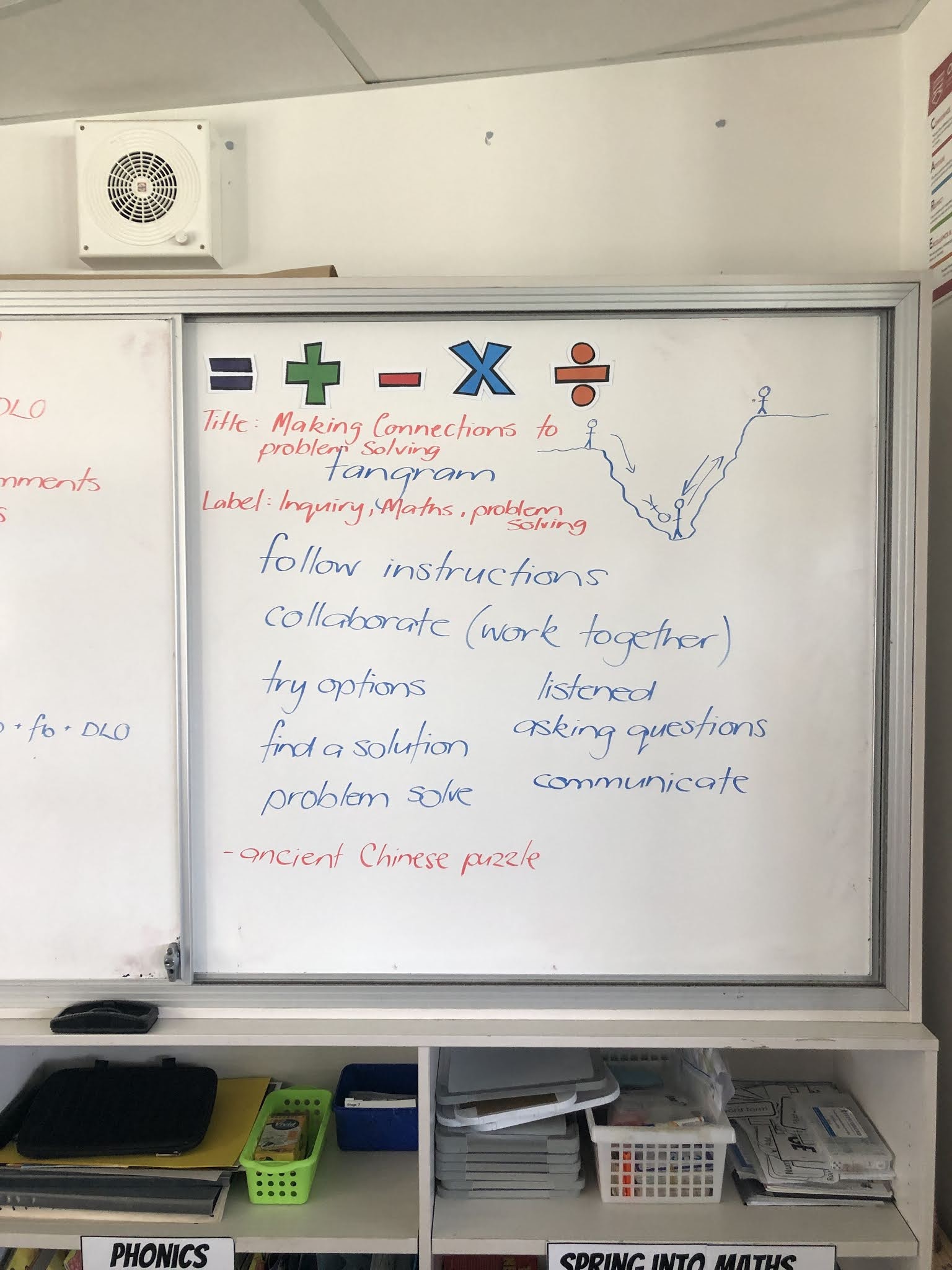

After morning tea we all came back to take part in the 'fun' challenge component. Greg Wong took the students who had made their tangrams through the challenges of creating animals from the shapes while I helped the group who had been at puberty talks to make their tangram. Team teaching was then the order of the day with Greg explaining the history behind the puzzle and me process of problem solving. As a result we were all able to make connections not only to the content but also to the origin of the puzzle and the process of problem solving. The blog posts from both classes reflect the learning, the fun and the content language that was revisited today.

Friday, 24 April 2020

Distance learning with LS2... Week 2

This week has been a very busy week for LS2 as far as distance learning is concerned. My amazing students have created a wide variety of DLOs that showcase their understanding of the tasks as they keep their learning going. Each day Linda (TA), myself and the students come together as a class to set ourselves up for the day, celebrate achievements and share work. Having Linda join us has been a real blessing as the students see both their teachers everyday, and whilst I have been kept really busy marking the work she has been kept equally as busy commenting on blogs. Teamwork at it's best!

In these sessions I have been asking my students to present their work as it helps us to continue to learn with and from each other. What's lovely to hear is the feedback they give each other after the presentations. LS2 has always been a collaborative learning environment, but what has impressed me is that despite being in their own family bubbles, many have kept this collaboration going. I'm enjoying reading the conversations taking part in the comments section of DLO's, and on many occasions I've joined in to give feedback. 


Florence presenting her timelapse movie showing the process she went through to make her poppy wreath. 

We have had to iron out a few areas and set very clear expectations as far as avoiding the temptation to simply click 'resolve' when I leave feedback. After talking everyone through this, especially my new learners, there has been some very rich learning conversations taking place and I now have a wealth of evidence to feed forward into my future planning. 

Another area we needed to revisit was the need to make sure all work was filed in the correct folders in our google drives. We also run a 'completed work' spreadsheet where links to completed work are posted. We've had a few hiccups here with work that isn't filed being linked as I can't access it correctly. However, when I think that these have been our only glitches so far, I can honestly say LS2 have been fully engaged in their distance learning.

When I think about my own learning this week I have definitely strengthened my skills when it comes to explaining things, with step by step snapshots of a process and emailing them to the person who needs this support being a great go-to if Google Meets are not an option. I have also noticed that my instructions are definitely a lot clearer and more succinct. My biggest success has been when Linda and I used a Google Meet to guide a student who had prior to lockdown, only been at our school 3 days, with how to post a variety of DLOs on her blog. This student came to us from overseas and had never used Google Docs before so each step of our distance learning has been new for her. What I have loved is that she asks questions and whether these have been answered in our Google Meets, by emails sent to me or to her friends, or by both of us working on her DLO at the same time her initiative has meant she has found a huge amount of success. 


Year 8 working with Mr Grundy

This morning we had our LS2 catch up then went off to Tech with Mr Grundy and Ms Ferguson at Tamaki College. After Tech we tuned in for our first Panmure Bridge School livestream assembly. This was such a great way to end our learning week as Mr Johnston was able to present virtual certificates to students who are making a huge effort to keep their learning going from home. Richard, Kiri and Anna this was a huge success and an extremely awesome way for all our PBS family to stay connected.


Tuesday, 20 June 2017

Learn Create Share in LS2

This term we have been looking at 'Reduce Reuse Recycle' during our Inquiry time in LS2. To help my learners deepen their understanding and strengthen connections to this, I planned a Reading challenge that would help my learners unpack the topic further. To encourage the deeper thinking I was after I asked, 'Is recycling the answer to our landfill problems?'

These learners have had a mix of guided and independent learning opportunities that encouraged them to access the information by reading, watching, listening and discussing. My hidden agenda was to continue to build a dialogic learning environment so I planned follow up tasks that promoted collaboration and learning talk. There was so much rich discussion during our 'create' process, my only regret is that I didn't capture this on film.

The slides below show our Recycling Reading Challenge, and include a few of the follow up activities suggested by Aaron Wilson, Woolf Fisher.


Mia, Zahra, Nazella and Fifita chose to share their learning by creating a short movie with a powerful message that makes you think about what happens inside our landfills if Reduce, Reuse and Recycle are overlooked. 


Friday, 7 April 2017

Perspectives and Negotiations...


Having spent the last three weeks preparing for camp, going on camp and celebrating camp I knew I had been given a 'fresh' and informed start when thinking about my reading program. I started as I mean to go on by actively planning opportunities for talk to take place.


We began by unpacking the word perspective by exploring provocations that I knew needed a point of view to be chosen about issues linked to our current cluster wide Te Taiao o Tamaki Inquiry. This allowed my learners a chance to state their opinion and use the texts in front of them to justify their thinking. Once we had two opposing sides I physically moved my students to different sides of the table then gave them time to share their thinking with those who held a similar opinion. No one was being asked to take a personal risk that might leave them feeling vulnerable. The 'team' approach meant their was confidence in numbers and the discussion flowed as each team endeavoured to persuade the other. I knew that by seeing what a guided dialogic discussion looked like I would be able to set a task that capitalised on this learning experience.


We used a task shared by Aaron Wilson from Wolf Fisher to help us identify the three most vital ideas in a text. To get to this point my learners began by individually identifying ideas they saw as important. These were recorded on post-it notes and placed in the 'Important Ideas' column on the table we were using. The next step was to discuss each point as a group and use their negotiating skills to decide which points they would move to the 'Important Ideas' column or the 'Vital Ideas' column using the evidence in the text and their own connections to the content to support their reasoning. Apart from moving between the groups and prompting through provocation the only scaffold I provided was the word 'because'.   


To complete the task we shared our informed perspectives as a class. I then asked my students find a critical friend and tell them about one opinion they agreed or disagreed with when they were negotiating. Finally I asked my learners to think about their own contributions and each critical friend was asked to co-construct a next step goal that would help their buddy take a step forward along our dialogic learning pathway.

Wednesday, 29 March 2017

Baseline Data Analysis


To gauge my learner's perspectives on how actively involved in the lessons they feel they are I asked them to complete Matrix 4 on the Evaluation Associates 'Student Capabilities Matrix': Promoting Further Learning. 

This paints an interesting picture as I have been able to see that all 5 students see their timing as being at the early stages as far as seeking feedback is concerned, but are spread across the matrix when thinking about when they implement feedback. When considering student initiation and involvement, 3/5 students identify as sometimes initiating or leading feedback that supports current learning and identifies next learning steps. 2/5 students seek explanation in a timely manner to take their learning further, with the remainder admitting that this may or may not happen. Pleasing to see is that 3/5 students are intrinsically motivated towards learning and feel confident enough to express their next learning steps.

I chose to use this method to measure levels of discussion as I believe if my learners can seek and respond to feedback from their peers they will realise that they don't always agree with opposing perspectives. Tapping into this is how I see the language of arguing developing in LS2. As motivation in the main is intrinsic, I am hopeful that personal connections to texts will become stronger as our learning journey evolves in a scaffolded and safe environment. My hunch is that if I actively plan opportunities for my learners to practise stating and justifying opinions in guided reading sessions, they will realise it is ok to see something through different eyes and will become confident dialogic learners who know when and how to share their own perspectives when working independently.

Tuesday, 6 December 2016

Key Competencies in action!

This morning the key competencies were alive and kicking in LS2. Using our multimodal reading site each group accessed the learning at their own pace and in their own way. This allowed for stronger connections to be made, something that was evident in the discussions that were taking place. Great collaboration LS2!


Thinking and making connections


Self managed reciprocal reading


Participating in and contributing to the learning


Understanding language, symbols and text


Relating to others


Tuesday, 29 November 2016

Celebrating our PBS CARE Awards

We are extremely proud of our student's ability to self manage and complete additional tasks linked to our PBS CARE values of confidence, attitude, respect and excellence and innovation in their own time. This system is set up for our Year 7/8 students to grow as leaders. They already receive badges to wear at assembly once they have completed a set of challenges linked to each CARE value. We have now added blog badges that will allow them to celebrate their success with their global audiences. 

The way these are set up allows us to add each badge on as they achieve it. So proud of Sajiha and Zeba who have completed both the silver and gold components of this challenge!


To show progress we have only coloured the badges achieved. Our students love the freedom to choose the order they complete the badges in. Using this format allows us to adapt the blog badge to align with individual achievements.


Tuesday, 22 November 2016

Making informed opinions:

A few weeks ago I asked the question 'Are pigeons special or pests?' to my learners. Immediately I was bombarded with a variety of opinions but was met with a wall of silence when I asked them how they knew these facts. I followed the suggestions of ways to strengthen connections and accelerate the learning made by Woolf Fisher to provide a scaffolding text, a complimentary text, a challenge text and a self selected text.

The DLOs below are examples of the learning that took place as we unpacked the information. Did we get everything right? In short, no but I do know places I can make changes next time. I found this an exciting process to follow as I could see very quickly where connections had been made and where the gaps were. My learners loved the collaboration and the tasks that followed each text.

It was really interesting to observe reactions to the challenge texts. I had introduced the topic by promoting the idea that pigeons post was an important part of our history. This resulted in a lot of animated discussion about how that was possible because in their words 'most letters would be as big as the pigeons!' After reading, watching and listening to texts that explained the vital role pigeons played in message delivery I caused major confusion by introducing text that explained that pigeons were pests. I think the fact we all found hard to believe was that in the 17th century pigeon guano (droppings) was heavily guarded as it was seen as a highly sought after ingredient in the making of gunpowder! We used this as the comparison point for the opinions of many people today who are now aware of the damage the acidity in the guano can do to buildings and other structures.

Our guided sessions were focused around synthesisng facts across and between texts. We still have work to do in this area, but as everything has a 'use by' date, I chose to move on. The groups below both chose to reflect their final informed opinions in different ways. One choosing to record soundbites on vocaroo, and the other group filmed their responses. If you would like to use any of the ideas we explored all our learning is visible on our class site.


Friday, 11 November 2016

Multimodal in LS2!

Last week after a staff meeting on multimodal sites I put my new learning into practise. I had already embraced suggestions made by Aaron from Woolf Fisher, that each of our learners make connections to learning in different ways. My initial planning aligned to included options for a scaffolding text, a complimentary text, a challenge text and a self selected text and was presented on a set of google slides.

Click on the image below to view this


The change to a multimodal page on our site was simplified as I had already created the content. Getting my head around html was a bit of an initial challenge but after blindly 'pushing buttons' and looking at 'help' sites our multimodal page was born. This was extremely well received by my students as they were initially hooked in by the layout. We explored the learning opportunities briefly together, before encouraging them have a closer look in pairs. The best part of this was the room was alive with a high level of excited conversation taking place as they clicked on the links. Normally I wouldn't do this but it was a first and I needed buy in.

Regrouping my students was the next task and how our mixed ability R-E-A-D groups came to be. Surprisingly there were no objections in regards to who was in each group. This highlights the importance of knowing your learners. 


 Our multimodal page - Click here to access the page

The image below reflects the high level of engagement in a reading lesson as my learners worked their way through the challenges on our new multimodal site. 


We have systematically worked our way through each task, discussing and recapping our learning and the comprehension strategies we have been using to make connections to the text. I have discovered that my learners prefer to work collaboratively. The independent task was not as successful as the opportunities for talking about the the learning were fewer. This is definitely something I will take on board. 

Our first task was the question matrix. This was an idea I adapted from my learning at the NZLA 2016 conference. Being able to write their own questions immediately personalised the learning. The idea behind the matrix is that as we answer the questions as we the find information. My intention was to turn this into a 'race', but one group took it upon themselves to begin answering their questions before I had a chance to set this task up!  

We decided to use a group follow up DLO to record our learning as we went along. This proved to be an excellent scaffold/resource that could be referred to as we explored the guided task of synthesising the ideas gained from each text. Sadly I didn't record any of this as it was one of the most powerful lessons I have seen this year. The rich dialogic discussion reflected the strong connections that had been made to the learning.

We used our learning from a earlier session taken by Mairi Ogilvie from the National Library, who reminded us how to narrow a search, to help us find a self selected text. I used one student's DLO on the site as a reference tool for this task.

Our final step is to form our opinions. Watch this space for the DLO's that reflect this and the feedback from my learners!


Sunday, 30 October 2016

Celebrating Success

This week we noticed that some of our students had hit the 500 post mark. An admirable achievement by anyones standards. We felt they needed some recognition for this so I created our very own 'PBS 500 Club' badge for their blogs. Huge congratulations to those students and yah me for working out how to create this GIF!