Showing posts with label collaboration. Show all posts

Wednesday, 29 July 2020

Making Connections to Problem Solving with Tangrams...

A small glitch with our internet connection this morning opened up a great opportunity to make the most of a teachable moment. Having been taken through the process of making my own tangram puzzle in a recent staff meeting I decided this was the perfect time to introduce this puzzle to LS1 and LS2. We had already come together as a block this morning for singing practise so decided to stay together for the learning experience, which meant we had a huge range of abilities as the students ranged from Y5 to Y8. There were no templates, no rulers, no pencils... just lots of smiling faces, blank pieces of A4 paper and lots of pairs of scissors. 

The instructions I gave were not written anywhere which gave me a great opportunity to remind everyone about the importance of listening carefully and asking questions. I made sure my instructions were explicit and found myself making folds and cutting along folded lines with my back to the class and my exemplar in the air, something far easier said than done! Along the way as each piece of the puzzle appeared I introduced the content language of 2d shapes so that each piece was referred to by the correct name and not 'this one' or 'that one'. 

Our students are really good at collaborating so without being asked I noticed my class immediately stepped up to support the younger ones. This learning experience was a very loud one as I encouraged everyone to talk to each other about what they needed to do at each step. Interestingly we only had two puzzles that needed to be remade. 


Organisation was one of the keys behind the success of the 'making' task and as we were using the content vocabulary collecting the offcuts was a breeze. Once all the pieces had been cut I asked everyone to mix up their puzzle (something quite hard to model in the air!) and put the pieces back together to make the original square. This is when the real conversation happened. There was a wealth of problem solving strategies being used so I took advantage of this and unpacked it further. 
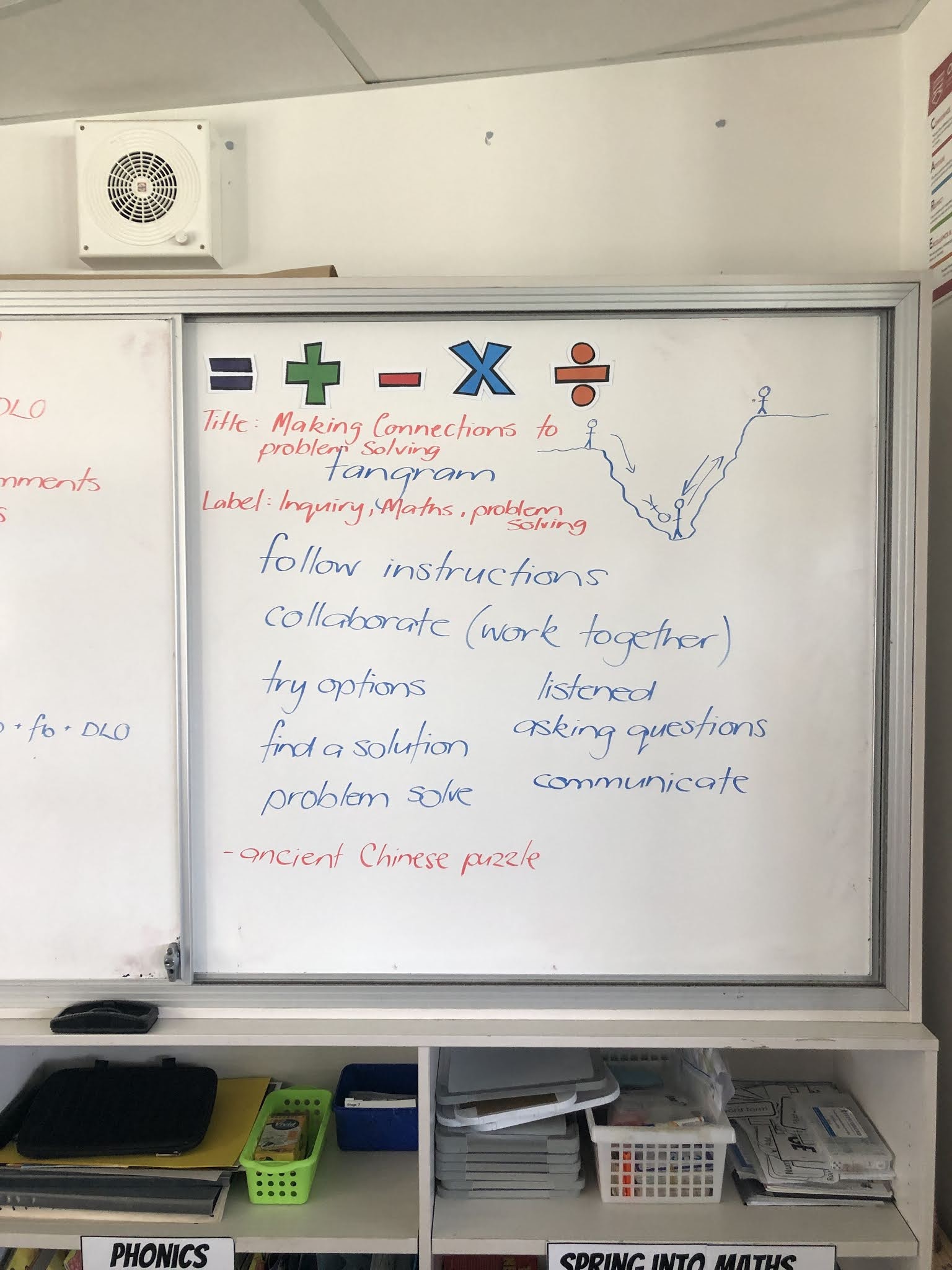

After morning tea we all came back to take part in the 'fun' challenge component. Greg Wong took the students who had made their tangrams through the challenges of creating animals from the shapes while I helped the group who had been at puberty talks to make their tangram. Team teaching was then the order of the day with Greg explaining the history behind the puzzle and me process of problem solving. As a result we were all able to make connections not only to the content but also to the origin of the puzzle and the process of problem solving. The blog posts from both classes reflect the learning, the fun and the content language that was revisited today.

Friday, 24 April 2020

Distance learning with LS2... Week 2

This week has been a very busy week for LS2 as far as distance learning is concerned. My amazing students have created a wide variety of DLOs that showcase their understanding of the tasks as they keep their learning going. Each day Linda (TA), myself and the students come together as a class to set ourselves up for the day, celebrate achievements and share work. Having Linda join us has been a real blessing as the students see both their teachers everyday, and whilst I have been kept really busy marking the work she has been kept equally as busy commenting on blogs. Teamwork at it's best!

In these sessions I have been asking my students to present their work as it helps us to continue to learn with and from each other. What's lovely to hear is the feedback they give each other after the presentations. LS2 has always been a collaborative learning environment, but what has impressed me is that despite being in their own family bubbles, many have kept this collaboration going. I'm enjoying reading the conversations taking part in the comments section of DLO's, and on many occasions I've joined in to give feedback. 


Florence presenting her timelapse movie showing the process she went through to make her poppy wreath. 

We have had to iron out a few areas and set very clear expectations as far as avoiding the temptation to simply click 'resolve' when I leave feedback. After talking everyone through this, especially my new learners, there has been some very rich learning conversations taking place and I now have a wealth of evidence to feed forward into my future planning. 

Another area we needed to revisit was the need to make sure all work was filed in the correct folders in our google drives. We also run a 'completed work' spreadsheet where links to completed work are posted. We've had a few hiccups here with work that isn't filed being linked as I can't access it correctly. However, when I think that these have been our only glitches so far, I can honestly say LS2 have been fully engaged in their distance learning.

When I think about my own learning this week I have definitely strengthened my skills when it comes to explaining things, with step by step snapshots of a process and emailing them to the person who needs this support being a great go-to if Google Meets are not an option. I have also noticed that my instructions are definitely a lot clearer and more succinct. My biggest success has been when Linda and I used a Google Meet to guide a student who had prior to lockdown, only been at our school 3 days, with how to post a variety of DLOs on her blog. This student came to us from overseas and had never used Google Docs before so each step of our distance learning has been new for her. What I have loved is that she asks questions and whether these have been answered in our Google Meets, by emails sent to me or to her friends, or by both of us working on her DLO at the same time her initiative has meant she has found a huge amount of success. 


Year 8 working with Mr Grundy

This morning we had our LS2 catch up then went off to Tech with Mr Grundy and Ms Ferguson at Tamaki College. After Tech we tuned in for our first Panmure Bridge School livestream assembly. This was such a great way to end our learning week as Mr Johnston was able to present virtual certificates to students who are making a huge effort to keep their learning going from home. Richard, Kiri and Anna this was a huge success and an extremely awesome way for all our PBS family to stay connected.


Wednesday, 16 October 2019

A fun way to teach summarising...

As mentioned in a previous post I recently attended a professional development day at the Pop Up Globe theatre. One of the activities that I formed the strongest connection to was the 5 sentence summary. This was taught to me in the context of Shakespeare's Romeo and Juliet, but even as we were working through each stage, I was thinking about the different contexts I could use this activity in the classroom. Today I did just that.

Our school-wide Inquiry for the term is Enterprise and Economics and for our Year 7/8 students this began by looking at early Maori enterprise. My learners worked used their smart searching skills to build on the foundations of the content knowledge I had gifted them. Their challenge was to make notes and record new vocabulary as they worked collaboratively to fill their knowledge ketes. To help strengthen their connections and understandings I challenged them to use their notes to help them summarise the key ideas in just 5 sentences. 

With our 5 sentence summaries complete I then challenged my students to add detail and make their thinking more succinct by turning each sentence into a 10 syllable sentence. My students absolutely loved this challenge. I know this because throughout the last part of this challenge 33/33 students were actively involved, contributing and engaged. 


Tuesday, 24 September 2019

Current Events with a difference...

During our Manaiakalani shared staff meeting a few weeks ago I listened to a number of teachers sharing the ways they cover current events in their classrooms. This sparked my curiosity as my current approach has been to encourage my learners to explore the provocation by unpacking the content, looking at the information from both perspectives before forming an opinion based on fact. What I am aware of though, is when you complete this type of task you walk away and often never refer to it again. 

Teacher inquiry challenges you to look closely at your own practice. If what you are doing is 'missing the mark' or has become 'stale' then you need to get creative and find ways to adapt what you are doing to help your learners make stronger connections to the learning. I still wanted my learners to be able to talk about what was happening in the world, both nationally and internationally so I merged a few ideas I saw others doing and came up with a new approach.

I needed to make sure everyone understood the difference between national and international news so we began by unpacking these words. We then revisited author's purpose to consolidate that understanding before looking at the different reasons why a news editor would decide to run or print a story. These included timeliness, magnitude, oddity and emotive to name a few. (Idea sourced from here) This was a fantastic opportunity to gift and explore new vocabulary.


I then asked my learners to find a partner and set them the challenge of finding an example of each of these types of stories using national news that they read, watched or listened to. Once they had found an example they would need to talk about their reasons they felt it was best suited to the chosen category, then plot where it took place on a google map. The only written component of this task was to include the title of the news item or article and the exact location it took place in the map pin. 

This was a huge success and was something that could be achieved by all my learners, regardless of ability level. We stopped periodically throughout the lesson to share our news items and justify why these were chosen. I found that throughout these lessons I was continually modelling and reinforcing the use of the vocabulary in context.  

All completed tasks were posted on our blogs. Here is one example of the learning from Mele and Marieta. To see the interactive map you will need to follow the link to Mele and Marieta's blogs.


We repeated the challenge the following week with international current events. What impressed me was the retention of vocabulary and level of understanding behind the reasons news items are run and printed. Here is Alex, Jack, Joseph, Julian and Aung Naing's international current events map. These boys joined forces and had rich and deep conversations as they tried to persuade each other to come to a shared reasoning for their selections. To see the interactive map you will need to follow the link to Alex's blog.


Throughout this learning opportunity all my learners were on task and actively engaged. They were all eager to share their examples, with responses evolving to include a short summary of the content. I'm so glad that I took the time to adapt and change the way we explore current events in LS2!

Tuesday, 2 July 2019

Connecting to maths language...

'Imagine a teacher running her hands across her desk as she tells her students, “A plane is a perfectly flat surface.” The students listen quietly, but one of them is thinking, “I thought a plane was something that flies.' Rubenstein and Thompson, 'Understanding and Supporting Children’s Mathematical Vocabulary Development' (p107, 2002). 


This is the type challenge many of my learners face everyday. Donna Yates shared this article with me after visiting LS2, along with a great idea to help us strengthen our connections to the maths language we encounter when reading and trying to make sense of written maths questions. Rather than reinventing the wheel I used this exact example to show my learners how confusing maths language can be, and gave us an authentic purpose the challenge that followed.

I find that when my learners collaborate and have the opportunity to talk about their tasks they gain a clearer understanding, so this is how we approached this challenge. There was a lot of negotiation and rich discussion as the vocabulary was manipulated into the corresponding columns. Donna is happy for me to share the link to this task which can be found here.

Going forward I will be tapping into the TESOL strategy of repetition without boring. If I want my learners to forge strong connections with the vocabulary they need to be successful in maths I know I need to provide multiple opportunities for these students to hear the words, see the words and use the words in context.

Friday, 28 June 2019

Digital Fluency Intensive... Day # 5

DFI Session# 5 was about collaboration with sites. Making learning visible is part of our Manaiakalani learning kaupapa. Simply put visible learning means you can see it? Can our whanau see what their tamariki are learning? Can our tamariki see their own learning pathways? Our technology can remove the barriers that stop this from happening and will help contribute to their success in learning.

Learning shared in advance makes a difference to our learners. Modes are the methods we use to engage our learners. We need to hook our learners in so they remain curious and inspired rather than simply looking and walking on. Multimodal captures the learning of a number of learning styles rather than just one size fits all. 
“What engages one in learning doesn’t necessarily engage another...”(Chrissie Butler). When planning teachers should ask ‘Will this hook my learners?’ If not think again to avoid losing the learning connections that can be made.
 Image result for sites logo
Google Sites:
  • Sites.google.com or if in drive: New - more - sites
  • Have a folder dedicated to site with permissions set to share with everyone to avoid blocking visibility
  • Class sites must be easy to navigate so students can access learning easily (within 3 clicks) - avoids barriers to learning
  • Use post-its to map out site pages - sub pages + content etc
  • Buttons can be created within sites and/or via google drawings
  • Scroll down the 'insert' toolbar to find shortcuts to link images, charts, slides etc - all can be accessed directly from your google drive
  • Embed YouTube playlists and a twitter feed
  • Embed forms and their corresponding spreadsheets 
Angela, Sarah and I collaborated to create a multimodal site that will allow our learners to explore the storytelling of myths and legends through multi textual opportunities to extend and deepen their connections to the learning.  


The link to our site is also on this spreadsheet created by Angela Moala. The thinking behind this awesome resource is explained in detail on her blog (Angela's blog reflection). 

Monday, 27 May 2019

Collaborating and Creating...

This week are capitalising on the power being able to 'create' can bring to our learning. For the last few weeks I have used my guided reading sessions to help my groups strengthen their connections to our inquiry focus of Space. To do this we have explored new vocabulary in context, identified the main ideas in the text, summarised the key points, searched for information, made connections between ourselves, other texts and the wider world, formed opinions and made evaluations. In addition to this I encouraged my more able learners to participate in dialogic learning conversations to help move their understanding to the next level. All strategies that are embedded into our reading program and help us make sense of new learning.

What excited me were the connections made during our visit to the Stardome. The conversations around the displays were rich, and the curiosities sparked during our reading time, explored further through the many rich questions that were asked of the experts. Luckily for us the Stardome educators were very happy to engage in these conversations over and over again, especially the ones that took place around the display of Yuri Gargarin parachuting onto the farmland. 

When I saw how much knowledge and content vocabulary my students were recalling and using without any prompting from me, I saw an opportunity to build on this further by providing an equally rich platform of opportunity to create DLOs that would enable them to share their new knowledge in an authentic way. So with that in mind, our literacy sessions this week are affording us the time to do this. 

We began today by recalling facts, skimming and scanning to find the information in our texts that supported our opinions, planning our storyboards (most groups have chosen to create an animation or an explainer movie), collaboratively writing scripts and purposefully using the content vocabulary needed to make connections to the learning in our inquiry lessons. The best part... every student was focused, engaged and on task! I can't wait to see the finished products.


Update: Here is an example of one of our finished DLOs...


Tuesday, 29 May 2018

Vaiaso o le Gagana Sāmoa

I am privileged to be the teacher of students who are proud to share their language and culture with confidence. So with their support today I stepped completely out of my comfort zone and embraced Vaiaso o le Gagana Sāmoa fully. 

Yesterday I sat down with my Samoan students and explained that this week was Samoan Language Week. We looked at the resources available to us online and with their help decided the direction we would follow in LS2. Two of my students felt it was important that we started by gaining an understanding of fa'a Samoa. Under their guidance, and with promises to help me with the teaching, we created a DLO that would help introduce us to this information. What I didn't expect was the DLO I was sent at 9 o'clock that evening that had been put together by Angela. She had thought carefully about the language she thought we should learn, and with the help of her family had created a prompt sheet for me. 


Ownership of the learning lead to widespread engagement across the classroom. We tapped into the expertise of our Samoan language speakers to ensure our pronunciation was correct and confidently explored our new learning with me leading by example. I was very self conscious but modelled what I expect my students to do. Along the way I was gently corrected when I got my pronunciation wrong, but at the same time continually praised by my co-teachers. 


Our purpose today was to pay it forward by creating DLOs that others could use to learn aspects of the Samoan language. After working collaboratively with our LS1 learning buddies to create these DLOs we had our own sharing time. As I said in my opening sentence, I am privileged to be the teacher of students who are proud to share their language and culture with confidence.


Masina o le Tausaga/Months of the Year 
Created by Christopher, Acein, Diana and Jay-Don


Monday, 30 October 2017

Revising structure and proof reading in context...

As teachers we always strive to set our students up for success by giving them the tools to make sense of the learning. Along the way some of these tools get used over and over again, while others are left unused and the knowledge of how to use them gets lost along the way. 

Writing is one area where this happens a lot. Once we master how to use a language feature, a punctuation mark or more sophisticated vocabulary, we use it over and over again to cement it's purpose in our own knowledge ketes. However, for many of our students the contents of their 'proof reading kete' are often sparse. I think that in many cases these students try so hard to get their ideas on paper, or on the screen, that they overlook the fact that what they have written often does not make sense to others. If you have used up all your creative energy completing the task, then there just isn't enough fuel in the tank to go back and check it. So what did I do about this? I adapted and repurposed a few of the ideas I had learned at the Jeff Anderson PD I went to earlier in the year. 

My learners had responded really well to the power writing and the 5-7-10 writing I introduced last term. With this in mind I got creative with today's task and introduced our 
10-9-8-7-6-5-4-3-2-1 timed writing challenge. The thinking behind this was that by breaking down the task into bite sized chunks it would add a 'fun' element to skills I needed my students to practise using. 


I have learned from my Reading inquiry this year that if I actively plan for front-loading opportunities, stronger connections are made to the learning. This is why I allowed for a total of 19 minutes of talking and planning. I tapped into aspects of the paired writing program so that each pair had a more able person who was able to guide, question and prompt. We agreed at the beginning of the lesson that this was to be a collaborative piece of writing, so must have input from both people to be done correctly. Initially the more able students took control so I intervened and included a role swap each time a new timed challenge began. This worked really well as it gave both parties an opportunity to record, read, notice, change and re-read along the way.

8-7-6-5 and 4 provided an opportunity for the structure and writing of an explanation to be practised, while 3-2 and 1 opened up the doors for proof reading to be revisited. This was derived from our LS2 adapted DRAFT process. The later part was where we got the most mileage today. It was empowering for me as a teacher to be able to hear the negotiating taking place as each pair took the time to look closely at their writing.

Once this was done I paired up the pairs and revisited the 3-2-1 again to allow our new audience to see if our learning intention of writing and DRAFTing an explanation that makes sense to the reader, had been met. I always find it interesting how tough my learners are on each other when they are giving feedback. They notice the small details in other's writing that are often overlooked in their own. Unfortunately at this time the bell rang so I wasn't able to capitalise on the immediate responses to the suggestions made. We did do this later in the day, but I think it would have been a more powerful learning opportunity if it was done straight away. 

Looking at the finished writing I can say this was most definitely a successful and 'fun' way to revisit learning. 

NOTE: I repurposed an activity I found here by adding the language of our classroom to the word bank. Each pair was given a word bank (that could most definitely be added to) and a blank framework (with no images or written prompts). I modelled how to use the word bank to craft paragraphs then let the talk flow. The reason I provided the content was that the learning was about structure and proof reading, and not on the ideas.


Wednesday, 18 October 2017

PBS Holiday Blogging Update

Wow! Just Wow! I can not believe how well our leaders and bloggers stepped up to this challenge. Last term I was trying to think of a way to keep the learning conversations and achievement gained over the term in our class, going over the holiday period. To do this I came up with the idea of creating our own holiday blogging challenge that was loosely based on the Woolf Fisher Holiday Blogging format. 

I know my learners and I know that if true buy-in was to take place the task design needed to be created by my learners for my learners using the language we use in our learning environment. As mentioned in my previous post our student leaders were challenged to set this up for their peers. We decided to go on a virtual trip around Auckland visiting the Sky Tower, Rainbow's End, Kelly Tarlton's, the Museum and the Zoo. Each task required my learners to use their smart searching skills to find and use the information provided on each of these websites to create a DLO or respond to a question that was then posted on their blogs.

This was not sold as a compulsory task but rather a way of strengthening their 2017 learning journey. 27 students signed up to take part and out of those 23 completed the challenge during the holiday break, with 5 more students electing to complete the tasks this week. 2 students took responsibility for not taking part and emailed me their reasons and 3 decided not to complete the challenge. Once again we had a significant number of boys take part. Our leaders had organised who would monitor which day and our participants had to take responsibility for adding their links to our Holiday Blogging Record. This worked extremely well and has given me a wonderful piece of learning evidence. 

The focus of my CoL inquiry this year has been to see how I could get my learners talking about their learning. In total our learners published 208 blog posts and between them made 924 comments on each other's blogs. From a teacher perspective that is 924 times that someone read a blog post, noticed the successes and errors, and gave their feedback and feed forward. Many of these comments are part of a thread which means learning conversations have taken place and are embedded in our learning culture!


Screenshot of the student managed blog post and comment record

Thursday, 28 September 2017

PBS Holiday Blogging Challenge - created for our learners by our learners!


Our wonderful student leaders were challenged to create and manage our own mini holiday blogging challenge. They have done an amazing job by creating activities that will take our holiday bloggers on a virtual tour around Auckland. There was a wealth of rich discussion as tasks were created and a lot collaborative problem solving to decide who will be responsible for which role in helping to manage the commenting and feedback. 

This challenge has been put in place to grow our leaders and strengthen our literacy skills. To make managing this task easier we have created a spreadsheet where bloggers will post the links to their blog posts and record which blogs they have commented on. 

This morning AJ and Mia introduced the challenge to those who have chosen to take part. What impressed me was the engagement of the audience and the clarity of the instruction. We have borrowed the points system from the Woolf Fisher Summer/Winter Learning Journey that runs over the December and July holidays, so will be giving out prizes to our own holiday blogging challenge champions (and managers). 

Anyone who would like to copy and repurpose this resource is most welcome. Link

Sunday, 13 August 2017

GEGNZ Student Summit 2017


Last week I took a group of students to the GEGNZ Student Summit at Ormiston Junior School. The confidence and pride I saw from each of the presenters in each of the breakout sessions, highlighted how much talent our young people bring to their own learning. This was a great opportunity for my learners to see first hand that we learn best when we learn with and from each other. I was extremely proud of Team PBS not only for the presentation they created and shared, but also for the respect they showed as audience members throughout the day.


The day was closed by Suan Yeo, from Google who reminded us all that if you're not sure, ask questions; if you see a problem, try to solve it and most importantly try to be the best you that you can be. 

A huge thank you to the GEGNZ team for their organisation, Ormiston Junior School for hosting us and to everyone who took part in the day. 


Tuesday, 4 July 2017

Capturing ALL voices...

Today we worked with Dorthe and Liz from Tamaki WRAP, to explore what 'away' looks like when we say we have 'thrown something away', and why there is a need for initiatives like Plastic Free July

I wanted to find out what my learners had found interesting, what they had found shocking or what an important message to share might be. I knew if I asked these questions during a class discussion I would get a few responses from those who felt confident enough to share. I knew if I asked the same questions with my learners working collaboratively in small groups, the more dominant personalities would shine and the quieter ones would remain silent. Using flipgridcom to gather my learner's perspectives enabled me to capture everyone's understanding of the learning. 

This is our first attempt at using this app and I quickly realised that if I stepped back and let my learners help each other to record their thinking I would get a much richer bank of evidence. This is an unedited version and it captures exactly what I had hoped it would. All my learner's voices!


Thursday, 29 June 2017

Getting the 'talk' going with new learners...

This week we have been exploring Matariki in LS2. With Kiri taking the role of lead teacher, my role has been to work with our group of learners who find many aspects of learning a challenge (not my focus group). I absolutely loved this opportunity to make a stronger connection with these students as we explored the topic at their pace. The scaffolds I had used to generate conversation with my more able learners worked equally as well with this group. The only difference was that I needed to prompt and encourage a little bit more. 

When I introduced the topic I asked, 'What do you already know about Matariki?' To sum this up, I started with a blank sheet and ended with a blank sheet. No one felt confident enough to offer their opinion. To get around this I suggested we read the text 'Celebrating Matariki' then try to answer the question again. 

I knew I needed to scaffold this further and hook them in, so I gave each person a vivid and asked them to write down any words they thought were important, any facts they thought were interesting or any questions they had on our shared thinking page. I explained that we were going to learn about Matariki together so we could help each other, but if that was going to be successful we would need to have lots of learning conversations. 

I used my 'steal' (the link is below) from observing Matt Goodwin, to help us unpack this text. The initial silence I had been met with earlier quickly disappeared as they raced to be the first to share their thinking or define new words. 


Click here to access this activity

After reading and talking about this text, we looked at our thinking sheet and set about finding the '20 most important words' in the information. It was really interesting to sit back after showing them how to identify if we had recorded the words more than once, and listen to the dialogic discussion evolve. Even more interesting to me was the fact that there were no longer any passengers on this learning journey, everyone was actively involved. I modelled how to find information in the text to support their responses. It is apparently, a lot of fun to 'race' to find the words by reading with quick eyes (skimming and scanning).

Once we had identified our important words, I introduced them to our summary scaffold. We then needed to reduce that list of 20 words to a smaller list of 6 words. I was amazed to see that there was no hesitation with this challenge. Our final task was to use the 6 words we had decided were most important and write them in sentences to summarise the facts in the text. This part needed a lot of teacher support, but that is the reality of working with learners who find learning a challenge.


Just before we finished I asked them again what they knew about Matariki. This time everyone had something to contribute and I accepted every response. I did, however, have to help one learner reword what they were trying to say as they had got a bit mixed up. Experience told me here that positive praise would keep the confidence growing and the talk going.

Over the next few days we referred back to this learning and built on it. Each time I noticed these learners were quiet participants at the start of each task, but were confidently sharing their thinking at the end. I did not simplify the framework in any way. What I did do was scaffold my language of instruction. A point that highlights how knowing your learners enables you to empower them.  


The DLO's above show how we added building blocks to this task to help strengthen our connections to a new topic. Over the last few days, together we have used learning conversations to explore the strategies of activating prior knowledge, skimming and scanning, questioning, making connections, summarising, finding information and evaluating at their level, and at their pace. 


Tuesday, 20 June 2017

Learn Create Share in LS2

This term we have been looking at 'Reduce Reuse Recycle' during our Inquiry time in LS2. To help my learners deepen their understanding and strengthen connections to this, I planned a Reading challenge that would help my learners unpack the topic further. To encourage the deeper thinking I was after I asked, 'Is recycling the answer to our landfill problems?'

These learners have had a mix of guided and independent learning opportunities that encouraged them to access the information by reading, watching, listening and discussing. My hidden agenda was to continue to build a dialogic learning environment so I planned follow up tasks that promoted collaboration and learning talk. There was so much rich discussion during our 'create' process, my only regret is that I didn't capture this on film.

The slides below show our Recycling Reading Challenge, and include a few of the follow up activities suggested by Aaron Wilson, Woolf Fisher.


Mia, Zahra, Nazella and Fifita chose to share their learning by creating a short movie with a powerful message that makes you think about what happens inside our landfills if Reduce, Reuse and Recycle are overlooked. 


Wednesday, 14 June 2017

The power of silence...

Today I set my learners the task of creating a shared response to the question, 'What can we do about the litter problem in schools?' We used my twist on the ESOL strategy consensus to help us do this. My learners were asked to draw their shapes then add their own response to the question in the portion directly in front of them. Once this was done they used their very creative ways to decide how they would formulate their shared response as my twist was that they were not allowed to speak to each other. 

I observed ticks appearing to show agreement, a 1/2 mark to show some agreement, question marks to show uncertainty, crosses to show disagreement, circle joined with lines to highlight repetition, hand signals, crossing out, arrows and even signatures to denote agreed and disagreed points. Shared responses were then co-constructed alongside pats on the back, smiles and lots of thumbs up. This was an extremely powerful learning opportunity as it showed first hand why we need to be able to have our Learning Space 2 (LS2) famous learning conversations.

During our sharing time I asked for feedback on the task. One usually quiet participant told me it would have been much easier if they were allowed to use our talking frames because it would have helped him know he was using the right words to show he disagreed with some of the opinions in his group. Another student pointed out that they used the summary strategy to identify the important words, then from there, use those words to write their shared opinion. The feedback was fantastic and showed real connections had been made to why talking about our learning is so important.


Tuesday, 6 December 2016

Key Competencies in action!

This morning the key competencies were alive and kicking in LS2. Using our multimodal reading site each group accessed the learning at their own pace and in their own way. This allowed for stronger connections to be made, something that was evident in the discussions that were taking place. Great collaboration LS2!


Thinking and making connections


Self managed reciprocal reading


Participating in and contributing to the learning


Understanding language, symbols and text


Relating to others