Showing posts with label Manaiakalani. Show all posts

Monday, 16 November 2020

TAI 2020 WFRC # 10 To what extent was the intervention successful in changing teaching?

I initially linked my inquiry question 'Will strengthening connections to Smart Relationships help our tamariki to understand and use content specific language and vocabulary in Maths?'  directly to our school wide professional development of maths, but due to the changes lockdown and distance learning presented, I widened my focus to incorporate the additional curriculum areas of reading and writing. This is something I see as a bonus as it afforded me the opportunity to reinforce and make connections across these curriculum areas. 

Since beginning my in-school COL teacher journey in 2017 I have realised the power knowing how to transfer learning across the curriculum areas really has. This isn't something new or something I hadn't done previously, but rather something I learnt to take time to think about and actively try to facilitate by consciously drawing attention to, and is something I feel is one of the key changes in my practice this year. 

Drawing attention to the learning intention helped us to identify the purpose behind the learning. In maths for example, the purpose of the lesson may be to 'make ten then add', and in reading might be to 'identify the main ideas', however because the word 'purpose' has been unpacked and used in context, the outcome is that my students know why they are learning what they are learning in both curriculum areas. Revisiting learning intentions (LI) to strengthen my own knowledge has meant these have become more specific. For many years I have written learning intentions on my teaching DLOs and discussed them at given points in the instructional lessons. One big change I have made this year is to record the LI's on the board, in modelling books or on whatever I am using to build the rewindable opportunities that allow visual connections to be made. I now make a conscious effort to begin each instructional lesson by introducing the learning intention. It has a dedicated place within each lesson and is referred to throughout so that I can show my learners where the connections are between the purpose of the task and the actual task. Even though I write these LIs before we begin the learning, on many occasions these are now tweaked and reconstructed with my learners using their words. The latter being highly valued as I think as teachers, it is important to embrace opportunities to learn from our students.

Identifying the learning intentions on blog posts became our point of focus when commenting on each others blogs. When I asked my learners to comment on their peer's blogs I taught them to first look for the learning. Knowing the purpose of learning intentions helped my learners to find the learning in the post. We followed this with a focus on questioning and explored the difference between open and closed questions. This enabled feedback to be given and questions to be asked that dug deeper and linked directly to that learning rather than surface level comments linked to the visual features of the DLOs. As a direct result dialogic and rich learning conversations in the form of comment threads emerged.


At the beginning of my inquiry this year I realised I needed to revisit how to write a quality blog post so that my learners had the tools they needed to work with when creating comment threads. The way I chose to do this was to create a blog post scaffold, and was something that forced me to really think about what learning I wanted my students to take away from each lesson. 
our blog post scaffold was created during our first round of distance learning and was  initially written by me, we progressed to co-construction as the year went on. Each scaffold gave my learners the title, blog post labels, the learning intention, a few points of information and / or a short co-constructed blurb that used the content specific vocabulary we had been using to unpack the learning, and a prompt to give a personal insight to the task. 

As with any class, my learners have a wide range of abilities. Some learners need a lot of scaffolding, while others use that scaffolding as a prompt, in this case, to help them write their own task description. By co-constructing these scaffolds with my learners we first get an opportunity to revisit the purpose of the learning and the content specific vocabulary we have been using, then get a further opportunity to think about the title and labels. 

By strengthening this area my students were then able to leave quality comments as they had the vocabulary tools to work with. 


I linked our cybersmart lessons directly to the learning taking place in our classroom. This allowed for immediate connections to be made. We revisited the purpose behind leaving a comment and discussed how this would help us strengthen our own connections to the learning. When I looked at the way I taught my learners to be cybersmart I realised I was skimming over components I believed my learners had already connected with and knew how to use. This was something I changed immediately. I realised that despite having participated in cybersmart lessons about how to write a quality blog post and comment since their digital learning journeys began, many of my students across all ability levels had not actually made a strong connection to this. 

To effect change here I began weaving this into all our sharing sessions. The words I used were the same, the scaffolds I used had the same structure and my expectation was that all blog posts would contain each element needed to allow our audience to make connections to our learning. Blog commenting was unpacked, scaffolded and given a place within the timetable. I found by actively planning for these opportunities they became the expected norm. 

Bullets free icon

Modelling and purposefully using the content specific vocabulary was another area I concentrated on in my own practice. In day to day classroom life often we think we are doing something, but the reality is often it this doesn't happen. To support this my observations this year have all focused on my use of content specific vocabulary (CSV) and how I am supporting my students to use this in their blog posts and comments. 

What do you want me to notice during the observation?
  • Do the student blog posts match my teaching DLO?
  • Are my instructions explicit?
  • Am I using content specific language throughout the lessons?
  • Does this language link to the task and the LI and cybersmart?
  • Are the students using CSV in their blog posts to explain their learning?
  • Do comments left use CSV reflect a connection to the learning?
Kiri Kirkpatrick observed my practice in Term 2 and then again in Term 4. Both observations had the same focus to allowed us to have a rich discussion. From these observations I see that I:
  • Provide very explicit learning intentions, both verbal and written
  • Vocabulary introduced by teacher and generated by students is recorded on the board so students can refer back to CSV
  • Students are engaged and ask questions for clarification.
  • Opportunities for peer to peer talk to strengthen connections

The most important learning I made through my inquiry is that by embracing change we strengthen our ability to provide our tamariki with the tools they need to strengthen their connections to the learning.

TAI 2020 WFRC # 9 To what extent were the changes in teaching effective to changing patterns of learning?

To gain a clear picture of the changes that have been made to patterns of learning I looked at patterns in their historical achievement data and analysed the shift data (PAT Reading and Maths, STAR and e-asTTle writing) of the Year 7 students in my focus group. To establish a norm across my classroom, I have compared their results against the remainder of my other Year 7 students whose data was captured at both time points. Additionally I have compared the student voice captured at Time Point 1 with the student voice captured at Time Point 2 as this best reflects the growth this learning journey has taken these students on. 

Assessment Data


Scale Score Shift Analysis

'The average scale score progress for each year group is described by a benchmark scale score for each year level from the Term 1 trials. They can be used as a guide to compare individual student /class progress between two assessment time points.' - source NZCER

I noticed student engagement, work completion rates and the confidence levels of my focus students increased when new learning was introduced and unpacked. This pattern was evident both in the classroom and during distance learning. This confidence did not always transfer to assessment situations. Student G71 and student G73 although both focused and engaged in class, seem to completely freeze when the task ahead is an assessment task. Their results do not reflect the work produced or quality of learning conversations I observed in class. This pattern is historic and shows me that next year I need to build self efficacy in this area.

Learning intentions gave us the purpose for the learning and once the connection was truely made to the value of understanding this, blog posts became easier to write in all curriculum areas. Content specific vocabulary was used to explain and discuss learning both in class and on blogs. This meant that comments on blogs linked specifically to the learning and threads that followed replicated learning conversations in the classroom. 

Questioning was another area we focused on. Once my students understood the power of open questions the quality of online interactions in blog comments became much richer. I noticed in class that my focus group students were the students who asked the most questions during learning time, something that became evident in emails to me to clarify understanding during distance learning time too. 

Student Voice


The Time Point 1 student voice data (captured 4/5/20) shows that all my focus students were aware of the purpose of commenting on others blogs, but when we unpacked this further I discovered that these were the words they had heard during cybersmart lessons and that they did not truly understand the value their feedback could have on their peer’s learning. The Time Point 2 slide shows these students have made a significant shift in their thinking as they have strengthened their connections to the purpose behind commenting on blogs. A possible reason for this is that blog commenting has a place and a purpose in our classroom.

B72: We comment on blogs so that we can give feedback and give them gratitude about their work (TP1)

B72: We comment on blogs to give positive feedback to someone’s blog post to help them improve their blogs. Commenting also gives us the opportunity to ask questions about their learning, by doing this we can create a comment thread (Blog Conversation). (TP2)

My initial hunch was that our students weren’t commenting because they were 'lazy' (even though they identified this as a reason in Time Point 1), but possibly because as teachers, we had not set them up for success in this area. When I saw their responses I knew that I was on the right track. This data has been unpacked in an earlier post. The Time Point 1 slide below (captured 4/5/20) . The Time Point 2 slide shows these students have made a significant shift in their thinking as they have strengthened their connections to the purpose behind commenting on blogs. A possible reason for this is that blog commenting has a place and a purpose in our classroom. 

G74:
I usually don’t comment because I’m not sure what to write. (TP1)

G74: 
For me it's not finding the L.I so I can understand the learning. This is very tricky because I can’t make a connection with them, and it is also very hard to find a question about their learning to try and help them fix their mistake. (TP2)

At the time this student voice was captured we were well into the first lockdown of 2020. I met with my target group on Google Meet. We had an open and honest discussion, and used this collaborative DLO to capture time point 1 student voice data and establish the group's understanding of how to write a quality blog comment. Posting and commenting on blogs during this time needed to be seen as a valuable part of the learning process so I set off on my quest to change their mindset and establish the purpose behind these two very important parts of our digital learning journey. Basically we reminded ourselves how to write a quality blog comment by co-constructing a collaborative comment and learnt how to create a comment thread. My learners then paired up and practised leaving comment threads on each others blog posts. As I have said earlier, I felt from the outset that this was not because they were lazy or disinterested, but rather because they were not sure of how to do this. After all if you don't know, you don't know.

One major hurdle we found as we began our challenge was that many students had become complacent when it came to including a learning intention. As one student said, ‘If I can’t find the learning, how can I comment on it?’ So rather than seeing this as a hurdle we couldn't climb over we decided that as a group we would model best practice. Baseline evidence unpacked here, had shown me that I not only needed to revisit how to write a quality blog comment, I also needed to revisit how to write a quality blog post. 

I knew from observations in my class, and other classes across our school, if students are asked to have a ‘learning conversation’ they will confidently carry out a conversation using content specific language and learning intentions to give their partner (or group) feedback and feed forward connected to a completed task. However before I could expect to see this taking place I needed to make sure that my learners were creating quality blog posts that clearly identify the purpose of the learning, a detailed explanation of the task and a personal statement linked to something they found interesting or where they feel they did something well.

.

TP1                                                      TP2

Comparisons between blog post content in the earlier part of the year and blog post content now is poles apart. 'Today we had to...', or 'Here is my my DLO of...' has been replaced with clear learning intentions and detailed explanations of tasks. I have noticed that content specific vocabulary is defined when included in a blog post, and used to build content. This shows learning in the classroom is being transferred in a way that shows connections have been made.

The challenge for my learners this year was to be able to create comment threads on blogs to help strengthen their own connections to the learning. I wanted my learners to refer to the learning intention and confidently use content specific language when giving feedback and feed forward. I wanted them to ask questions that provide opportunities for those receiving the comments to justify their thinking, and I wanted them to understand that giving and receiving blog comments is an important part of our learning. So has this happened?

In a nutshell yes! However, this success is not yet the norm for all my learners. The reflections here pertain only to my focus students. I chose to work with this group of Year 7 students this year so that I was able to move into 2021 with an 'expert' group who could both model and teach their peers how to strengthen their connections to the learning through blog commenting.

Thursday, 20 August 2020

Student Design for Learning: Naomi Rosedale

Our T3 Manaiakalani 'create' staff meeting began with Naomi Rosedale sharing some of the findings of her PhD research. There were two of the key messages that resonated with me and became my takeaways. 

Firstly, I realised that I had not ever given thought to mismatched images and text. This very quickly became our next planned cybersmart lesson as I need my learners see what this looks like. After exploring this online and strengthening our connections to why our text and images needed to have a connection we decided this was an important message to share.

Fau and Liletina 

Chris and Sakshi

Secondly I was stunned by the graph that showed how often we fall back on the known of slide presentations. I had recently made a point of driving home the missed opportunities of voice recordings so thought while it was fresh in my mind I would revisit this in depth. I borrowed one of the online references in Naomi's presentation as it fit in perfectly with our science/reading focus. 

The challenge for my learners was to create a Screencastify that focused on the learning of why scientists must carry out fair tests when experimenting. I reminded my learners that the voice I wanted to capture was not about the process they went through on the online challenge but rather about the knowledge they acquired from completing the task. The slide below is from my teaching DLO.


Florence, Haylee and Sakina have given me permission to share their DLO.


Screencastify recording of the girls' thinking


Saturday, 25 April 2020

Cybersmart Observation...

Edit: This observation took place in February 2020

Over the summer period my class took part in the Summer Learning Journey. As a school we did extremely well as far as participation and output, but dropped the ball as far as commenting was concerned. Our students actively commented on the blogs of other participants but did not comment in a way that created a thread of comments. I didn't know how to strengthen this understanding so I asked Heather Collins, one of our Manaiakalani facilitators to model a Cybersmart lesson for me. We have access to a wealth of Cybersmart resources but as someone who has been a part of Manaiakalani from the beginning I have not had the opportunity to observe one of these lessons first hand. 

Here are the notes I took:
  • Begin by stating the purpose of the lesson (- this linked to the reasons I have mentioned above)
  • State the Learning Intention - LI: To create a thread of comments
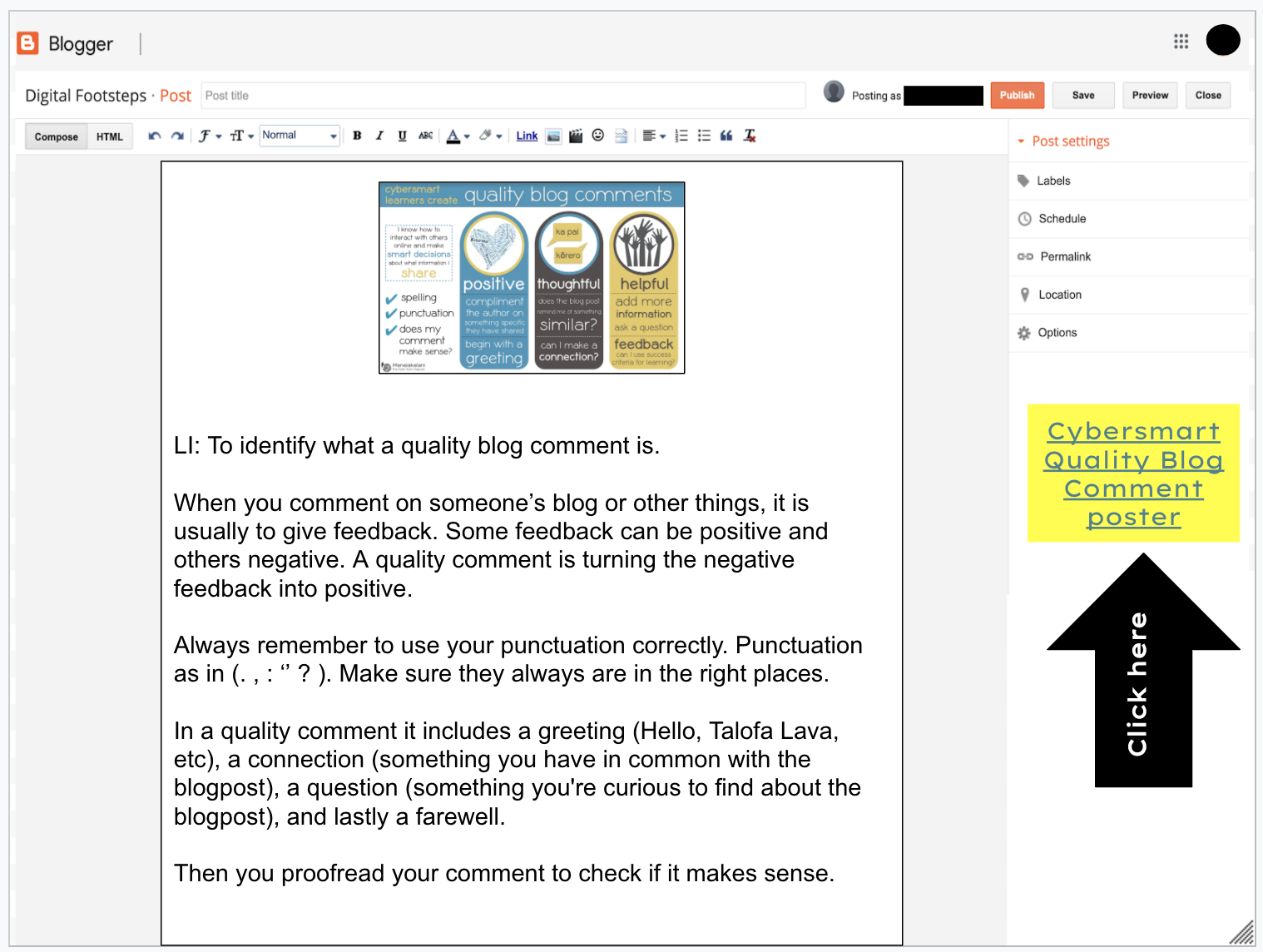
  • Display the 'Quality Blog Comments Poster' and unpack
  • Ask students to generate sentence starters for 'compliments'
  • Model how to write a quality blog comment using a student blog post (promotes a connection)
  • Explain that a question has been asked so now needs a reply.
  • Ask: How might you reply to this comment?
  • Co-construct a reply

Where to next:
  • Actively plan time for students to comment on blogs and respond to comments on their own blogs.
  • Revisit the Manaiakalani cybersmart lessons to access the resources available. The shared language of instruction will help my learners to continue to build on and strengthen the knowledge they have, and will scaffold and support my students new to Manaiakalani this year.
  • Make a display that reflects our unpacking and understanding of how to write a quality blog comment - make it visible - keep it visible.

Thursday, 6 February 2020

Te Hiku Cluster Presentation

Last week I joined the Te Hiku cluster for their TOD. Apart from meeting some lovely people and taking in the new learning myself, I had an opportunity to present my 2019 teacher inquiry and run two workshops.


Thursday, 21 November 2019

Bursts and Bubbles

This afternoon the Manaiakalani COL teachers shared the impact of their 2019 Teaching as Inquiry as impact bursts in a panel setting. Here is my journey...


This year I wanted to find out if an ‘increased emphasis on reading comprehension instruction would lead to better subject achievement in reading, writing and maths’.

Having spoken to my students and analysed a summary of current and historical data, my hunch was that my target group struggled to read and interpret written questions. This meant many learning situations, and all testing situations were seen as highly stressful and overwhelming experiences.

After the Term 1 assessments my target group shared the fact that for most questions, they simply clicked on any answer. This honesty meant I did not have a true picture of their achievement as I was not actually assessing their ability to interpret, recall and use their knowledge; instead I was in reality, assessing their skills of random selection.

Deeper analysis of student data and my own observations showed none of my target group were able to respond accurately to questions that were asking them to infer. So rather than focusing on reading comprehension as a whole, I narrowed my focus to only the comprehension strategy of inference, as often it is the inferential component in written questions that cause the disconnects.


What happened for the learners:
  • Engagement and agency increased through the co-construction of scaffolds and shared ownership of the learning.
  • Overall confidence levels increased. Meaning these students are now asking and answering questions, and trying hard to apply new learning when working independently. Something that was not happening at the start of the year. So this is a huge change.
  • The increases in student self efficacy has had a positive impact on the amount of work completed and posted on blogs. 
What evidence do I have for this:

The detailed data analysis on my blog shows most of my target group made the expected achievement shifts across the board and in some cases, accelerated shifts. These students are not at the national norms yet but now, unlike the start of the year, none of our Y7/8s are on the colour wheel, below level 2b in writing or below stage 4 in maths.

To make this happen I...

  • Actively sought and embraced help from colleagues
  • Personalised the language of instruction to make it explicit
  • Used think alouds, learner talk and written exemplars to unpack new learning and vocabulary.
  • Used the same lesson structure in all curriculum areas to help my learners to see that what we learn in one curriculum area can be transferred to another.
  • Identified opportunities to practise using and reinforce connections to inference in all subjects.
  • Adapted support programmes with ongoing help from Donna Ryan in literacy and maths, that include an inferential component and align with our Y7/8 content. Running these in-class has meant the students are not missing learning time in one curriculum area whilst trying to fill gaps in another.
  • Made my learners and myself accountable for unfinished work.
The most important learning I made from my inquiry is that changes in teacher practice are paramount to success. If strong connections to learning are to be made, the learning must be accessible to all students. We need to be mindful of the external factors affecting our tamariki that we can not control, as we gently nudge these same students out of their comfort zones using factors we can control.

WFRC#13 Summarise Key Changes in Student Learning...


'The average scale score progress for each year group is described by a benchmark scale score for each year level from the Term 1 trials. They can be used as a guide to compare individual student /class progress between two assessment time points.' - source NZCER

To build a rich picture of my students’ learning I used their historical data, their current data (PAT Reading and Maths, STAR, e-asTTle writing, Probe running record analysis, IKAN and GLoSS), student voice (T1, T2, T3) and my own in-class observations.

Student self-efficacy and self belief about their own ability to understand, interpret and answer questions when in a test, determines the level of confidence or anxiety they bring to that testing situation. The insight my previous inquiry has given me in regards to student self-efficacy and self belief has strongly influenced the way I introduce new learning, guide and feed back to my learners. By this I mean, I have reflected a lot on the changes I made to my teaching practice last year. The excerpt below is taken from a blog post I wrote at the end of 2018.

'I lived by the idea of 'Repetition without boring' which when unpacked, means repurposing, revisiting and tapping into the known to help access the unknown. In other words repeat, repeat, repeat, but do it in a creative way! I used the same lesson format, regardless of text type. Began each lesson by co-constructing the success criteria and revisiting the available scaffolds and exemplars created by our group. Talk was actively planned for to front-load the vocabulary needed to unpack the topic in context, and the language of instruction personalised and explicit. Moving forward I will continue to actively plan time for front-loading, time for planning and time for talk in my lessons, but most importantly, I will try really hard to make sure my learners not only think that they’re good at writing but also think I think they’re good at writing.'

Whilst my previous focus was solely on writing, I found myself applying the same thinking across the curriculum areas. As this year has progressed I have noticed student engagement, work completion rates and confidence levels have increased so I was keen to see if this increased level of efficacy and self belief would be make a difference to my learners when we compared how they felt during data collection time point one with data c
ollection time point two. 

After the Term 1 assessments, my target group shared the fact that for most questions, they simply clicked on any answer. This honesty meant I did not have a true picture of their achievement as I was not actually assessing their ability to interpret, recall and use their knowledge; instead I was in reality, assessing their skills of random selection.
It seems quite a lot has changed since our time point 1 testing. I asked these three questions at the end of each time point 2 assessment session to 
ensure their responses were authentic. The responses below reflect only the students in my target group who were at school during assessment week.


'A rising tide lifts all ships' and I hope that the levels of confidence and self belief are strong enough to keep these students believing they have the knowledge and skills to swim with the current as they begin next year's learning journey.

WFRC #14 Evaluating changes in teaching practice ...

The catalytic aspect of student learning my inquiry focused on this year was whether ‘increased emphasis on reading comprehension instruction could lead to better subject achievement in reading, writing and maths’. After talking to Fiona Grant at the start of Term 3, I realised that I had already narrowed this from 'increased emphasis on reading comprehension instruction' to 'increased emphasis on the reading comprehension strategy of inference'. We all need an overarching umbrella question to guide our inquiries whilst giving us room to veer off and explore, but I now realise I had an overarching marquee! My question was too broad and without refining would have meant valuable stones were left unturned.


I identified this as my focus when I noticed how real the ongoing struggle is for our learners who do not have the language acquisition and literacy skills needed to make sense of learning at our level.

To build a rich picture of my students’ learning I used their historical data, their current data (PAT Reading and Maths, STAR, e-asTTle writing, Probe running record analysis, IKAN and GLoSS), student voice (T1, T2, T3) and my own in-class observations.
                                                  
The main patterns of student learning I identified in the profiling phase were that they struggled to read and interpret instructions and tasks, which meant that all testing situations were seen as being highly stressful experiences. My target students could not see that we could use the language and strategies we learn in reading, in maths. I needed them to understand that what we learn in one subject can be used to help us in another. The example I chose to explore further was the strategy of inference because the data that identified the gaps in comprehension across my focus group, reflected none of them were able to respond accurately to questions that were asking them to infer. In addition to this, my reading and conversations with colleagues identified that often it is the inferential component in a written maths question that causes the disconnects.


I have always sought and embraced feedback and suggestions from expert colleagues. so the profiling of my own teaching was done collaboratively with my critical friend, Donna Ryan who observed my practice across several different learning areas. Her observations showed that I had strengths in weaving learning from previous sessions into current lessons, co-constructing learning intentions and scaffold supports, teacher modelling of vocabulary and strategies, and questioning.


However I realised quite quickly that my students would likely make more progress if I asked them to remind me why we were doing the task we were doing. Putting the onus on the students to recap the purpose of the learning gave them an increased sense of ownership. Recording responses as they were offered allowed them to see immediate success and gave us a valuable resource to take further steps along our learning paradigm. I have always taken time to listen to and implement student feedback but this time I identified the person/people responsible for the ideas. Doing this again personalised the changes made and showed that I valued their thinking.

The changes I made in my teaching were that I consciously used think alouds to model explicit use of content language and/or the strategy I was teaching in all subject areas. For example, when introducing new words we unpacked the meaning then I used a variety of synonyms to show these words meant the same as known words. An example of this is the way the word multiply is broken down as times tables or groups of. Doing this each time I use the word allows a wider number of students to make the connections they need, to make sense of the learning.


I purposely planned activities that encouraged my learners to use the vocabulary in partner, group and class discussions, and set follow up tasks that gave my learners opportunities to use and apply the vocabulary and strategies in context. To support this I provide co-constructed written models at the start of each lesson so my learners are able to continue to make the visual connections to the learning they need in order to find success. By generating these ourselves and not using pre-made versions, I found that my students saw recalling strategy steps and written structures as a natural part of the lesson. 

I took time to notice the types of questions my learners responded to and tried hard to adapt the type of question I asked to suit the purpose and the learner. What I mean by that was sometimes I had to scaffold the questions by really unpacking the language I used, and asking literal questions that I knew my learners could respond to. Other times my questioning was much more open ended for those who were able to respond to a challenge without feeling insecure. Ensuring my learners could find success was the catalyst behind this thinking. My target students preferred to respond to literal questions as they felt safe sharing information they could see. In comparison my more able students tended not to respond to these questions, preferring instead to offer their informed opinions. Over time I have been able to merge this gap by using question stems to support those who struggle with knowing how to word their responses. 


To grow my own knowledge I sought advice from colleagues who have expertise in teaching Maths. Donna Yates (Te Hiku Cluster outreach facilitator) shared an article with me and some great ideas to help learners access a wider variety of Maths language. Sheree Hodge (Ranui School In-school Maths CoL teacher) helped me strengthen my own connections to inference. The professional readings I used are listed in these blog posts - Link 1. Link 2.

Overall I would rate the changes in student learning as a success. The evidence for my rating is that despite the results achieved in the online testing, the results achieved in the GLoSS, IKAN and Probe assessments showed my learners have made progress. This aligns with what I have seen in the classroom. My target students, like their peers have become more confident when faced with new learning, are actively involved in discussions and try hard to apply strategies at their level when working independently on follow up tasks. The latter being something that was not happening at the start of the year, with my target students relying on the learned behaviour of waiting for help from their peers or from me. This is a huge change. They are no longer the students who sit quietly watching the learning happening around them as they adopt every known strategy to avoid having to answer a question or give an opinion. A lot of positive reinforcement and gentle nudging has helped them start trying to swim through the sea of learning by using and applying the strokes of their own knowledge.

Image result for stress icon
The most important learning I made about whether an increased emphasis on the strategy of inference could lead to better subject achievement in reading, writing and maths, was that whilst standardised testing data is an important measure of achievement, it is most definitely not the only measure that should be observed. The external factors that our students come to school with are real. Our tamariki can not be expected to automatically disassociate from a highly stressful situation outside of school because I am asking them to in many cases, undertake the highly stressful situation of sitting a test. I am proud of the effort they put into their learning this year, even though some results do not align with the work that happened daily in our classroom.

The most important learning I made about inquiry was that change is paramount to success. If strong connections to learning are to be made as teachers we need to make the learning accessible for all students. We need to be empathetic and supportive as we push our learners out of their comfort zones. Our learners in return, need to take risks and embrace change; and where possible commit to continuous patterns of attendance to avoid the disconnects in learning that erratic absences cause. 


Some learnings that would be relevant to other teachers are that it is important to rememb
er the external factors out of our control, should not affect the factors we can control.


Icons made by Freepik from www.flaticon.com

Monday, 16 September 2019

Critical Friend Observations...

When carrying out an inquiry into your own teaching practice it is really helpful to have a critical friend who can see your practice from a different perspective. Their feedback and feed forward helps you to adapt your practice to continue to meet the learning needs of the students in your classroom. As I mentioned in a previous post, for me this person is Donna Ryan. I know what I think I do/say when I am teaching, but having Donna observe me taking a phonics session, and record exactly what she saw me do, was a valuable learning opportunity.

This is what I did/said to help my learners make the connections they needed to make sense of the learning:

  • Recap learning from last session
  • Check in to see if understanding is in place
  • Co-construct the learning intention (LI) and goals for the lesson
  • Asked the students "What do you need to do today to achieve this?"
  • Gave students control of the learning by giving them the opportunity to choose the follow up activity
  • Asked "Why are we doing this?" to recap on the purpose of the learning
  • Reinforced the focus/goal as a reminder
  • Modelled the learning
  • Guided/scaffolded students towards next step
  • Checked in to make sure understanding was in place
  • Identified where they had met the LI
  • Reaffirmed "I like the way you have used the commas correctly, we learnt that yesterday and this shows me you were listening carefully"
  • Asked "Can you remind me what we were focussing on today?"

From this I can see that I share control of the learning with my students, continually check that connections are being made, scaffold through questioning and teacher modelling, and reaffirm to ensure self efficacy and confidence continues to grow.

Wednesday, 21 August 2019

Looking for micro-shifts...

With my class having recently completed the Individual Knowledge Assessment of Number (IKAN) assessment for the second time this year I had an opportunity to take a closer look at the shifts in data. When I compared the overall achievement stage from time one with the overall achievement stage from the time two data I was left quite underwhelmed. Whilst there had been no backwards slide, sadly there had been no gains in this section of the data either. My target student's data appears to have flatlined which doesn't in any way align with what I have seen happening in the classroom. This assessment does not show the huge increase in the confidence levels, the huge increase in work output levels and the huge change in engagement during learning time.

Rather than basing my evaluation of student and teacher success on this one section I dug a little deeper and looked for the micro-shifts in the other four sections. Refer to graphs below. This painted a picture that aligned more closely to what I see happening in the classroom. 


I can see from the data where stronger connections to the learning are being made. In this case fractions and basic facts. A possible reason for this is that fractions has been our most recent focus, and basic facts because of the number knowledge games we play to make sure these are being used and recalled at speed. Each lesson also includes 15 minutes on the self pacing e-Ako maths programme, 10 minutes of times table challenges and 10 minutes of levelled basic facts challenges. These three activities were introduced to help develop confidence and number knowledge when working with the basic facts and multiplication tables that are needed to be recalled and used when working with larger numbers.

The place value questions in banks 1 and 2 of the IKAN test ask how many tens are in a given number and how many groups of 10 make a number. All these students were able to do this with confidence when the numbers they were working with 2 digit numbers, however when the numbers increased to 3 digit numbers they were not able to apply the same knowledge to find the answer. I wanted to understand why this was so I had a 1:1 follow up chat with each of my focus group. When I asked them the place value questions again, I noticed that 8/8 students quickly answered the questions involving the 2 digit numbers. However when I asked the same type of questions using the larger numbers, no one was able to make the connection between 'groups of' and the times tables. I know that I am constantly modelling and recording on the board the fact that 'times' is the same as saying 'groups of' but I think I need to make this more visible by creating a permanent scaffold for the wall. Looking at my own practice I see that I need to increase the pace I move at with regards to using larger number denominations in the classroom. This should help my learners approach these questions with increased confidence. 

The number word sequence questions were all answered correctly when the numbers they were being asked to find remained under 1000. Once these moved to 6 digit numbers only the question that asked for the number 'after' was answered correctly. Again this is an area that I need to increase the pace in. I can see it is not ok to play safe by only using numbers my learners gain success from.

This snapshot of achievement shows me where our hotspots and knowledge gaps are in these four areas. My challenges are now are to find fun ways of helping my learners make the connections they need to be able to work successfully with larger numbers, and remind myself to stop using only 'safe' numbers to help my learners find success.

Monday, 1 July 2019

Inference: When do we use it in our learning?...

Having unpacked and explored the comprehension strategy of inference during reading lessons I wanted my target students to be able to tap into this learning and use their inferencing skills during our maths lesson. As a scaffold for these students I asked my whole class to remind me of when we use inferencing skills in our learning. What completely shocked me was that not one person could answer this question. Incase there was a confusion between inferencing and inference I asked my students what inference was. Again no one could give me an answer! I used a variety of DATS (direct acts of teaching) to prompt a response but still no one gave me a correct response. Thinking on my feet, I recited the nursery rhyme, Jack and Jill then asked my learners two questions. 
  1. Was Jack a boy or a girl? 
  2. How old was Jack? 
When the answers were given I asked, 'How do you know?' I was told that Jack is a boy's name so we can assume he's a boy, and he's young because in all the books they have a little kid drawn. I then cast a written version to the TV and asked everyone to talk to their buddy and show them where this information was in the text. One student said 'We can't Miss because it's not there.' I then explained it isn't written in the text because there are enough clues in the words (and images) for us to logically guess this information. 

I think my learners were thrown by my question because we always talk about inference and respond to inferential questions during our guided reading sessions, but on this occasion I asked them a reading based question during our maths learning time. Unfortunately none of my learners were able to knowingly transfer learning from one context to another. 

We then looked at the maths question: 


197 adults and 152 children were on the afternoon flight from Christchurch to Auckland. If 176 of the people that boarded the plane are male, how many are female? 
Aeroplane, Airliner, Airbus, Airplane

In pairs I asked my learners to read the question aloud then reread it and find the maths. Once they had the numbers to work with I asked them to decided were they being asked to find a sum or an addend. When that had been established I asked them to use what they already knew to decide which number operation would be the best choice to help them find the answer. Alongside each step we revisited the fact that we were inferring (ie: using the clues given with our prior knowledge to help us find the answer). 

What began as a scaffolding strategy evolved into a deep dive into a learning experience full of rich discussion for all my learners that I hope to build on to strengthen the connections between inference in reading and inference in maths.

Friday, 14 June 2019

Digital Fluency Intensive... Day # 3


DFI Session# 3 had a media focus. My animation reflects the content we explored today to will help us help our tamariki become ‘creators of content not merely consumers’. We need to make sure our learners are safe in an online environment, something that is no different to the way we make sure our learners are safe in an EOTC environment. As teachers in a 1:1 environment we can do this by ensuring the settings in YouTube and Blogger are in place.

‘Creativity is not about doing something better than others, it's about thinking, discovering, exploring and imagining’, Kohl (2008). Joining us in our session today were three of my skilled creators Jack, Alex and Nyjah who confidently shared with their amazing digital drawing skills. They began with a 'how to' presentation that they had created then took us step by step through creating an animation in Google Slides and creating a drawing using the line tools in Google Draw. This part of my reflection is unashamedly a boast post!


My takeaways from today are:

  • To make time to make sure the safety settings on blogger and YouTube are in place so that my learners can operate safely in an online environment.
  • To share the online safety reminders with our PBS staff.
  • To think about the opportunities my learners have to create.
  • To share the possibilities of introducing of rewindable learning that our drone can offer sport training. Thank you Kent for this tip.
  • To share the possibilities that our drone can offer for live streaming and delayed coverage so we can strengthen whanau connections.
  • To use the Google Slides to create my own pick a path style maths challenges to help strengthen my learners number knowledge and vocabulary connections.
  • To use the Google Slides to encourage my learners to create pick a path DLOs that reflect their understandings and connections to the learning.
  • To strengthen my own digital drawing skills by completing my own digital portrait.

Friday, 7 June 2019

Digital Fluency Intensive... Day # 2


The infographic above reflects the takeaways from todays session that I have taken from our session today. The shortcuts for calendar are a great way to flip between views (weekly, daily, monthly). Google Keep has so many amazing features! I used this tool often for note taking and thought I was making use of all the features available. I now realise I was not! To be able to upload an image with text and then have the ability to grab the text is something I will definitely use in the classroom as there are so many possibilities to this feature. Angela Moala shared an idea with me of using Google Keep when I am commenting on my student's work. So often we find we are writing the same feedback so being able to have this bank of often used comments that can be copied and pasted is something I will access often.

I found the workflow session linked to organising our gmail and tabs incredibly valuable. I no longer have an overflow of comments sitting in my inbox. These are now all archived or sitting under the appropriate labels with filters in place.

We had an introduction to Google Hangouts and explored possibilities of how we can use this tool outside of what we already do with toolkits. Here is the screen recording of my hangout session with Angela and Sarah. Thank you Sarah for capturing this.

Here is the link to my notes from our learning today.

Friday, 31 May 2019

Digital Fluency Intensive... Day # 1


Learn, create share is the pedagogy we follow as part of the Manaiakalani cluster so it is important that as teachers we not only model this process, but also remember to give our learners time to share their work.


The infographic (our skills challenge to make using only a google doc) above reflects the takeaways from todays session that I will be taking back and ensuring my learners are able to use. In addition to this I will be using these words when we open new documents in G Suite. "Locate your folder - open a new doc/presentation etc - write your name followed by the learning title." Starting a new doc in folder helps to ensure all work is shared with the teacher. If Chrome and Drive are to be effective they need to be set up well.
  • Comments tool/Assign to: A great tool for encouraging student led reading comprehension by assigning questions and responding to assigned questions.
  • Voice Typing: A great tool to help learners of all ability levels. 
  • Scavenger Hunt: A fun way to practise skills.
  • Explore Tool: Enables web, image and drive access within Google docs.
  • Table of Contents: Provides visual links to headings and subtitles in a doc.
  • Overview: Save page 'real estate' by adding links to headings and subtitles on the side of the doc.
  • Shortcuts: Time savers... command + shift + B (opens bookmarks bar), command + shift + T (opens a new tab), command + Z (adds a doc to your Drive without making a copy), command + shift + v (pastes without formatting). Command for Mac/Control for Chromebooks

My teacher takeaway from today is the zoom feature. Being able to enlarge the words or images I want my learners to focus on while I'm talking to them will be so much more effective than asking them to focus on the cursor. The pathway to unlock this feature is:

System preferences - Accessibility - Zoom (my settings look like this...)


DFI Cohort 2 2019
Update:

Today (4/6/19) I challenged my students to create their DLOs using only Google Docs. I noticed that my instructions were a lot more detailed and specific following my day at DFI. It was interesting that this challenge was met with 'Why can't we just use Google Draw?'.... I explained that I wanted to introduce them to the explore tool so we set about creating our DLOs following the same set of challenges that we had at our DFI session. This was a huge success with one group choosing to use the draw tool to create their images, and several powerful conversations taking place as to which definition best suited the purpose of the task. What I noticed most about my instruction was that it was explicit and I was able to problem solve quickly which meant that momentum was not lost. 

The image below was my instructional exemplar that was created so that I could model how to use the explore tool. 


Here are a few examples of our completed DLOs:


Our next challenge was to use the voice to text tool to write our information reports. I set this as the challenge component of our collaborative writing task and judging by the feedback was very well received due to the novelty factor, as well as how it helped my learners notice where punctation was needed. Mele and Marieta's example below reflects what we did in this lesson. Click here for the link to Mele's blog post. 

I also used this tool with my phonics group so they could dictate their sentences, taking away the hard part and allowing them to show their real understanding of the learning.