Showing posts with label CoL Teachers. Show all posts

Tuesday, 7 October 2025

What the Research says...

With technology at my fingertips and time not on my side, I prompted Gemini to undertake a deep research to find out more about why teacher confidence levels drop when faced with implementing new learning. 

Click on image to hear the audio overview of full research findings

Volume Icon, Transparent Volume.PNG ...

This is my summary of the findings...

The decline in teacher confidence during the implementation of new learning initiatives is a predictable reaction caused by challenges to personal competence and structural deficiencies like planning time pressures and knowledge gaps. Teachers initially find themselves juggling  anxieties where they worry about the changes needed to be made to routinesalongside professional fears associated with the uncertainty that comes with stepping into the unknown. 

As implementation begins, the concern shifts to logistical and structural constraints where concern connects to the amount of time needed to be prepared to teach the new approach. This efficacy dip is often worsened by perceived external and internal pressures to find the success quickly. PLD must be ongoing, curriculum-specific, and designed to close identified content and pedagogical knowledge gaps, moving away from generic, one-size-fits-all training. Time for reflection, implementation, peer and self observation, and skill practice should be allowed. Everyone learns at their own pace and recognising this is important. What has made the implementation of sound practice in structured literacy more fragmented for my team is the fact the Year 4-6 kaiako have had separate sessions from the year 7/8 kaiako. Different online delivery options has meant a similar message has been shared but as I attend one and most of my team the other, there are bound to be gaps in our shared learning which in turn has lead to levels of uncertainty being higher as I have always been two days behind in my own learning and unable to effectively support my team as they begin each new learning journey.

As a leader fostering a buffer against the cognitive and emotional load is vital is success is to be found and a genuine buy-in to be established. Allowing my team complete agency and control over their implementation decisions within their classrooms has meant we have come back together again with a stronger connection to our new learning. Confidence is emerging and as a result mentor observations to gather a baseline picture have begun. It is only now that I can begin to look for the opportunities being provided for their learners to be creative when undertaking structured literacy learning. I look forward to see where this takes us as the term progresses.

Describe and Explain the changes/tweaks you have made in your practice along the way...

I began with a focus of how we (PBS) are harnessing the digital to explore the create aspect of structured literacy. Students learn by actively constructing knowledge, not just absorbing it. This involves breaking down, rearranging, selecting, and demonstrating their understanding, so that  aElwyn Richardson stated, “...whatever was in their mind, whatever they could visualise, whatever they could see, they created...” It is because of the very reason just mentioned, that I felt this is the the most important and catalytic issue of learning for our learners this year. I didn't want to introduce and unpack a text verbally through preset comprehension strategies. I didn't want to be the teacher who asked my students to summarise a text on a graphic organiser then leave it there. I am the teacher who asks a provocation and encourages talk and creativity. I want my learners to show me their connections to the aspects of the text we are unpacking using the plethora of digital tools available to us. Defaulting to substitution in response to a structured learning process does not, in my opinion, open the opportunities to 'empower my students with creative learning opportunities to help accelerate achievement'.

At the start of my inquiry I thought I would look at our school as a whole. This was when I realised I was comparing apples with pears. Many of our junior team facilitate amazing opportunities for their students to create to show their understanding of a text. Their learners are fully engaged and excited to share what they have been doing any time I walk into one of their rooms. The difference between what they do, and what the senior team do is that many of their create challenges are not limited to capitalising on the affordances digital tools provide. Changing my focus to just the senior team was my first tweak. 

When we began our structured learning PLD in Term 2 with our introduction to the program. We then moved forward into Term 3 for our Community of Practice (COP) sessions and began implementing our structured literacy programs. I made the decision from the outset to lead from the front. By that I mean I made a point of finding ways to include opportunities for my learners to show their understanding of the texts read by being creative. What I noticed other members of my team doing was simply trying to get it right with our new learning. I do have the advantage here of having taught structured literacy for a number of years in the UK. I was definitely 'rusty' but felt confident to add in the new elements to my program. Term 3 was not the time to push the 'create' as I needed a team who were strengthening their own connections and that was more important. This was my second tweak as I took the focus of others and focused purely on myself.

When we met to plan for term 4 I jumped on my 'create' bandwagon. With a number of examples under my belt and on my blog I was able to lead by example. Being able to visualise the outcome has seen a huge change in planning content in my team in literacy this term. I am now looking forward to seeing how these initial ideas look when they are finished. The change here is in my thinking. I now realise that adding create opportunities that capitalise on the digital tools we have at our fingertips comes when teachers feel confident of the challenge ahead. 

Saturday, 4 November 2023

Describe and explain the changes/tweaks you have made in your practice along the way...

As I have previously stated, motivation is intrinsically related to engagement. If my inquiry this year was to make an impact on my learners achievement, I needed to find engaging and purposeful ways for my learners to embrace the challenges that come from being introduced to a wide variety of new vocabulary. At the start of the year I felt that the hurdles in front of us were connected to spelling and my learner's connections to rules of spelling. Time point one spelling and writing assessments showed a huge disconnect between how words sounded and what my learners appeared to hear. 

I began by capturing my learner's attitudes towards spelling through the e-asTTle self reflection analysis and through a survey that helped me get to know my learners as spellers. There were definitely some eye opening results with the fact spelling was seen as important but this group of students did not see themselves as being good at spelling with the majority choosing to use an easier word when the one they wanted was not one they could spell. Traditional spelling activities were suggested as ways of strengthening our connections to the conventions of spelling but I was excited by this. I remember as a child learning my words, getting them all correct in the weekly test then never thinking about them again. I didn't see the purpose of the test then and I couldn't see it now. I do remember the students who rarely found success in this activity spending many Fridays in the sickbay. I did not want that pattern to develop so I knew what ever we did it had to be fun, purposeful and achievable. This where, following an online PD session with Louise Dempsey that I blogged about previously, our journey into the world of affixes began.

What I noticed here was that once the knowledge of simple rules and/or conventions of spelling, (eg: dropping the 'e' off a base word before adding the suffix 'ing') was in place the challenge element was lost. My learner's enjoyed the activities but I noticed the time taken to complete them became shorter, and the reliance on the dictionaries to create new words from a base or root word was becoming less and less. Therefore it was time to make some changes to keep the learning and motivation going. 

Change came after a meeting with Dr Jacinta Oldehaver. I explained my dilemma and asked if there were any readings she knew of that might support my word consciousness journey. Jacinta shared a reading with me about the word gifting experiences of Sylvia Ashton-Warner. I was about to begin a new T shaped literacy focus and needed to find a way to help my learners connect with the sophisticated vocabulary associated with the unit that they needed to be able to use and apply in context and independently. This post will explain what we did. In a nutshell, what began as a focus on spelling conventions and rules quickly morphed into an inquiry into word consciousness which involved my learners 'being aware of new words, their meanings, and how these words are used. Students who are conscious of the words they are meeting are motivated to learn them and use them. 

Student responses to the texts reflected an accurate use of words most had not heard of before, being used both in extended discussions and in the justifications of their thinking. A definite win here! My learners thrive on challenge so as explained in the link to the post above, I added the challenge of each person being required to use their word twice each reading lesson. I noticed that both of my groups had created a tally sheet so the score was kept. I view that as intrinsic motivation at its best! 

The fear of spelling a word wrong or choosing a simpler word seemed to have been left behind as the desire to use the words was more powerful. I was able to quickly correct spelling errors with a hotspot style workshop that used the conventions of spelling as a reference point. To consolidate that part we used the dictionaries (our version of 'paper google'), to find other words that followed these conventions so that we could make the all important visual and auditory connections needed. The learning became about the words and not the hurdles of the order the letters are written, that prevent them from being used. My part in this was to model the use of these new words we were meeting across the curriculum. The more I did it the more my students did it. The key learning here as their teacher is, if I want something to happen I need to walk the walk, talk the talk and continually drive the challenge outside of the context in which the words were actually met. You can not simply introduce something and leave it there. New learning must be revisited and used if it is to become internalised knowledge. 

The graphic below is something I found after I had been on my inquiry journey. This reaffirms the direction I took to shift student achievement and change my practice was the right one. The reading component in the graphic below aligns with the T shaped literacy units of Great Beginnings, Representation and Genre that I have been doing as part of a research initiative lead by the University of Auckland.
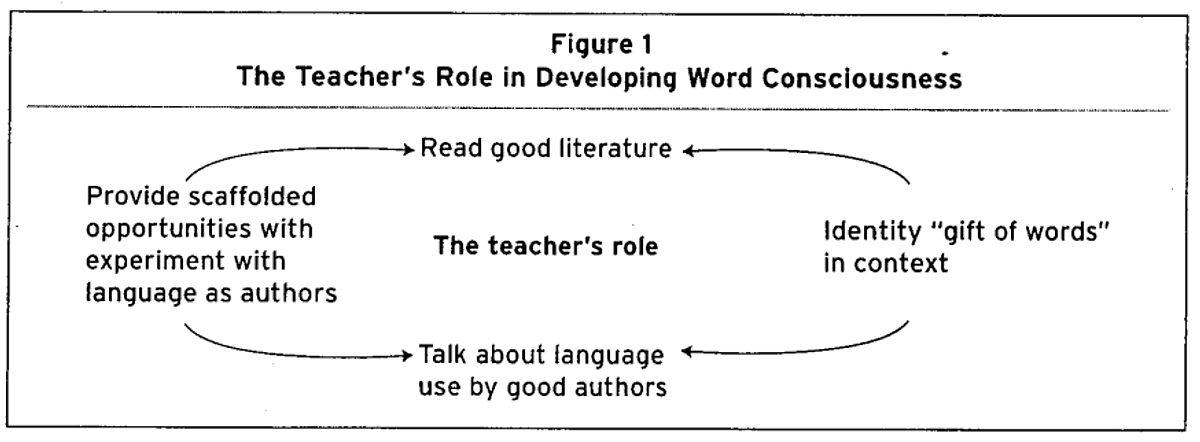
Gift of Words 2

Graphic retrieved from here

Being confident to use and apply more sophisticated vocabulary in context accurately was a huge step towards changing mindsets. I know this helped us make shifts in literacy in the classroom this year and am looking forward to seeing if there has been a change in the types of words used in our time point two writing assessments. By strengthening students connections to vocabulary and the spelling conventions that accompany these new words, I hoped to see a change in attitude towards word choice which would be transferred to personal writing, higher levels of self efficacy and an overall shift in achievement so that a higher number of our learners are achieving at or above the expected norms in literacy. The most noticeable change has been the change in the mindsets of both myself and my students. 


Friday, 18 November 2022

2022 Teacher Inquiry Evaluation...

This year I set out to find out if focusing on Reading for Enjoyment would increase student self efficacy and capability in Reading?

My reason for choosing this inquiry and the shifts between time point 1 testing and time point 2 testing are explained in detail in the previous two posts. The changes/tweaks I made are shared here and the picture the data paints is here. These posts explore both the qualitative and quantitative measures undertaken this year.

Summarise evidence about key changes in teaching and other factors that influence student learning.

Creating a causal chain helps you to stay focused on the purpose of your teacher inquiry. It is so easy to fall down many rabbit holes along the way so having a causal chain to look back on helps to keep you on track. My biggest takeaway from looking at a variety of readings is if we are to develop reading for pleasure habits in students we need a collective and collaborative approach that allows our tamariki to see role models at school and at home who value reading.

I wanted my students to want to read a wide variety of texts because they want to. My aim this year was to help the students in LS2 to see our weekly library visit as both fun and to quote one of my learners, understand 'that opening the covers of books you haven't read books is a fun way to find new ideas or even learn a thing or two.... It's like a supermarket for the brain' - quote taken with student permission from this year's T1 writing sample. My challenge was to find out why the links in the chain appeared to be broken again. I work in an ILE and share a class with Dianne Fisi’iahi and knew that if my inquiry was to become a success it needed to become our inquiry.

We began by:
  • Actively planning time in class for reading for enjoyment, after all if you want something to happen you need to make time for it to happen.
  • Getting to know our learners as readers by gathering student voice through Naomi Rosedale’s Reading for Enjoyment survey.
  • Analysing beginning of year data to give us a clear picture of what our students can do and where our knowledge gaps are.
  • Connecting with whanau to foster support for reading for enjoyment at home
  • Using our student leaders as role models to promote reading for enjoyment across our school
  • Creating our own LS2 Reading Challenge to motivate our learners to read a wider variety of texts.
  • Making reading for enjoyment visible in our class
  • Researching the benefits of RFE and ways other schools have grown this culture

Write an overall evaluation of your intervention in terms of the causal chain you had theorised. To what extent was the intervention successful in changing factors such as teaching? To what extent were those changes in teaching effective in changing patterns of student learning?

At the end of Term 2 I looked back at my causal chain and realised through our weekly RFE tips shared at assemblies by our student leaders and our Leaders in the Library initiative, my students are seen as readers. More importantly they are beginning to see themselves as readers as we are actively reading for enjoyment in our classroom each day. To reinforce this latter point I made a point of capturing all of this in photos which were prominently displayed in our classroom. However because I was always beyond the lens I had not been allowing my learners to consistently see me as a reader.

I was introduced to my students as readers when they completed RFE survey at the start of the year and got to know them better by observing what books they were choosing to read then taking time to talk to them about their chosen texts. I also asked for text recommendations and made sure my learners saw me reading the texts they had suggested I read. This served two purposes, one showed that I was an active reader and the second that I valued their input.

We turned the results of our monitored time we spent RFE and the RFE survey into purposeful statistical inquiries by using the data gathered to identify the problem areas and offer possible solutions. This gave all of us ownership of our shared goal of increasing the time we spent reading for enjoyment.

The RFE display in the classroom not only gave my learners the opportunity to see themselves as readers but also the opportunity to talk about the importance of RFE to their whanau during our student-led conferences. The parents/caregivers enjoyed seeing not only their children in LS2 reading but also their younger children. Listening to some of the conversations taking place during this time I realised that our learners understood what RFE was and were able to talk about why they needed to be encouraged to do this at home. As a result most of the parents/caregivers leaving the room promised to help keep the reading for enjoyment going at home.

Timetable opportunities for RFE so students read the books they take out of the library and introduce LS2 RFE challenge to encourage students to RFE in their own time helped us to drive this initially, however whilst the timetabling remained in place, our reading challenge fell by the wayside. After several attempts to reignite this we understood that our 2022 were not motivated by the follow up challenges. We wanted them to want to read so readily removed any barriers that may have prevented this from happening. What was a success however was our RFE Holiday Challenge. A reading challenge created and managed by two of our student leaders. What was exciting to see was who participated and what they have posted on their blogs, even more amazing was the interaction that took place in the blog comments. 38% of our class took part in this challenge which may look like a low number, but in my mind that's 38% of our class that we know of who made time to read for enjoyment over the holiday break.

As I stated in a previous inquiry, in all assessments our students are required to read and respond to questions. Often our students are often not literate in their own language so the gaps that emerge when questions are written in English are getting wider, thus causing bigger disconnects in the learning. Sharing an infographic I saw online with our class last helped to strengthen connections and understandings to the importance of RFE. We didn't focus on the test scores rather the amount of word knowledge gained by finding 20 minutes a day to read.

Creating and referring back to my causal chain has resulted in this intervention successfully changing my thinking around the value of RFE in the classroom. I am now seen as a reader and know that if this is to continue I need to continue to motivate my learners and plan time for this to happen within our class program. The changes in teaching have been effective in changing patterns of student learning as our students now open the covers of the books that once simply stayed in their trays. The data analysed in my previous two posts are evidence of the shifts in both mindset and learning. I do see a change in attitude towards reading, strengthened connections to new learning, increased vocabulary awareness which has been transferred to personal writing, higher levels of self efficacy and an overall shift in achievement which has resulted in a higher number of our learners achieving at or above the expected norms in literacy.

Write a reflection on your own professional learning through this inquiry cycle.

One of the most important changes I made in my teaching was to make sure my students saw me as a reader. Chrissy Smith put it best when she said ‘by not reading with our students we are not valuing what we are asking them to do’. I am definitely now a teacher who actively opens a book when my students open a book. My biggest takeaway from looking at a variety of readings earlier in the year was that if we were to develop reading for pleasure habits in students we needed a collective and collaborative approach that allowed our tamariki to see role models at school and at home who value reading. Leaders in the Library, whanau support and sharing RFE tips at assemblies has helped achieve this and are initiatives I want to keep in place when we move into our 2023 learning journey.

I have summarised my own learning in my Bursts in Bubbles presentation which can be read  here. My journey this year reminded me if you want something to become a success you need to be walking the walk and talking the talk. Plan for it, drive it and find ways to give your students ownership of the change you want to effect.

Thursday, 10 November 2022

Describe and explain the changes/tweaks you have made in your practice along the way...

Motivation is intrinsically related to engagement, so learner engagement was a vital component in establishing a class culture of learners who are motivated to read for enjoyment and understand the benefits that reading outside of the classroom could bring them. Developing this motivation did not happen by magic. This is something Dianne and I have worked hard to develop with one of the most important changes we made to our teaching being to make sure our students saw us as a readers. Chrissy Smith put it best when she said ‘by not reading with our students we are not valuing what we are asking them to do’

If I roll back the clock to the start if the year, I remember walking past the student trays in our class and noticing that the library books I had seen earlier in the week were in exactly the same place. The reason for this was simply that no one said they could take the books they had borrowed home. I knew I needed to do something about this but I didn’t know how.

After a very rich learning conversation with Naomi Rosedale I had a tentative pathway mapped out going forward and was challenged to think about and inquire into and track my learners’ reading dispositions and interests. I didn’t have to start from scratch as I was able to use Naomi's Reading for Enjoyment survey with my class to help me get to know my students as readers.

Our data showed that within our class there was a huge disparity between the students who have made the connections they need to allow them to operate at a higher and more challenging level, and those for whom the gap has widened each year. By strengthening students connections to the benefits of reading for enjoyment, I hoped to see a change in attitude towards reading, strengthened connections to new learning, increased vocabulary awareness which would be transferred to personal writing, higher levels of self efficacy and an overall shift in achievement so that a higher number of our learners are achieving at or above the expected norms in literacy.

Gathering student voice gave us a clear picture of where our students were at, what they were thinking and what we needed to do to allow our learners to make their individual connections to the learning. Naomi's reading for enjoyment survey has allowed me to measure both the small and big changes. The presentation below does exactly that. Each slide contains the comparative data gathered from time point 1 and time point 2. Underneath the graphs I have analysed the shifts in more detail. It is important to note here that although this was a whole class inquiry I have only anaysed the data gathered from the 26 students present at both data collection times. I have gathered data from a cross section of students. The biggest and most noticeable change towards the benefits of reading for enjoyment are the mindsets of our students. 


We adapted our timetable to incorporate RFE as a valued and visible part of our program and by that I don't mean we just made a time slot for reading. We discussed books, created book chains, created our own student led holiday reading challenge (explained in more detail in this post), introduced the Leaders in the Library initiative (explained in more detail in this post), shared our weekly RFE tips at our school assemblies and invited our whanau to share our journey. Reading for enjoyment needed to be visible so I spent the year capturing and displaying photos of our learners actively reading. The idea behind this was that if we couldn't see ourselves as readers change would not happen. Additionally we made and displayed posters to encourage others to RFE. 

One of the most successful ideas we tried was to put the data we gathered back in the hands of our learners. As a class we analysed the initial RFE survey findings and came up with ideas as to how we could change the deficit we had towards RFE. This was how the LS2 Reading Challenge was born. Our thinking was that if our learners had ownership of the challenge they would have more skin in the game. Following on from this we decided to capture the time spent RFE. This post explains this in more detail. What surprised us as teachers was that simply being transparent with the amount of time spent RFE motivated our most reluctant readers to come in before school and open the cover of a book. 

However not everything we tried worked. When we began this journey as I mentioned earlier, we created our own RFE challenge. This started with a hiss and a roar but Dianne and I quickly realised that our students preferred to read and talk about their books instead of completing follow up challenges. Not wanting disengagement to raise its head we let this idea fall by the wayside. It's not something I wouldn't try to use in the future but was something that didn't work this year.  

Did our focus on Reading for Enjoyment increase student self efficacy and capability in Reading? The qualitative data discussed and analysed in this post indicates that we most definitely increased our student's motivation to read which tells us that barriers have come down because we took the time to make something that was not the norm become the norm. By walking the walk and talking the talk we removed the fear of failure that fuels low self efficacy and showed our learners that RFE opens the doors to a wide variety of learning opportunities.


Wednesday, 4 May 2022

Q2: What is it that we want our students to learn?

Developing an intrinsic motivation to want to read for pleasure is not going to happen by magic. This is something I need to develop by first analysing the baseline data that was gathered at the end of Term 1. I actually took this a step further and got my learners to analyse the data we collected and come up with their own suggestions as to how we can grow a culture of reading for enjoyment in our class. You can find a more detailed explanation of this task here.

A post on the National Library website states that reading for enjoyment 'gives people access to culture and heritage and empowers them to become active citizens, who can contribute to economic and social development.... It is also reading that may have begun at someone else’s request, which we continue because we are interested in it... AND CAN BE can be described as an act of play, which allows us to experience different worlds in our imagination and a creative and active/ interactive process.'

Research carried out by the Education Standards Research Team (ESARD) in the UK in 2012 found that reading for pleasure had educational benefits, supported personal development and had a positive impact on reading including:
  • reading attainment and writing ability
  • text comprehension and grammar
  • breadth of vocabulary
  • positive reading attitudes
  • self-confidence as a reader
The post also shares findings from The Growing Independence: Summary of Key Findings from the Competent Learners at 14 Project report that found, 'The ability to read competently and, more importantly, the enjoyment of reading has implications for a student’s academic success.'
  • higher scores on the cognitive and social/attitudinal competencies
  • consistently higher scores in mathematics, reading, logical problem-solving and attitude
  • higher average scores for engagement in school
  • higher levels of motivation towards school.

I want my students to want to read a wide variety of texts because they want to. My aim this year is to help the students in LS2 to see our weekly library visit as both fun and to quote one of my learners, understand 'that opening the covers of books you haven't read books is a fun way to find new ideas or even learn a thing or two.... It's like a supermarket for the brain' - quote taken with student permission from this year's T1 writing sample.


Our data shows that within our class there is a huge disparity between the students who have made the connections they need to allow them to operate at a higher and more challenging level, and those for who the gap widens each year. By doing helping all of my students understand the benefits of reading for enjoyment, I hope to see a change in attitude towards reading, strengthened connections to new learning, increased vocabulary awareness which is transferred to personal writing, higher levels of self efficacy and an overall shift in achievement so that a higher number of our learners are achieving at or above the expected norms in literacy.


Monday, 2 May 2022

Qu 1: Student Inquiry Foci...

The National Library Trust (UK), defines reading for pleasure as 'Reading we do of our own free will, anticipating the satisfaction we will get from the act of reading.' With this in mind the questions I am asking this year is, 'Will a focus on Reading for Enjoyment increase student self efficacy and capability in Reading?' 

Earlier this term I walked past the student trays in our class and noticed that the library books I had seen earlier in the week were in exactly the same place. I half heartedly asked my class if the books they took out of the library each week just stayed in their trays until the following week when they returned them to the library... what then completely shocked me was that most students very honestly replied, 'Yes!' We then discussed why this was and I unravelled the missing piece of the puzzle which was simply that no one said they could take them home. Immediately I thought about ways I could change this that were both fun and engaging.

A few weeks later I was speaking to Naomi Rosedale who in an earlier blog comment had already challenged me to think about inquiring into and tracking learners’ reading dispositions and interests. I know from a personal perspective that if I'm not interested or engaged in something, I simply don't do it. Sometimes this is because I don't think I could do it, or think I wouldn't enjoy it, and other times it's because I haven't made a personal connection to it. This made me think about my current student's self efficacy in reading. A few years ago I inquired into ways I could grow this with a group of struggling learners in my class. These students are all well into their college journey now, so with the students I teach now in mind, I can see a number of them are exhibiting the same aversions to reading. Motivation is intrinsically related to engagement so learner engagement is vital if I am to establish a culture in my class where my learners are motivated to read for enjoyment and understand the benefits that reading outside of the classroom will bring them. My challenge now is to find out why the links in the chain appear to be broken again. To do this I will be looking at shift or change in:

  • Disposition
  • Data
  • Reading mileage
  • Student voice

Having decided on my inquiry focus this year I approached Naomi to talk it through. I came away from a very rich learning conversation with a tentative pathway mapped out going forward but also a renewed sense of enthusiasm. I'm not starting at this point from scratch as I have been able to use Naomi's Reading for Enjoyment survey with my class to help me get to know my students as readers. Responses in this survey has opened both my eyes and my student's eyes. I'm excited to see where this inquiry takes us this year.

Monday, 8 March 2021

Q2: What is it that we want our students to learn?

As a school we are unified in the fact we want to strengthen our students' oral language skills, for many of us, it is so our students are able to confidently talk about their learning and understanding in maths. This not only deepens their understanding but also strengthens their connections. Strong connections allow for confidence to be increased and with an increased confidence comes the ability to ask questions. By using content specific language in context our students paint a much clearer picture for us of where they are at. These pictures also help us to see where misconceptions and disconnects are hiding. It is this detail that not only informs our practice but shows us when we need to make changes. 


Our data shows that across each class there is a huge disparity between the students who have made the connections they need to allow them to operate at a higher and more challenging level, and those for who the gap widens each year. It must feel incredibly disempowering to keep trying and not reap the rewards of success that mastery of a concept brings. Talk Moves is something every student can do and is something where every student regardless of achievement level will begin to feel success. 

Transferring this learning talk to blog commenting is going to afford our learners a further opportunity to revisit their learning in context. The Covid 19 lockdowns of 2020, and more recently, of 2021 meant all our learning abruptly shifted to the online platform. There was a lot less opportunity to have that 1:1 teacher time that our lower ability learners need in order to help them feel supported when taking risks in new learning. Talk Moves will not only provide a well rehearsed pattern of conversation within a google meet, but in addition will allow our students to continue learning as they maintain the all important connections with their peers via their blogs.


As I mentioned in my previous post, we realised that if we were expecting the comments to be specific, the learning behind the blog post content needed to be equally as specific. By linking the language we want our learners to use to the Talk Moves process, we are providing an authentic opportunity for our learners to practise using the language we are hoping to see within both a blog post and a blog comment. By having the opportunity to practise we are removing the unknown and affording our learners the rich opportunity to learn both from and with each other in context. 


As teachers not all the adaptations we make work but by carrying out continued inquiry we are able to continually reflect, adapt and try. The ideas we try that are not successful are often referred to as mistakes. However it is by sharing these ‘mistakes’ along with our successes that others have the opportunity to learn the most from us. Something that may or may not have worked for one teacher, might just be the key that unlocks the door another teacher is trying to open.


Q1: Brainstorming Student Inquiry Foci...

At Panmure Bridge School our shared aim for 2021 is to carry out visible and rich teacher inquiries to help us meet one of our school’s strategic goals of 1 ½ times accelerated shift in Maths. 


Currently our inquiries fit under the wider umbrella of Achievement Challenge 6, to lift the achievement in maths for all students years 1-13, in our case years 1-8. Throughout 2020 our school wide professional development focus was Maths. This year we began the year with a teacher only day on maths that allowed us to top up our own knowledge ketes and strengthen our own connections to this curriculum area. Consolidation is the key to success here as it allows us to take the learning from 2020 and give it a place of value in 2021.

One area we can all implement as we embark on our 2021 learning journey with our students, regardless of level, is the strategy of Talk Moves. Talk Moves is a strategy that promotes classroom conversations centred on maths that helps to improve students' understanding of mathematical concepts. Talk Moves is a framework to prompt the discussion. Frameworks was the one thing most of us identified as being the most powerful tool towards helping increase student achievement. These frameworks or prompts were not generic, they were class specific, created by the teacher to help meet the learning needs of the students in front of them. The idea of frameworks or prompts was the most common tool teachers at PBS wanted to carry forward in 2021. I’m excited to see how each teacher adapts the Talk Moves framework for their class. As a teacher of Year 7 and 8 students I know that I can definitely learn from the work done by the teachers in the class levels below mine, as they can learn from me. Often a word that makes no sense to one person can be the word that unlocks the learning for another.

Last year we all encouraged our learners to use and apply their learning, and the language and vocabulary linked to that learning, by leaving purposeful comments on each other's blogs to promote authentic dialogic interactions. The differentiation came in the form of individual peer to peer comments in the senior school, and class to class comments in the junior school. Doing this allowed us all to peek into the learning going on in each room. 

At the end of the 2020 school year I had a check in chat with each teacher. Once again we were all on the same page with our reflections identifying that changes in practice not only gave us opportunities to develop a strong cybersmart program, but also encouraged us to think critically about the learning and language behind each lesson. In the senior school we realised that if we were expecting the comments to be specific, the learning behind the blog post content needed to be equally as specific. Rather than moving on and leaving this rich learning behind, as a school we have decided to focus our teacher inquiries around how the language and learning need to actively participate in Talk Moves can be harnessed and replicated in blog comments. 


Data from the SLJ shows that the value we placed on blog commenting helped our students to connect to the learning shared online by their Manaiakalani, and their wider outreach school peers in a meaningful and purposeful way. Dialogic conversations were not the exception, they were the norm. With this evidence and the evidence we have from our 2020 learning journey, we have chosen to capitalise on this momentum and continue to strengthen what we began last year. The power for us as a school is how each teacher puts their own spin on it.

One size definitely does not fit all in this case. What I am excited about as the in-school COL teacher for Panmure Bridge School is finding out how each teacher approaches this challenge. We all agree that we want to use Talk Moves in Maths to help us meet our school’s strategic goal of 1 ½ times accelerated shift in that curriculum area. The changes we identify that we now need to make to our practice is where the learning will come from.  It takes a village and each member of our PBS village who willingly shares their practice, ideas and inquiry journeys allow us to strengthen our own teaching and learning skills. 

For us, it is the opportunity to consolidate our learning from 2020 that we hope will be the key to our success.

Thursday, 21 November 2019

Bursts and Bubbles

This afternoon the Manaiakalani COL teachers shared the impact of their 2019 Teaching as Inquiry as impact bursts in a panel setting. Here is my journey...


This year I wanted to find out if an ‘increased emphasis on reading comprehension instruction would lead to better subject achievement in reading, writing and maths’.

Having spoken to my students and analysed a summary of current and historical data, my hunch was that my target group struggled to read and interpret written questions. This meant many learning situations, and all testing situations were seen as highly stressful and overwhelming experiences.

After the Term 1 assessments my target group shared the fact that for most questions, they simply clicked on any answer. This honesty meant I did not have a true picture of their achievement as I was not actually assessing their ability to interpret, recall and use their knowledge; instead I was in reality, assessing their skills of random selection.

Deeper analysis of student data and my own observations showed none of my target group were able to respond accurately to questions that were asking them to infer. So rather than focusing on reading comprehension as a whole, I narrowed my focus to only the comprehension strategy of inference, as often it is the inferential component in written questions that cause the disconnects.


What happened for the learners:
  • Engagement and agency increased through the co-construction of scaffolds and shared ownership of the learning.
  • Overall confidence levels increased. Meaning these students are now asking and answering questions, and trying hard to apply new learning when working independently. Something that was not happening at the start of the year. So this is a huge change.
  • The increases in student self efficacy has had a positive impact on the amount of work completed and posted on blogs. 
What evidence do I have for this:

The detailed data analysis on my blog shows most of my target group made the expected achievement shifts across the board and in some cases, accelerated shifts. These students are not at the national norms yet but now, unlike the start of the year, none of our Y7/8s are on the colour wheel, below level 2b in writing or below stage 4 in maths.

To make this happen I...

  • Actively sought and embraced help from colleagues
  • Personalised the language of instruction to make it explicit
  • Used think alouds, learner talk and written exemplars to unpack new learning and vocabulary.
  • Used the same lesson structure in all curriculum areas to help my learners to see that what we learn in one curriculum area can be transferred to another.
  • Identified opportunities to practise using and reinforce connections to inference in all subjects.
  • Adapted support programmes with ongoing help from Donna Ryan in literacy and maths, that include an inferential component and align with our Y7/8 content. Running these in-class has meant the students are not missing learning time in one curriculum area whilst trying to fill gaps in another.
  • Made my learners and myself accountable for unfinished work.
The most important learning I made from my inquiry is that changes in teacher practice are paramount to success. If strong connections to learning are to be made, the learning must be accessible to all students. We need to be mindful of the external factors affecting our tamariki that we can not control, as we gently nudge these same students out of their comfort zones using factors we can control.

Friday, 15 March 2019

WFRC #1/2: Introducing my 2019 Inquiry...


Our Manaiakalani Community of Learning (COL) is part of the agency for change that is necessary for our tamariki to succeed. Manaiakalani’s evidence helps bring about teacher practice changes through inquiry. Across our cluster our NE enter school well below norm due to their limited language acquisition. As they progress through the learning levels the gap gets wider. The team from the Woolf Fisher Research Centre (WFRC) will be working with the Manaiakalani cluster again using meta analysis to identify what’s working and sharing what these teachers are doing.

As a Year 7/8 teacher I see how real the ongoing struggle is for our learners who do not have the language acquisition and literacy skills needed to make sense of learning at our level. Recent assessment data has showed that my target group were not able to unpack what the questions were asking them to do. Looking back at trends in their historical data (from Year 5), the picture is no different. These disconnects result in wider gaps in learning that are becoming harder and harder to fill.


With this in mind this year I will be inquiring into whether increased emphasis on reading comprehension instruction can lead to better subject achievement in reading, maths and writing. I have selected this focus as all of my target group have had Reading Recovery, Rainbow Reading and STEPS interventions. 5/9 students have had ESOL funding. 2/9 have had Teacher Aide support each year. Self efficacy is something I will continue to grow as each of these students are aware they find learning a challenge, something that has become more evident as the gap between their achievement levels and the achievement levels of their peers widens.

My hunch is that some issues with my students’ math achievement are related to issues they have with reading instructions and tasks. I noticed during our 1:1 running record assessment time that 9/9 students were able to recall a lot of literal information. Most reverted to tapping into prior knowledge when asked questions they were not able to recall. Despite being reminded gently at the start of the assessment to refer back to the text as the words hold the information, only 3/9 were able to do this. These students read the text in entirety from the top down each time. This highlighted to me that skimming and scanning are additional skills that need to be developed.

I am currently analysing my data more thoroughly and will update my blog with this information when this is complete.


Sunday, 18 November 2018

Impact Bursts 2018

Last week the Manaiakalani COL teachers shared the impact of their 2018 Teaching as Inquiry as impact bursts in a panel setting. Here is my journey...


I chose to focus my inquiry around our hardest to shift writers in Year 8. All boys who didn’t think they were good at writing, and more affronting to me, didn’t think I thought they were good at writing. Instead of taking risks and trying the new, they opted for the safety of falling back on the known, or employed the go to work avoidance techniques they had mastered over time.

What I noticed happening with my learners was the default of quiet compliance and procrastination was replaced with purposeful chat, as word knowledge and confidence needed to join in the learning conversations, evolved. The quantity of work increased, with the students writing more than they ever have before. Alongside this, the quality of the content also improved when student participation in the learning moved from passive, to active.

I know this because of the changes in attitude and demeanour - what I mean by that is, I went from looking at a group of students who slouched at the tables, avoided eye contact and utilised every strategy known to them to avoid work; to a group of students who smiled, raised their hands and confidently shared their thinking. The shifts this group made are on my blog so I would like to use this time to tell you about the student I am most proud of. He was formerly our most reluctant writer who came to us with the historical lack of self belief that continued failure brings. This year he shifted from <2B to 2B for the first time ever!  

 . 

To make this happen I lived by the idea of 'Repetition without boring' which when unpacked, means repurposing, revisiting and tapping into the known to help access the unknown. In other words repeat, repeat, repeat, but do it in a creative way! I used the same lesson format, regardless of text type. Began each lesson by co-constructing the success criteria and revisiting the available scaffolds and exemplars created by our group. Talk was actively planned for to front-load the vocabulary needed to unpack the topic in context, and the language of instruction personalised and explicit

Moving forward I will continue to actively plan time for front-loading, time for planning and time for talk in my lessons, but most importantly, I will try really hard to make sure my learners not only think that they’re good at writing but also think I think they’re good at writing.

Thursday, 16 November 2017

Impact Bursts...


A huge THANK YOU to everyone who was part of the Manaiakalani Community of Learning. This afternoon the CoL teachers shared our impact bursts. It was really interesting to listen to the shared struggles, innovations and successes our inquiries presented as we worked towards accelerating the learning in our classrooms. It has been an absolute privilege working alongside you all this year. I look forward to growing the connections I made, as I have learnt so much by listening to your feedback and following your inquiries.