As mentioned in a previous post I recently attended a professional development day at the Pop Up Globe theatre. One of the activities that I formed the strongest connection to was the 5 sentence summary. This was taught to me in the context of Shakespeare's Romeo and Juliet, but even as we were working through each stage, I was thinking about the different contexts I could use this activity in the classroom. Today I did just that.
Our school-wide Inquiry for the term is Enterprise and Economics and for our Year 7/8 students this began by looking at early Maori enterprise. My learners worked used their smart searching skills to build on the foundations of the content knowledge I had gifted them. Their challenge was to make notes and record new vocabulary as they worked collaboratively to fill their knowledge ketes. To help strengthen their connections and understandings I challenged them to use their notes to help them summarise the key ideas in just 5 sentences.
With our 5 sentence summaries complete I then challenged my students to add detail and make their thinking more succinct by turning each sentence into a 10 syllable sentence. My students absolutely loved this challenge. I know this because throughout the last part of this challenge 33/33 students were actively involved, contributing and engaged.
Wednesday, 16 October 2019

Monday, 14 October 2019
WFRC #12
Describe the evidence you have so far about the effects of your changed practices or intervention on desired learner outcomes and how you summarised and recorded these...
What do my learners think?
Often when I ask my students a question about their learning or my teaching they will try their best to give me the answer they think I want to hear. This often involves wanting to do well or learning something so they can go to university, especially when asked about the purpose of the lesson. This is despite me having unpacked and continuing to unpack learning intentions on a regular basis. To see if their responses would differ if asked by someone else I asked Donna Ryan to ask my inquiry group the same questions I ask at the end of each term. Donna is well known to my class so my learners were confident and happy when talking to her about their learning. Student G4 was away overseas for the last three weeks of Term 3 so has been excluded from this snapshot to keep the data clean.

Explain the reflections and tweaks you have made along the way and the reasons why you made these changes. Share your evidence for these decisions...
Previous posts that link to this question and describe the some of the tweaks in my practice can be found here:
Often when I ask my students a question about their learning or my teaching they will try their best to give me the answer they think I want to hear. This often involves wanting to do well or learning something so they can go to university, especially when asked about the purpose of the lesson. This is despite me having unpacked and continuing to unpack learning intentions on a regular basis. To see if their responses would differ if asked by someone else I asked Donna Ryan to ask my inquiry group the same questions I ask at the end of each term. Donna is well known to my class so my learners were confident and happy when talking to her about their learning. Student G4 was away overseas for the last three weeks of Term 3 so has been excluded from this snapshot to keep the data clean.

What the data linked to my inquiry shows:
- 7/7 students enjoyed being in LS2 this term.
- 1/7 identified Maths as being their favourite learning area at both time points
- 3/7 identified Maths as being their favourite learning area when talking to Donna
- 1/7 responses to what they liked about Reading aligned at both time points. What I noticed here was that the responses aligned with the learning focus at the time.
- 1/7 responses to what they needed help with in Reading aligned at both time points. What I noticed here was that the responses were detailed and specific so as a result I have been able to adapt my current term planning to address these needs.
- 2/7 responses to what they liked about Maths aligned at both time points. What I noticed here was that the responses aligned with the learning focus at the time. I can also see from this data that the Spring Into Maths programme is popular. This is good to know as student buy-in is vital to the success of the intervention.
- 2/7 responses to what they needed help with in Maths aligned at both time points. What I noticed here was that the responses reflected the common thread of times tables, larger numbers, strategies and fractions. What is needed now is more opportunities to practise the learning in a variety of contexts. Recalling quick responses is addressed through maths games.
- 5/7 responses reflect they feel they have improved in Maths and/or Reading at both time points. A possible reason for this is that we have celebrated successes throughout the year so my learners know when and how they have achieved the learning intentions.
What does this tell me?
The responses show that the student perceived successes and gaps in learning are quite specific (although at times link to the current area of focus at the time the questions were asked). That tells me that connections have been made, and learning intentions and lesson purposes have been unpacked successfully. I will be adapting my planning to meet the 'gaps' as that will show my learners that I value their opinions. I can see what learning they like as well. This is a bonus as I now have a toolkit of learning that resonates with these students. I will feed the gaps into the Spring into Maths and Phonics sessions so that they will have the opportunity to experience the learning in guided teaching time with me and during intervention time with Linda.
Important to note:
Our end of term evaluation is given to the whole class and is much more detailed than the responses I have analysed below. I use the student voice to inform my planning and welcome the opportunities to make adaptations that will help meet the specific learning needs of my students across all curriculum areas. A section I always include in our end of term evaluations but have not shared as I need to respect privacy, is the sentence starter... 'I want Mrs Anderson to know...' This is very powerful as it allows me an insight to changes in friendship circles and home environments etc. Often something our older students tend to keep close to their chests but can definitely help to explain changes in work habits, connections to learning and behaviour. Mind you it is not all doom and gloom. My students also use this section to share successes and milestones, or thank me for specific help I have given them during the term.
Wednesday, 9 October 2019
Engaging Shakespeare for Y1-8 PD...
Today Kiri and I attended the Engaging Shakespeare for Y1-8 PD at the Pop Up Globe theatre. The course was run by Rita Stone who took us through a variety of ways we can introduce Shakespeare to a younger audience.

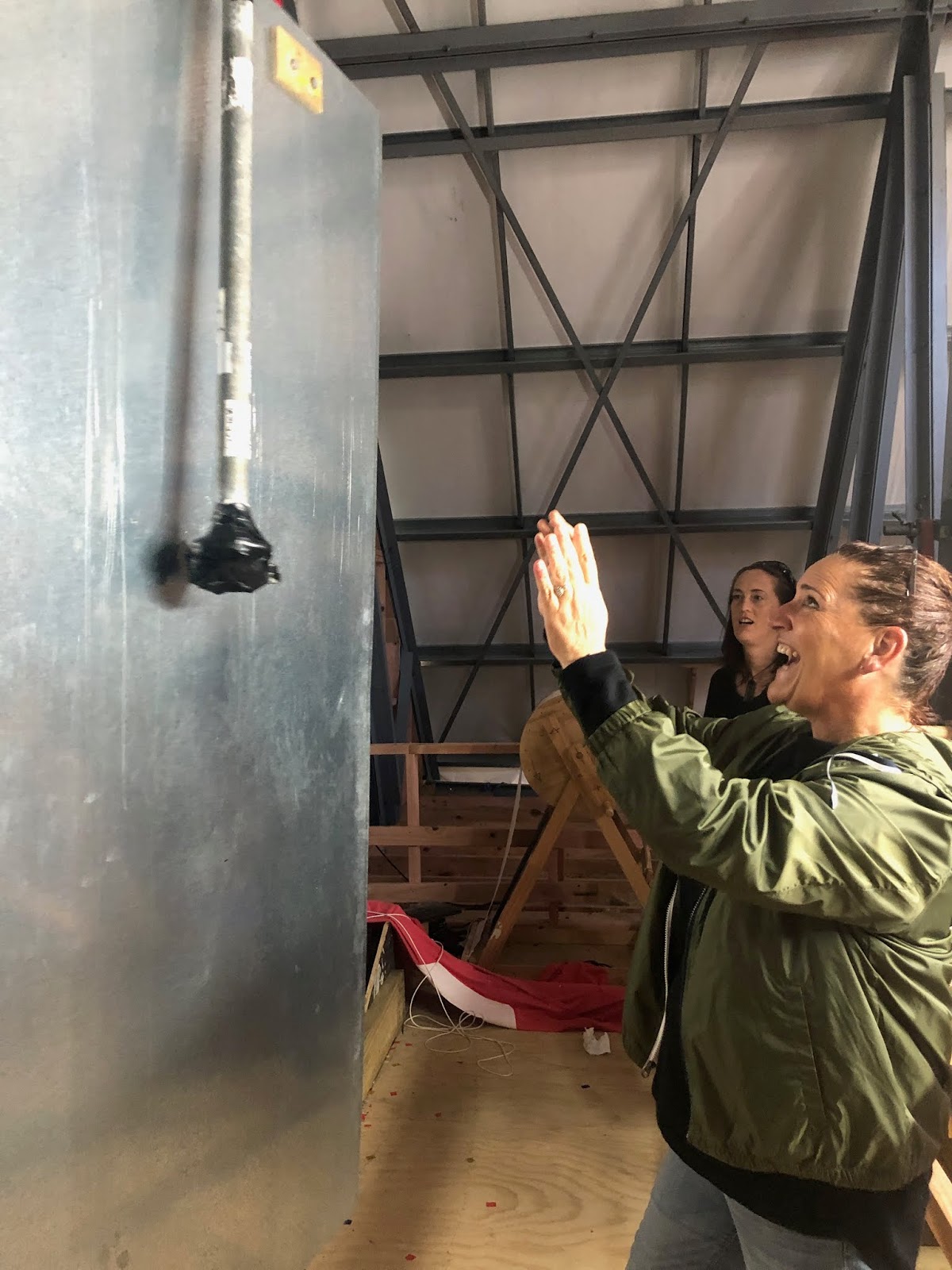
We began with a behind the scenes tour of the theatre which was really interesting. We walked through the 'rat run' and made our way to the stage. This was a perfect opportunity for us to learn about the 4th wall, a theatrical term for the imaginary “wall” that exists between actors on stage and the audience. From there we moved up the stairs to the 'Romeo and Juliet' balcony, and yes we all tried to find Romeo! We then climbed another set of stairs to find out how the sound effects are created. This was a lot of fun as this was very much a hands on experience.




Thunder Rain Wind
After exploring the space we would be working in the practical sessions began. Using the characters from A Midsummer Night's Dream we learnt how to move and speak in ways they would have. The challenge was to not only stay in character, incorporate dialogue and use gestures, but also to remember to make use of the whole stage. Easier said than done when you are completely out of your comfort zone! This activity taught us about freeze frames and travelling. We then moved onto an activity called 'Silent Movies'. This required us to choose five words from a scene, create a frozen image for each word, select a move genre and add music. Once these performances had been shared they were all put together using the entire section of the scene.
After lunch we were introduced to Romeo and Juliet, through my favourite activity of the day. Our challenge was to write a five sentence story that tells the story of two families who loathe each other and the two children who fall in love. This was a fantastic activity to practise summarising and could be used across all curriculum areas. After sharing our stories we were challenged to turn each of our five sentences into ten syllable sentences. I loved this! I noticed that I was collaborating and negotiating as my partner and I trialed, tested, adapted and changed our sentence structure and vocabulary choices.


5 sentences 10 syllable sentences
We were then introduced to the 'Shaboom' rhythm. This helped us to understand how Shakespeare used iambs, trochees, spondees and pyrrich feet to show the actors which syllables to emphasise when delivering their dialogues. Using the symbols / - helped us make sense of this before we moved onto reading a sonnet and unpacking the rhyming structure within it.
We then explored the tactics of demanding, pleading and rejecting in pairs using only the words 'yes' and 'no' as our dialogue. Again we were challenged to stay in character, incorporate dialogue, use gestures and make use of the whole stage. This was a great introduction to our final performance of reading and acting out a scene from Romeo and Juliet on stage at the Pop Up Globe!

Tuesday, 24 September 2019
Maths PD with Marie Hirst
Last week we had some fabulous professional development with Marie Hirst who showed us how we could make connections between numeracy and our Term 4 topic of Enterprise. Our session began with Marie showing a slide that asked us to discuss which option we would choose. This question was taken from the site wouldyourathermath.com. Each question encourages you to pick a path and justify your reasons why. I can't wait to introduce this challenge as I can see so many possibilities for my learners to use their number knowledge and strategies in both collaborative and independent situations.


Following on from this challenge we explored a selection of games that use money as a context for number. What I really liked about the follow up discussion was the sharing time when we shared the strategies we had used, and discussed some possible adaptations that could be made to meet the learning needs of a wider range of ability levels.

We spent the last part of the session carrying out the practical task of finding the real cost of owning a pet through exploring costs, spending and budgets. This was a collaborative task that required us to discuss, research, negotiate and strategise. This is definitely another idea I am looking forward to challenging my class. Click here to find more challenges like this on TKI.

Current Events with a difference...
During our Manaiakalani shared staff meeting a few weeks ago I listened to a number of teachers sharing the ways they cover current events in their classrooms. This sparked my curiosity as my current approach has been to encourage my learners to explore the provocation by unpacking the content, looking at the information from both perspectives before forming an opinion based on fact. What I am aware of though, is when you complete this type of task you walk away and often never refer to it again.
Teacher inquiry challenges you to look closely at your own practice. If what you are doing is 'missing the mark' or has become 'stale' then you need to get creative and find ways to adapt what you are doing to help your learners make stronger connections to the learning. I still wanted my learners to be able to talk about what was happening in the world, both nationally and internationally so I merged a few ideas I saw others doing and came up with a new approach.
I needed to make sure everyone understood the difference between national and international news so we began by unpacking these words. We then revisited author's purpose to consolidate that understanding before looking at the different reasons why a news editor would decide to run or print a story. These included timeliness, magnitude, oddity and emotive to name a few. (Idea sourced from here) This was a fantastic opportunity to gift and explore new vocabulary.

We repeated the challenge the following week with international current events. What impressed me was the retention of vocabulary and level of understanding behind the reasons news items are run and printed. Here is Alex, Jack, Joseph, Julian and Aung Naing's international current events map. These boys joined forces and had rich and deep conversations as they tried to persuade each other to come to a shared reasoning for their selections. To see the interactive map you will need to follow the link to Alex's blog.

Teacher inquiry challenges you to look closely at your own practice. If what you are doing is 'missing the mark' or has become 'stale' then you need to get creative and find ways to adapt what you are doing to help your learners make stronger connections to the learning. I still wanted my learners to be able to talk about what was happening in the world, both nationally and internationally so I merged a few ideas I saw others doing and came up with a new approach.
I needed to make sure everyone understood the difference between national and international news so we began by unpacking these words. We then revisited author's purpose to consolidate that understanding before looking at the different reasons why a news editor would decide to run or print a story. These included timeliness, magnitude, oddity and emotive to name a few. (Idea sourced from here) This was a fantastic opportunity to gift and explore new vocabulary.

I then asked my learners to find a partner and set them the challenge of finding an example of each of these types of stories using national news that they read, watched or listened to. Once they had found an example they would need to talk about their reasons they felt it was best suited to the chosen category, then plot where it took place on a google map. The only written component of this task was to include the title of the news item or article and the exact location it took place in the map pin.
This was a huge success and was something that could be achieved by all my learners, regardless of ability level. We stopped periodically throughout the lesson to share our news items and justify why these were chosen. I found that throughout these lessons I was continually modelling and reinforcing the use of the vocabulary in context.
All completed tasks were posted on our blogs. Here is one example of the learning from Mele and Marieta. To see the interactive map you will need to follow the link to Mele and Marieta's blogs.

All completed tasks were posted on our blogs. Here is one example of the learning from Mele and Marieta. To see the interactive map you will need to follow the link to Mele and Marieta's blogs.


Throughout this learning opportunity all my learners were on task and actively engaged. They were all eager to share their examples, with responses evolving to include a short summary of the content. I'm so glad that I took the time to adapt and change the way we explore current events in LS2!
Monday, 23 September 2019
T3 PBS Teacher Inquiry Check-in...
Today I met with all our staff to talk about their teacher inquiries. I asked everyone to share with me where they were at now, what changes had been made to their teaching practice and how I could support their inquiry moving forward into term 4. These were rich conversations and provided a great forum for sharing successes and bouncing ideas.

The list below reflects the common themes and recurring ideas when teachers discussed the changes made in their teaching practice to help us accelerate shifts in our learners from Year 0 to Year 8:
This was a very valuable opportunity as it showed that as a staff, we are all on the same page. No one apportioned 'blame' to students where innovations tried had not been successful. Our conversations instead, focused on changes or adaptations made when these speed bumps appeared.

The list below reflects the common themes and recurring ideas when teachers discussed the changes made in their teaching practice to help us accelerate shifts in our learners from Year 0 to Year 8:
- Teachers modelling/gifting language they want students to use in context across curriculum areas
- Increase in time spent to unpack vocabulary
- Timetable changed to cater for late students
- Phonics programmes implemented in all classes
- Changes/adaptations made to the way data is recorded to give a clearer picture of micro shifts
- Drawing connections with visual scaffolds
- Use of mentor texts as exemplars
- Incorporating elements of critical literacy to help strengthen connections
- Shifted locus of control to give students a more agentic experience in the classroom
- Increase in instructional time
- Revisiting learning when connections are not strong through rewindable opportunities and further instruction
- Making connections to prior learning
- Differentiation is needs based and can be supported with upskilling of TAs
- Adapting teaching DLOs to meet the needs of learners
- Planning for talk time
- Making use of collegial expertise
This was a very valuable opportunity as it showed that as a staff, we are all on the same page. No one apportioned 'blame' to students where innovations tried had not been successful. Our conversations instead, focused on changes or adaptations made when these speed bumps appeared.
Monday, 16 September 2019
Critical Friend Observations...
When carrying out an inquiry into your own teaching practice it is really helpful to have a critical friend who can see your practice from a different perspective. Their feedback and feed forward helps you to adapt your practice to continue to meet the learning needs of the students in your classroom. As I mentioned in a previous post, for me this person is Donna Ryan. I know what I think I do/say when I am teaching, but having Donna observe me taking a phonics session, and record exactly what she saw me do, was a valuable learning opportunity.
This is what I did/said to help my learners make the connections they needed to make sense of the learning:
From this I can see that I share control of the learning with my students, continually check that connections are being made, scaffold through questioning and teacher modelling, and reaffirm to ensure self efficacy and confidence continues to grow.
This is what I did/said to help my learners make the connections they needed to make sense of the learning:
- Recap learning from last session
- Check in to see if understanding is in place
- Co-construct the learning intention (LI) and goals for the lesson
- Asked the students "What do you need to do today to achieve this?"
- Gave students control of the learning by giving them the opportunity to choose the follow up activity
- Asked "Why are we doing this?" to recap on the purpose of the learning
- Reinforced the focus/goal as a reminder
- Modelled the learning
- Guided/scaffolded students towards next step
- Checked in to make sure understanding was in place
- Identified where they had met the LI
- Reaffirmed "I like the way you have used the commas correctly, we learnt that yesterday and this shows me you were listening carefully"
- Asked "Can you remind me what we were focussing on today?"
From this I can see that I share control of the learning with my students, continually check that connections are being made, scaffold through questioning and teacher modelling, and reaffirm to ensure self efficacy and confidence continues to grow.
Subscribe to:
Posts (Atom)