Showing posts sorted by relevance for query comment thread. Sort by date Show all posts

Thursday, 6 August 2020

Learning how to leave a Comment Thread...

The image below shows the first comment thread to appear in our 2020 learning journey. This has been a goal of mine since hearing the SLJ feedback that our student's post to comment ratio was very unbalanced with comments being an area that was not focused on. I felt from the outset that this was not because they were lazy or disinterested, but rather because they were not sure of how to do this. After all if you don't know, you don't know.


In my now weekly focus group meet up, I used the whiteboard to show my learners what a comment thread looked like, unpacked the process and identified the purpose. Explicit teaching, think alouds to promote co-construction opportunities and modelling of the task was very much the order of the day. 

Creating a comment thread is this week's blogging challenge. As a group we decided that a 6 comment thread would be achievable so that became the benchmark. Each person was buddied up by me so that when thinking about ability and confidence levels we created a tuakana teina relationship. To meet the challenge each pair needed to write quality blog comments on each other's blogs in order to have a learning conversation that allowed them to revisit and strengthen their connections to the learning. The choice of blog post was left up to the individual.

I look forward to seeing how this evolves and am curious as to what support my learners will need from me in order to sustain this momentum.

Thursday, 20 August 2020

Keeping my Inquiry going in Level 3...


Level 3 saw our weekly planned group meeting move from face to face to online. We have these meetings to reflect on the challenge from the previous week and set ourselves up for the current week's challenge. 

As I mentioned in previous posts, this term my focus students have created their own blog commenting challenges to help them develop the quality of their comments and strengthen their connections to our learning. Last week's challenge built on from the previous week's challenge of creating a comment thread of three comments, to creating a comment thread of five comments. By increasing the number of interactions my learners are now able to see this is an authentic way of having a learning conversation. 

The content below is an example of the our challenge. I have copied the comments directly form the blog to maintain anonymity but am sharing this will full permission from my learners.
                           

Comment Thread:

Kia ora G2
I liked reading your blog post today. All the information in the blurb and document makes your blog post very informative. I liked that the document consists of the information related to the topic and the blurb consists of the information on what you did in school. Did you find the concept of summarizing the text easy? If yes, than in what way and what are the advantages?
                             ___________________________________________________________________
Kia Ora G5
Thank you for commenting on my blogpost today! I think with alot of information from videos and online sites the concept (science) was quite easy to summarise. Me and my group all collaborated to complete this task. Did you and your group find this concept easy to summarise?
                             ___________________________________________________________________

Thank you for replying to my comment! Me and my group also found watching the video and learning from various sites quite informative and knowledgeable. We thought that the summary table made our work easy as well. I think that using the poster notes as a way of moving the important points ahead was the best strategy as it was new and we could write notes in a more detailed version. What were the three facts (related to science) you found most interesting in the whole task?
                            ___________________________________________________________________

I also think using the poster notes were quite helpful. In my opinion, the 3 most interesting facts about science that I found were:
Science is divided into 3 branches, Physics, Biology, and Chemistry.
Basic science is knowing something and applied science is using what we know.
Science is the knowledge behind every question.

What were the 3 facts you found interesting? Or, what were the 3 most vital information you and your group found using the poster notes?
                             ___________________________________________________________________

I agree with all the interesting facts you have said! In my opinion the three most vital and interesting facts I found were:

1. Applied science is dependent on basic science as the experiment is done first and the conclusions and discussions are done later.
2. Science can be quite dangerous as well as beneficial. It all depend on the way it is used and seen.
3. Science is used in the most basic tasks in life such as making a lime juice. Mixing lemon and sugar results in juice is chemistry, the force through which it is mixed is physics and the benefits we get from drinking it is biology.

Do you know any other experiment which includes all the three branches? (Physics, Chemistry and Biology) If yes, then what is it?
 ___________________________________________________________________

Your 3 most vital facts look very interesting! I think an experiment using all 3 branches would be making a coffee using coffee beans which comes from biology (nature) then you apply force to grind the the coffee beans together which comes under physics. Then lastly combining the grinded coffee with hot water and milk making hot coffee.

Did you know some points about science before did this task?
 ___________________________________________________________________

Wow, I never thought that making coffee also includes all the three branches of science. Yes, I knew that science is divided into three branches which are Chemistry, Physics and Biology as I have studied the various topics under it in India. I also knew the steps included in an experiment which is the things needed or requirements, method or hypotheses, experimenting or verification and at the last the conclusion or answer. Did you know that each branch is related to a different occupation? Doctors study biology, Mathematicians study physics and scientists study chemistry! Which branch do you like the most and why?
 ___________________________________________________________________

I never knew that each branch is related to a different occupation! In my opinion the branch I enjoy learning about has to be Geology and Astronomy. Even though it is not apart of the 3 branches it is still included. I think Geology and Astronomy because I enjoy learning about celestial objects and the terrestrial planet. Which branch do you like/enjoy learning about the most?
 ___________________________________________________________________

I never knew you liked geology and astronomy. I also love to study about the life outside our planet! I really like all the four branches but I enjoy learning about biology as my desired career is to be a doctor. I think that except of learning about our own body we must also learn about other living and non-living organisms as well. Biology is also my favorite branch because it still has some unsolved mysteries like the fungus and other micro-organisms are still not defined as living or non-living. I really want to find a conclusion to many such unsolved mysteries in life. Can you tell three different topics each in the three branches of science?
 ___________________________________________________________________

Wow! Becoming a doctor sounds very interesting! Three different topics for the 3 branches would be:

Physics - gravity, light and force

Chemistry - acids, bases and heat
Biology - plants, animals and humans


Thank you for commenting on my blog! It was really nice talking to you and learning about each other's opinions. I hope you feel the same way and you like my other blog posts too.


I am continually amazed with the direction this intervention is taking. The quality and content of these threads is far beyond what I initially hoped for. Our challenge over the next few weeks is to create a collaborative DLO (online) that will show others what a comment thread looks like and how they can create one. The purpose behind this challenge according to my focus students, is to create a learning tool that we can use to help all of our class understand that we can use blog comments to help us strengthen our connections to our learning by asking questions and sharing our thinking. 
Monday, 16 November 2020

TAI 2020 WFRC # 9 To what extent were the changes in teaching effective to changing patterns of learning?

To gain a clear picture of the changes that have been made to patterns of learning I looked at patterns in their historical achievement data and analysed the shift data (PAT Reading and Maths, STAR and e-asTTle writing) of the Year 7 students in my focus group. To establish a norm across my classroom, I have compared their results against the remainder of my other Year 7 students whose data was captured at both time points. Additionally I have compared the student voice captured at Time Point 1 with the student voice captured at Time Point 2 as this best reflects the growth this learning journey has taken these students on. 

Assessment Data


Scale Score Shift Analysis

'The average scale score progress for each year group is described by a benchmark scale score for each year level from the Term 1 trials. They can be used as a guide to compare individual student /class progress between two assessment time points.' - source NZCER

I noticed student engagement, work completion rates and the confidence levels of my focus students increased when new learning was introduced and unpacked. This pattern was evident both in the classroom and during distance learning. This confidence did not always transfer to assessment situations. Student G71 and student G73 although both focused and engaged in class, seem to completely freeze when the task ahead is an assessment task. Their results do not reflect the work produced or quality of learning conversations I observed in class. This pattern is historic and shows me that next year I need to build self efficacy in this area.

Learning intentions gave us the purpose for the learning and once the connection was truely made to the value of understanding this, blog posts became easier to write in all curriculum areas. Content specific vocabulary was used to explain and discuss learning both in class and on blogs. This meant that comments on blogs linked specifically to the learning and threads that followed replicated learning conversations in the classroom. 

Questioning was another area we focused on. Once my students understood the power of open questions the quality of online interactions in blog comments became much richer. I noticed in class that my focus group students were the students who asked the most questions during learning time, something that became evident in emails to me to clarify understanding during distance learning time too. 

Student Voice


The Time Point 1 student voice data (captured 4/5/20) shows that all my focus students were aware of the purpose of commenting on others blogs, but when we unpacked this further I discovered that these were the words they had heard during cybersmart lessons and that they did not truly understand the value their feedback could have on their peer’s learning. The Time Point 2 slide shows these students have made a significant shift in their thinking as they have strengthened their connections to the purpose behind commenting on blogs. A possible reason for this is that blog commenting has a place and a purpose in our classroom.

B72: We comment on blogs so that we can give feedback and give them gratitude about their work (TP1)

B72: We comment on blogs to give positive feedback to someone’s blog post to help them improve their blogs. Commenting also gives us the opportunity to ask questions about their learning, by doing this we can create a comment thread (Blog Conversation). (TP2)

My initial hunch was that our students weren’t commenting because they were 'lazy' (even though they identified this as a reason in Time Point 1), but possibly because as teachers, we had not set them up for success in this area. When I saw their responses I knew that I was on the right track. This data has been unpacked in an earlier post. The Time Point 1 slide below (captured 4/5/20) . The Time Point 2 slide shows these students have made a significant shift in their thinking as they have strengthened their connections to the purpose behind commenting on blogs. A possible reason for this is that blog commenting has a place and a purpose in our classroom. 

G74:
I usually don’t comment because I’m not sure what to write. (TP1)

G74: 
For me it's not finding the L.I so I can understand the learning. This is very tricky because I can’t make a connection with them, and it is also very hard to find a question about their learning to try and help them fix their mistake. (TP2)

At the time this student voice was captured we were well into the first lockdown of 2020. I met with my target group on Google Meet. We had an open and honest discussion, and used this collaborative DLO to capture time point 1 student voice data and establish the group's understanding of how to write a quality blog comment. Posting and commenting on blogs during this time needed to be seen as a valuable part of the learning process so I set off on my quest to change their mindset and establish the purpose behind these two very important parts of our digital learning journey. Basically we reminded ourselves how to write a quality blog comment by co-constructing a collaborative comment and learnt how to create a comment thread. My learners then paired up and practised leaving comment threads on each others blog posts. As I have said earlier, I felt from the outset that this was not because they were lazy or disinterested, but rather because they were not sure of how to do this. After all if you don't know, you don't know.

One major hurdle we found as we began our challenge was that many students had become complacent when it came to including a learning intention. As one student said, ‘If I can’t find the learning, how can I comment on it?’ So rather than seeing this as a hurdle we couldn't climb over we decided that as a group we would model best practice. Baseline evidence unpacked here, had shown me that I not only needed to revisit how to write a quality blog comment, I also needed to revisit how to write a quality blog post. 

I knew from observations in my class, and other classes across our school, if students are asked to have a ‘learning conversation’ they will confidently carry out a conversation using content specific language and learning intentions to give their partner (or group) feedback and feed forward connected to a completed task. However before I could expect to see this taking place I needed to make sure that my learners were creating quality blog posts that clearly identify the purpose of the learning, a detailed explanation of the task and a personal statement linked to something they found interesting or where they feel they did something well.

.

TP1                                                      TP2

Comparisons between blog post content in the earlier part of the year and blog post content now is poles apart. 'Today we had to...', or 'Here is my my DLO of...' has been replaced with clear learning intentions and detailed explanations of tasks. I have noticed that content specific vocabulary is defined when included in a blog post, and used to build content. This shows learning in the classroom is being transferred in a way that shows connections have been made.

The challenge for my learners this year was to be able to create comment threads on blogs to help strengthen their own connections to the learning. I wanted my learners to refer to the learning intention and confidently use content specific language when giving feedback and feed forward. I wanted them to ask questions that provide opportunities for those receiving the comments to justify their thinking, and I wanted them to understand that giving and receiving blog comments is an important part of our learning. So has this happened?

In a nutshell yes! However, this success is not yet the norm for all my learners. The reflections here pertain only to my focus students. I chose to work with this group of Year 7 students this year so that I was able to move into 2021 with an 'expert' group who could both model and teach their peers how to strengthen their connections to the learning through blog commenting.

Saturday, 25 April 2020

Cybersmart Observation...

Edit: This observation took place in February 2020

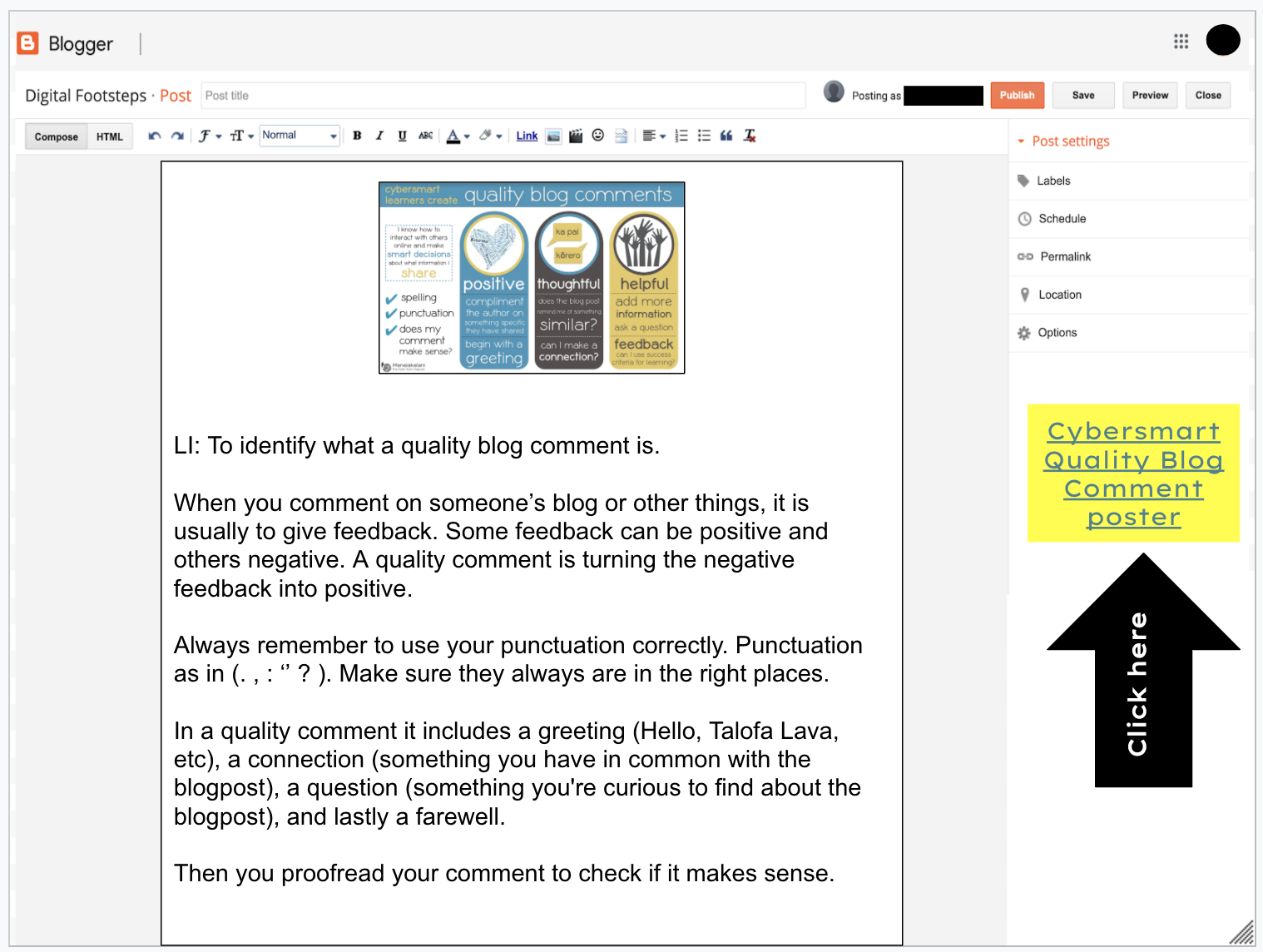
Over the summer period my class took part in the Summer Learning Journey. As a school we did extremely well as far as participation and output, but dropped the ball as far as commenting was concerned. Our students actively commented on the blogs of other participants but did not comment in a way that created a thread of comments. I didn't know how to strengthen this understanding so I asked Heather Collins, one of our Manaiakalani facilitators to model a Cybersmart lesson for me. We have access to a wealth of Cybersmart resources but as someone who has been a part of Manaiakalani from the beginning I have not had the opportunity to observe one of these lessons first hand. 

Here are the notes I took:
  • Begin by stating the purpose of the lesson (- this linked to the reasons I have mentioned above)
  • State the Learning Intention - LI: To create a thread of comments
  • Display the 'Quality Blog Comments Poster' and unpack
  • Ask students to generate sentence starters for 'compliments'
  • Model how to write a quality blog comment using a student blog post (promotes a connection)
  • Explain that a question has been asked so now needs a reply.
  • Ask: How might you reply to this comment?
  • Co-construct a reply

Where to next:
  • Actively plan time for students to comment on blogs and respond to comments on their own blogs.
  • Revisit the Manaiakalani cybersmart lessons to access the resources available. The shared language of instruction will help my learners to continue to build on and strengthen the knowledge they have, and will scaffold and support my students new to Manaiakalani this year.
  • Make a display that reflects our unpacking and understanding of how to write a quality blog comment - make it visible - keep it visible.

Wednesday, 18 October 2017

PBS Holiday Blogging Update

Wow! Just Wow! I can not believe how well our leaders and bloggers stepped up to this challenge. Last term I was trying to think of a way to keep the learning conversations and achievement gained over the term in our class, going over the holiday period. To do this I came up with the idea of creating our own holiday blogging challenge that was loosely based on the Woolf Fisher Holiday Blogging format. 

I know my learners and I know that if true buy-in was to take place the task design needed to be created by my learners for my learners using the language we use in our learning environment. As mentioned in my previous post our student leaders were challenged to set this up for their peers. We decided to go on a virtual trip around Auckland visiting the Sky Tower, Rainbow's End, Kelly Tarlton's, the Museum and the Zoo. Each task required my learners to use their smart searching skills to find and use the information provided on each of these websites to create a DLO or respond to a question that was then posted on their blogs.

This was not sold as a compulsory task but rather a way of strengthening their 2017 learning journey. 27 students signed up to take part and out of those 23 completed the challenge during the holiday break, with 5 more students electing to complete the tasks this week. 2 students took responsibility for not taking part and emailed me their reasons and 3 decided not to complete the challenge. Once again we had a significant number of boys take part. Our leaders had organised who would monitor which day and our participants had to take responsibility for adding their links to our Holiday Blogging Record. This worked extremely well and has given me a wonderful piece of learning evidence. 

The focus of my CoL inquiry this year has been to see how I could get my learners talking about their learning. In total our learners published 208 blog posts and between them made 924 comments on each other's blogs. From a teacher perspective that is 924 times that someone read a blog post, noticed the successes and errors, and gave their feedback and feed forward. Many of these comments are part of a thread which means learning conversations have taken place and are embedded in our learning culture!


Screenshot of the student managed blog post and comment record