Showing posts with label Inquiry Questions 2023. Show all posts

Sunday, 5 November 2023

Exploring Qualitative and Quantitative Data...

Each slide below contains the comparative data gathered from time point 1 and time point 2. Underneath the graphs I have analysed the shifts in more detail. It is important to note here that I have only analysed the data gathered from the 15 students in my literacy group that present both data collection times.


What I noticed as a result of my intervention was that once the knowledge of simple rules and/or conventions of spelling was in place, the challenge element was lost. If I wanted the momentum to continue I quickly realised I needed to adapt and change my thinking and my approaches.

As mentioned in my previous post, the fear of spelling a word wrong or choosing a simpler word seemed to have been left behind as the desire to use the words was more powerful. The learning became about the words and not the hurdles that prevent them from being used. The more I used these words, the more my students used them. Being confident to use and apply more sophisticated vocabulary in context accurately became the norm. My expectations were clear and I noticed that as my student's confidence grew the higher my expectations became. The exciting part was the students took ownership of this challenge and regularly helped each other find the words to use to shift responses to the next level. Student created and driven tally charts evolved as a way of monitoring that everyone had used their word twice, with the others in their group prompting those who had not met daily challenge. 

An interesting observation with the word gifting strategy was when I physically gave my students a piece of paper with their word on it, the ownership and connection to that words was much stronger than when we used a randomiser wheel to select our words. I feel this was because the words on paper could be physically touched, seen and used. Making the gifted words digital made them more abstract. Maybe this was a step too far too quickly, as looking back we overlooked the consolidation step. 

Student voice gathered at both TP1 and TP2 and collated in the DLO above, allows for a comparison of student voice and attitudes towards spelling. To collect this data we used a Google Form survey to get to know our class as spellers. I have edited the original survey responses to reflect those only from my focus group who were present at both time points.

The comparison between the two timepoints (all analysed in the DLO above) shows there are some positive shifts happening in mindsets but when looking closely at how my learners see themselves I see we have a long way to go. This is possibly due to the historical belief that I can't spell it so I won't use it, ESOL obstacles and a fear of getting it wrong. This will definitely take more than a year for change to cement itself, but as we close our 2023 learning journey's deep dive into word consciousness, I feel confident we have laid some strong foundations to build on.

Saturday, 4 November 2023

Describe and explain the changes/tweaks you have made in your practice along the way...

As I have previously stated, motivation is intrinsically related to engagement. If my inquiry this year was to make an impact on my learners achievement, I needed to find engaging and purposeful ways for my learners to embrace the challenges that come from being introduced to a wide variety of new vocabulary. At the start of the year I felt that the hurdles in front of us were connected to spelling and my learner's connections to rules of spelling. Time point one spelling and writing assessments showed a huge disconnect between how words sounded and what my learners appeared to hear. 

I began by capturing my learner's attitudes towards spelling through the e-asTTle self reflection analysis and through a survey that helped me get to know my learners as spellers. There were definitely some eye opening results with the fact spelling was seen as important but this group of students did not see themselves as being good at spelling with the majority choosing to use an easier word when the one they wanted was not one they could spell. Traditional spelling activities were suggested as ways of strengthening our connections to the conventions of spelling but I was excited by this. I remember as a child learning my words, getting them all correct in the weekly test then never thinking about them again. I didn't see the purpose of the test then and I couldn't see it now. I do remember the students who rarely found success in this activity spending many Fridays in the sickbay. I did not want that pattern to develop so I knew what ever we did it had to be fun, purposeful and achievable. This where, following an online PD session with Louise Dempsey that I blogged about previously, our journey into the world of affixes began.

What I noticed here was that once the knowledge of simple rules and/or conventions of spelling, (eg: dropping the 'e' off a base word before adding the suffix 'ing') was in place the challenge element was lost. My learner's enjoyed the activities but I noticed the time taken to complete them became shorter, and the reliance on the dictionaries to create new words from a base or root word was becoming less and less. Therefore it was time to make some changes to keep the learning and motivation going. 

Change came after a meeting with Dr Jacinta Oldehaver. I explained my dilemma and asked if there were any readings she knew of that might support my word consciousness journey. Jacinta shared a reading with me about the word gifting experiences of Sylvia Ashton-Warner. I was about to begin a new T shaped literacy focus and needed to find a way to help my learners connect with the sophisticated vocabulary associated with the unit that they needed to be able to use and apply in context and independently. This post will explain what we did. In a nutshell, what began as a focus on spelling conventions and rules quickly morphed into an inquiry into word consciousness which involved my learners 'being aware of new words, their meanings, and how these words are used. Students who are conscious of the words they are meeting are motivated to learn them and use them. 

Student responses to the texts reflected an accurate use of words most had not heard of before, being used both in extended discussions and in the justifications of their thinking. A definite win here! My learners thrive on challenge so as explained in the link to the post above, I added the challenge of each person being required to use their word twice each reading lesson. I noticed that both of my groups had created a tally sheet so the score was kept. I view that as intrinsic motivation at its best! 

The fear of spelling a word wrong or choosing a simpler word seemed to have been left behind as the desire to use the words was more powerful. I was able to quickly correct spelling errors with a hotspot style workshop that used the conventions of spelling as a reference point. To consolidate that part we used the dictionaries (our version of 'paper google'), to find other words that followed these conventions so that we could make the all important visual and auditory connections needed. The learning became about the words and not the hurdles of the order the letters are written, that prevent them from being used. My part in this was to model the use of these new words we were meeting across the curriculum. The more I did it the more my students did it. The key learning here as their teacher is, if I want something to happen I need to walk the walk, talk the talk and continually drive the challenge outside of the context in which the words were actually met. You can not simply introduce something and leave it there. New learning must be revisited and used if it is to become internalised knowledge. 

The graphic below is something I found after I had been on my inquiry journey. This reaffirms the direction I took to shift student achievement and change my practice was the right one. The reading component in the graphic below aligns with the T shaped literacy units of Great Beginnings, Representation and Genre that I have been doing as part of a research initiative lead by the University of Auckland.
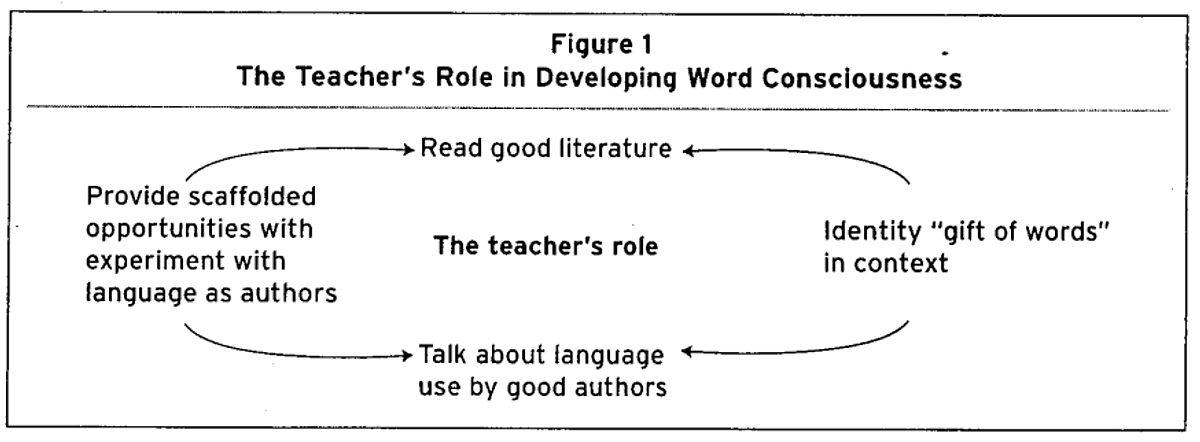
Gift of Words 2

Graphic retrieved from here

Being confident to use and apply more sophisticated vocabulary in context accurately was a huge step towards changing mindsets. I know this helped us make shifts in literacy in the classroom this year and am looking forward to seeing if there has been a change in the types of words used in our time point two writing assessments. By strengthening students connections to vocabulary and the spelling conventions that accompany these new words, I hoped to see a change in attitude towards word choice which would be transferred to personal writing, higher levels of self efficacy and an overall shift in achievement so that a higher number of our learners are achieving at or above the expected norms in literacy. The most noticeable change has been the change in the mindsets of both myself and my students. 



Restating my inquiry question and chain of events...

This year I want to find out if a focus on spelling conventions foster an environment where word consciousness strengthens connections to the learning? Creating a causal chain helps me stay focused on the purpose of my teacher inquiry. We all know how easy to fall down many rabbit holes along the way so having a causal chain to look back on helps to keep me on track and visualise the end point. My initial post to introduce my causal chain is here.

At the start of term 2 my role in our school changed dramatically. I went from being one of three deputy principals to being the only DP. This change aligned perfectly with the start of my ERO journey so as I'm sure everyone will appreciate, my focus and time was spent co-constructing our matrix evidence. I found I was spending less time in the classroom and more time meeting the commitments of my DP role. Fortunately our students weren't bounced from reliever to reliever as Dianne took on the leadership of our day to day teaching component and I tried as hard as I could to be both a teacher and a leader. I quickly realised that I needed to let go of many of the lessons I loved teaching. The only one I held steadfastly to was literacy. That part was non negotiable. I was one year and one term into my T shaped literacy journey and didn't want to let that go so I had to learn how to be present in both roles. The flip side of this was that although I was using my teaching time to work towards increasing my learner's confidence using more powerful vocabulary and exploring affixes in an attempt to strengthen phonological and spelling awareness I did not blog my journey formally. Instead I had a Google doc full of notes that I knew I would be able to transcribe at a later date.

I capitalised on the PD provided as part of the T shaped literacy initiative and attended a number of online PD sessions run by The Literacy Place. This helped me grow as a teacher who knew I needed to model what I wanted my students to replicate. Looking back at the 'intervention' box on my causal chain kept me on track. I ended up using this like a checklist which meant I had a plan and was able to stick to it to help me achieve the goals I set for myself. When looking through my student's eyes, the reading responses both oral and written, to questions and provocations provided by our T shaped units, has continued throughout the year to be our record of their shifts in the complexity of their vocabulary choices from experimental to mastery. 


Sunday, 23 April 2023

Qu 4: Collecting evidence and data...

Begin to collect evidence and data and come to the next session ready to share your preliminary findings about the nature and extent of the student challenge i.e. using your baseline student data and evidence.

I will use this opportunity to introduce the group of students I will be working with on this inquiry this year. There are 19 students in this group of year 7/8 students (5 Year 7 girls, 3 Year 7 boys, 3 Year 8 girls and 8 Year 8 boys). When referring to the Writing and Spelling data, these students have been identified as our most able students. 


What I noticed when looking closely at their e-asTTle results was that our Year 8 students scored well in their vocabulary choices, possibly due to the increased levels of vocabulary they gained from actively participating in the Reading for Enjoyment and T-shaped literacy initiatives last year. The Year 7 students however, chose to play safe and use the words they knew how to spell. One example of this evident in a comparison of two of the Term 1 e-asTTle writing explanations on the same community facility. The Year 8 student referred to the facility as 'appealing' and 'affordable', whereas the Year 7 student explained that it was 'fun' and 'didn't cost much'. 

My next steps are to explore ways I can grow vocabulary, the knowledge of words and word meanings so that the words met on this journey are transferred from where they were found, to my learner's personal word banks. 


Wednesday, 12 April 2023

Qu 3: Building an accurate profile of students' learning - tools, measures and approaches...

Describe the tools/measures/approaches you plan to use to get a more detailed and accurate profile of students’ learning in relation to that challenge. Justify why you chose these approaches and tools.

Vocabulary refers to the knowledge of words and word meanings. Helping students become word conscious is a crucial endeavour for teachers across all levels, and more so for teachers working with students whose prior vocabulary exposure may be limited. One of the biggest hurdles I have observed when I ask my learners to complete a writing task is their problem solving skills when it comes to vocabulary choice. At some point in their learning journeys so far our learners have formed the mindset that making a mistake when spelling is not ok. This deficit mindset causes problems when it comes to experimenting and/or taking risks with new vocabulary. Additionally it stops the flow of writing and results in many students just giving up or embracing the idea that they simply are not good at writing or spelling. 

Dianne and I are carrying out a collaborative inquiry this year but have chosen at this point to work independently with different groups. Dianne chose the students who find spelling a challenge which has left me with the students who are more able spellers. Having collected the baseline data and captured student voice (shared in an earlier post), we have decided to adopt the strategy of divide and conquer. Our ongoing conversations about the spelling hurdles we need to 'knock down' have opened our eyes to the fact our students who struggle with spelling need a different intervention than those who have some understanding. We want our students to take risks but are fully aware that those who see themselves as 'not good at spelling' need to revisit the basics in a safe space where they feel empowered. 

The analysis below reflects the responses of the attitude towards spelling of the 25 students in our class who have shown in our data to be our more able spellers. When responding to the e-asTTle attitude question, ‘I am good at spelling’. 70% of these students see themselves as being good spellers, while in contrast 30% do not. It is the mindset of the 40% who’s thinking I need to change.


The tools/measures/approaches:

Planning changes:

Making time to implement anything needs to become a reality if any success is to be achieved. We have a dedicated time for Word Consciousness in our timetable so that we are accountable for teaching it and our students see this as something we value. In my group I have a mix of book work and digital work. We use dictionaries and thesaurus' to build skills and work both independently and collaboratively.

Student Voice:

Gathering student voice is a vital part of teaching. It gives us a clear picture of where our students are at, what they're thinking and what we need to do to allow of learners to make their individual connections to the learning. We have devised a Spelling survey which will completed at the end of each term, allowing us to measure both the small and big changes. 

Peters/e-asTTLE Assessments:

Analysing these results gives us a clear picture of what our students can do and where our knowledge gaps are.  We will use these results to inform our planning and identify shifts in achievement. 

Next steps:

  • Explore creative and fun ways we can grow our word consciousness culture in our class
  • Make word consciousness visible in our class
  • Explore success in our school, other schools and other clusters 
  • Professional Readings/ PLD
  • Use student created DLOs as exemplars 


To sum up, we think limited word knowledge is the problem and now need to find out why it is the problem. It is not about weekly spelling lists, but rather meeting, noticing, unpacking, understanding, exploring and using a wider variety of words across the curriculum that will hopefully strengthen the spelling ability and word consciousness of the students in LS2 2023. Looking forward we feel that by addressing this now we will open the doors of learning wider when it comes to the transition into Year 9.