Showing posts with label Word consciousness. Show all posts

Saturday, 4 November 2023

Describe and explain the changes/tweaks you have made in your practice along the way...

As I have previously stated, motivation is intrinsically related to engagement. If my inquiry this year was to make an impact on my learners achievement, I needed to find engaging and purposeful ways for my learners to embrace the challenges that come from being introduced to a wide variety of new vocabulary. At the start of the year I felt that the hurdles in front of us were connected to spelling and my learner's connections to rules of spelling. Time point one spelling and writing assessments showed a huge disconnect between how words sounded and what my learners appeared to hear. 

I began by capturing my learner's attitudes towards spelling through the e-asTTle self reflection analysis and through a survey that helped me get to know my learners as spellers. There were definitely some eye opening results with the fact spelling was seen as important but this group of students did not see themselves as being good at spelling with the majority choosing to use an easier word when the one they wanted was not one they could spell. Traditional spelling activities were suggested as ways of strengthening our connections to the conventions of spelling but I was excited by this. I remember as a child learning my words, getting them all correct in the weekly test then never thinking about them again. I didn't see the purpose of the test then and I couldn't see it now. I do remember the students who rarely found success in this activity spending many Fridays in the sickbay. I did not want that pattern to develop so I knew what ever we did it had to be fun, purposeful and achievable. This where, following an online PD session with Louise Dempsey that I blogged about previously, our journey into the world of affixes began.

What I noticed here was that once the knowledge of simple rules and/or conventions of spelling, (eg: dropping the 'e' off a base word before adding the suffix 'ing') was in place the challenge element was lost. My learner's enjoyed the activities but I noticed the time taken to complete them became shorter, and the reliance on the dictionaries to create new words from a base or root word was becoming less and less. Therefore it was time to make some changes to keep the learning and motivation going. 

Change came after a meeting with Dr Jacinta Oldehaver. I explained my dilemma and asked if there were any readings she knew of that might support my word consciousness journey. Jacinta shared a reading with me about the word gifting experiences of Sylvia Ashton-Warner. I was about to begin a new T shaped literacy focus and needed to find a way to help my learners connect with the sophisticated vocabulary associated with the unit that they needed to be able to use and apply in context and independently. This post will explain what we did. In a nutshell, what began as a focus on spelling conventions and rules quickly morphed into an inquiry into word consciousness which involved my learners 'being aware of new words, their meanings, and how these words are used. Students who are conscious of the words they are meeting are motivated to learn them and use them. 

Student responses to the texts reflected an accurate use of words most had not heard of before, being used both in extended discussions and in the justifications of their thinking. A definite win here! My learners thrive on challenge so as explained in the link to the post above, I added the challenge of each person being required to use their word twice each reading lesson. I noticed that both of my groups had created a tally sheet so the score was kept. I view that as intrinsic motivation at its best! 

The fear of spelling a word wrong or choosing a simpler word seemed to have been left behind as the desire to use the words was more powerful. I was able to quickly correct spelling errors with a hotspot style workshop that used the conventions of spelling as a reference point. To consolidate that part we used the dictionaries (our version of 'paper google'), to find other words that followed these conventions so that we could make the all important visual and auditory connections needed. The learning became about the words and not the hurdles of the order the letters are written, that prevent them from being used. My part in this was to model the use of these new words we were meeting across the curriculum. The more I did it the more my students did it. The key learning here as their teacher is, if I want something to happen I need to walk the walk, talk the talk and continually drive the challenge outside of the context in which the words were actually met. You can not simply introduce something and leave it there. New learning must be revisited and used if it is to become internalised knowledge. 

The graphic below is something I found after I had been on my inquiry journey. This reaffirms the direction I took to shift student achievement and change my practice was the right one. The reading component in the graphic below aligns with the T shaped literacy units of Great Beginnings, Representation and Genre that I have been doing as part of a research initiative lead by the University of Auckland.
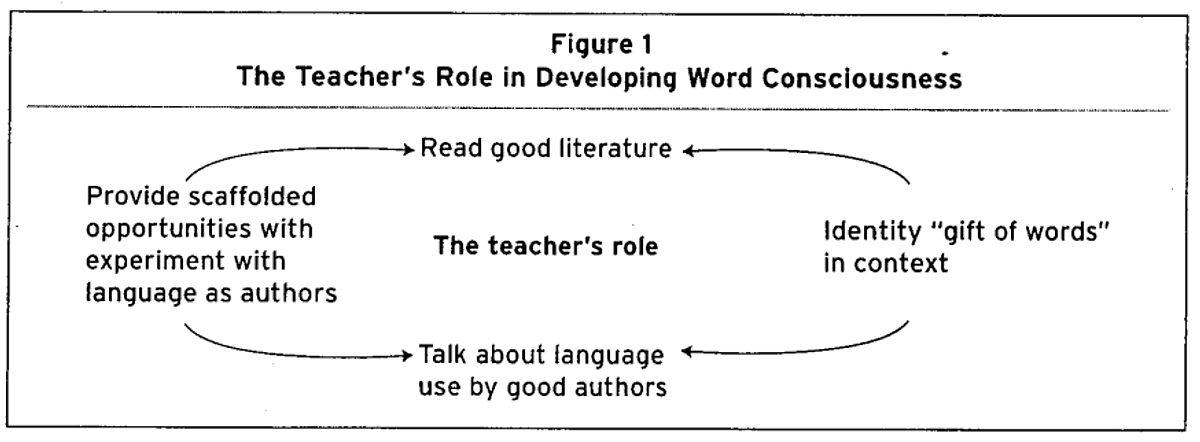
Gift of Words 2

Graphic retrieved from here

Being confident to use and apply more sophisticated vocabulary in context accurately was a huge step towards changing mindsets. I know this helped us make shifts in literacy in the classroom this year and am looking forward to seeing if there has been a change in the types of words used in our time point two writing assessments. By strengthening students connections to vocabulary and the spelling conventions that accompany these new words, I hoped to see a change in attitude towards word choice which would be transferred to personal writing, higher levels of self efficacy and an overall shift in achievement so that a higher number of our learners are achieving at or above the expected norms in literacy. The most noticeable change has been the change in the mindsets of both myself and my students. 


Monday, 28 August 2023

Celebrating the win...

This week the words I heard in our class speech competition completely stopped me in my tracks. Standing in front of an audience of their peers was every member of my reading groups confidently used the vocabulary we have encountered, unpacked and explored throughout our Reading units this year in context. Gone were the usual go-to's and in their place was a plethora of sophisticated vocabulary. This is a win in every sense of the word! 

To give my last sentence some context, the previous week I had taught an explicit lesson on speech writing. This lesson contained exemplars at a variety of e-asTTle writing levels. That meant my learners were exposed to a healthy mix of simple and more powerful vocabulary. One of our challenges involved applying our knowledge language features to edit an exemplar and move it to the next level. This is where my students very sound understanding of the more powerful vocabulary needed came to the fore. This then lead to a rich discussion as each group discussed their vocabulary choices and explained why they had made these changes. We applied the same strategy to levelling up the structural features.

Unfortunately the next few days saw me off sick, which meant my learners were left to work independently on their own speeches. I did share explicit instructions via email but knew these students would be working without guided teacher support. The comments tool in Google docs definitely gets a shout out here. I shared my feedback and left them to it. Move forward to today. I saw and heard the outcome of explicit teaching, creative ways of helping my learners connect to new and powerful vocabulary and a year long focus on affixes in action. 

My next step is to record some of these speeches that will be uploaded here so that I have a permanent record of what success looks like.

Monday, 21 August 2023

Listening to my Learners...

Collecting student voice is one of the most powerful forms of feedback. As the strategy of word gifting was new for us I wanted to see if my thoughts aligned with the thoughts of my learners. To capture this I shared a Google form with the students in my reading groups. The slides reflect the responses.

The questions I asked were:

  • What did you like about the vocabulary gifting in Reading?
  • What might you do differently to get to know the new words in Reading?
  • How did this help you in the Representation topic?


Implement and Try#2: Word Gifting...

I have been approaching my inquiry into word consciousness as a whole language focus and not simply looking for opportunities to strengthen spelling skills. This term I have actively planned for opportunities to adopt the word gifting strategy that Sylvia Ashton-Warner used to elicit key vocabulary. 

Making Reading Meaningful - Sylvia Ashton-Warner and the Language Experience Approach by Sherron Killingsworth Roberts points out that by embracing some of the guiding principles for practice of Sylvia Ashton-Warner’s work in developing the Language Experience Approach (LEA) we can strengthen the connections our tauira have to the more challenging topic based vocabulary needed to make sense of new learning. The principle that resonates most with me is to offer ongoing, authentic language and literacy experiences, including lots of opportunities to speak, listen, read, write, and think about their own and others’ words.

In my reading program this term I have been focusing on the concept of representation in texts. This unit was designed as part of the T-Shaped literacy PLD that I have been on with the University of Auckland for the past two years. In each unit there is a vocabulary component that we up until now have unpacked as a class. This time around I decided to make a few changes, with the most powerful change being to gift the content specific vocabulary to my learners. 

The first thing I did was to create a list of the words and their definitions. These were then cut up and placed face down in front of the groups. After everyone physically selected their card the next challenge was to find the their partner by matching the word to its meaning. We needed to establish ownership of these words so the challenge to use their specific words twice each reading lesson was laid down. To ensure this happened my learners were asked to bring their word to every time we had reading. These word cards were not pretty or laminated but became a part of every reading lesson as along with ownership came a sense of responsibility.


No one immediately connects to a word so each pair was given the challenge of introducing their word to us. The details of the challenge are on the slide below.


What I found was that strong connections were made by the owners of these words. This was evident in reading responses, extended discussions and questions asked. What I wasn't expecting was that every student in the group could use every word accurately and in context. The example below from team 1 shows how these words were used in context accurately and effectively.

With the success I found in reading using this strategy, I decided to transfer this challenge to our science inquiry. Again, ownership meant connections and connections meant explanations of experiment outcomes were explicit. This is definitely an activity I would use again as it was unique, purposeful and fun.

Wednesday, 12 April 2023

Qu 3: Building an accurate profile of students' learning - tools, measures and approaches...

Describe the tools/measures/approaches you plan to use to get a more detailed and accurate profile of students’ learning in relation to that challenge. Justify why you chose these approaches and tools.

Vocabulary refers to the knowledge of words and word meanings. Helping students become word conscious is a crucial endeavour for teachers across all levels, and more so for teachers working with students whose prior vocabulary exposure may be limited. One of the biggest hurdles I have observed when I ask my learners to complete a writing task is their problem solving skills when it comes to vocabulary choice. At some point in their learning journeys so far our learners have formed the mindset that making a mistake when spelling is not ok. This deficit mindset causes problems when it comes to experimenting and/or taking risks with new vocabulary. Additionally it stops the flow of writing and results in many students just giving up or embracing the idea that they simply are not good at writing or spelling. 

Dianne and I are carrying out a collaborative inquiry this year but have chosen at this point to work independently with different groups. Dianne chose the students who find spelling a challenge which has left me with the students who are more able spellers. Having collected the baseline data and captured student voice (shared in an earlier post), we have decided to adopt the strategy of divide and conquer. Our ongoing conversations about the spelling hurdles we need to 'knock down' have opened our eyes to the fact our students who struggle with spelling need a different intervention than those who have some understanding. We want our students to take risks but are fully aware that those who see themselves as 'not good at spelling' need to revisit the basics in a safe space where they feel empowered. 

The analysis below reflects the responses of the attitude towards spelling of the 25 students in our class who have shown in our data to be our more able spellers. When responding to the e-asTTle attitude question, ‘I am good at spelling’. 70% of these students see themselves as being good spellers, while in contrast 30% do not. It is the mindset of the 40% who’s thinking I need to change.


The tools/measures/approaches:

Planning changes:

Making time to implement anything needs to become a reality if any success is to be achieved. We have a dedicated time for Word Consciousness in our timetable so that we are accountable for teaching it and our students see this as something we value. In my group I have a mix of book work and digital work. We use dictionaries and thesaurus' to build skills and work both independently and collaboratively.

Student Voice:

Gathering student voice is a vital part of teaching. It gives us a clear picture of where our students are at, what they're thinking and what we need to do to allow of learners to make their individual connections to the learning. We have devised a Spelling survey which will completed at the end of each term, allowing us to measure both the small and big changes. 

Peters/e-asTTLE Assessments:

Analysing these results gives us a clear picture of what our students can do and where our knowledge gaps are.  We will use these results to inform our planning and identify shifts in achievement. 

Next steps:

  • Explore creative and fun ways we can grow our word consciousness culture in our class
  • Make word consciousness visible in our class
  • Explore success in our school, other schools and other clusters 
  • Professional Readings/ PLD
  • Use student created DLOs as exemplars 


To sum up, we think limited word knowledge is the problem and now need to find out why it is the problem. It is not about weekly spelling lists, but rather meeting, noticing, unpacking, understanding, exploring and using a wider variety of words across the curriculum that will hopefully strengthen the spelling ability and word consciousness of the students in LS2 2023. Looking forward we feel that by addressing this now we will open the doors of learning wider when it comes to the transition into Year 9.


Implement and Try #1: Digital Escape Rooms

Last term I attended the Creating Digital Escape Rooms with Donna Yates toolkit. Donna introduced us to a collection of published digital escape rooms which we had an opportunity to explore. We were also shown how to create our own escape rooms using Google forms. 

Here is the link to Donna's presentation. Slides 7-15 have clear steps to follow if you are keen to give this a try.

As a way of putting my new learning into practise and helping my students strengthen their connections to their affixes learning, we created our own affix themed digital escape rooms. The challenge was to devise 10 affix related questions that their peers would then answer in their quest to open an online game that let them apply their new learning in a fun way. The games selected were found using our smart searching skills so are not our own creations. That is one of our next challenges.

This was a fun and practical way of reinforcing learning. Dictionaries were out in full force and the discussion was rich and very loud as questions were being tested on friends orally before being recorded on the Google form. What I liked about this activity was the fact it forced my learners to draw on and recall their new learning, the dictionaries and the books they have been completing challenges in were used purposefully and the whole activity was met with a huge level of enthusiasm. 'Easy' questions were soon pushed to the side as the desire to write the 'hardest' question became the challenge of the day. This activity took two blocks of learning to complete but was absolutely worth it as the 'I've escaped' cheers showed the level of buy-in and allowed my learners to see their own success in real time, and I was able to see just how strong the connections to our new learning are.

We have created a page on our class site for our escape rooms which can be found here

Friday, 17 March 2023

Our First Footsteps into Word Consciousness...

After attending the PLD: Supporting students to become confident and competent spellers run by Louise Dempsey I put some of my new learning into place. About 1/3 of our class are participating in the STEPSWEB program which opens up a slot on our timetable for the other 2/3 of our class to focus on growing their own word knowledge.

Introducing affixes:

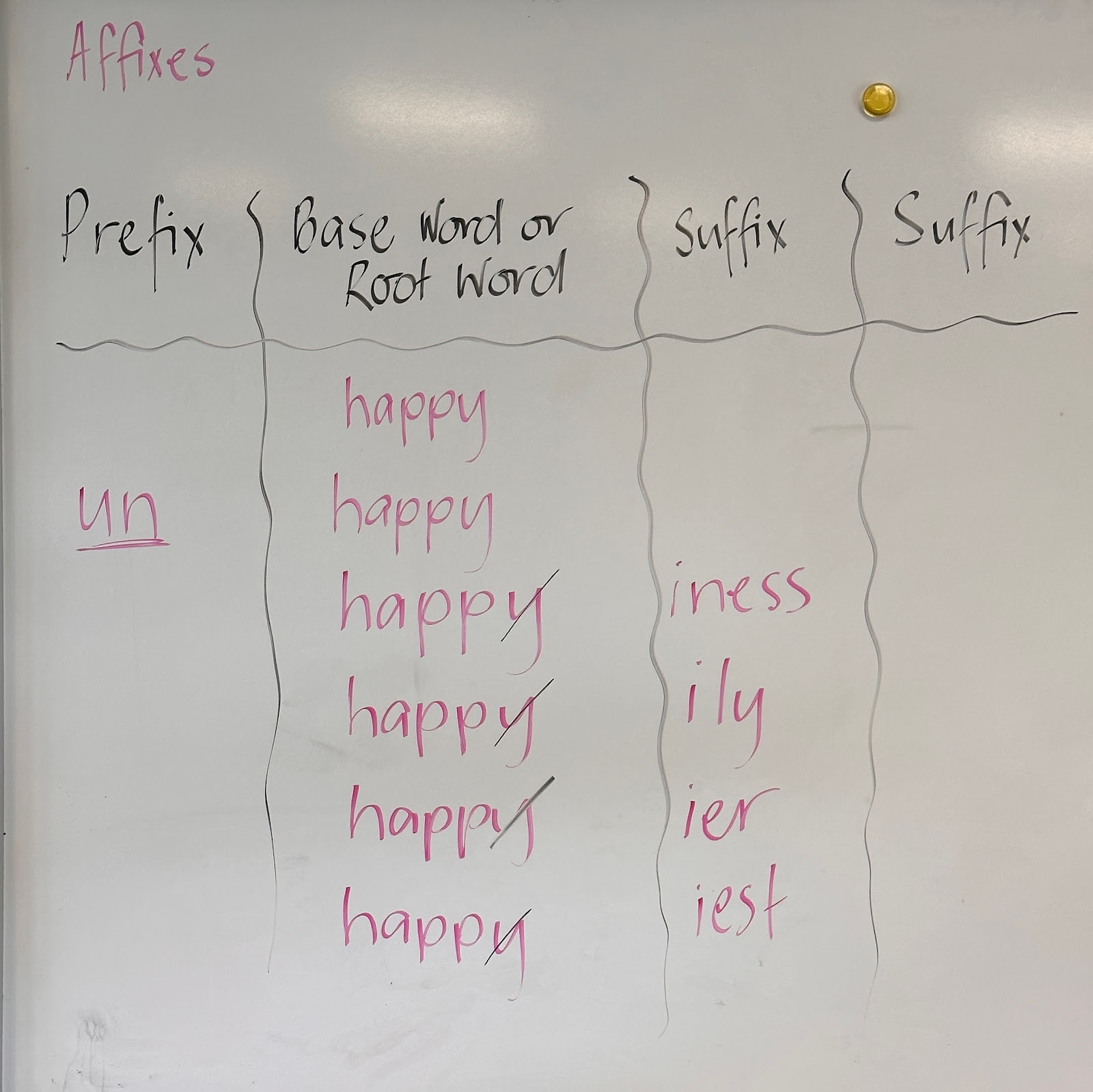
I used a template shared by Louise that shows how base words become completely different words with the introduction of prefixes and suffixes. We began by defining base words as being a complete word by itself that prefixes and suffixes can be added to make a new word. The example we used was the base word, happy. I then challenged my learners to make new words that had the word happy in them. At this stage we had only the knowledge of affixes that we brought to the lesson. As the words were generated from known words I filled in the template on the board (see image below).


We then explored possible reasons why I might have written some parts of the words in different sections of the table. A question that opened the doors for the introduction of the words prefix and suffix, and allowed us to unpack what these words might mean and what effect they had on the base word. All devices were closed at this time which gave me the opportunity to introduce the dictionaries and thesaurus' that were in all honesty, sitting on the shelf gathering dust. Having become so used to opening Chromebooks and defining words meant a quick lesson was needed on how to use a dictionary (or 'paper google' as it has now become known as).

After this I set my learners the challenge of building a word list using the base word excite. To make sure we were selecting actual words, only words generated that could be found in the dictionary were able to be recorded. We then unpacked what each of the affixes meant and explored how they changed the based word.  
Eg: the prefix over (too much or more than normal) + the base word, excite (being enthusiastic or happy) = over excite (more than normally enthusiastic or happy). 

Deziah's blog post explains this activity - (shared with permission).