Showing posts with label Inquiry 2023. Show all posts

Tuesday, 21 November 2023

Bursts and Bubbles 2023

Last week the Manaiakalani COL teachers shared the impact of their 2023 Teacher Inquiry. The link to all the inquiry bursts can be found here. 

Here is my journey...


Here’s a question that frustrates me each time I mark easttle writing samples… Why have you used that word? Yes, the words change, but the question stays the same. 

We model, unpack and provide rich opportunities for a wide variety of vocabulary to be explored and used, yet at the end of 2022 and again at the start of this year, most of my learners reverted back to using simple everyday words in their independent writing. I thought this was the catalyst for the low vocabulary and spelling scores. Scores, I thought, we could improve with a concentrated focus on spelling conventions and rules.

The time point 1 data analysis showed that my learners were using words they could spell, instead of the words they wanted to use, but couldn’t spell. 

However, as we all know, some ideas don’t go the way you want them to. I thought, if we knew how to spell the words, we would use them. Wrong! Yes my learners could easily spell and define the vocabulary we explored in class, but unless directed to, simply did not use them. 

This all changed when Dr Jacinta Oldehaver sent me a professional reading that unpacked the word gifting journey Sylvia Ashton Warner had been on many years before me. In a nutshell, what began as a focus on spelling conventions and rules, quickly morphed into an inquiry into word consciousness which involved my learners being aware of new words, their meanings, and how these words are used. 

My students were conscious of the words they were meeting in their T shaped literacy units because they owned them. When I say owned them, it is because I physically gifted them a word each. A word on a square of paper that they had to keep alive by looking after them and bringing with them physically, to each literacy lesson. 

The motivation to learn these words, and more importantly use them in context came through daily challenges that as a group they were expected to meet. Who would have ever thought these small squares of paper would encourage 15 students to make sure each word had been used by its owner twice each lesson! This group knew when a word had only been used by it’s owner once, and got very creative in their ways to ensure the daily target had been met. Intrinsic motivation at its best.

Ironically I started hearing these words used in discussions across the curriculum and noticed they were spelt correctly when used in written responses, which was something we never actually focused on. 

The inclusion of these words in the T4 easttle writing samples resulted in a noticeable change in vocabulary and spelling scores when time point 2 data was analysed. Student voice collected at both time points shows the fear of making a mistake remains the biggest hurdle. However for these students, the journey towards overcoming this has begun.

The most important learning I made in regards to fostering a culture of word consciousness, is that sometimes things don’t go to plan so don’t be afraid to start again if it all goes wrong. Drive the change and find ways to give your students ownership of the change you want to effect by making it purposeful and fun.


Sunday, 5 November 2023

Exploring Qualitative and Quantitative Data...

Each slide below contains the comparative data gathered from time point 1 and time point 2. Underneath the graphs I have analysed the shifts in more detail. It is important to note here that I have only analysed the data gathered from the 15 students in my literacy group that present both data collection times.


What I noticed as a result of my intervention was that once the knowledge of simple rules and/or conventions of spelling was in place, the challenge element was lost. If I wanted the momentum to continue I quickly realised I needed to adapt and change my thinking and my approaches.

As mentioned in my previous post, the fear of spelling a word wrong or choosing a simpler word seemed to have been left behind as the desire to use the words was more powerful. The learning became about the words and not the hurdles that prevent them from being used. The more I used these words, the more my students used them. Being confident to use and apply more sophisticated vocabulary in context accurately became the norm. My expectations were clear and I noticed that as my student's confidence grew the higher my expectations became. The exciting part was the students took ownership of this challenge and regularly helped each other find the words to use to shift responses to the next level. Student created and driven tally charts evolved as a way of monitoring that everyone had used their word twice, with the others in their group prompting those who had not met daily challenge. 

An interesting observation with the word gifting strategy was when I physically gave my students a piece of paper with their word on it, the ownership and connection to that words was much stronger than when we used a randomiser wheel to select our words. I feel this was because the words on paper could be physically touched, seen and used. Making the gifted words digital made them more abstract. Maybe this was a step too far too quickly, as looking back we overlooked the consolidation step. 

Student voice gathered at both TP1 and TP2 and collated in the DLO above, allows for a comparison of student voice and attitudes towards spelling. To collect this data we used a Google Form survey to get to know our class as spellers. I have edited the original survey responses to reflect those only from my focus group who were present at both time points.

The comparison between the two timepoints (all analysed in the DLO above) shows there are some positive shifts happening in mindsets but when looking closely at how my learners see themselves I see we have a long way to go. This is possibly due to the historical belief that I can't spell it so I won't use it, ESOL obstacles and a fear of getting it wrong. This will definitely take more than a year for change to cement itself, but as we close our 2023 learning journey's deep dive into word consciousness, I feel confident we have laid some strong foundations to build on.

Monday, 21 August 2023

Implement and Try#2: Word Gifting...

I have been approaching my inquiry into word consciousness as a whole language focus and not simply looking for opportunities to strengthen spelling skills. This term I have actively planned for opportunities to adopt the word gifting strategy that Sylvia Ashton-Warner used to elicit key vocabulary. 

Making Reading Meaningful - Sylvia Ashton-Warner and the Language Experience Approach by Sherron Killingsworth Roberts points out that by embracing some of the guiding principles for practice of Sylvia Ashton-Warner’s work in developing the Language Experience Approach (LEA) we can strengthen the connections our tauira have to the more challenging topic based vocabulary needed to make sense of new learning. The principle that resonates most with me is to offer ongoing, authentic language and literacy experiences, including lots of opportunities to speak, listen, read, write, and think about their own and others’ words.

In my reading program this term I have been focusing on the concept of representation in texts. This unit was designed as part of the T-Shaped literacy PLD that I have been on with the University of Auckland for the past two years. In each unit there is a vocabulary component that we up until now have unpacked as a class. This time around I decided to make a few changes, with the most powerful change being to gift the content specific vocabulary to my learners. 

The first thing I did was to create a list of the words and their definitions. These were then cut up and placed face down in front of the groups. After everyone physically selected their card the next challenge was to find the their partner by matching the word to its meaning. We needed to establish ownership of these words so the challenge to use their specific words twice each reading lesson was laid down. To ensure this happened my learners were asked to bring their word to every time we had reading. These word cards were not pretty or laminated but became a part of every reading lesson as along with ownership came a sense of responsibility.


No one immediately connects to a word so each pair was given the challenge of introducing their word to us. The details of the challenge are on the slide below.


What I found was that strong connections were made by the owners of these words. This was evident in reading responses, extended discussions and questions asked. What I wasn't expecting was that every student in the group could use every word accurately and in context. The example below from team 1 shows how these words were used in context accurately and effectively.

With the success I found in reading using this strategy, I decided to transfer this challenge to our science inquiry. Again, ownership meant connections and connections meant explanations of experiment outcomes were explicit. This is definitely an activity I would use again as it was unique, purposeful and fun.

Sunday, 25 June 2023

Linking my Inquiry to the Literature....

Share academic or professional readings and explain how they and other sources helped you form hypotheses about aspects of teaching that might contribute to current patterns of learning.

Teaching Spelling in Primary and Intermediate Schools - Link to article

'Spelling is key to success in writing... In the intermediate years, spelling and handwriting combined (together labelled ‘transcription skills’) account for 41% of the difference in students’ writing fluency. Working memory is limited in its capacity which means that if transcription skills – spelling and handwriting – have not been practised to automaticity, these will likely occupy all of working memory and prevent the student from thinking about other things, such as the ideas they wish to express.'

Reasons why spelling impacts on students’ writing:
  • Misspelled words may blur the writer’s message and could influence teachers perceptions of the student’s ability.
  • Lack of spelling knowledge may lead to a student avoiding certain words
  • Spelling difficulties may affect student confidence about their ability to write, which in turn may impact on motivation and cause them to avoid writing practice
  • Spelling supports decoding as it allows students to hear sounds in words and represent them with letters and orthographic patterns (the ways sounds are spelt).  
  • Key learning in a spelling program (explained here) should include phonemes, graphemes, vowels, consonants, syllables, digraphs, morphology, and etymology. A challenge because of the 44 sounds (phonemes) in spoken English, the 250 ways to write those sounds (graphemes) and the facts that many of these sounds can be represented in more than one way.
  • Teachers should follow a spelling programme to support teaching of spelling patterns and rules.
  • Students need to practise retrieving knowledge from memory before it needs to be taught again. 
  • 10 minutes of spelling instruction every day is more effective than longer less frequent lessons - guided reading allows opportunities to revisit this learning at the right level.
What to teach...
  • Phonemic awareness (listen for sounds and syllables in words)
  • Sound-to-letter patterns and relevant spelling rules.
  • Use lists of words with the same sound-to-letter correspondences (not randomly spelt ‘essential words’).
  • Morphology– the study of meaningful word parts (eg: adding prefixes and suffixes and how they change word meanings)
  • Latin and Greek roots
  • Etymology– the study of word origins.
  • Identify the anomalies of written English
Joy Allcock' example of senior primary spelling program...
  • Day 1: Sound or rule for the week
  • Day 2: Word meanings
  • Day 3/4: Segmenting and write words with the spelling pattern
  • Day 5: Dictation


Effective Vocabulary Instruction - Link to article

'Vocabulary knowledge is fundamental to reading comprehension; one cannot understand text without knowing what most of the words mean... The amounts of difficult words in a text predicts text difficulty, and a reader’s general vocabulary knowledge predicts of how well a reader can understand text.... The goal of all vocabulary teaching is for students to be able to use new vocabulary fluently and purposefully in speaking, reading, and writing. This is best achieved through a combination of explicit instruction and opportunities for meaningful practice,  both during literacy instruction and across the curriculum'

  • Vocabulary knowledge is a strong predictor of reading comprehension by Year 5, and by Year 8 it is the main predictor of success. Research has shown the gaps and disparities between high and low achieving students widens as students in these year levels require higher levels of word knowledge in order to infer new word meanings, make meaning and find success. 
  • Whole class teaching has been shown to be just as effective as small group and one-on-one interventions, and short sessions (of 20 minutes or less) can be just as effective as longer ones.
  • To achieve students need to learn about 3,000 words per school year.
  • Vocabulary knowledge is the key to progress in literacy, and in all other curriculum areas. 

Incidental learning and explicit instruction

  • Incidental word learning occurs within the context of reading
  • Teachers should model use of sophisticated vocabulary across the curriculum and in instructional language
  • Use the think aloud strategy to define words and reflect on the author’s use of a word in a text.
  • Explicit instruction in word meanings is essential as a deficit in vocabulary knowledge will prevent inferences from being made.
Selecting words to teach during literacy instruction and across the curriculum
  • When planning a unit consider vocabulary challenges to identify which words that need explicit instruction.
  • Use a three-tiered system to decide which words need to be taught explicitly:
    • Tier 1 words are common, everyday words used in oral language
    • Tier 2 words are more wide-ranging, specific used in written language more than in conversation 
    • Tier 3 are content specific 
  • Tear 2 words are the words that will need to be targeted for explicit instruction.
What to teach...
  • Correct pronunciation, the written form, and an understanding of the word’s meaning are key priorities
  • Greek and Latin roots
  • Affixes
How to do this...
  • Be clear and explicit when discussing word meanings
  • Repetition to consolidate
  • Use visual representations of words to aid memory
  • Provide opportunities for students to pronounce the words themselves
  • Finish a sentence which uses the word
  • Act out word meanings
  • Unpack sentences with the word that do and do not, make sense
  • Identify examples and non-examples of the word’s meaning. 
  • Find synonyms and use in context

The Role of Motivation in Learning - Link to article

Motivation is what ‘moves’ us and is the reason we do anything at all. It is an orientation towards learning. Motivation can be intrinsic (motivated by enjoyment) and extrinsic (motivated by reward). For teachers, a lack of motivation has long been one of the most frustrating obstacles to student learning. 

How to do this... 

  • Set goals - performance and mastery
  • Be aware of self efficacy - the extent to which a student values learning a skill or concept directly impacts their effort and mastery of that skill or concept. 
  • Normalise the struggle 
  • Encourage the importance of asking for help
  • Students who believe that they can succeed are more likely to reach their goals.
  • Use the analysis of the student survey 
  • Remind students of the purpose behind the learning
  • Allow for visual connections to be made

How these readings helped me to form a hypothesis... 

My hunch at the start of the year was that my learners opted for the safe and known when selecting vocabulary to use when asked to write independently. It is the fear of making errors that decides the levels of self efficacy. If you begin school with a vocabulary deficit the gap only widens as the depth of learning increases. To help overcome the low self efficacy and reliance on the use of everyday words I see from these readings that I need to be actively planning for more opportunities for word consciousness to be explicitly taught. This term I did the training and will be introducing 'The Code' spelling programme to support the teaching of spelling patterns and rules, something suggested in the article, 'Teaching Spelling in Primary and Intermediate Schools'. 

Much of what I have read affirms the direction I am taking, with my biggest takeaway being the amount of time I need to spend focusing on word consciousness. To date we have been spending longer but less frequent periods of time on these lessons, so I will be increasing the frequency and decreasing the amount of time spent on each lesson. I now need find out if I am motivating my students to want to use more challenging vocabulary, not because I want them to, but because they realise they know how to do this and want to take risks in their writing.


Tuesday, 2 May 2023

Teaching as Inquiry 2023


Click here to see how I align my inquiry with the Manaiakalani framework.

“Recognising and spreading sophisticated pedagogical practice across our community so that students learn in better and more powerful ways...”

The Manaiakalani Community of Learning is working together on this task using the expertise existing in of our community of learning. 


Labels:

LEvidence, LScan, LTrend, LHypothesise, LResearch, LReflect,
CPlan, CTry, CInnovate, CImplement, CReflect,
SPublish, SCoteach, SModel, SGuide, SFback, SReflect

Sunday, 23 April 2023

Qu 4: Collecting evidence and data...

Begin to collect evidence and data and come to the next session ready to share your preliminary findings about the nature and extent of the student challenge i.e. using your baseline student data and evidence.

I will use this opportunity to introduce the group of students I will be working with on this inquiry this year. There are 19 students in this group of year 7/8 students (5 Year 7 girls, 3 Year 7 boys, 3 Year 8 girls and 8 Year 8 boys). When referring to the Writing and Spelling data, these students have been identified as our most able students. 


What I noticed when looking closely at their e-asTTle results was that our Year 8 students scored well in their vocabulary choices, possibly due to the increased levels of vocabulary they gained from actively participating in the Reading for Enjoyment and T-shaped literacy initiatives last year. The Year 7 students however, chose to play safe and use the words they knew how to spell. One example of this evident in a comparison of two of the Term 1 e-asTTle writing explanations on the same community facility. The Year 8 student referred to the facility as 'appealing' and 'affordable', whereas the Year 7 student explained that it was 'fun' and 'didn't cost much'. 

My next steps are to explore ways I can grow vocabulary, the knowledge of words and word meanings so that the words met on this journey are transferred from where they were found, to my learner's personal word banks. 


Wednesday, 12 April 2023

Qu 3: Building an accurate profile of students' learning - tools, measures and approaches...

Describe the tools/measures/approaches you plan to use to get a more detailed and accurate profile of students’ learning in relation to that challenge. Justify why you chose these approaches and tools.

Vocabulary refers to the knowledge of words and word meanings. Helping students become word conscious is a crucial endeavour for teachers across all levels, and more so for teachers working with students whose prior vocabulary exposure may be limited. One of the biggest hurdles I have observed when I ask my learners to complete a writing task is their problem solving skills when it comes to vocabulary choice. At some point in their learning journeys so far our learners have formed the mindset that making a mistake when spelling is not ok. This deficit mindset causes problems when it comes to experimenting and/or taking risks with new vocabulary. Additionally it stops the flow of writing and results in many students just giving up or embracing the idea that they simply are not good at writing or spelling. 

Dianne and I are carrying out a collaborative inquiry this year but have chosen at this point to work independently with different groups. Dianne chose the students who find spelling a challenge which has left me with the students who are more able spellers. Having collected the baseline data and captured student voice (shared in an earlier post), we have decided to adopt the strategy of divide and conquer. Our ongoing conversations about the spelling hurdles we need to 'knock down' have opened our eyes to the fact our students who struggle with spelling need a different intervention than those who have some understanding. We want our students to take risks but are fully aware that those who see themselves as 'not good at spelling' need to revisit the basics in a safe space where they feel empowered. 

The analysis below reflects the responses of the attitude towards spelling of the 25 students in our class who have shown in our data to be our more able spellers. When responding to the e-asTTle attitude question, ‘I am good at spelling’. 70% of these students see themselves as being good spellers, while in contrast 30% do not. It is the mindset of the 40% who’s thinking I need to change.


The tools/measures/approaches:

Planning changes:

Making time to implement anything needs to become a reality if any success is to be achieved. We have a dedicated time for Word Consciousness in our timetable so that we are accountable for teaching it and our students see this as something we value. In my group I have a mix of book work and digital work. We use dictionaries and thesaurus' to build skills and work both independently and collaboratively.

Student Voice:

Gathering student voice is a vital part of teaching. It gives us a clear picture of where our students are at, what they're thinking and what we need to do to allow of learners to make their individual connections to the learning. We have devised a Spelling survey which will completed at the end of each term, allowing us to measure both the small and big changes. 

Peters/e-asTTLE Assessments:

Analysing these results gives us a clear picture of what our students can do and where our knowledge gaps are.  We will use these results to inform our planning and identify shifts in achievement. 

Next steps:

  • Explore creative and fun ways we can grow our word consciousness culture in our class
  • Make word consciousness visible in our class
  • Explore success in our school, other schools and other clusters 
  • Professional Readings/ PLD
  • Use student created DLOs as exemplars 


To sum up, we think limited word knowledge is the problem and now need to find out why it is the problem. It is not about weekly spelling lists, but rather meeting, noticing, unpacking, understanding, exploring and using a wider variety of words across the curriculum that will hopefully strengthen the spelling ability and word consciousness of the students in LS2 2023. Looking forward we feel that by addressing this now we will open the doors of learning wider when it comes to the transition into Year 9.


Implement and Try #1: Digital Escape Rooms

Last term I attended the Creating Digital Escape Rooms with Donna Yates toolkit. Donna introduced us to a collection of published digital escape rooms which we had an opportunity to explore. We were also shown how to create our own escape rooms using Google forms. 

Here is the link to Donna's presentation. Slides 7-15 have clear steps to follow if you are keen to give this a try.

As a way of putting my new learning into practise and helping my students strengthen their connections to their affixes learning, we created our own affix themed digital escape rooms. The challenge was to devise 10 affix related questions that their peers would then answer in their quest to open an online game that let them apply their new learning in a fun way. The games selected were found using our smart searching skills so are not our own creations. That is one of our next challenges.

This was a fun and practical way of reinforcing learning. Dictionaries were out in full force and the discussion was rich and very loud as questions were being tested on friends orally before being recorded on the Google form. What I liked about this activity was the fact it forced my learners to draw on and recall their new learning, the dictionaries and the books they have been completing challenges in were used purposefully and the whole activity was met with a huge level of enthusiasm. 'Easy' questions were soon pushed to the side as the desire to write the 'hardest' question became the challenge of the day. This activity took two blocks of learning to complete but was absolutely worth it as the 'I've escaped' cheers showed the level of buy-in and allowed my learners to see their own success in real time, and I was able to see just how strong the connections to our new learning are.

We have created a page on our class site for our escape rooms which can be found here

Friday, 17 March 2023

Our First Footsteps into Word Consciousness...

After attending the PLD: Supporting students to become confident and competent spellers run by Louise Dempsey I put some of my new learning into place. About 1/3 of our class are participating in the STEPSWEB program which opens up a slot on our timetable for the other 2/3 of our class to focus on growing their own word knowledge.

Introducing affixes:

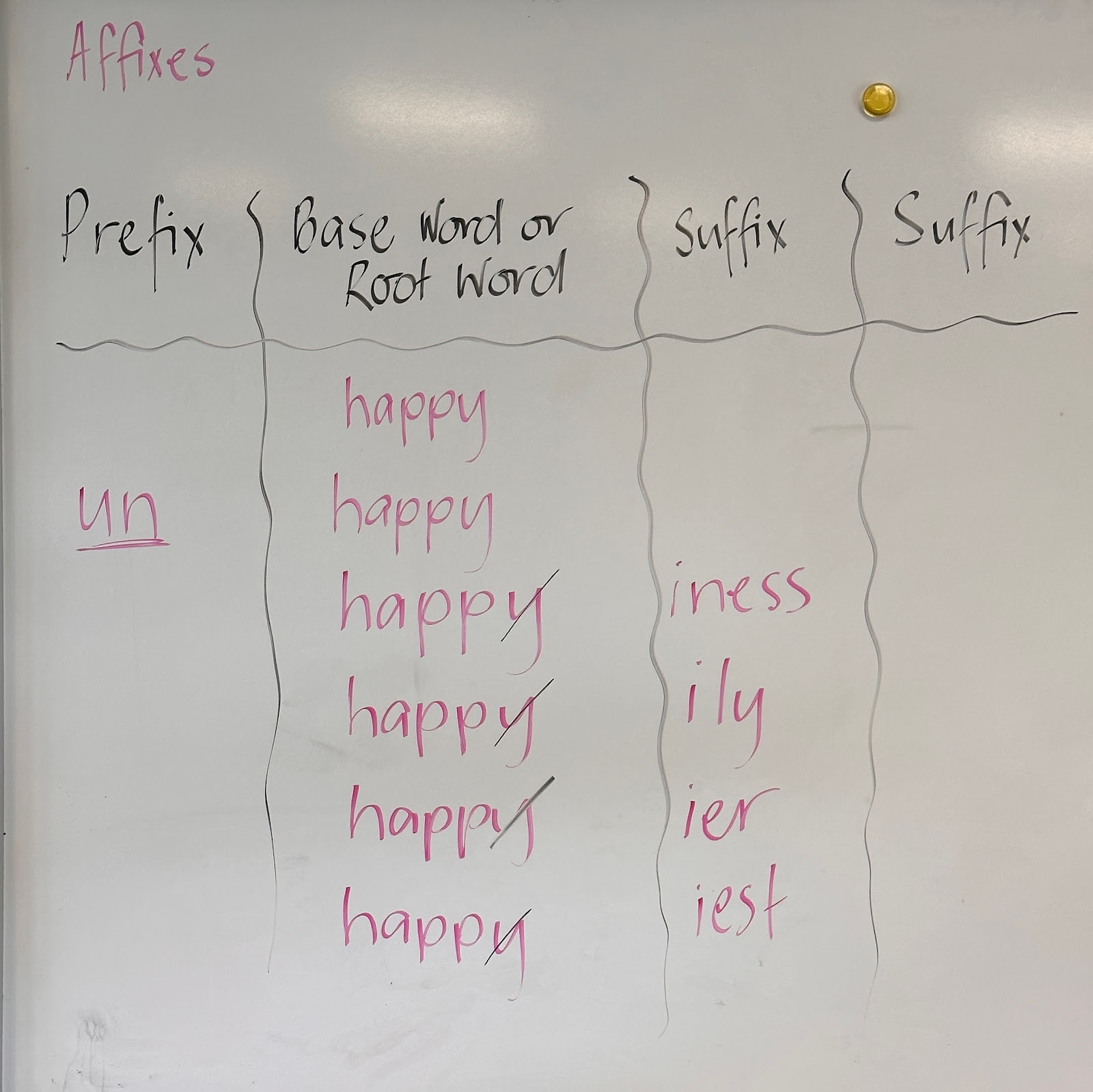
I used a template shared by Louise that shows how base words become completely different words with the introduction of prefixes and suffixes. We began by defining base words as being a complete word by itself that prefixes and suffixes can be added to make a new word. The example we used was the base word, happy. I then challenged my learners to make new words that had the word happy in them. At this stage we had only the knowledge of affixes that we brought to the lesson. As the words were generated from known words I filled in the template on the board (see image below).


We then explored possible reasons why I might have written some parts of the words in different sections of the table. A question that opened the doors for the introduction of the words prefix and suffix, and allowed us to unpack what these words might mean and what effect they had on the base word. All devices were closed at this time which gave me the opportunity to introduce the dictionaries and thesaurus' that were in all honesty, sitting on the shelf gathering dust. Having become so used to opening Chromebooks and defining words meant a quick lesson was needed on how to use a dictionary (or 'paper google' as it has now become known as).

After this I set my learners the challenge of building a word list using the base word excite. To make sure we were selecting actual words, only words generated that could be found in the dictionary were able to be recorded. We then unpacked what each of the affixes meant and explored how they changed the based word.  
Eg: the prefix over (too much or more than normal) + the base word, excite (being enthusiastic or happy) = over excite (more than normally enthusiastic or happy). 

Deziah's blog post explains this activity - (shared with permission).


Wednesday, 1 March 2023

Qu. #2 - Why we judge this to be the most important and catalytic issue of learning for this group of learners this year...

Last week after talking to the teachers I am mentoring in the RPI program I was reminded of the Reading for Enjoyment survey I did last year to get to know my learners as readers. In a conversation with Dianne afterwards, I suggested that we could try to create a similar survey that would help us get to know our learners a spellers. Our Principal understands our concerns with regards to spelling abilities in our current class and is fully supportive of our proposed inquiry into word consciousness. 

The results of this survey are below.


We judge this to be the most important and catalytic issue of learning for this group of learners this year as the results here affirm our initial thinking that a deficit in word consciousness and a 'fear' of getting words wrong, limits the level of vocabulary used in independent writing, and causes meaning to be lost in reading. It will be interesting to analyse the self efficacy rating and the spelling level given when the e-asTTle writing assessment data is complete. (NB: Our plan is to look at the current and historical data of the e-asTTle writing, PAT Reading and the Peter's spelling test to identify trends). 


Qu 1: Student Inquiry Foci...

This year Dianne Fisi'iahi and I will be undertaking a collaborative inquiry. What this will look like exactly at this stage is still on the drawing board although we do know our purpose. This year we want to find out if a focus on spelling conventions will foster an environment where word consciousness strengthens connections to the learning.

We teach a Year 7/8 class with 40 learners, all who bring a wide a varied connection to the conventions of spelling to the table. We know from past experience and from what we have observed so far this year, that our learners physically stop writing, stop reading and avoid sharing back to the class when they lose the connection to words needed to continue to make sense of the learning. There are many reasons as to why this happens but rather than focus solely on that, we want to focus on how we can prevent this pattern from continuing to evolve into a hurdle that is too challenging to get over. Our thinking is that if we begin to develop these skills and understandings, the transition to language of instruction used in Y9 may be strengthened by stronger connection to word knowledge.

Having decided on our inquiry focus this year, Dianne and I spoke with Anna Salmon, our Reading Recovery teacher about the barriers children in the junior school face with spelling, and how she helps the students she is working with to overcome these barriers. We came away from a very rich learning conversation with lots of ideas to pull together a tentative pathway forward. Here are the notes we made to help us formulate a plan going forward

'Word consciousness involves being aware and interested in words and word meanings (Anderson & Nagy, 1992; Graves & Watts-Taffe, 2002) and noticing when and how new words are used (Manzo & Manzo, 2008). Individuals who are word conscious are motivated to learn new words and able to use them skilfully '(Sourced here). Our challenge now is to find out why the links in the chain appear to be broken again. Last year I began my inquiry by getting to know my learners as readers through a survey. This year we plan to use this strategy to get to know our learners as spellers. To do this we will be looking at shift or change in:

  • Disposition
  • Data
  • Word consciousness
  • Student voice
  • Strategies used to make sense of new or unfamiliar words

Further Reading/PLD to grow my own knowledge kete: