Showing posts with label PLD. Show all posts

Monday, 1 July 2024

ISTE 24 Denver: Padlet - Expo session


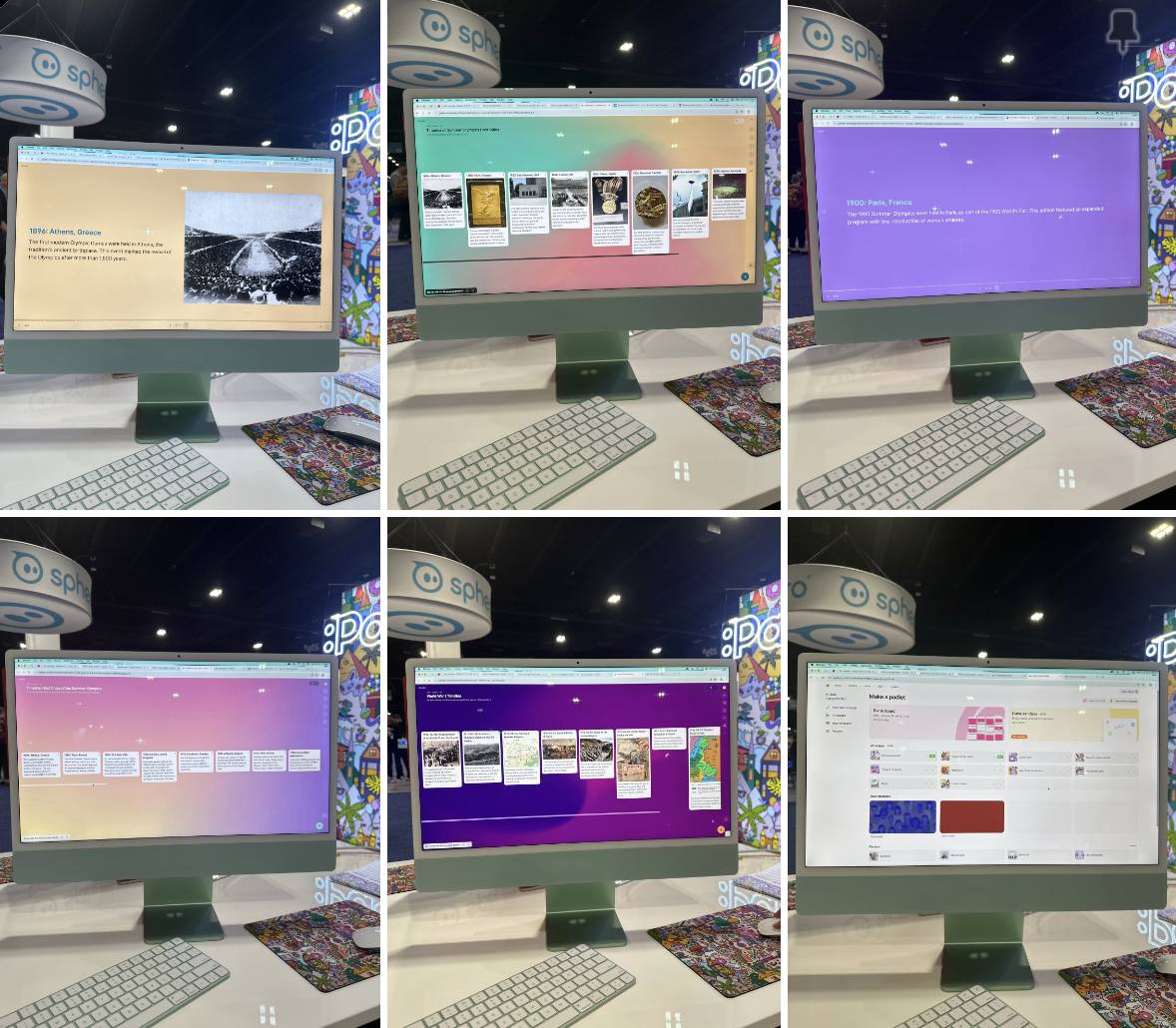
The Expo hall is huge! This is where exhibitors share their products, allow for hands on learning and provide PLD sessions. During one visit I had a 1:1 training session with Chelsea at the Padlet booth. Padlet is something I have used for a long time but after what I saw I now realise I was not making the most of the features it offers. 

Padlet can generate lesson plans, quizzes, YouTube links, make timeline (this can be played as a slideshow - eg above is of the summer Olympics - need to ask for images if wanting more than a timeline of words. AI timeline play button gives you a slideshow.
                                  

  • If creating a discussion board wanting anonymous responses - submission request link - create a space and submit info without names

  • Copy link

  • Post in padlet

  • Great privacy


The free version allows for 5 free padlets at one time - delete old if wanting new boards etc

You can sign up for beta with this link: padlet.link/beta


Monday, 21 August 2023

Listening to my Learners...

Collecting student voice is one of the most powerful forms of feedback. As the strategy of word gifting was new for us I wanted to see if my thoughts aligned with the thoughts of my learners. To capture this I shared a Google form with the students in my reading groups. The slides reflect the responses.

The questions I asked were:

  • What did you like about the vocabulary gifting in Reading?
  • What might you do differently to get to know the new words in Reading?
  • How did this help you in the Representation topic?


Wednesday, 1 March 2023

PLD: Supporting students to become confident and competent spellers - Louise Dempsey

To grow our own knowledge and strengthen our connections to teaching phonics, morphology and spelling conventions Dianne and I signed up to the PLD: Supporting students to become confident and competent spellers run by Louise Dempsey.


Aims of the two workshops:

  • Develop subject knowledge about phonics, morphology and spelling conventions

  • Unpack the progression of skills (phonics, spelling conventions, and morphology)

  • Learn high-impact strategies and activities to teach word and sub-word level skills


My takeaways:
  • Spelling is an obstacle that gets in the way of reading and writing. However it is a learnt skill that can be taught and is an integral skill to make meaning. If learners can spell, they can read and write.
  • Children need a decent bank of words to allow them to pick up and use a wider vocabulary
  • Confidence comes when children can hear identified sounds
  • Encourage self correction
  • Phonics and spelling patterns are crucial for our students when writing
  • Fluent writers need to be aware of spelling conventions, morphology/affixes and word origins
  • Decode in reading and encode in writing by applying rules
  • Spelling skills are learnt progressively - the list below was unpacked with valuable examples that are recorded in my notes
    • Phonics: letters and sounds
    • Analogy: rime eg: cat/sat/mat
    • Try: say - listen- write -try and underline to show unsure = taking risks
    • Analogy and affixes help strengthen vocabulary eg: look/looks/looked/ looking
    • Spelling conventions: rules
    • Morphology: know affixes and how to add them to base words
    • Word origins eg: bio = life + ology = study of so biology = study of life
After attending these sessions Dianne and I decided we need to co-construct with our learners a 'working' wall display that we build alongside our learning of morphology, spelling conventions, phonics at our level. This not only makes it visible, but also makes it rewindable.

Resources to support development of word consciousness:

  • Spelling bank - Link
  • The Literacy Place books - Link