Showing posts with label Spelling. Show all posts

Wednesday, 1 May 2024

Qu. #2 - Why we judge this to be the most important and catalytic issue of learning for this group of learners this year...

Achieving accelerated shift in Literacy was identified as being one of the most important and catalytic issues of learning facing our students in Y4 - 8, this year, when the time point one data was analysed. Exploring how learning gained from professional development is helping to strengthen teacher practice and achievement in literacy is something I haven't looked at before so I am looking forward to sharing my findings.

As I am not looking specifically into my own practice it is important to maintain anonymity. This inquiry is a syndicate wide focus and therefore not a focus on individual teachers. Our starting point with professional development linked to Literacy undertaken by the senior syndicate (Y4-Y8) in the 2023/24 period consists of:

  • In Class Support (ICS) 2023
  • Reading Program Intensive 2023 teacher/mentor meetings and observations 2023
  • T Shaped Literacy 2023
  • The Code 2024
  • In Class Support (ICS) 2024
  • PRT Y1/2 teacher/mentor meetings and observations 2023/24

To measure the shift I needed clear picture of where our student's starting points were. What to collect for baseline data was something I struggled with as I couldn't decide on the best way to do this. Like many faced with a direction conundrum, the task ahead found its way to the 'I'll do it later basket'. My problem was 'later' became a hard time to find. I knew I needed help and today that help came in the form of Amy Tofa and Matt Goodwin. 

I explained my inquiry focus and together we came up with a way forward that made sense to me. A really useful piece of advice here is to talk to your colleagues as saying things out loud and getting a 2nd opinion, or 3rd in my case, is one of the most valuable resources we can tap into. Amy pointed out to me that the picture I was trying to capture was huge and suggested I focus on one group of students. I am 100% taking her advice to focus on our students who scored 'Below' on our beginning of year literacy assessments.


The data above shows the percentage of our Year 4 -8 students who scored Below expectation on the PAT Reading Comprehension and e-asTTle assessments. I will be using this data to measure the shift made between the two cluster wide assessment timepoints in my target group. 


Tuesday, 30 April 2024

Qu 1: Student Inquiry Foci...

With the Manaiakalani goals of achieving 1.5 years progress inside a year (big 3), improving teacher practice, increasing attendance and hauora in mind, Richard Johnston, (our principal), challenged me to look at 'How we (PBS) are using PLD to accelerate shift across our school'. Having inquired into my own practice for many years I was excited to embrace this much bigger school wide focus. However, when I sat down to map out the way forward I realised I could make more impact if I looked across my own team, the senior syndicate.

To do this I am going to need to drill down into student achievement and teacher planning across our syndicate and look closely at how my team is using their new knowledge to change their practice and accelerate shift in student achievement in Literacy. To ensure this new learning becomes embedded within teacher practice we capture the journey via our appraisal system. This gives both myself as the appraiser and the teacher as the appraisee, a shared vision of how we can both contribute to their professional growth moving forward. It also means I can, to quote Russell Burt, capitalise on my role as our in school COL teacher to lead the teacher inquiry process to help 'build teacher and school capability in raising student achievement outcomes by linking evidence to practice.'

When looking at our class data we already have processes in place that allow each teacher to identify where the gaps are and think about why these gaps might be there before we can begin to fill them. It is not about trying to fix everything but rather strengthen the areas that need the most focus. In our team we do this both individually at class level and collaboratively at syndicate level. It helps to identify the commonalities so that we can move forward together learning with and from each other along the way. I will share this process in my next post.

My challenge now is to find out how I can capitalise on the learning gained from professional development undertaken by my team to help accelerate shift across our Year 4 - 8 classes. When I unpacked my journey forward I realised it's not about only strengthening teacher practice but also about how we can harness the creativity and power of our new learning to strengthen student engagement and spark curiosity in literacy.


Monday, 28 August 2023

Celebrating the win...

This week the words I heard in our class speech competition completely stopped me in my tracks. Standing in front of an audience of their peers was every member of my reading groups confidently used the vocabulary we have encountered, unpacked and explored throughout our Reading units this year in context. Gone were the usual go-to's and in their place was a plethora of sophisticated vocabulary. This is a win in every sense of the word! 

To give my last sentence some context, the previous week I had taught an explicit lesson on speech writing. This lesson contained exemplars at a variety of e-asTTle writing levels. That meant my learners were exposed to a healthy mix of simple and more powerful vocabulary. One of our challenges involved applying our knowledge language features to edit an exemplar and move it to the next level. This is where my students very sound understanding of the more powerful vocabulary needed came to the fore. This then lead to a rich discussion as each group discussed their vocabulary choices and explained why they had made these changes. We applied the same strategy to levelling up the structural features.

Unfortunately the next few days saw me off sick, which meant my learners were left to work independently on their own speeches. I did share explicit instructions via email but knew these students would be working without guided teacher support. The comments tool in Google docs definitely gets a shout out here. I shared my feedback and left them to it. Move forward to today. I saw and heard the outcome of explicit teaching, creative ways of helping my learners connect to new and powerful vocabulary and a year long focus on affixes in action. 

My next step is to record some of these speeches that will be uploaded here so that I have a permanent record of what success looks like.

Monday, 21 August 2023

Listening to my Learners...

Collecting student voice is one of the most powerful forms of feedback. As the strategy of word gifting was new for us I wanted to see if my thoughts aligned with the thoughts of my learners. To capture this I shared a Google form with the students in my reading groups. The slides reflect the responses.

The questions I asked were:

  • What did you like about the vocabulary gifting in Reading?
  • What might you do differently to get to know the new words in Reading?
  • How did this help you in the Representation topic?


Implement and Try#2: Word Gifting...

I have been approaching my inquiry into word consciousness as a whole language focus and not simply looking for opportunities to strengthen spelling skills. This term I have actively planned for opportunities to adopt the word gifting strategy that Sylvia Ashton-Warner used to elicit key vocabulary. 

Making Reading Meaningful - Sylvia Ashton-Warner and the Language Experience Approach by Sherron Killingsworth Roberts points out that by embracing some of the guiding principles for practice of Sylvia Ashton-Warner’s work in developing the Language Experience Approach (LEA) we can strengthen the connections our tauira have to the more challenging topic based vocabulary needed to make sense of new learning. The principle that resonates most with me is to offer ongoing, authentic language and literacy experiences, including lots of opportunities to speak, listen, read, write, and think about their own and others’ words.

In my reading program this term I have been focusing on the concept of representation in texts. This unit was designed as part of the T-Shaped literacy PLD that I have been on with the University of Auckland for the past two years. In each unit there is a vocabulary component that we up until now have unpacked as a class. This time around I decided to make a few changes, with the most powerful change being to gift the content specific vocabulary to my learners. 

The first thing I did was to create a list of the words and their definitions. These were then cut up and placed face down in front of the groups. After everyone physically selected their card the next challenge was to find the their partner by matching the word to its meaning. We needed to establish ownership of these words so the challenge to use their specific words twice each reading lesson was laid down. To ensure this happened my learners were asked to bring their word to every time we had reading. These word cards were not pretty or laminated but became a part of every reading lesson as along with ownership came a sense of responsibility.


No one immediately connects to a word so each pair was given the challenge of introducing their word to us. The details of the challenge are on the slide below.


What I found was that strong connections were made by the owners of these words. This was evident in reading responses, extended discussions and questions asked. What I wasn't expecting was that every student in the group could use every word accurately and in context. The example below from team 1 shows how these words were used in context accurately and effectively.

With the success I found in reading using this strategy, I decided to transfer this challenge to our science inquiry. Again, ownership meant connections and connections meant explanations of experiment outcomes were explicit. This is definitely an activity I would use again as it was unique, purposeful and fun.

Sunday, 25 June 2023

Linking my Inquiry to the Literature....

Share academic or professional readings and explain how they and other sources helped you form hypotheses about aspects of teaching that might contribute to current patterns of learning.

Teaching Spelling in Primary and Intermediate Schools - Link to article

'Spelling is key to success in writing... In the intermediate years, spelling and handwriting combined (together labelled ‘transcription skills’) account for 41% of the difference in students’ writing fluency. Working memory is limited in its capacity which means that if transcription skills – spelling and handwriting – have not been practised to automaticity, these will likely occupy all of working memory and prevent the student from thinking about other things, such as the ideas they wish to express.'

Reasons why spelling impacts on students’ writing:
  • Misspelled words may blur the writer’s message and could influence teachers perceptions of the student’s ability.
  • Lack of spelling knowledge may lead to a student avoiding certain words
  • Spelling difficulties may affect student confidence about their ability to write, which in turn may impact on motivation and cause them to avoid writing practice
  • Spelling supports decoding as it allows students to hear sounds in words and represent them with letters and orthographic patterns (the ways sounds are spelt).  
  • Key learning in a spelling program (explained here) should include phonemes, graphemes, vowels, consonants, syllables, digraphs, morphology, and etymology. A challenge because of the 44 sounds (phonemes) in spoken English, the 250 ways to write those sounds (graphemes) and the facts that many of these sounds can be represented in more than one way.
  • Teachers should follow a spelling programme to support teaching of spelling patterns and rules.
  • Students need to practise retrieving knowledge from memory before it needs to be taught again. 
  • 10 minutes of spelling instruction every day is more effective than longer less frequent lessons - guided reading allows opportunities to revisit this learning at the right level.
What to teach...
  • Phonemic awareness (listen for sounds and syllables in words)
  • Sound-to-letter patterns and relevant spelling rules.
  • Use lists of words with the same sound-to-letter correspondences (not randomly spelt ‘essential words’).
  • Morphology– the study of meaningful word parts (eg: adding prefixes and suffixes and how they change word meanings)
  • Latin and Greek roots
  • Etymology– the study of word origins.
  • Identify the anomalies of written English
Joy Allcock' example of senior primary spelling program...
  • Day 1: Sound or rule for the week
  • Day 2: Word meanings
  • Day 3/4: Segmenting and write words with the spelling pattern
  • Day 5: Dictation


Effective Vocabulary Instruction - Link to article

'Vocabulary knowledge is fundamental to reading comprehension; one cannot understand text without knowing what most of the words mean... The amounts of difficult words in a text predicts text difficulty, and a reader’s general vocabulary knowledge predicts of how well a reader can understand text.... The goal of all vocabulary teaching is for students to be able to use new vocabulary fluently and purposefully in speaking, reading, and writing. This is best achieved through a combination of explicit instruction and opportunities for meaningful practice,  both during literacy instruction and across the curriculum'

  • Vocabulary knowledge is a strong predictor of reading comprehension by Year 5, and by Year 8 it is the main predictor of success. Research has shown the gaps and disparities between high and low achieving students widens as students in these year levels require higher levels of word knowledge in order to infer new word meanings, make meaning and find success. 
  • Whole class teaching has been shown to be just as effective as small group and one-on-one interventions, and short sessions (of 20 minutes or less) can be just as effective as longer ones.
  • To achieve students need to learn about 3,000 words per school year.
  • Vocabulary knowledge is the key to progress in literacy, and in all other curriculum areas. 

Incidental learning and explicit instruction

  • Incidental word learning occurs within the context of reading
  • Teachers should model use of sophisticated vocabulary across the curriculum and in instructional language
  • Use the think aloud strategy to define words and reflect on the author’s use of a word in a text.
  • Explicit instruction in word meanings is essential as a deficit in vocabulary knowledge will prevent inferences from being made.
Selecting words to teach during literacy instruction and across the curriculum
  • When planning a unit consider vocabulary challenges to identify which words that need explicit instruction.
  • Use a three-tiered system to decide which words need to be taught explicitly:
    • Tier 1 words are common, everyday words used in oral language
    • Tier 2 words are more wide-ranging, specific used in written language more than in conversation 
    • Tier 3 are content specific 
  • Tear 2 words are the words that will need to be targeted for explicit instruction.
What to teach...
  • Correct pronunciation, the written form, and an understanding of the word’s meaning are key priorities
  • Greek and Latin roots
  • Affixes
How to do this...
  • Be clear and explicit when discussing word meanings
  • Repetition to consolidate
  • Use visual representations of words to aid memory
  • Provide opportunities for students to pronounce the words themselves
  • Finish a sentence which uses the word
  • Act out word meanings
  • Unpack sentences with the word that do and do not, make sense
  • Identify examples and non-examples of the word’s meaning. 
  • Find synonyms and use in context

The Role of Motivation in Learning - Link to article

Motivation is what ‘moves’ us and is the reason we do anything at all. It is an orientation towards learning. Motivation can be intrinsic (motivated by enjoyment) and extrinsic (motivated by reward). For teachers, a lack of motivation has long been one of the most frustrating obstacles to student learning. 

How to do this... 

  • Set goals - performance and mastery
  • Be aware of self efficacy - the extent to which a student values learning a skill or concept directly impacts their effort and mastery of that skill or concept. 
  • Normalise the struggle 
  • Encourage the importance of asking for help
  • Students who believe that they can succeed are more likely to reach their goals.
  • Use the analysis of the student survey 
  • Remind students of the purpose behind the learning
  • Allow for visual connections to be made

How these readings helped me to form a hypothesis... 

My hunch at the start of the year was that my learners opted for the safe and known when selecting vocabulary to use when asked to write independently. It is the fear of making errors that decides the levels of self efficacy. If you begin school with a vocabulary deficit the gap only widens as the depth of learning increases. To help overcome the low self efficacy and reliance on the use of everyday words I see from these readings that I need to be actively planning for more opportunities for word consciousness to be explicitly taught. This term I did the training and will be introducing 'The Code' spelling programme to support the teaching of spelling patterns and rules, something suggested in the article, 'Teaching Spelling in Primary and Intermediate Schools'. 

Much of what I have read affirms the direction I am taking, with my biggest takeaway being the amount of time I need to spend focusing on word consciousness. To date we have been spending longer but less frequent periods of time on these lessons, so I will be increasing the frequency and decreasing the amount of time spent on each lesson. I now need find out if I am motivating my students to want to use more challenging vocabulary, not because I want them to, but because they realise they know how to do this and want to take risks in their writing.

Friday, 17 March 2023

Our First Footsteps into Word Consciousness...

After attending the PLD: Supporting students to become confident and competent spellers run by Louise Dempsey I put some of my new learning into place. About 1/3 of our class are participating in the STEPSWEB program which opens up a slot on our timetable for the other 2/3 of our class to focus on growing their own word knowledge.

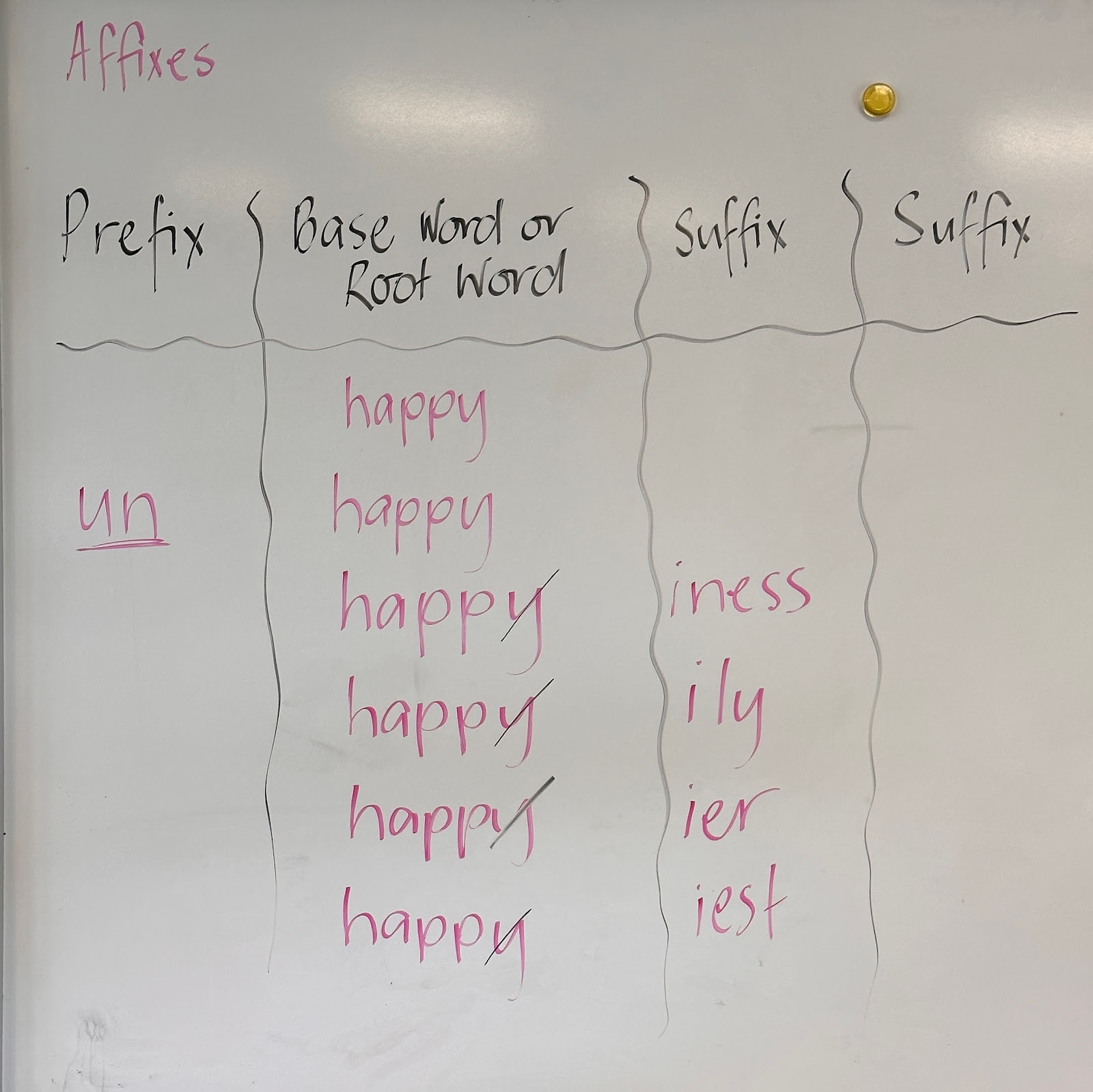
Introducing affixes:

I used a template shared by Louise that shows how base words become completely different words with the introduction of prefixes and suffixes. We began by defining base words as being a complete word by itself that prefixes and suffixes can be added to make a new word. The example we used was the base word, happy. I then challenged my learners to make new words that had the word happy in them. At this stage we had only the knowledge of affixes that we brought to the lesson. As the words were generated from known words I filled in the template on the board (see image below).


We then explored possible reasons why I might have written some parts of the words in different sections of the table. A question that opened the doors for the introduction of the words prefix and suffix, and allowed us to unpack what these words might mean and what effect they had on the base word. All devices were closed at this time which gave me the opportunity to introduce the dictionaries and thesaurus' that were in all honesty, sitting on the shelf gathering dust. Having become so used to opening Chromebooks and defining words meant a quick lesson was needed on how to use a dictionary (or 'paper google' as it has now become known as).

After this I set my learners the challenge of building a word list using the base word excite. To make sure we were selecting actual words, only words generated that could be found in the dictionary were able to be recorded. We then unpacked what each of the affixes meant and explored how they changed the based word.  
Eg: the prefix over (too much or more than normal) + the base word, excite (being enthusiastic or happy) = over excite (more than normally enthusiastic or happy). 

Deziah's blog post explains this activity - (shared with permission).


Wednesday, 1 March 2023

Qu. #2 - Why we judge this to be the most important and catalytic issue of learning for this group of learners this year...

Last week after talking to the teachers I am mentoring in the RPI program I was reminded of the Reading for Enjoyment survey I did last year to get to know my learners as readers. In a conversation with Dianne afterwards, I suggested that we could try to create a similar survey that would help us get to know our learners a spellers. Our Principal understands our concerns with regards to spelling abilities in our current class and is fully supportive of our proposed inquiry into word consciousness. 

The results of this survey are below.


We judge this to be the most important and catalytic issue of learning for this group of learners this year as the results here affirm our initial thinking that a deficit in word consciousness and a 'fear' of getting words wrong, limits the level of vocabulary used in independent writing, and causes meaning to be lost in reading. It will be interesting to analyse the self efficacy rating and the spelling level given when the e-asTTle writing assessment data is complete. (NB: Our plan is to look at the current and historical data of the e-asTTle writing, PAT Reading and the Peter's spelling test to identify trends). 


PLD: Supporting students to become confident and competent spellers - Louise Dempsey

To grow our own knowledge and strengthen our connections to teaching phonics, morphology and spelling conventions Dianne and I signed up to the PLD: Supporting students to become confident and competent spellers run by Louise Dempsey.


Aims of the two workshops:

  • Develop subject knowledge about phonics, morphology and spelling conventions

  • Unpack the progression of skills (phonics, spelling conventions, and morphology)

  • Learn high-impact strategies and activities to teach word and sub-word level skills


My takeaways:
  • Spelling is an obstacle that gets in the way of reading and writing. However it is a learnt skill that can be taught and is an integral skill to make meaning. If learners can spell, they can read and write.
  • Children need a decent bank of words to allow them to pick up and use a wider vocabulary
  • Confidence comes when children can hear identified sounds
  • Encourage self correction
  • Phonics and spelling patterns are crucial for our students when writing
  • Fluent writers need to be aware of spelling conventions, morphology/affixes and word origins
  • Decode in reading and encode in writing by applying rules
  • Spelling skills are learnt progressively - the list below was unpacked with valuable examples that are recorded in my notes
    • Phonics: letters and sounds
    • Analogy: rime eg: cat/sat/mat
    • Try: say - listen- write -try and underline to show unsure = taking risks
    • Analogy and affixes help strengthen vocabulary eg: look/looks/looked/ looking
    • Spelling conventions: rules
    • Morphology: know affixes and how to add them to base words
    • Word origins eg: bio = life + ology = study of so biology = study of life
After attending these sessions Dianne and I decided we need to co-construct with our learners a 'working' wall display that we build alongside our learning of morphology, spelling conventions, phonics at our level. This not only makes it visible, but also makes it rewindable.

Resources to support development of word consciousness:

  • Spelling bank - Link
  • The Literacy Place books - Link


Qu 1: Student Inquiry Foci...

This year Dianne Fisi'iahi and I will be undertaking a collaborative inquiry. What this will look like exactly at this stage is still on the drawing board although we do know our purpose. This year we want to find out if a focus on spelling conventions will foster an environment where word consciousness strengthens connections to the learning.

We teach a Year 7/8 class with 40 learners, all who bring a wide a varied connection to the conventions of spelling to the table. We know from past experience and from what we have observed so far this year, that our learners physically stop writing, stop reading and avoid sharing back to the class when they lose the connection to words needed to continue to make sense of the learning. There are many reasons as to why this happens but rather than focus solely on that, we want to focus on how we can prevent this pattern from continuing to evolve into a hurdle that is too challenging to get over. Our thinking is that if we begin to develop these skills and understandings, the transition to language of instruction used in Y9 may be strengthened by stronger connection to word knowledge.

Having decided on our inquiry focus this year, Dianne and I spoke with Anna Salmon, our Reading Recovery teacher about the barriers children in the junior school face with spelling, and how she helps the students she is working with to overcome these barriers. We came away from a very rich learning conversation with lots of ideas to pull together a tentative pathway forward. Here are the notes we made to help us formulate a plan going forward

'Word consciousness involves being aware and interested in words and word meanings (Anderson & Nagy, 1992; Graves & Watts-Taffe, 2002) and noticing when and how new words are used (Manzo & Manzo, 2008). Individuals who are word conscious are motivated to learn new words and able to use them skilfully '(Sourced here). Our challenge now is to find out why the links in the chain appear to be broken again. Last year I began my inquiry by getting to know my learners as readers through a survey. This year we plan to use this strategy to get to know our learners as spellers. To do this we will be looking at shift or change in:

  • Disposition
  • Data
  • Word consciousness
  • Student voice
  • Strategies used to make sense of new or unfamiliar words

Further Reading/PLD to grow my own knowledge kete: