Sunday, 23 April 2023
Qu 4: Collecting evidence and data...
Wednesday, 12 April 2023
Qu 3: Building an accurate profile of students' learning - tools, measures and approaches...
Describe the tools/measures/approaches you plan to use to get a more detailed and accurate profile of students’ learning in relation to that challenge. Justify why you chose these approaches and tools.
Vocabulary refers to the knowledge of words and word meanings. Helping students become word conscious is a crucial endeavour for teachers across all levels, and more so for teachers working with students whose prior vocabulary exposure may be limited. One of the biggest hurdles I have observed when I ask my learners to complete a writing task is their problem solving skills when it comes to vocabulary choice. At some point in their learning journeys so far our learners have formed the mindset that making a mistake when spelling is not ok. This deficit mindset causes problems when it comes to experimenting and/or taking risks with new vocabulary. Additionally it stops the flow of writing and results in many students just giving up or embracing the idea that they simply are not good at writing or spelling.
Dianne and I are carrying out a collaborative inquiry this year but have chosen at this point to work independently with different groups. Dianne chose the students who find spelling a challenge which has left me with the students who are more able spellers. Having collected the baseline data and captured student voice (shared in an earlier post), we have decided to adopt the strategy of divide and conquer. Our ongoing conversations about the spelling hurdles we need to 'knock down' have opened our eyes to the fact our students who struggle with spelling need a different intervention than those who have some understanding. We want our students to take risks but are fully aware that those who see themselves as 'not good at spelling' need to revisit the basics in a safe space where they feel empowered.
The analysis below reflects the responses of the attitude towards spelling of the 25 students in our class who have shown in our data to be our more able spellers. When responding to the e-asTTle attitude question, ‘I am good at spelling’. 70% of these students see themselves as being good spellers, while in contrast 30% do not. It is the mindset of the 40% who’s thinking I need to change.
Next steps:
- Explore creative and fun ways we can grow our word consciousness culture in our class
- Make word consciousness visible in our class
- Explore success in our school, other schools and other clusters
- Professional Readings/ PLD
- Use student created DLOs as exemplars
Implement and Try #1: Digital Escape Rooms
Last term I attended the Creating Digital Escape Rooms with Donna Yates toolkit. Donna introduced us to a collection of published digital escape rooms which we had an opportunity to explore. We were also shown how to create our own escape rooms using Google forms.
Here is the link to Donna's presentation. Slides 7-15 have clear steps to follow if you are keen to give this a try.
As a way of putting my new learning into practise and helping my students strengthen their connections to their affixes learning, we created our own affix themed digital escape rooms. The challenge was to devise 10 affix related questions that their peers would then answer in their quest to open an online game that let them apply their new learning in a fun way. The games selected were found using our smart searching skills so are not our own creations. That is one of our next challenges.
This was a fun and practical way of reinforcing learning. Dictionaries were out in full force and the discussion was rich and very loud as questions were being tested on friends orally before being recorded on the Google form. What I liked about this activity was the fact it forced my learners to draw on and recall their new learning, the dictionaries and the books they have been completing challenges in were used purposefully and the whole activity was met with a huge level of enthusiasm. 'Easy' questions were soon pushed to the side as the desire to write the 'hardest' question became the challenge of the day. This activity took two blocks of learning to complete but was absolutely worth it as the 'I've escaped' cheers showed the level of buy-in and allowed my learners to see their own success in real time, and I was able to see just how strong the connections to our new learning are.
We have created a page on our class site for our escape rooms which can be found here.
Friday, 17 March 2023
Our First Footsteps into Word Consciousness...
After attending the PLD: Supporting students to become confident and competent spellers run by Louise Dempsey I put some of my new learning into place. About 1/3 of our class are participating in the STEPSWEB program which opens up a slot on our timetable for the other 2/3 of our class to focus on growing their own word knowledge.
Introducing affixes:
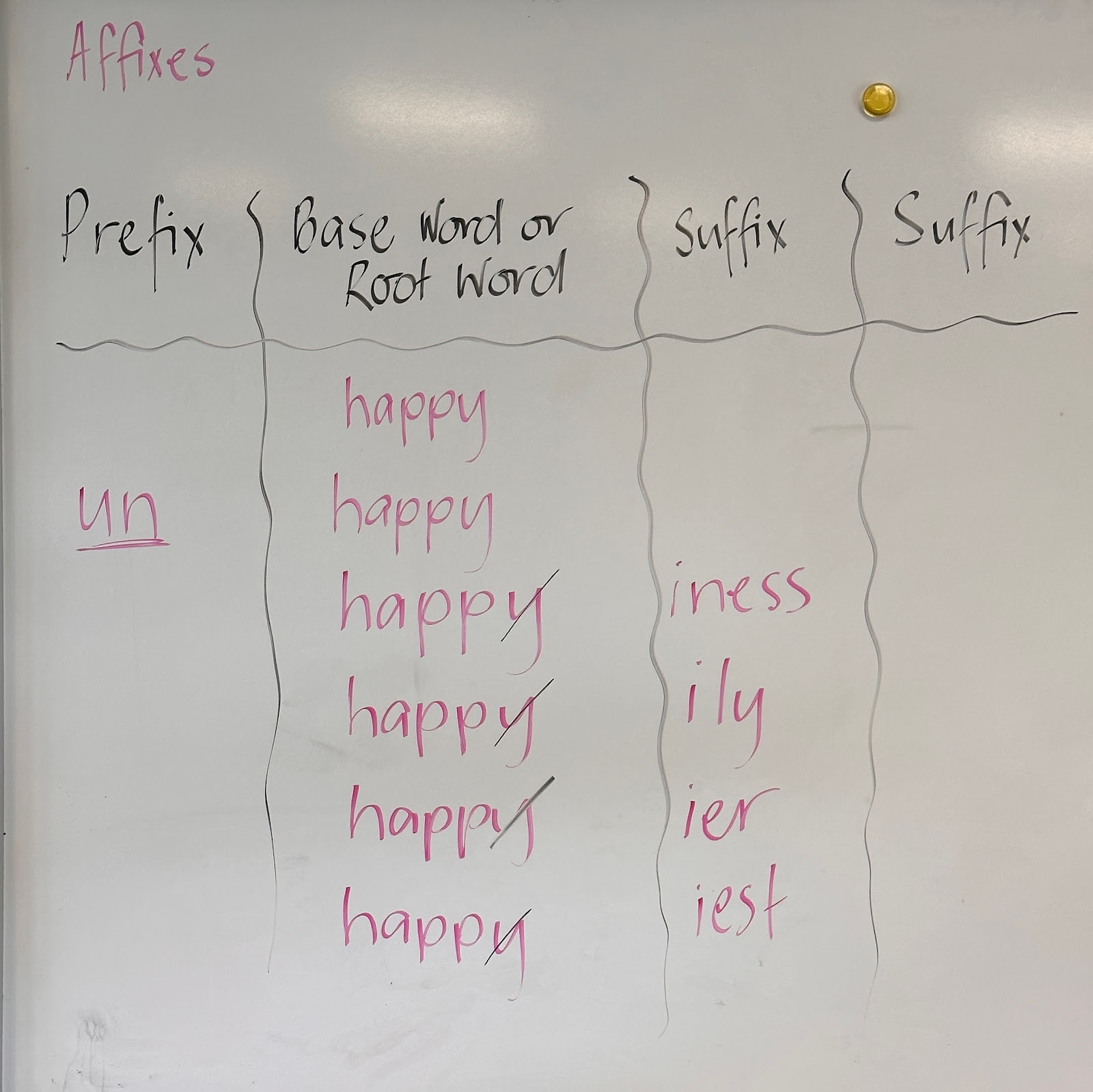
I used a template shared by Louise that shows how base words become completely different words with the introduction of prefixes and suffixes. We began by defining base words as being a complete word by itself that prefixes and suffixes can be added to make a new word. The example we used was the base word, happy. I then challenged my learners to make new words that had the word happy in them. At this stage we had only the knowledge of affixes that we brought to the lesson. As the words were generated from known words I filled in the template on the board (see image below).
Eg: the prefix over (too much or more than normal) + the base word, excite (being enthusiastic or happy) = over excite (more than normally enthusiastic or happy).
Wednesday, 1 March 2023
Qu. #2 - Why we judge this to be the most important and catalytic issue of learning for this group of learners this year...
Last week after talking to the teachers I am mentoring in the RPI program I was reminded of the Reading for Enjoyment survey I did last year to get to know my learners as readers. In a conversation with Dianne afterwards, I suggested that we could try to create a similar survey that would help us get to know our learners a spellers. Our Principal understands our concerns with regards to spelling abilities in our current class and is fully supportive of our proposed inquiry into word consciousness.
The results of this survey are below.
PLD: Supporting students to become confident and competent spellers - Louise Dempsey
To grow our own knowledge and strengthen our connections to teaching phonics, morphology and spelling conventions Dianne and I signed up to the PLD: Supporting students to become confident and competent spellers run by Louise Dempsey.
Develop subject knowledge about phonics, morphology and spelling conventions
Unpack the progression of skills (phonics, spelling conventions, and morphology)
Learn high-impact strategies and activities to teach word and sub-word level skills
- Spelling is an obstacle that gets in the way of reading and writing. However it is a learnt skill that can be taught and is an integral skill to make meaning. If learners can spell, they can read and write.
- Children need a decent bank of words to allow them to pick up and use a wider vocabulary
- Confidence comes when children can hear identified sounds
- Encourage self correction
- Phonics and spelling patterns are crucial for our students when writing
- Fluent writers need to be aware of spelling conventions, morphology/affixes and word origins
- Decode in reading and encode in writing by applying rules
- Spelling skills are learnt progressively - the list below was unpacked with valuable examples that are recorded in my notes
- Phonics: letters and sounds
- Analogy: rime eg: cat/sat/mat
- Try: say - listen- write -try and underline to show unsure = taking risks
- Analogy and affixes help strengthen vocabulary eg: look/looks/looked/ looking
- Spelling conventions: rules
- Morphology: know affixes and how to add them to base words
- Word origins eg: bio = life + ology = study of so biology = study of life
Qu 1: Student Inquiry Foci...
This year Dianne Fisi'iahi and I will be undertaking a collaborative inquiry. What this will look like exactly at this stage is still on the drawing board although we do know our purpose. This year we want to find out if a focus on spelling conventions will foster an environment where word consciousness strengthens connections to the learning.
We teach a Year 7/8 class with 40 learners, all who bring a wide a varied connection to the conventions of spelling to the table. We know from past experience and from what we have observed so far this year, that our learners physically stop writing, stop reading and avoid sharing back to the class when they lose the connection to words needed to continue to make sense of the learning. There are many reasons as to why this happens but rather than focus solely on that, we want to focus on how we can prevent this pattern from continuing to evolve into a hurdle that is too challenging to get over. Our thinking is that if we begin to develop these skills and understandings, the transition to language of instruction used in Y9 may be strengthened by stronger connection to word knowledge.
Having decided on our inquiry focus this year, Dianne and I spoke with Anna Salmon, our Reading Recovery teacher about the barriers children in the junior school face with spelling, and how she helps the students she is working with to overcome these barriers. We came away from a very rich learning conversation with lots of ideas to pull together a tentative pathway forward. Here are the notes we made to help us formulate a plan going forward
'Word consciousness involves being aware and interested in words and word meanings (Anderson & Nagy, 1992; Graves & Watts-Taffe, 2002) and noticing when and how new words are used (Manzo & Manzo, 2008). Individuals who are word conscious are motivated to learn new words and able to use them skilfully '(Sourced here). Our challenge now is to find out why the links in the chain appear to be broken again. Last year I began my inquiry by getting to know my learners as readers through a survey. This year we plan to use this strategy to get to know our learners as spellers. To do this we will be looking at shift or change in:- Disposition
- Data
- Word consciousness
- Student voice
- Strategies used to make sense of new or unfamiliar words
- Supporting students to become competent and confident spellers - Louise Dempsy